Do you keep repeating the word “important” in your essays? If so, you’re not alone. Many students struggle to find precise alternatives, especially in academic writing where vocabulary range directly affects your score. Using the same word again and again can make your writing sound basic and limit your ability to express complex ideas.
In this guide, you’ll learn exactly what to use instead of important in academic writing so your essays sound more formal, precise, and professional. Whether you’re preparing for IELTS, university assignments, or research papers, choosing the right synonym can significantly improve clarity and impact.
By the end of this article, you’ll have a complete list of alternatives, understand when to use each one, and avoid common mistakes that cost marks. Let’s upgrade your academic vocabulary step by step.
Quick Answer:
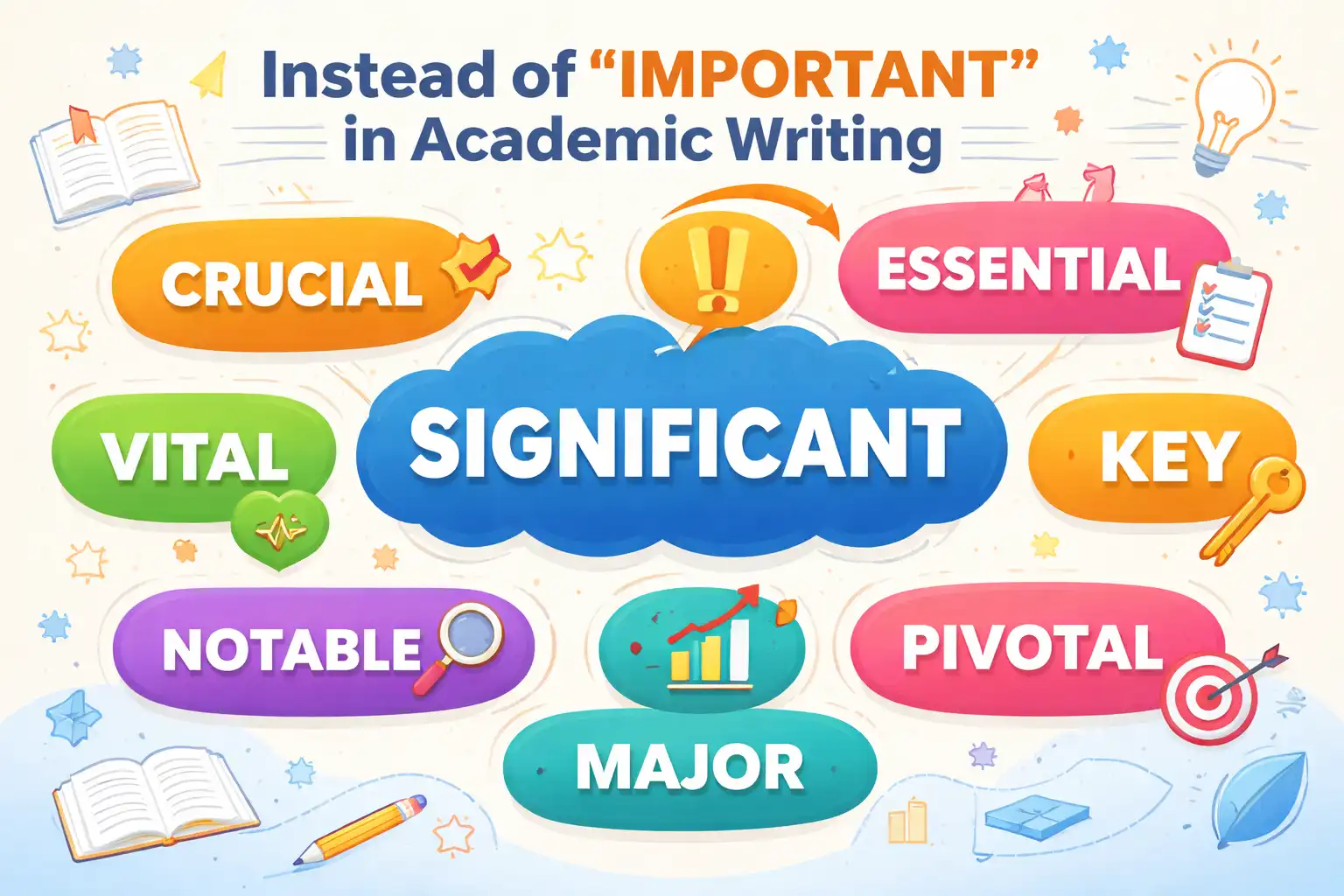
Instead of “important” in academic writing, use more precise synonyms such as significant, crucial, essential, or vital. These words add clarity and formality.
Examples:
- This issue is significant for policy development.
- Education plays a crucial role in society.
- Water is essential for human survival.
- Technology has a vital impact on communication.
What Does “Important” Mean?
In academic writing, “important” refers to something that has great value, influence, or impact. It highlights the relevance of an idea, argument, or result.
However, the word itself is too general. Academic standards expect you to be more specific. According to academic writing conventions and IELTS band descriptors, higher-level writing demonstrates lexical variety and precision, not repetition.
For example:
- Weak: This topic is important.
- Strong: This topic is highly significant in modern economics.
Complete Synonyms List
Here are strong alternatives you can use instead of important in academic writing:
- Significant
- Crucial
- Essential
- Vital
- Key
- Fundamental
- Critical
- Noteworthy
- Influential
- Central
- Primary
- Pivotal
IELTS Tip:
Use “significant” and “crucial” frequently in Task 2 essays. They are widely accepted and improve your lexical resource score.
Comparison Table
| Word | Simple Meaning | Best Used When | Avoid When |
| Significant | Meaningful or impactful | Research findings, data analysis | Casual conversation |
| Crucial | Extremely necessary | Arguments, causes, decisions | Minor points |
| Essential | Absolutely necessary | Basic needs, core ideas | Optional elements |
| Vital | Very important for survival | Health, environment, systems | Less serious topics |
| Key | Main or central | Main points, arguments | Highly formal research papers |
| Fundamental | Basic and foundational | Theories, principles | Small details |
| Critical | Extremely important | Analysis, evaluation | Informal essays |
| Pivotal | Turning point importance | Historical or major changes | General descriptions |
Formal vs Informal Synonyms
| Formal (Academic) | Informal (Avoid in Essays) |
| Significant | Big deal |
| Crucial | Super important |
| Essential | Really needed |
| Fundamental | Basic stuff |
| Critical | Very big |
| Pivotal | Huge moment |
Why this matters: Academic writing requires formal tone and precision. Informal phrases reduce credibility and lower your grade.
Real Example Sentences
Here are practical examples using alternatives instead of important in academic writing:
- Climate change is a significant global challenge.
- Education plays a crucial role in economic growth.
- Clean water is essential for public health.
- Communication skills are vital in professional settings.
- Technology is a key driver of innovation.
- Scientific research forms the foundation of modern medicine.
- This discovery was pivotal in advancing medical science.
- Critical thinking is a fundamental skill for students.
In our experience helping writers:
Students who replace “important” with precise terms often improve their IELTS writing band by 0.5–1 point because their vocabulary becomes more academic.
When to Use vs When NOT to Use
When to Use
Use alternatives to “important” when you want to:
- Emphasize impact or relevance
- Sound more academic and formal
- Avoid repetition
- Show lexical variety
When NOT to Use
Do not replace “important” blindly:
- If the synonym changes the meaning
- When the context is simple or general
- If the word sounds too strong (e.g., “crucial” for minor ideas)
Example:
- Incorrect: This minor detail is crucial.
- Correct: This minor detail is useful.
Common Mistakes Writers Make
1. Using synonyms without understanding nuance
Not all words mean exactly the same.
Crucial ≠ Significant (crucial is stronger).
2. Overusing advanced vocabulary
Trying to sound “too academic” can make writing unnatural.
3. Mixing formal and informal tone
Example:
- Incorrect: This is a crucial big deal.
4. Replacing every “important”
Sometimes repetition is better than awkward wording.
5. Using incorrect collocations
Example:
- Incorrect: “Important role” → “Essential role” (better: crucial role)
Tips and Best Practices
1. Match strength to context
- Mild: Significant
- Strong: Crucial / Vital
2. Learn collocations
Common academic phrases:
- Crucial role
- Significant impact
- Essential requirement
3. Use variety naturally
Don’t force synonyms in every sentence.
4. Practice with real essays
Rewrite your previous essays using better vocabulary.
5. Focus on clarity first
Academic writing values clarity over complexity.
IELTS Tip:
Band 7+ writing requires flexible use of vocabulary. Using varied synonyms correctly shows examiner-level control.
Frequently Asked Questions
Q1: What is the best synonym for “important” in academic writing?
A: The best synonym depends on context. “Significant” is the safest and most versatile choice. “Crucial” works for strong arguments, while “essential” is ideal for necessities. Always match the word to the meaning you want to express.
Q2: Can I use “key” instead of “important” in essays?
A: Yes, “key” is acceptable in semi-formal academic writing. It works well for highlighting main ideas or arguments. However, in highly formal research papers, “significant” or “crucial” may be more appropriate.
Q3: Is “crucial” stronger than “important”?
A: Yes, “crucial” is much stronger. It implies something is absolutely necessary or decisive. Use it carefully, only when the situation truly demands emphasis.
Q4: How many synonyms should I use in one essay?
A: You should use a variety, but naturally. Aim for 3–5 different alternatives across your essay. Avoid overuse, as it can make your writing sound forced or unnatural.
Q5: Is “vital” suitable for IELTS writing?
A: Yes, “vital” is a strong and effective academic word. It is particularly useful when discussing health, environment, or survival-related topics. It helps demonstrate advanced vocabulary usage.
Q6: Why should I avoid repeating “important”?
A: Repetition reduces your lexical score and makes your writing less engaging. Academic standards expect variety and precision. Using synonyms shows a wider vocabulary range and improves readability.
Q7: Are all synonyms interchangeable?
A: No, they are not. Each synonym has a slightly different meaning and strength. For example, “fundamental” refers to basic principles, while “pivotal” suggests a turning point. Always consider context.
Q8: What is the safest academic synonym?
A: “Significant” is the safest option. It fits most academic contexts, including essays, reports, and research writing, without sounding too strong or too informal.
Conclusion
Using the right word instead of “important” can transform your academic writing. You’ve learned how to choose precise synonyms like significant, crucial, and essential, when to use them, and how to avoid common mistakes. These small changes make a big difference in clarity and scoring.
You might also want to read our guide on “powerful synonyms for ‘good’ in essays” to further improve your vocabulary.
Keep practising, stay consistent, and your writing will steadily become more advanced and confident.

Andrew Collins is an academic English educator with over 12 years of experience helping university students, IELTS candidates, and ESL learners improve their writing vocabulary.