Do you ever struggle with how to begin your paragraphs in essays or academic writing? You’re not alone. Many students rely on simple starters like “also” or “and,” which can weaken the overall tone of their work. If you want your writing to sound more professional and polished, learning formal words to start a paragraph is essential.
In academic contexts—especially IELTS, university essays, and research papers—your paragraph openings set the tone for clarity and coherence. Strong transitions not only guide your reader but also improve your logical flow and cohesion score.
In this guide, you’ll learn the best formal paragraph starters, their meanings, when to use them, and how to avoid common mistakes. Whether you’re aiming for a higher IELTS band or stronger academic writing, this article will give you practical tools you can apply immediately.
Quick Answer:
Formal words to start a paragraph include transitions like “Furthermore,” “Moreover,” “In addition,” “However,” “Therefore,” and “Consequently.” These words help organize ideas, improve coherence, and create a professional tone in essays, reports, and academic writing.
What Does “Formal Words to Start a Paragraph” Mean?
Formal words to start a paragraph are transition words or phrases used to introduce new ideas, contrast points, or expand arguments in a structured and professional way.
According to academic writing conventions, these words:
- Improve coherence and cohesion
- Help readers follow your argument
- Signal relationships between ideas clearly
In IELTS writing, for example, using appropriate linking devices can significantly impact your Coherence and Cohesion band score.
Complete Synonyms List (Formal Paragraph Starters)
Here are some of the most effective formal words to start a paragraph:
- Furthermore
- Moreover
- In addition
- Additionally
- However
- Nevertheless
- On the other hand
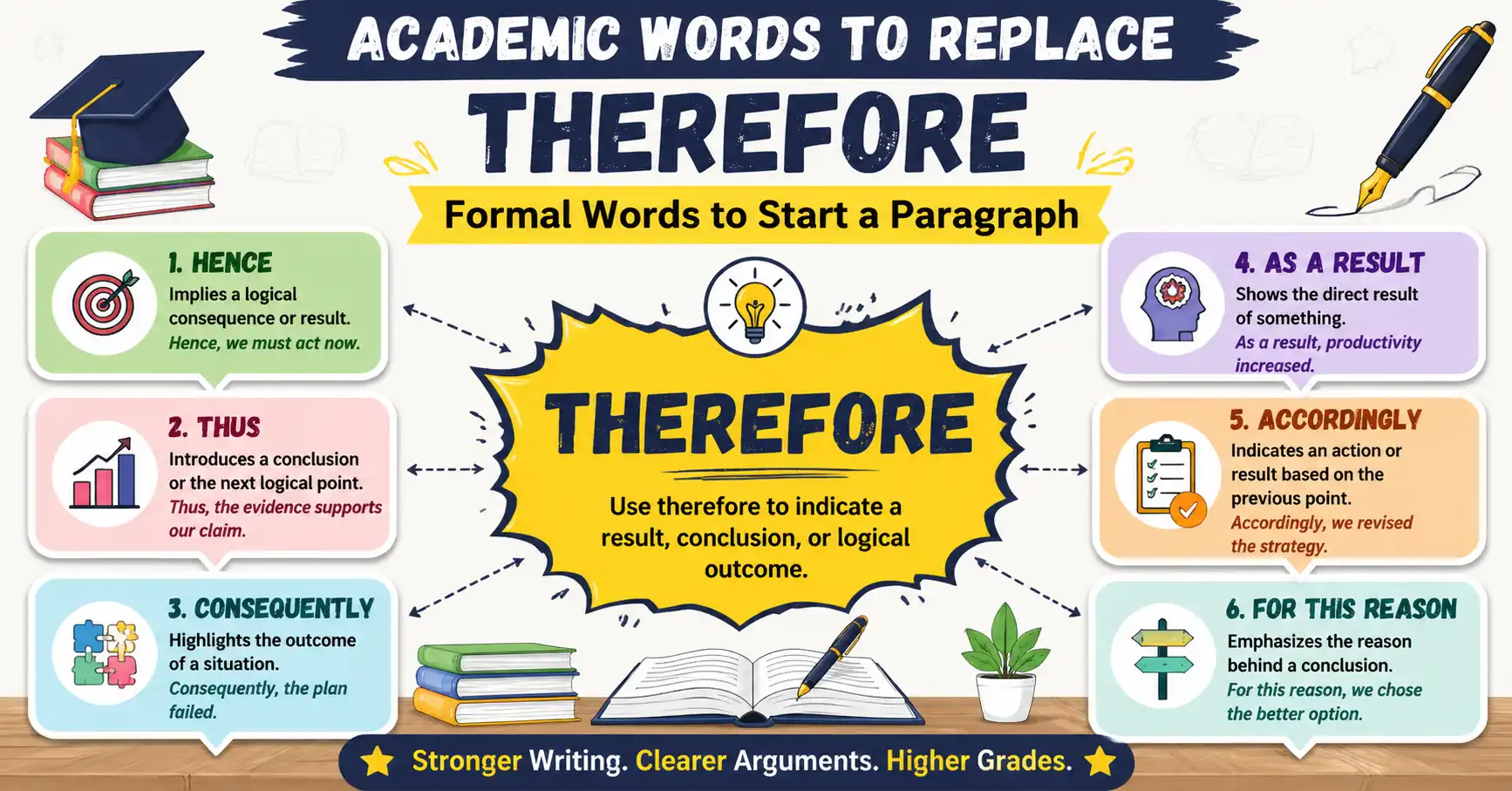
- Therefore
- Consequently
- Thus
- For instance
- In contrast
IELTS Tip:
Use a mix of these words instead of repeating the same one. Examiners look for range and flexibility, not repetition.
Comparison Table
| Word | Simple Meaning | Best Used When | Avoid When |
| Furthermore | Add more information | Expanding an argument | Repeating the same idea |
| Moreover | Strong addition | Emphasizing importance | Casual writing |
| However | Show contrast | Introducing opposing ideas | No clear contrast |
| Therefore | Show result | Logical conclusions | Weak or unclear reasoning |
| Consequently | Result of action | Formal essays | Informal contexts |
| In addition | Add idea | Supporting points | Overuse in same essay |
| On the other hand | Contrast two sides | Balanced arguments | One-sided discussion |
| Thus | Formal result | Academic conclusions | Speaking or casual tone |
Formal vs Informal Synonyms
| Formal Word | Informal Alternative | Use in Academic Writing? |
| Furthermore | And | Yes |
| Moreover | Also | Yes |
| However | But | Yes |
| Therefore | So | Yes |
| Consequently | So then | Yes |
| In addition | Plus | Yes |
| Nevertheless | Still | Yes |
| Thus | So | Yes |
Key Insight: Informal words like “so” or “and” are acceptable in speech but reduce your score in formal writing tasks.
Real Example Sentences
Here are practical examples you can use in essays:
- Furthermore, education plays a vital role in economic development.
- Moreover, technological advancements have improved communication globally.
- However, this approach has several limitations.
- In addition, students benefit from interactive learning environments.
- Therefore, governments should invest more in public education.
- Consequently, many workers are adapting to remote work models.
- On the other hand, some argue that technology creates social isolation.
- Thus, it is clear that balanced policies are necessary.
IELTS Tip:
Place a comma after these words. This small detail improves grammatical accuracy.
When to Use vs When NOT to Use
When to Use
Use formal paragraph starters when:
- Writing academic essays
- Preparing IELTS or TOEFL responses
- Structuring research papers
- Creating reports or formal documents
They are especially useful when:
- Adding ideas → Furthermore, In addition
- Contrasting ideas → However, On the other hand
- Showing results → Therefore, Consequently
When NOT to Use
Avoid overusing these words when:
- Writing informal emails or messages
- Speaking casually
- Repeating the same transition too often
In our experience helping writers, overuse is one of the biggest issues. Students often begin every paragraph with “Moreover,” which makes writing sound mechanical.
Common Mistakes Writers Make
1. Overusing the Same Word
Using “Furthermore” repeatedly reduces variety and lowers quality.
2. Using Formal Words Without Logic
Example:
“Therefore, students like sports.”
There is no clear cause-effect relationship.
3. Incorrect Punctuation
Always use a comma after transition words.
4. Mixing Formal and Informal Tone
Example:
“Moreover, kids like it.”
Use “children” instead of “kids” in formal writing.
5. Starting Every Paragraph with a Transition
Not every paragraph needs one. Sometimes a direct topic sentence works better.
Tips and Best Practices
1. Match the Purpose
Choose the word based on function:
- Addition → Furthermore
- Contrast → However
- Result → Therefore
2. Use Variety
Rotate between synonyms to avoid repetition.
3. Keep It Natural
Don’t force transitions. If they don’t fit, skip them.
4. Practice with Real Essays
Rewrite your old essays using better paragraph starters.
5. Focus on Clarity First
Transitions support your ideas—they don’t replace them.
IELTS Tip:
Band 7+ essays typically show flexible and accurate use of linking devices, not just memorized phrases.
Frequently Asked Questions
Q1: What are the best formal words to start a paragraph?
A: The best formal words include “Furthermore,” “Moreover,” “However,” “Therefore,” and “In addition.” These words help organize ideas logically and improve academic tone, especially in essays and IELTS writing tasks.
Q2: Can I use “and” to start a paragraph in formal writing?
A: While grammatically possible, it is not recommended in academic writing. Formal alternatives like “Furthermore” or “In addition” create a more professional tone and improve clarity in structured essays.
Q3: How many transition words should I use in an essay?
A: Use them strategically rather than frequently. Typically, one transition per paragraph is enough. Overuse can make your writing sound repetitive and unnatural instead of clear and professional.
Q4: Are these words important for IELTS writing?
A: Yes. Transition words directly impact your Coherence and Cohesion score. Using them correctly and naturally helps you achieve a higher band, especially from Band 6 to Band 7 and above.
Q5: What is the difference between “Furthermore” and “Moreover”?
A: Both add information, but “Moreover” often adds stronger emphasis. “Furthermore” is slightly more neutral. In most academic contexts, they can be used interchangeably without affecting meaning significantly.
Q6: Can I start every paragraph with a formal word?
A: No. Starting every paragraph with a transition can make your writing repetitive. Use them only when they add clarity or show relationships between ideas. Strong topic sentences are equally important.
CONCLUSION
Using formal words to start a paragraph is a simple yet powerful way to improve your academic writing. These transitions help organize your ideas, guide your reader, and create a professional tone—especially important for IELTS and university essays.
Remember to use them thoughtfully, vary your vocabulary, and focus on clarity over complexity. Writers we work with often see immediate improvement just by fixing their paragraph openings.
You might also want to read our guide on academic linking words for essays to further strengthen your writing skills. Keep practicing—you’re closer to confident, polished writing than you think.

Andrew Collins is an academic English educator with over 12 years of experience helping university students, IELTS candidates, and ESL learners improve their writing vocabulary.