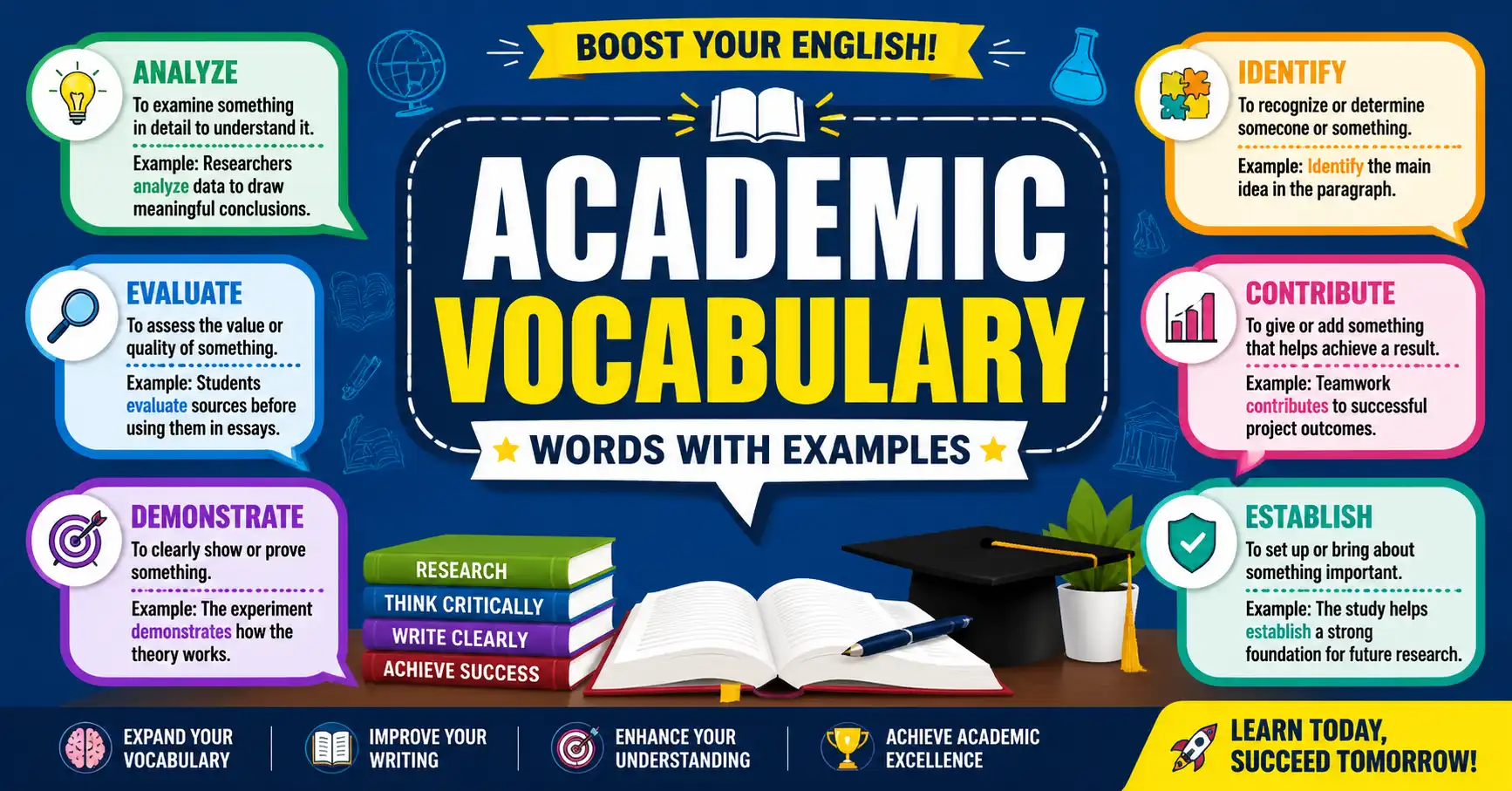
If you are a student, researcher, or English learner trying to improve your writing, mastering academic vocabulary words with examples is one of the most powerful steps you can take. These are not just fancy words — they are the precise, professional terms that appear in essays, research papers, university lectures, standardized tests like IELTS, TOEFL, GRE, and SAT, and everyday academic communication.
Studies in educational linguistics consistently show that students with a strong academic vocabulary score significantly higher in reading comprehension and writing assessments. Yet most lists online give you words without context, leaving you unsure how to actually use them.
This guide fixes that. You will get over 100 essential academic vocabulary words organized by category, complete with clear definitions and real sentence examples — so you can learn each word the right way.
What Are Academic Vocabulary Words?
Academic vocabulary refers to words and phrases that appear frequently in educational settings but are less common in everyday casual speech. They are used in textbooks, academic essays, research papers, lectures, and formal discussions.
Educational linguist Averil Coxhead’s famous Academic Word List (AWL) identified 570 word families that appear across virtually all academic disciplines. These words are not subject-specific technical terms — they are general academic words that every student, regardless of their field, needs to know.
Two Types of Academic Vocabulary
General Academic Words appear across all subjects — science, history, economics, and literature. Examples include: analyze, significant, conclude, evidence.
Domain-Specific Words belong to one subject area. For example, photosynthesis in biology or depreciation in economics. This guide focuses on general academic vocabulary since it benefits every student.
Why Academic Vocabulary Matters
Before diving into the word lists, it is worth understanding why this vocabulary is so important.
Higher Exam Scores
Research consistently shows that vocabulary strength is one of the strongest predictors of academic performance. Students who know academic vocabulary tend to score 10–20% higher in reading comprehension tests. On standardized exams like IELTS and TOEFL, academic vocabulary appears throughout the reading, listening, and writing sections.
Clearer, More Professional Writing
When you use precise academic vocabulary, your writing becomes sharper and more credible. Instead of writing “the thing that shows,” you write “the evidence that demonstrates.” One sentence sounds like a student; the other sounds like a scholar.
Better Reading Comprehension
University textbooks and academic journals are dense with academic language. Knowing these words means you spend less mental energy decoding text and more energy understanding ideas.
Academic Vocabulary Words with Examples — By Category
The most effective way to learn academic vocabulary is to group words by function — what they do in a sentence. This section gives you the most important academic words organized by their purpose.
1. Words for Analyzing and Evaluating
These words help you examine, judge, and break down ideas — essential for any essay or research paper.
| Word | Part of Speech | Meaning | Example Sentence |
| Analyze | Verb | To examine something closely and in detail | The researcher analyzed the data to identify trends. |
| Assess | Verb | To evaluate or judge the quality of something | The committee assessed the impact of the new policy. |
| Critique | Verb/Noun | To evaluate something, pointing out strengths and weaknesses | She critiqued the methodology used in the original study. |
| Evaluate | Verb | To make a judgment about the value or quality of something | Students must evaluate the reliability of their sources. |
| Interpret | Verb | To explain the meaning of something | How you interpret the results will shape your conclusion. |
| Examine | Verb | To look at something carefully in order to understand it | The study examines the relationship between poverty and education. |
2. Words for Arguing and Asserting
Use these words to state your position clearly and defend your viewpoint.
| Word | Part of Speech | Meaning | Example Sentence |
| Argue | Verb | To give reasons in support of a position | The author argues that climate change is the defining issue of this century. |
| Assert | Verb | To state something confidently and firmly | The professor asserted that the experiment was flawed from the beginning. |
| Claim | Verb/Noun | To state something as true without necessarily proving it | Critics claim that the research lacks sufficient evidence. |
| Contend | Verb | To argue or maintain firmly | Many economists contend that inflation is largely demand-driven. |
| Emphasize | Verb | To give special importance to something | The report emphasizes the need for immediate action. |
| Propose | Verb | To put forward an idea or plan for consideration | The researchers propose a new model for understanding behavior. |
3. Words for Showing Cause and Effect
Academic writing often requires you to explain why things happen and what they lead to.
| Word | Part of Speech | Meaning | Example Sentence |
| Cause | Noun/Verb | Something that brings about a result | Deforestation is a leading cause of habitat loss. |
| Consequently | Adverb | As a result | The study was poorly designed; consequently, its findings are unreliable. |
| Generate | Verb | To produce or create something | The new policy is expected to generate significant economic growth. |
| Influence | Verb/Noun | To have an effect on something | Social media strongly influences the opinions of younger generations. |
| Result in | Phrase | To lead to a particular outcome | The experiment resulted in a breakthrough discovery. |
| Stem from | Phrase | To originate or arise from something | Many social problems stem from inequality in education. |
4. Words for Comparing and Contrasting
These transition words and academic terms help you draw parallels and highlight differences.
| Word | Part of Speech | Meaning | Example Sentence |
| Conversely | Adverb | On the other hand; in the opposite way | The first group showed improvement. Conversely, the control group declined. |
| Distinguish | Verb | To recognize or show the difference between two things | It is important to distinguish between correlation and causation. |
| Similarly | Adverb | In the same way | Similarly, the second study found no significant difference. |
| In contrast | Phrase | Used to compare two very different things | In contrast to earlier findings, the new data suggests the opposite. |
| Parallel | Adjective/Noun | Very similar or corresponding | There is a parallel between the economic crises of 1929 and 2008. |
5. Words for Presenting Evidence
These words help you introduce data, citations, and supporting information.
| Word | Part of Speech | Meaning | Example Sentence |
| Demonstrate | Verb | To show clearly using evidence | The findings demonstrate a strong link between diet and mental health. |
| Indicate | Verb | To point to or suggest something | The results indicate that further research is needed. |
| Illustrate | Verb | To make something clear by giving examples | The graph illustrates how income inequality has grown over decades. |
| Reveal | Verb | To make previously unknown information known | The audit revealed several critical gaps in the organization’s finances. |
| Substantiate | Verb | To provide evidence to support a claim | Without data, it is impossible to substantiate the hypothesis. |
| Corroborate | Verb | To confirm or support a statement | Multiple sources corroborate the original findings. |
6. Words for Structuring Your Writing
These are the connective and organizational words that give academic writing its logical flow.
| Word | Part of Speech | Meaning | Example Sentence |
| Furthermore | Adverb | In addition; also (adds weight to a point) | The approach saves money. Furthermore, it reduces environmental damage. |
| Nevertheless | Adverb | In spite of that; however | The evidence was weak. Nevertheless, the conclusion was widely accepted. |
| Notwithstanding | Preposition/Adverb | Despite; in spite of | Notwithstanding the limitations, the study makes a valuable contribution. |
| Subsequent | Adjective | Coming after or following | Subsequent research confirmed the initial hypothesis. |
| Whereby | Adverb | By means of which; through which | A system whereby students are assessed monthly proved more effective. |
| Albeit | Conjunction | Although; even though | The results were promising, albeit not entirely conclusive. |
7. Essential Academic Adjectives
These descriptive words are essential for qualifying and sharpening your academic arguments.
| Word | Meaning | Example Sentence |
| Significant | Important; of considerable meaning | The study found a significant improvement in test scores. |
| Empirical | Based on observation or evidence | The theory needs empirical support to be accepted. |
| Comprehensive | Complete; covering all aspects | The report provides a comprehensive review of existing literature. |
| Relevant | Closely connected to the topic | Only relevant sources should be cited in academic writing. |
| Inherent | Existing as a natural or essential characteristic | There is an inherent risk in any clinical trial. |
| Ambiguous | Open to more than one interpretation | The phrasing of the question was ambiguous and confused participants. |
| Prevalent | Widespread; commonly occurring | Social anxiety is particularly prevalent among university students. |
8. High-Value Academic Nouns
These nouns appear across virtually every academic discipline.
| Word | Meaning | Example Sentence |
| Hypothesis | A proposed explanation that needs testing | The hypothesis was tested through a controlled experiment. |
| Framework | A structure or system used for analysis | The researchers applied a cognitive framework to analyze behavior. |
| Paradigm | A standard model or pattern of thinking | The discovery caused a paradigm shift in the field of physics. |
| Criteria | Standards used to judge or decide something | The selection criteria were outlined in the methodology section. |
| Variable | A factor that can change in an experiment | Age was treated as an independent variable in the study. |
| Implication | A possible effect or result of something | The implications of this finding for public health are significant. |
| Scope | The range or extent of something | The scope of the research was limited to urban populations. |
Common Mistakes Students Make with Academic Vocabulary
Overusing Complex Words
Not every sentence needs a sophisticated word. Academic writing values precision over complexity. Using utilize when use is perfectly sufficient does not improve your writing — it clutters it. Use academic vocabulary when it adds clarity or specificity, not just to sound impressive.
Using Words Without Knowing Their Full Meaning
A common error is using words like methodology or paradigm incorrectly because the student knows they “sound academic.” Always verify a word’s exact meaning and check how it is used in a sentence before including it in your writing.
Ignoring Word Form (Parts of Speech)
Many academic words change form depending on how they are used. Analyze (verb) becomes analysis (noun) and analytical (adjective). Knowing only one form limits your writing flexibility. Study all forms of each word you learn.
How to Learn Academic Vocabulary Effectively
Learn in Context, Not Isolation
Reading a word in a sentence teaches you far more than memorizing a definition alone. Read academic articles, journals, and well-written essays regularly. Highlight unfamiliar terms, look them up, and note the sentence in which they appeared.
Use Spaced Repetition
Tools like Anki or Quizlet use spaced repetition algorithms to show you words at the exact moment your brain is about to forget them. Research shows this method is significantly more effective than cramming.
Write Sentences of Your Own
For every new word you learn, write two original sentences using it. This is the single most effective technique for moving vocabulary from short-term recognition to long-term active use.
Group Words by Category
Just as this article does, grouping words by function (cause-effect words, argument words, comparison words) makes them easier to retrieve when you need them in writing.
Frequently Asked Questions
What are academic vocabulary words?
Academic vocabulary words are words frequently used in educational settings, research papers, essays, and standardized tests. They are more formal than everyday language and appear across multiple disciplines.
How many academic vocabulary words should I learn?
The Academic Word List (AWL) contains 570 word families. For most students, mastering the most frequent 200–300 words will dramatically improve reading comprehension and writing quality. Quality of understanding matters more than quantity.
Are academic vocabulary words the same as SAT or IELTS words?
There is significant overlap. Most SAT, IELTS, TOEFL, and GRE vocabulary lists draw heavily from academic English. Learning academic vocabulary helps you perform better on all of these tests simultaneously.
What is the difference between academic vocabulary and technical vocabulary?
Academic vocabulary (like analyze, significant, evidence) appears across all fields. Technical vocabulary (like osmosis, depreciation, jurisprudence) belongs to a specific subject area.
How long does it take to master academic vocabulary?
With consistent daily practice of 10–15 new words per week, most students can build a solid academic vocabulary base in 3–6 months. Using spaced repetition and writing practice accelerates this significantly.
Final Thoughts
Building your academic vocabulary words with examples is not about memorizing a list — it is about understanding how each word functions in context and practicing it until it becomes natural. The words in this guide appear in academic papers, university lectures, standardized exams, and professional writing around the world. Start with one category at a time, practice each word in your own sentences, and revisit difficult words regularly.
The difference between a good essay and an excellent one often comes down to precision of language. These words give you the precision you need.
Note: This article is based on established academic vocabulary research, including Coxhead’s Academic Word List (AWL) and corpus-based frequency studies in academic English.

Andrew Collins is an academic English educator with over 12 years of experience helping university students, IELTS candidates, and ESL learners improve their writing vocabulary.