Do you find yourself overusing “therefore” in your essays? You’re not alone. Many students rely on it as a default connector, especially in IELTS and academic writing. But repeating the same word can make your writing feel basic and limit your score potential.
If you’re aiming for a higher band score or stronger academic style, you need a range of academic words to replace therefore. These alternatives help you sound more precise, formal, and varied—key qualities examiners look for.
In this guide, I’ll show you exactly which words to use, when to use them, and just as importantly, when not to. You’ll also get real examples, comparison tables, and practical tips from my 12 years of teaching academic English. By the end, you’ll confidently replace “therefore” with more effective transitions in your writing.
Quick Answer:
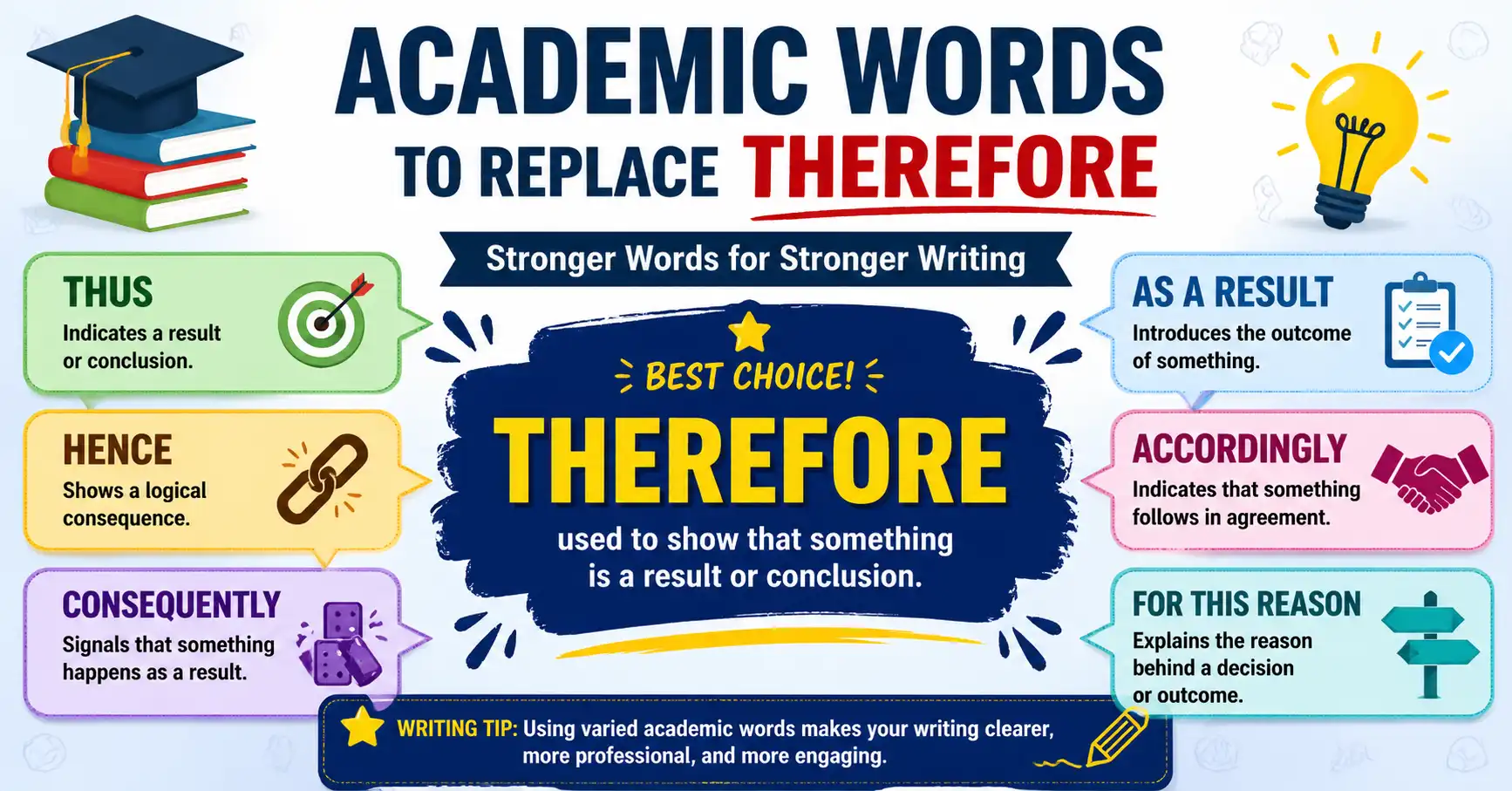
The best academic words to replace “therefore” include: thus, consequently, hence, as a result, accordingly, and for this reason.
These words express cause and effect but vary in formality and tone. Choose based on sentence structure and context—some fit formal essays better, while others work in more flexible academic writing.
What Does “Therefore” Mean?
“Therefore” is a conjunctive adverb used to show cause and effect. It connects a reason to its logical result.
Example:
- The experiment failed. Therefore, the hypothesis was rejected.
In academic writing, “therefore” signals logical progression. However, relying on it too often reduces lexical variety—something that directly affects your IELTS score.
According to IELTS band descriptors, a higher score requires:
- A wide range of vocabulary
- Accurate and flexible use of linking devices
That’s why learning academic words to replace therefore is essential.
Complete Synonyms List
Here are strong alternatives you can use in essays:
- Thus
- Consequently
- Hence
- As a result
- Accordingly
- For this reason
- So (limited academic use)
- Ergo (very formal, rare)
- Thereby
- On that basis
- In consequence
IELTS Tip:
Use “thus,” “consequently,” and “as a result” most often—they are clear, natural, and widely accepted in academic writing.
Comparison Table
| Word | Simple Meaning | Best Used When | Avoid When |
| Thus | In this way / result | Formal essays, logical conclusions | Casual writing |
| Consequently | Because of this | Strong cause-effect argument | Simple sentences |
| Hence | For this reason | Short formal conclusions | Overuse in one paragraph |
| As a result | Because of that | Clear explanation for readers | Highly formal tone needed |
| Accordingly | In line with this | Formal reports, academic tone | Informal essays |
| For this reason | Due to this | Emphasis on reasoning | Repetition |
| Thereby | By doing this | Explaining method/result link | General conclusions |
| Ergo | Therefore (Latin) | Very formal academic style | IELTS writing (too rare) |
Formal vs Informal Synonyms
| Formal Alternatives | Informal / Semi-Formal |
| Thus | So |
| Consequently | Because of that |
| Hence | That’s why |
| Accordingly | As a result |
| Thereby | So then |
Key Insight:
In academic writing, formal synonyms are always safer. Informal ones like “so” should be used sparingly, especially in IELTS Task 2 essays.
Real Example Sentences
Here are practical examples showing how to use these alternatives:
- The data was incomplete; thus, the conclusion cannot be considered reliable.
- The company reduced costs significantly. Consequently, profits increased.
- The sample size was too small; hence, the results lack validity.
- The temperature rose rapidly. As a result, the reaction accelerated.
- The policy failed to address key issues. Accordingly, revisions are necessary.
- The theory lacks evidence. For this reason, it is widely criticized.
- The process improves efficiency, thereby reducing overall costs.
- The students did not prepare adequately; consequently, their performance declined.
IELTS Tip:
Mix different connectors across paragraphs. Repeating “therefore” or even “thus” too often reduces your lexical resource score.
When to Use vs When NOT to Use
When to Use Academic Alternatives
Use these synonyms when:
- You are explaining cause and effect
- You want a more formal tone
- You need to improve lexical variety
- You are writing essays, reports, or research papers
When NOT to Use Them
Avoid these words when:
- The connection is obvious and doesn’t need a connector
- You are writing informal texts (emails, chats)
- You already used a similar connector in the same sentence
- The sentence becomes too complex or unnatural
Example Mistake:
- Incorrect: The study failed, thus therefore the hypothesis is rejected.
- Correct: The study failed; therefore, the hypothesis is rejected.
Common Mistakes Writers Make
From my experience teaching IELTS students, these are the most frequent errors:
1. Overusing One Word
Students often replace “therefore” with “thus” everywhere.
Fix: Rotate between 3–5 connectors.
2. Incorrect Punctuation
Many learners forget punctuation rules.
- Correct: The results were unclear; therefore, further research is needed.
- Incorrect: The results were unclear therefore further research is needed.
3. Using Informal Alternatives
Words like “so” are overused in essays.
Fix: Replace with “as a result” or “consequently.”
4. Misplacing the Connector
Putting the word in the wrong position breaks flow.
- Correct: The method failed. Consequently, changes were made.
- Incorrect: Consequently the method failed changes were made.
5. Using Rare Words Incorrectly
Words like “ergo” sound unnatural if forced.
In our experience helping writers, simple and clear always scores higher than overly complex vocabulary.
Tips and Best Practices
1. Learn Usage, Not Just Meaning
Knowing a word isn’t enough—you must understand how it fits in a sentence.
2. Build a Core Set
Focus on these 5:
- Thus
- Consequently
- As a result
- Hence
- Accordingly
These cover most academic situations.
3. Match Tone to Context
- Research paper → “thus,” “accordingly”
- Essay → “as a result,” “consequently”
4. Avoid Overcomplication
Simple clarity beats complex vocabulary.
5. Practice Sentence Variation
Rewrite the same sentence using different connectors.
IELTS Tip:
Examiners reward range + accuracy. Using 3–4 different connectors correctly is better than using 10 incorrectly.
Frequently Asked Questions
Q1: What are the best academic words to replace therefore?
A: The best alternatives include “thus,” “consequently,” “hence,” “as a result,” and “accordingly.” These words express cause and effect clearly while maintaining a formal tone suitable for essays, reports, and IELTS writing tasks.
Q2: Can I use “so” instead of therefore in academic writing?
A: You can use “so” occasionally, but it is considered informal. In academic contexts like IELTS or university essays, it is better to use formal alternatives such as “thus” or “as a result” for higher clarity and professionalism.
Q3: Is “hence” more formal than therefore?
A: Yes, “hence” is slightly more formal and concise than “therefore.” It works well in academic writing but should be used carefully to avoid sounding repetitive or overly formal when used multiple times in the same piece.
Q4: How many linking words should I use in an essay?
A: You should use linking words naturally, not excessively. Around 5–10 well-placed connectors in a standard IELTS essay are enough. Focus on clarity and variety rather than forcing too many transitions into your writing.
Q5: Do synonyms of therefore improve IELTS scores?
A: Yes. Using a range of appropriate connectors improves your Lexical Resource score. However, accuracy matters more than variety. Incorrect usage can lower your score, so always prioritize correct context and grammar.
Q6: What is the easiest alternative to therefore for beginners?
A: “As a result” is the easiest and safest alternative. It is clear, widely accepted, and works in most academic contexts. Beginners should start with this phrase before using more advanced options like “consequently” or “accordingly.”
Conclusion
Using academic words to replace therefore is one of the simplest ways to improve your writing. It enhances clarity, boosts your IELTS score, and makes your essays sound more professional.
Focus on a small set of reliable alternatives like “thus,” “consequently,” and “as a result.” Use them correctly, vary your vocabulary, and avoid common mistakes.
You might also want to read our guide on academic words to replace however to further strengthen your writing skills.
Keep practicing—strong vocabulary is built step by step.

Andrew Collins is an academic English educator with over 12 years of experience helping university students, IELTS candidates, and ESL learners improve their writing vocabulary.