Are you struggling to find the right words in your IELTS essays? Do your ideas feel simple even when you know the topic well? This is one of the most common challenges IELTS candidates face. Strong vocabulary is not just about knowing more words—it’s about using the right words in the right context.
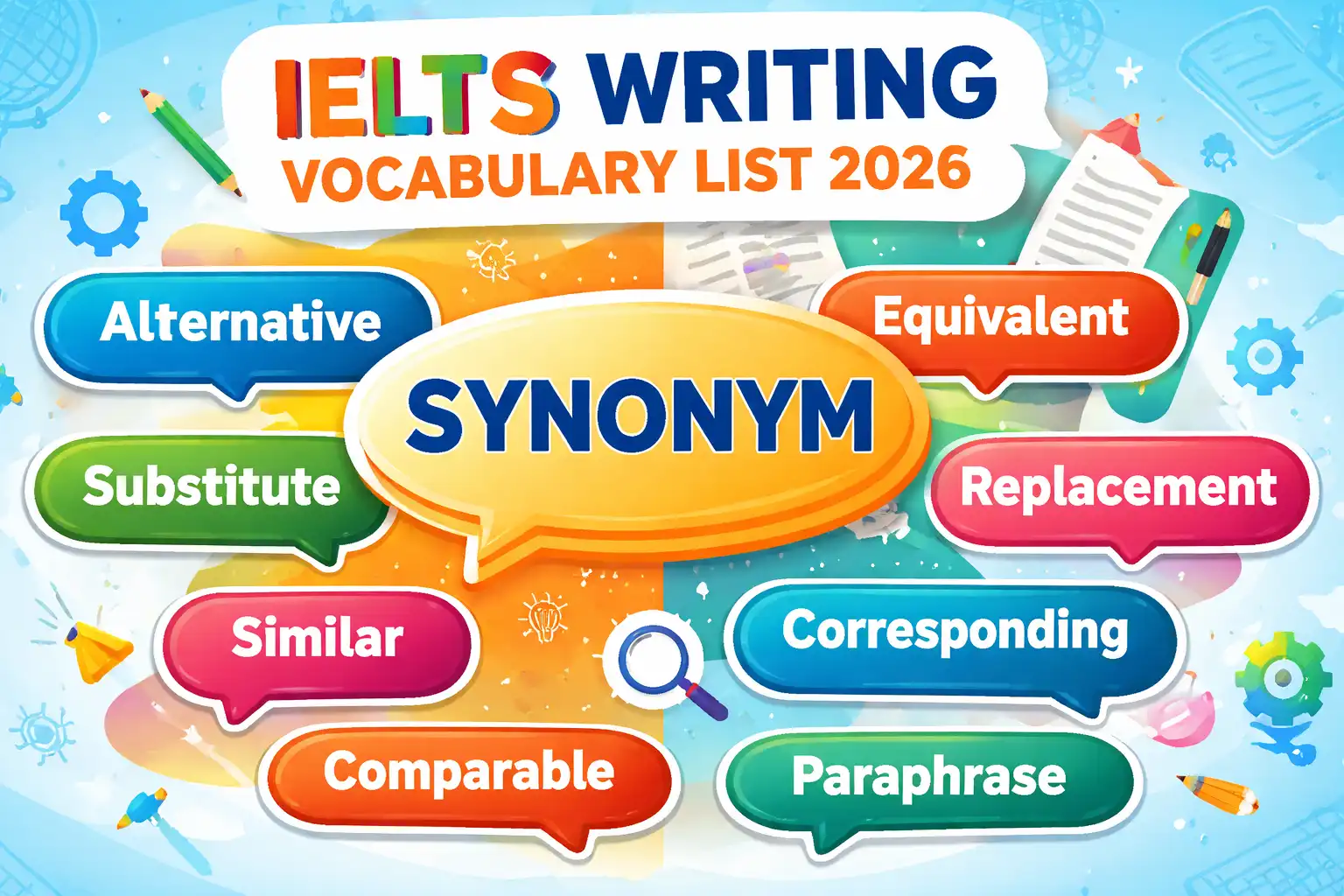
In this guide, you’ll get a complete IELTS writing vocabulary list 2026 designed to help you improve clarity, precision, and academic tone. You’ll learn synonyms, usage rules, real examples, and practical strategies that actually work in exams.
As an IELTS instructor with over a decade of experience, I’ve seen students jump from Band 6 to Band 7+ simply by improving vocabulary control. This article gives you exactly what you need—no fluff, just effective vocabulary you can use immediately in Task 1 and Task 2.
Quick Answer:
The IELTS writing vocabulary list 2026 includes high-impact academic words like “significant,” “increase,” “decline,” and “impact” along with their synonyms and correct usage.
Examples:
- significant → considerable, substantial
- increase → rise, grow
- decline → decrease, drop
- impact → effect, influence
Use these words to improve clarity, coherence, and lexical resource in IELTS essays.
What does IELTS Writing Vocabulary mean?
IELTS writing vocabulary refers to the range of academic, formal, and topic-specific words you use in your essays to express ideas clearly and accurately.
According to IELTS band descriptors, Lexical Resource accounts for 25% of your writing score. This means:
- You must show variety of vocabulary
- You must use words accurately
- You must avoid repetition
In academic writing, vocabulary is not about using difficult words randomly. It’s about:
- Choosing precise words
- Avoiding informal language
- Showing control over synonyms
IELTS Tip:
Examiners reward accuracy more than complexity. A simple word used correctly is better than a complex word used incorrectly.
Complete Synonyms List
Here is a powerful IELTS-focused vocabulary list with synonyms you should learn:
Common IELTS Words and Synonyms
- Important → crucial, essential, significant, vital
- Increase → rise, grow, escalate, surge
- Decrease → decline, drop, reduce, diminish
- Problem → issue, challenge, difficulty, obstacle
- Solution → remedy, resolution, approach, strategy
- Good → beneficial, positive, advantageous
- Bad → harmful, negative, detrimental
- Big → large, substantial, considerable
- Small → minor, limited, minimal
- Change → alter, modify, transform
- Effect → impact, influence, consequence
- Reason → cause, factor, explanation
In our experience helping writers, students who actively replace basic words like “good” and “bad” with academic alternatives improve their lexical score quickly.
Comparison Table
| Word | Simple Meaning | Best Used When | Avoid When |
| Significant | Very important | Academic arguments, data analysis | Casual writing |
| Increase | Go up | Graphs, trends, statistics | When change is unclear |
| Decline | Go down | Formal reports, Task 1 writing | Informal conversation |
| Impact | Effect or influence | Essays discussing causes/effects | Overuse in every sentence |
| Crucial | Extremely important | Strong arguments | When importance is minor |
| Detrimental | Harmful | Negative consequences | Simple everyday writing |
Formal vs Informal Synonyms
Understanding tone is critical in IELTS writing.
| Informal Word | Formal Alternative | Usage Context |
| Kids | Children | Academic essays |
| A lot of | Numerous | Formal writing |
| Get | Obtain | Task 2 arguments |
| Big | Significant | Data or impact discussion |
| Bad | Detrimental | Negative effects |
| Fix | Resolve | Problem-solving essays |
IELTS Tip:
Never use slang or casual expressions in IELTS writing. Always choose formal vocabulary.
Real Example Sentences
Here are practical examples using IELTS vocabulary:
- The government should take significant measures to reduce pollution.
- There has been a substantial increase in urban population.
- This issue has a negative impact on society.
- Education plays a crucial role in economic development.
- The number of cars has declined gradually over the years.
- This approach offers a viable solution to the problem.
- Many students face academic challenges in higher education.
- Technology has transformed communication in modern society.
Writers we work with often memorize words but fail to use them in sentences. Practice like this builds real skill.
When to Use vs When NOT to Use
When to Use
Use advanced vocabulary when:
- Writing Task 2 essays
- Describing trends in Task 1
- Explaining causes, effects, and solutions
- Making formal arguments
When NOT to Use
Avoid advanced vocabulary when:
- You are unsure of meaning
- You cannot use correct grammar
- The word feels unnatural in context
- Simpler words are clearer
According to academic writing conventions, clarity always comes first.
Common Mistakes Writers Make
Here are the most frequent vocabulary mistakes:
1. Using words incorrectly
Example: “This problem is very significance” ❌
Correct: “This problem is very significant” ✔️
2. Overusing the same word
Repeating “important” in every sentence reduces your score.
3. Using informal language
Words like “stuff,” “things,” or “kids” weaken your writing.
4. Memorizing without understanding
Many students learn lists but cannot apply them.
5. Using overly complex words
Unnatural vocabulary lowers coherence and clarity.
Tips and Best Practices
1. Learn Vocabulary in Context
Always study words inside sentences—not isolated lists.
2. Focus on High-Frequency IELTS Words
Prioritize words commonly used in essays like:
- impact
- increase
- solution
- challenge
3. Practice Synonym Replacement
Take a simple sentence and upgrade it:
- “This is a big problem” →
“This is a significant issue”
4. Build Topic-Based Vocabulary
Focus on themes like:
- Environment
- Education
- Technology
- Health
5. Use Collocations
Learn word combinations:
- heavy traffic
- strong argument
- major issue
IELTS Tip:
Examiners look for natural collocations more than rare words.
Frequently Asked Questions
Q1: What is the best IELTS writing vocabulary list for 2026?
A: The best IELTS writing vocabulary list 2026 includes high-frequency academic words like “significant,” “impact,” and “decline,” along with their synonyms and correct usage. Focus on words commonly used in essays and Task 1 reports to improve your lexical resource score effectively.
Q2: How many vocabulary words should I learn for IELTS writing?
A: You don’t need thousands of words. Around 200–300 well-understood academic words are enough. Focus on quality over quantity. Use them correctly in sentences, and practice applying them in essays to improve your band score.
Q3: Can advanced vocabulary increase my IELTS band score?
A: Yes, but only if used correctly. According to IELTS criteria, vocabulary contributes 25% of your score. However, incorrect usage or unnatural words can reduce your score. Accuracy and context matter more than complexity.
Q4: Should I use difficult words in IELTS essays?
A: Not necessarily. Use words you fully understand. Simple but accurate vocabulary is better than complex but incorrect usage. Examiners value clarity and precision over showing off difficult words.
Q5: What are common vocabulary mistakes in IELTS writing?
A: Common mistakes include repetition, incorrect word forms, informal language, and misuse of synonyms. Many students also memorize lists without understanding how to use words in context, which affects their score.
Q6: How can I improve my IELTS vocabulary quickly?
A: Practice daily with real sentences, learn synonyms, and read academic texts. Focus on topic-based vocabulary and review your mistakes. Writing essays regularly and getting feedback is one of the fastest ways to improve.
Q7: Is vocabulary more important than grammar in IELTS writing?
A: Both are equally important. Vocabulary (Lexical Resource) and grammar each contribute 25% to your score. Strong vocabulary without correct grammar will not help you achieve a high band score.
Q8: What vocabulary is best for Task 1 vs Task 2?
A: Task 1 requires vocabulary for describing trends, such as “increase,” “decline,” and “fluctuate.” Task 2 focuses on argument-based vocabulary like “impact,” “solution,” and “challenge.” Each task requires a slightly different vocabulary set.
Conclusion
Improving your vocabulary is one of the fastest ways to boost your IELTS writing score. With the IELTS writing vocabulary list 2026, you now have practical words, synonyms, and strategies you can apply immediately. Focus on accuracy, context, and consistency.
In our experience helping students, those who practice vocabulary through real writing improve faster than those who only memorize lists.
You might also want to read our guide on academic synonyms for essays to deepen your vocabulary skills.
Keep practising—you’re closer to your target band than you think.

Andrew Collins is an academic English educator with over 12 years of experience helping university students, IELTS candidates, and ESL learners improve their writing vocabulary.