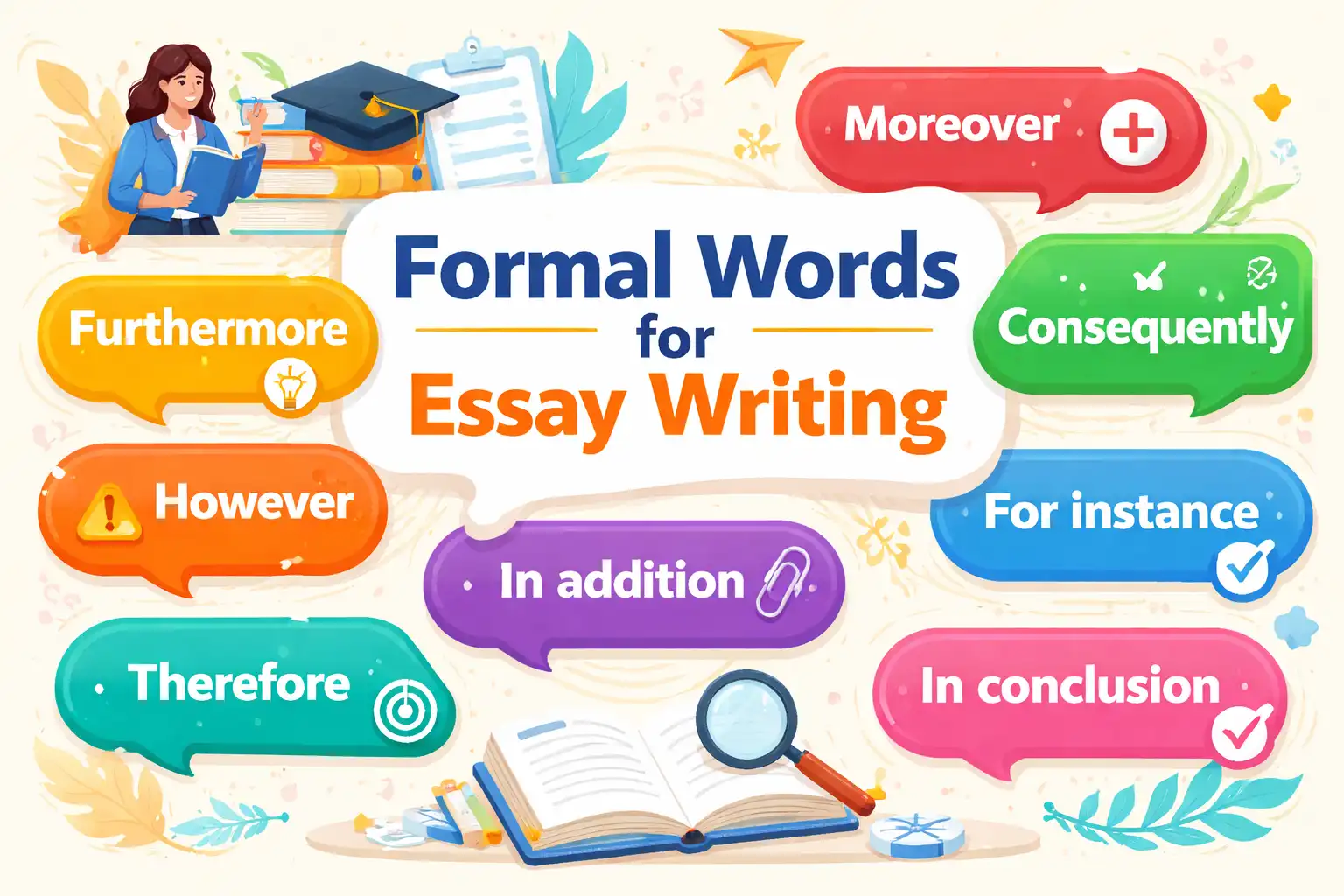
Do you ever feel your essays sound too simple or conversational? You’re not alone. Many students struggle to move from everyday English to a more academic tone. That’s where formal words for essay writing become essential. They help you sound more precise, professional, and convincing—especially in exams like IELTS or university assignments.
In this guide, you’ll learn exactly how to upgrade your vocabulary without sounding unnatural. I’ll show you the most useful formal alternatives, explain when to use them, and give you real examples you can copy into your own writing. Whether you’re aiming for a higher band score or stronger academic essays, this article will give you a clear, practical roadmap.
By the end, you’ll know not just what words to use—but why they work and how to use them effectively.
Quick Answer:
Formal words for essay writing are advanced vocabulary choices used to replace casual language in academic contexts. They improve clarity and professionalism. For example:
- get → obtain
- show → demonstrate
- help → assist
- buy → purchase
Using these words makes your writing more suitable for essays, reports, and exams like IELTS.
What Does “Formal Words for Essay Writing” Mean?
Formal words for essay writing refer to vocabulary that fits academic, professional, or scholarly contexts. These words avoid slang, contractions, and casual phrasing.
In academic writing, clarity and precision matter. According to IELTS band descriptors, higher-level writing (Band 7+) requires a range of vocabulary with accurate usage and appropriate tone. That’s where formal vocabulary becomes critical.
Key Characteristics:
- More precise than everyday words
- Often Latin-based (e.g., commence instead of start)
- Used in essays, reports, and research papers
- Avoid emotional or conversational tone
👉 In our experience helping writers, the biggest improvement in essay scores comes not from using difficult words—but from choosing the right formal alternative consistently.
Complete Synonyms List
Here are commonly used formal words for essay writing with their simpler equivalents:
- Obtain → get
- Demonstrate → show
- Assist → help
- Purchase → buy
- Commence → start
- Terminate → end
- Therefore → so
- However → but
- Additionally → also
- Require → need
- Significant → important
- Numerous → many
👉 These words are not “fancier” just for style—they are standard in academic writing conventions.
Comparison Table
| Word | Simple Meaning | Best Used When | Avoid When |
| Obtain | Get | Academic essays, formal reports | Casual emails or chats |
| Demonstrate | Show | Explaining evidence or arguments | Informal storytelling |
| Assist | Help | Professional or academic tone | Friendly conversations |
| Purchase | Buy | Business or formal writing | Everyday speech |
| Commence | Start | Formal introductions or processes | Simple instructions |
| Terminate | End | Technical or legal writing | Emotional or narrative writing |
Formal vs Informal Synonyms
| Informal Word | Formal Alternative |
| Get | Obtain |
| Show | Demonstrate |
| Help | Assist |
| Buy | Purchase |
| Start | Commence |
| End | Terminate |
| So | Therefore |
| But | However |
👉 IELTS Tip: Replace just 2–3 informal words per paragraph with formal alternatives. This improves your lexical resource score without making your writing unnatural.
Real Example Sentences
Here are practical examples using formal words for essay writing:
- The study demonstrates the impact of climate change on agriculture.
- Students must obtain reliable sources for their research.
- Governments should implement policies to reduce pollution.
- This approach can assist learners in improving their skills.
- The project will commence next month.
- The company decided to terminate the agreement.
- There are numerous factors influencing economic growth.
- The results were significant in understanding the issue.
👉 Writers we work with often improve clarity immediately by switching from “show” to demonstrate in argument-based essays.
When to Use vs When NOT to Use
When to Use:
- Academic essays
- IELTS Writing Task 2
- Research papers
- Formal reports
- University assignments
NOT to Use:
- Text messages or chats
- Personal blogs (casual tone)
- Informal emails
- Conversations
👉 Overusing formal words in casual contexts makes your writing sound unnatural and distant.
Common Mistakes Writers Make
- Overusing formal words
Using too many advanced words can reduce clarity. - Using the wrong context
Example: “terminate a friendship” sounds too harsh. - Mixing formal and informal tone
Example: “The study demonstrates… and stuff like that.” - Memorizing without understanding
Words must fit the sentence’s meaning. - Forcing complex vocabulary
Simplicity is still important in academic writing.
👉 According to academic writing standards, clarity always comes before complexity.
Tips and Best Practices
1. Replace Gradually
Start by upgrading common words:
- get → obtain
- show → demonstrate
2. Focus on Function Words
Use connectors like:
- However
- Therefore
- Additionally
3. Practice in Context
Write full sentences, not just word lists.
4. Read Academic Texts
Notice how formal vocabulary is used naturally.
5. Keep It Clear
If a formal word sounds confusing, don’t use it.
👉 In our teaching experience, students who focus on accuracy + appropriateness score higher than those who chase difficult vocabulary.
Frequently Asked Questions
Q1: What are formal words in essay writing?
A: Formal words are vocabulary used in academic and professional writing instead of casual language. They improve clarity, precision, and tone. Examples include “demonstrate” instead of “show” and “obtain” instead of “get.” These words help meet academic standards in essays and exams like IELTS.
Q2: Why are formal words important in essays?
A: Formal words make your writing more professional and credible. They align with academic expectations and improve your lexical resource score in exams. Using appropriate vocabulary shows that you can communicate ideas clearly and effectively in a formal context.
Q3: Can I use informal words in essays?
A: Yes, but only in limited cases. Most academic writing requires a formal tone. Overusing informal words like “stuff,” “a lot,” or “get” can lower the quality of your essay and affect your score in exams like IELTS.
Q4: How can I improve my formal vocabulary?
A: Practice replacing common informal words with formal alternatives. Read academic articles and write regularly. Focus on understanding how words are used in context rather than memorizing lists. Consistent practice leads to natural improvement.
Q5: Are formal words always better?
A: Not always. The best writing balances clarity and formality. Overusing complex words can confuse readers. Choose formal words only when they fit naturally and improve precision in your sentence.
Q6: What is the difference between formal and academic vocabulary?
A: Formal vocabulary is used in professional contexts, while academic vocabulary is specific to essays and research writing. Many words overlap, but academic vocabulary often includes discipline-specific terms and structured expressions.
Q7: Do formal words improve IELTS scores?
A: Yes. According to IELTS criteria, a wider range of vocabulary used accurately can increase your band score. However, incorrect usage or overuse of complex words can reduce clarity and lower your score.
Q8: How many formal words should I use in an essay?
A: There is no fixed number. Aim to replace common informal words consistently throughout your essay. A balanced approach—using formal vocabulary naturally—is more effective than forcing too many advanced words.
Conclusion
Mastering formal words for essay writing is one of the fastest ways to improve your academic writing. You don’t need hundreds of complex words—just the right ones used correctly. Focus on clarity, consistency, and context.
You might also want to read our guide on academic linking words to strengthen your essays further. Keep practising, stay consistent, and your writing will improve with every paragraph you write.

Andrew Collins is an academic English educator with over 12 years of experience helping university students, IELTS candidates, and ESL learners improve their writing vocabulary.