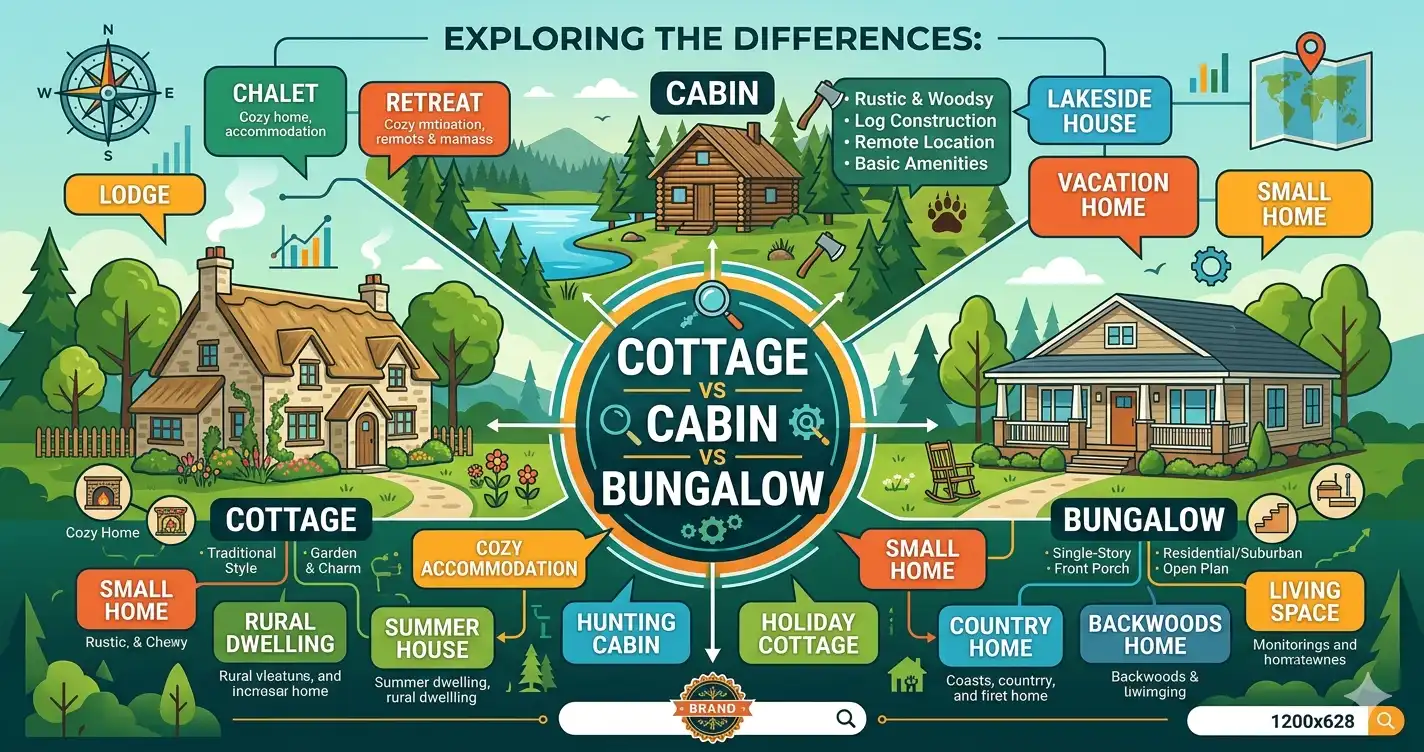
If you’ve ever found yourself using the words cottage, cabin, and bungalow( Cottage vs Cabin vs Bungalow ) interchangeably, you’re not alone. These three terms describe small, cozy dwelling types that often overlap in people’s minds — but they are architecturally, historically, and functionally quite different from one another.
Whether you’re planning a vacation rental stay, buying property, or simply curious about architecture, this guide breaks down everything you need to know about cottages, cabins, and bungalows — clearly, accurately, and side by side.
What Is a Cottage?
A cottage is a small, modest home — typically single-storied — that is often located in a rural or semi-rural setting. The word “cottage” has its roots in medieval England, where it referred to the dwelling of a cotter, a rural tenant farmer who lived on and worked someone else’s land.
Key Characteristics of a Cottage
- Size: Small to medium; usually under 1,500 square feet
- Stories: Traditionally single-story, though many modern cottages have an attic loft converted into a second bedroom
- Construction materials: Stone, brick, stucco, or wood — varies widely
- Roof: Often steeply pitched or thatched in traditional designs
- Location: Near lakes, beaches, mountains, or countryside villages
- Amenities: Modern cottages are fully equipped with kitchens, bathrooms, and often Wi-Fi
- Atmosphere: Charming, whimsical, cozy — often described as “storybook” in feel
Origins and History
Cottages originated in the northeastern regions of Europe, particularly England, where small, warm homes were needed to survive cold winters. Over time, the style traveled to North America and became synonymous with vacation homes — especially near lakes and coastlines in Canada and the northeastern United States.
Today, the term “cottage” is broadly applied to any small, quaint home — regardless of its exact architectural style. This flexibility in definition is one reason cottages are often confused with cabins and bungalows.
What Is a Cabin?
A cabin is a small dwelling primarily built from natural materials — most commonly logs or timber. The word evokes images of dense forests, mountain trails, and crackling fireplaces. Cabins have their roots in Scandinavia and Eastern Europe, where log construction was the standard method of building as far back as the Bronze Age (around 3500 BC).
Key Characteristics of a Cabin
- Size: Small; typically 400–1,200 square feet
- Stories: Usually one story, though two-story log cabins exist
- Construction materials: Logs, timber, or rough-hewn wood — rarely brick or masonry
- Roof: Low-pitched or gabled, often with exposed wood beams inside
- Location: Remote forests, mountains, or wooded lakesides — more secluded than cottages
- Amenities: Ranges from very basic (no running water) to fully modern luxury cabins
- Atmosphere: Rustic, adventurous, nature-immersive
Cabins in America
When European settlers arrived in North America, log cabins were one of the first structures they built — quick, practical shelters using the abundant timber available. Over time, these evolved from rough temporary shelters into the beloved vacation homes we know today.
Modern cabins are sometimes sold as prefabricated kits, making them highly customizable. You can find camping cabin kits, off-grid solar-powered cabins, and luxury wilderness retreats — all still categorized under the “cabin” umbrella.
What Is a Bungalow?
A bungalow is a more architecturally specific dwelling than either a cottage or a cabin. The word comes from the Bengali word bangla, referring to the style of house common in the Bengal region of India. British colonists adopted this style and brought it to England and, eventually, the rest of the world.
Key Characteristics of a Bungalow
- Size: Small to medium; typically 1,000–2,000 square feet
- Stories: Traditionally single-story; sometimes has a partial second floor or attic dormer
- Construction materials: Wood, brick, or concrete — more structured than a cabin
- Roof: Low, gently sloping roof with wide overhanging eaves
- Location: Suburban neighborhoods, residential areas — not typically rural or remote
- Amenities: Fully modern; built as permanent residences, not vacation homes
- Atmosphere: Casual, open-plan, practical — built for comfortable everyday living
The Architectural DNA of a Bungalow
The original Indian bungalow was elevated two to three feet above ground level to avoid flooding during monsoon seasons and to improve air circulation in the intense heat. This is why traditional bungalows have wide verandas, large windows, and open hallways — all designed for natural ventilation.
As bungalows spread to Western countries, the elevation feature was often dropped, but the open floor plan, wrap-around porch, and low-slung roof remained central to the design. In the United States, the Craftsman bungalow became especially popular in the early 20th century and remains a beloved architectural style today.
Cottage vs Cabin vs Bungalow — Side-by-Side Comparison
| Feature | Cottage | Cabin | Bungalow |
| Origin | Medieval England | Scandinavia / Eastern Europe | Bengal, India |
| Primary Use | Vacation or semi-rural living | Vacation / wilderness retreat | Permanent residence |
| Construction | Stone, brick, stucco, wood | Logs, timber | Wood, brick, concrete |
| Location | Countryside, lakes, coast | Remote forests, mountains | Suburban neighborhoods |
| Stories | 1 (sometimes attic loft) | 1–2 | 1 (sometimes partial 2nd) |
| Typical Size | 600–1,500 sq ft | 400–1,200 sq ft | 1,000–2,000 sq ft |
| Amenities | Moderate to modern | Basic to modern | Fully modern |
| Atmosphere | Charming, cozy, whimsical | Rustic, adventurous | Practical, open-plan |
| Seclusion | Medium | High | Low |
| Cost | Moderate | Moderate | Moderate to high |
The Key Differences Summarized
1. Construction Materials
The most fundamental difference is how each structure is built. Cabins are made from logs or raw timber — that’s what defines them. Cottages can be built from almost any material including stone, brick, or wood, giving them visual variety. Bungalows are more standardized — typically built with wood frames, brick, or concrete, resembling a typical residential home in structure.
2. Location and Setting
Cabins are the most remote of the three — often nestled deep in forests, up mountains, or far from any town. Cottages occupy a middle ground — close to nature (a lake, a beach, a village), but with reasonable access to civilization. Bungalows are suburban structures, built in residential areas and designed for convenient daily living, not wilderness escapes.
3. Purpose and Lifestyle
If you want to disconnect from the world, a cabin is your pick and want a charming vacation home with character and some modern comfort, a cottage fits the bill. If you want a permanent, practical home with modern amenities in a residential area, a bungalow is the right choice.
4. Historical and Cultural Roots
Each of the three styles carries its own cultural heritage. Cottages come from English rural tradition. Cabins come from Scandinavian and North American frontier history. Bungalows come from South Asian tropical architecture. Understanding their origins helps explain why they look and feel so different.
Can a Bungalow Be a Cottage — or Vice Versa?
This is a common question. The short answer: a small bungalow can sometimes described as a cottage, but not all cottages are bungalows.
A bungalow is a specific architectural style with defined features — the low roof, the veranda, the single-story open plan. A cottage is a looser, more romantic term that can apply to any small, charming home. When a bungalow is particularly cozy, rural, and decorative, people might call it a “cottage-style bungalow” — but the two are not technically interchangeable.
A cabin, on the other hand, is distinctly its own category. The use of log or timber construction is what sets it apart and a cabin didn’t consider a cottage or bungalow.
Which One Is Right for You?
Here’s a simple decision guide:
- Choose a Cottage if: You want a charming vacation home near a lake, coast, or countryside village with a warm, storybook feel and moderate modern amenities.
- Choose a Cabin if: You crave a deep nature experience — total seclusion, rustic simplicity, and a genuine escape from urban life. Ideal for adventurers, hikers, and those seeking digital detox.
- Choose a Bungalow if: You’re looking for a permanent residence that’s practical, affordable (relative to larger homes), easy to maintain, and located in a suburban neighborhood. Great for first-time homebuyers and small families.
Final Thoughts
Cottages, cabins, and bungalows each tell a story — of the people who built them, the climates they designed for, and the lifestyles they support. While modern versions of all three have blurred some of the original distinctions, understanding their core differences helps you make better decisions — whether you’re booking a vacation, buying property, or simply satisfying your curiosity about architecture.
The bottom line: cabins built from logs in the wilderness, cottages are charming small homes in nature-adjacent settings, and bungalows are stylish, low-profile permanent residences with South Asian roots. Each is beautiful in its own way — and each serves a very different purpose.

Andrew Collins is an academic English educator with over 12 years of experience helping university students, IELTS candidates, and ESL learners improve their writing vocabulary.