Struggling to improve your IELTS writing score because your vocabulary feels too basic? You’re not alone. Many candidates repeat simple words like good, bad, or big, which limits their band score. To reach Band 7, you need more precise and varied language.
This guide to IELTS synonyms for common words band 7 will show you exactly how to upgrade your vocabulary the right way. You’ll learn practical synonyms, when to use them, and when to avoid them. More importantly, you’ll understand how examiners evaluate lexical resource based on the official IELTS band descriptors.
As an academic English educator, I’ve helped hundreds of students move from Band 6 to Band 7 by refining their word choices—not just memorizing lists. In this article, you’ll get real examples, comparison tables, and proven tips you can apply immediately in your essays.
Quick Answer:
To achieve Band 7 in IELTS writing, you must replace basic words with more precise synonyms (e.g., “good” → “beneficial,” “bad” → “detrimental”) while using them accurately in context. Variety alone is not enough—correct usage, tone, and appropriateness are essential for a higher lexical resource score.
What does IELTS synonyms for common words band 7 mean?
The phrase IELTS synonyms for common words band 7 refers to replacing simple, overused vocabulary with more advanced, context-appropriate alternatives to meet IELTS scoring criteria.
According to academic writing standards:
- Band 6: Limited range, repetition of common words
- Band 7: Sufficient range with some flexibility and accuracy
This means you must:
- Use less common lexical items
- Avoid repetition
- Maintain natural, correct usage
Why it matters in Academic Writing:
Examiners are trained to look for lexical variety and precision. Using the right synonym shows control over language—not just memorization.
Complete Synonyms List
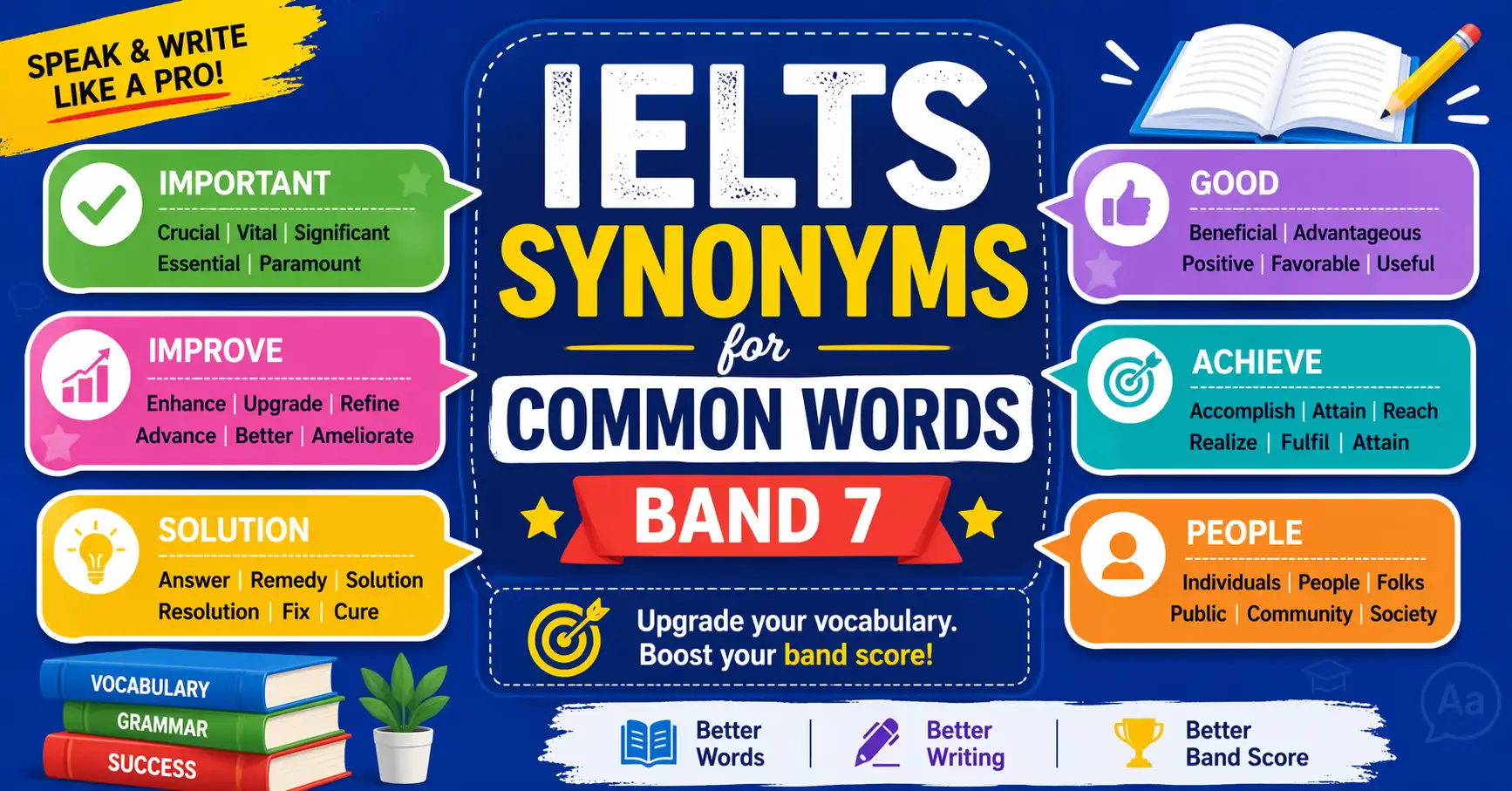
Here are essential upgrades for common IELTS words:
| Common Word | Band 7 Synonyms |
| Good | beneficial, advantageous, positive |
| Bad | detrimental, harmful, negative |
| Big | significant, substantial, considerable |
| Small | minor, limited, negligible |
| Important | crucial, essential, vital |
| Many | numerous, several, a large number of |
| Help | assist, support, facilitate |
| Show | demonstrate, illustrate, indicate |
| Change | alter, modify, transform |
| Problem | issue, challenge, concern |
IELTS Tip:
Do not try to replace every word. Focus on key nouns, verbs, and adjectives that impact meaning.
Comparison Table
| Word | Simple Meaning | Best Used When | Avoid When |
| Beneficial | Helpful, positive | Discussing outcomes | Informal speaking |
| Detrimental | Harmful | Academic arguments | Casual writing |
| Significant | Important or large | Data, trends | Personal opinions |
| Numerous | Many | Formal essays | Small quantities |
| Illustrate | Show clearly | Examples, explanations | Informal tone |
Formal vs Informal Synonyms
| Informal Word | Formal Synonym | Academic Use |
| Get | Obtain | Research or data context |
| A lot of | Numerous | Essays and reports |
| Fix | Resolve | Problem-solving discussions |
| Show | Demonstrate | Evidence-based writing |
| Big | Substantial | Statistics or impact |
Key Insight:
According to academic writing conventions, formal vocabulary is expected in IELTS Writing Task 2. Informal words reduce your score.
Real Example Sentences
Here’s how Band 7 vocabulary works in real IELTS-style sentences:
- This policy has a beneficial impact on public health.
- Pollution has a detrimental effect on the environment.
- There has been a significant increase in urban populations.
- Governments must address this critical issue urgently.
- A substantial number of students prefer online learning.
- This trend can be attributed to technological advancements.
- The study clearly demonstrates the importance of education.
- Financial support can facilitate economic growth.
When to Use vs When NOT to Use
When to Use:
- In IELTS Writing Task 2 essays
- When repeating a word more than once
- In formal arguments and explanations
- To improve lexical variety naturally
NOT to Use:
- When you are unsure of meaning
- In informal speaking contexts
- When it makes the sentence unnatural
- When a simple word is clearer
In our experience helping writers, overusing complex words incorrectly is worse than using simple words correctly.
Common Mistakes Writers Make
Many IELTS candidates lose marks due to these errors:
1. Using synonyms incorrectly
Example:
❌ “This problem is very significant” (wrong context)
✔ “This issue is very serious”
2. Forcing advanced vocabulary
Using words you don’t fully understand leads to awkward sentences.
3. Ignoring collocations
Some words naturally pair together:
- “Make a decision” ✔
- “Do a decision” ❌
4. Over-replacing every word
This makes writing unnatural and confusing.
Tips and Best Practices
1. Learn synonyms in context
Do not memorize lists blindly. Study them in sentences.
2. Focus on high-impact words
Improve:
- Adjectives (good → beneficial)
- Verbs (show → demonstrate)
3. Practice paraphrasing
This is essential for IELTS:
- “Many people think” → “A large number of individuals believe”
4. Use repetition strategically
Repeating a key term is sometimes better than a poor synonym.
5. Build topic-based vocabulary
For example:
- Environment: pollution, sustainability, emissions
- Education: curriculum, literacy, assessment
IELTS Tip:
Examiners reward accuracy over complexity. A correct simple word scores higher than a wrong advanced word.
Frequently Asked Questions
Q1: What synonyms should I learn for IELTS Band 7?
A: Focus on high-frequency academic synonyms like “beneficial,” “significant,” and “demonstrate.” Learn them in context, not isolation. This ensures correct usage and helps improve lexical resource without making your writing unnatural or forced.
Q2: Is using advanced vocabulary enough for Band 7?
A: No. You must use synonyms accurately and naturally. According to IELTS criteria, incorrect word choice lowers your score even if the vocabulary is advanced. Balance variety with clarity and precision.
Q3: Can I use informal synonyms in IELTS writing?
A: Avoid informal vocabulary in Writing Task 2. Words like “a lot of” or “get” should be replaced with formal alternatives such as “numerous” or “obtain” to meet academic writing expectations.
Q4: How many synonyms should I use in one essay?
A: Use synonyms naturally where repetition occurs. There is no fixed number, but aim for variety without overcomplicating sentences. Quality and correctness matter more than quantity.
Q5: What is the fastest way to improve vocabulary for IELTS?
A: Practice paraphrasing daily. Rewrite sentences using synonyms and check usage in real examples. This builds both vocabulary range and confidence in applying it correctly during the exam.
Q6: Do synonyms help in IELTS Speaking too?
A: Yes, but with caution. In speaking, fluency matters more. Use natural synonyms rather than overly formal words. Focus on clarity, pronunciation, and confidence alongside vocabulary variety.
CONCLUSION
Mastering IELTS synonyms for common words band 7 is not about memorizing long lists—it’s about using the right word in the right context. Focus on clarity, accuracy, and natural expression. Replace basic words strategically, not mechanically.
Writers we work with often see quick improvements when they practice paraphrasing and focus on high-impact vocabulary rather than trying to sound overly complex.
You might also want to read our guide on academic vocabulary for IELTS essays to continue building your skills.
Keep practicing. With consistent effort, Band 7 is absolutely within your reach.

Andrew Collins is an academic English educator with over 12 years of experience helping university students, IELTS candidates, and ESL learners improve their writing vocabulary.