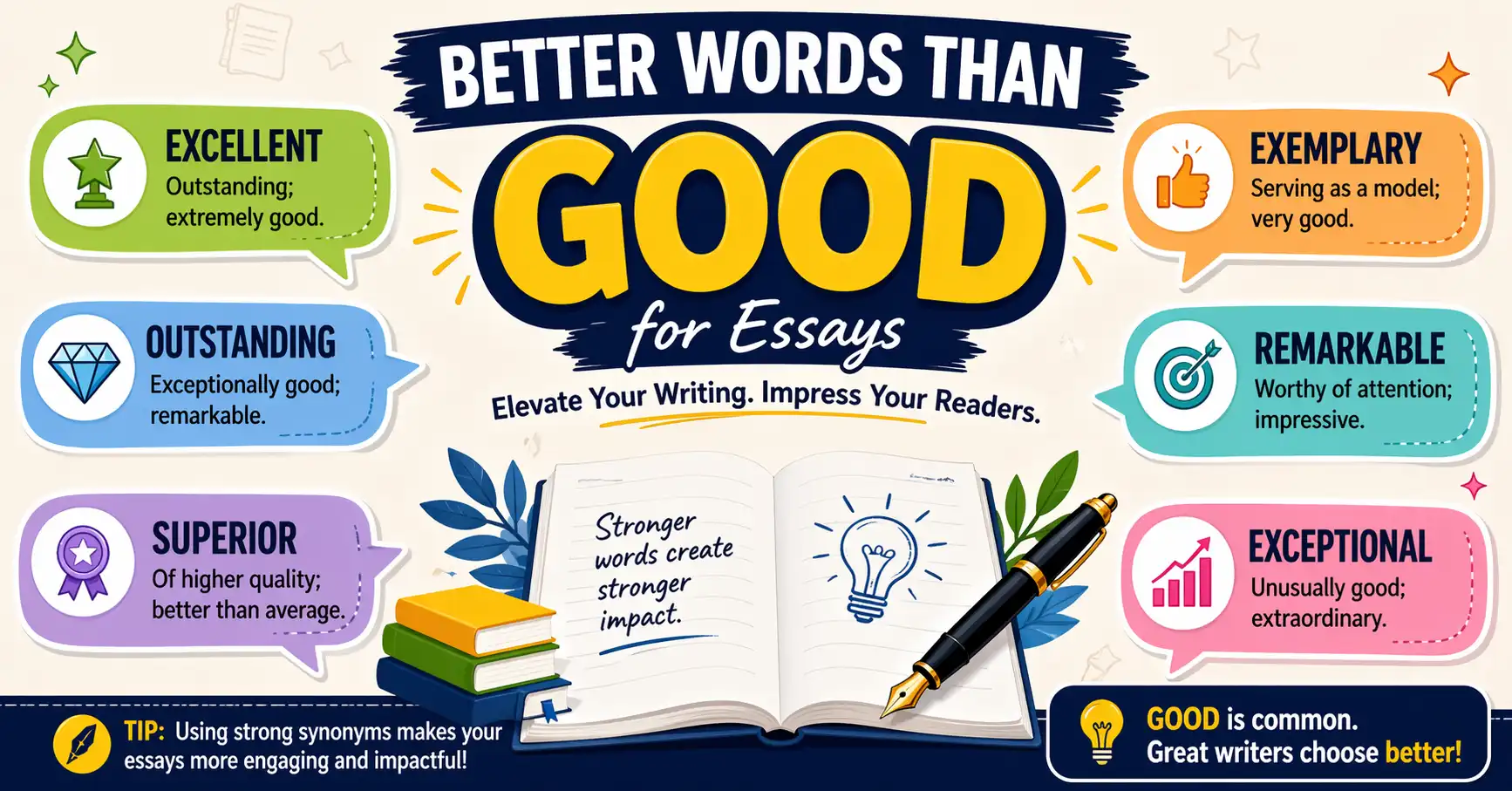
You already know that using the word “good” in an essay feels too basic. But what should you use instead? This is one of the most common struggles students face, especially in academic and IELTS writing. If you rely too much on simple words, your writing can sound repetitive and lack depth.
In this guide, you’ll learn better words than good in essay writing that instantly improve clarity, tone, and sophistication. More importantly, you’ll understand when and why to use each alternative — because not every synonym fits every sentence.
As an academic English educator with over 12 years of experience, I’ve seen how vocabulary choice directly impacts writing scores. In IELTS, for example, lexical resource accounts for 25% of your band score. That means upgrading words like good is not optional — it’s essential.
By the end of this article, you’ll have a clear list of powerful synonyms, practical examples, and expert strategies to strengthen your essays.
Quick Answer:
Better words than “good” in an essay include excellent, effective, beneficial, advantageous, impressive, strong, positive, and valuable. Choose the synonym based on context. For academic writing, words like effective and beneficial are preferred because they sound precise and formal, unlike the vague and overused word “good.”
What Does “Good” Mean in Essays?
In academic writing, good is a general adjective. It describes something positive, but it lacks precision.
For example:
- “This is a good solution.”
What does good mean here? Effective? Practical? Affordable?
According to academic writing conventions, vague language weakens your argument. Strong essays use specific vocabulary to express clear meaning.
Complete Synonyms List
Here are some of the best alternatives to “good” in essays:
- Excellent
- Effective
- Beneficial
- Advantageous
- Positive
- Valuable
- Significant
- Impressive
- Strong
- Efficient
- Reliable
- Constructive
IELTS Tip:
In our experience helping IELTS candidates, replacing “good” with “effective” or “beneficial” often leads to a higher band score because these words show precision and academic awareness.
Comparison Table
| Word | Simple Meaning | Best Used When | Avoid When |
| Excellent | Very high quality | Praising results or performance | Formal research analysis |
| Effective | Produces results | Explaining outcomes or solutions | Casual opinions |
| Beneficial | Helpful or useful | Discussing advantages | Negative contexts |
| Valuable | Important or useful | Highlighting importance | Minor points |
| Strong | Powerful or convincing | Arguments or evidence | Emotional descriptions |
| Positive | Favorable outcome | Results or impacts | Neutral discussions |
| Impressive | Worth admiration | Achievements | Formal academic tone |
| Efficient | Works well with less waste | Systems or processes | General descriptions |
Formal vs Informal Synonyms
| Formal (Academic) | Informal (Avoid in Essays) |
| Effective | Good |
| Beneficial | Nice |
| Advantageous | Great |
| Significant | Awesome |
| Valuable | Cool |
According to academic standards, formal vocabulary is essential for essays. Informal words reduce credibility.
Real Example Sentences
Here are practical examples using better words than good in essay writing:
- The new policy had a beneficial impact on public health.
- This method is highly effective in reducing pollution levels.
- The results show a significant improvement in student performance.
- Renewable energy is a valuable resource for future sustainability.
- The study presents a strong argument against the use of plastic.
- The government introduced an advantageous economic reform.
- This approach provides a positive outcome for both parties.
- The researcher offered an excellent analysis of the data.
When to Use vs When NOT to Use
When to Use Better Synonyms
Use precise alternatives when:
- You want to explain results clearly
- You are writing academic essays or IELTS tasks
- You need to show critical thinking and depth
When NOT to Use Them
Avoid replacing “good” blindly:
- Do not use excellent in formal research analysis
- Avoid impressive in objective essays
- Do not overuse advanced words just to sound smart
In our experience helping writers, forcing complex vocabulary often makes writing sound unnatural. Clarity always comes first.
Common Mistakes Writers Make
Many students try to improve vocabulary but make these errors:
1. Using the Wrong Synonym
Example:
- ❌ “This policy is impressive for the economy.”
- ✔ “This policy is beneficial for the economy.”
2. Overusing One Word
Repeating “effective” too often reduces impact.
3. Ignoring Context
Each synonym has a slightly different meaning. Misuse can confuse readers.
4. Choosing Informal Words
Words like awesome or great should never appear in academic essays.
Tips and Best Practices
Here’s how to use better words than good in essay writing effectively:
1. Focus on Meaning First
Ask yourself: What exactly do I mean by “good”?
2. Build a Personal Vocabulary List
Keep a list of 10–15 strong academic synonyms.
3. Practice with Real Sentences
Rewrite your essays and replace “good” with precise alternatives.
4. Learn Collocations
Some words naturally fit certain contexts:
- Effective solution
- Significant impact
- Valuable insight
IELTS Tip:
Writers we work with often improve quickly by memorizing common academic collocations, not just individual words.
Frequently Asked Questions
Q1: What is the best synonym for “good” in essays?
A: The best synonym depends on context. Words like effective, beneficial, and significant are commonly used in academic writing because they provide clarity and precision. Avoid vague replacements and focus on meaning instead.
Q2: Can I use “excellent” in academic essays?
A: You can use “excellent,” but sparingly. It is more suitable for descriptive or evaluative writing, not formal research essays where objective tone is required. Words like “effective” or “significant” are usually better choices.
Q3: Why should I avoid using “good” in essays?
A: “Good” is vague and lacks specificity. Academic writing requires precise language to explain ideas clearly. Using stronger synonyms improves clarity and demonstrates a higher level of vocabulary, which is important for IELTS and university essays.
Q4: How can I improve my vocabulary for essays?
A: Practice regularly by reading academic texts, learning collocations, and rewriting sentences with better synonyms. Focus on understanding context rather than memorizing long lists of words without knowing how to use them correctly.
Q5: Are advanced words always better in essays?
A: No. Advanced words are only useful when used correctly. Overcomplicating your writing can reduce clarity. According to IELTS criteria, accuracy and appropriateness matter more than complexity alone.
Q6: What are common mistakes when replacing “good”?
A: Common mistakes include choosing incorrect synonyms, overusing one word, and using informal alternatives. Many writers also ignore context, which leads to awkward or incorrect sentences. Always match the word to the meaning.
CONCLUSION
Using better words than good in essay writing is one of the fastest ways to improve your academic vocabulary. Instead of relying on vague language, you now have a range of precise alternatives like effective, beneficial, and significant.
Remember, strong writing is not about using complicated words — it’s about using the right words. Focus on clarity, context, and consistency.
You might also want to read our guide on better words than bad in essays to further refine your vocabulary.
Keep practicing. With the right word choices, your writing will become sharper, clearer, and more professional.

Andrew Collins is an academic English educator with over 12 years of experience helping university students, IELTS candidates, and ESL learners improve their writing vocabulary.