Do you ever feel your writing sounds too simple for academic essays or IELTS tasks? You may have strong ideas, but without advanced vocabulary, your work can fall short of a high band score. This is exactly where a C1 level formal English words list becomes essential.
At the C1 level, you are expected to express complex ideas clearly, use precise vocabulary, and maintain a formal tone. Many learners struggle because they either overuse basic words or misuse advanced ones. Both issues can reduce clarity and impact.
In this guide, you’ll get a carefully curated C1 level formal English words list tailored for academic writing. You’ll also learn how to use these words correctly, avoid common mistakes, and understand when formal vocabulary actually improves your writing.
By the end, you’ll be able to write with more authority, precision, and confidence—just like high-scoring IELTS candidates and university-level writers.
Quick Answer:
A C1 level formal English words list includes advanced vocabulary used in academic and professional writing, such as “substantial,” “mitigate,” “consequently,” and “significant.” These words help you express complex ideas clearly, improve essay quality, and meet IELTS Band 7–8 vocabulary expectations.
What Does C1 Level Formal English Words Mean?
C1 level vocabulary refers to advanced English words that demonstrate a high level of language proficiency. According to academic writing conventions and IELTS band descriptors, C1 users can:
- Express ideas fluently and precisely
- Use a wide range of vocabulary
- Avoid repetition
- Maintain a formal tone
In academic writing, these words are not just “difficult.” They are purposeful and precise.
For example:
- Basic: big problem
- C1: significant issue
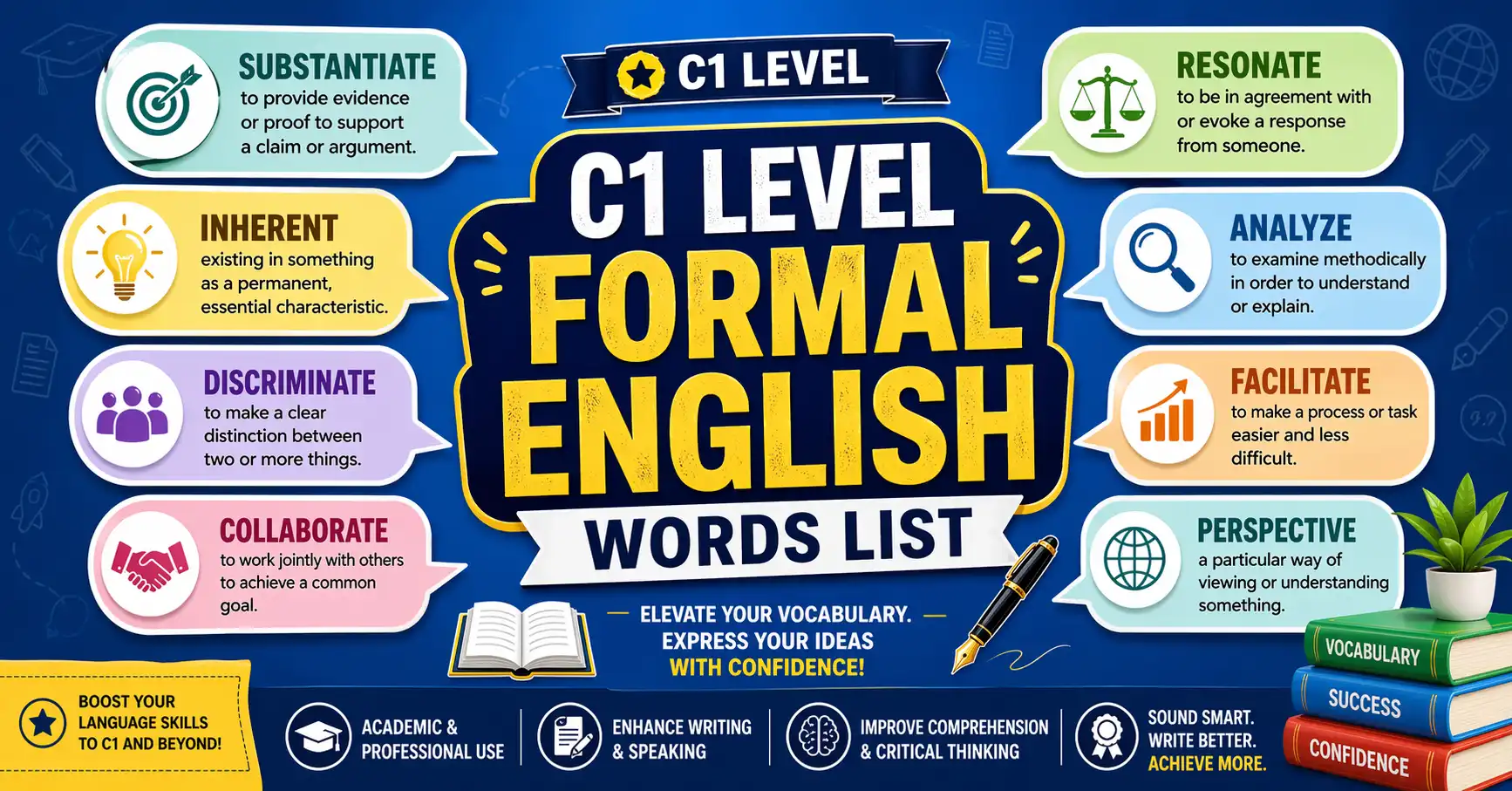
Complete C1 Level Formal English Words List
Here is a carefully selected list of commonly used C1 formal words:
- Significant
- Substantial
- Consequently
- Furthermore
- Mitigate
- Demonstrate
- Establish
- Indicate
- Allocate
- Enhance
- Diminish
- Evaluate
- Justify
- Facilitate
- Interpret
These words frequently appear in IELTS essays, research papers, and academic reports.
Comparison Table: Meaning and Usage
| Word | Simple Meaning | Best Used When | Avoid When |
| Significant | Important | Emphasizing impact | Casual writing |
| Mitigate | Reduce | Discussing problems | Everyday conversation |
| Facilitate | Make easier | Explaining processes | Informal speech |
| Demonstrate | Show clearly | Giving evidence | Simple storytelling |
| Allocate | Assign resources | Formal reports | Personal writing |
| Enhance | Improve | Academic arguments | Basic descriptions |
| Evaluate | Assess | Analysis tasks | Simple opinions |
| Justify | Give reasons | Supporting claims | Emotional writing |
Formal vs Informal Synonyms
| Formal Word | Informal Equivalent |
| Purchase | Buy |
| Assist | Help |
| Obtain | Get |
| Inform | Tell |
| Require | Need |
| Commence | Start |
| Terminate | End |
| Investigate | Look into |
Key Insight: Formal words are not always “better”—they are appropriate only in academic contexts.
Real Example Sentences
Here are practical examples using C1 vocabulary:
- The study demonstrates a clear link between diet and health.
- Governments must mitigate the effects of climate change.
- This policy will enhance economic stability.
- The data clearly indicates a rising trend.
- Researchers must evaluate the results carefully.
- Funding should be allocated to education sectors.
- The findings justify further investigation.
- Technology can facilitate communication across borders.
IELTS Tip:
In IELTS Writing Task 2, using words like “significant,” “consequently,” and “evaluate” correctly can push your vocabulary score toward Band 7 or higher.
When to Use vs When NOT to Use
✅ Use C1 Words When:
- Writing essays or reports
- Preparing for IELTS or academic exams
- Presenting arguments or analysis
- Avoiding repetition
❌ Do NOT Use C1 Words When:
- Writing informal emails or chats
- You are unsure of the meaning
- Simpler words express the idea clearly
- It sounds unnatural in context
In our experience helping writers, overusing complex vocabulary often makes writing less clear, not more impressive.
Common Mistakes Writers Make
Many learners misuse advanced vocabulary. Here are the most common errors:
1. Using Words Incorrectly
Example:
❌ This solution mitigates success
✔ This solution mitigates risks
2. Overcomplicating Sentences
Long, complex words do not automatically improve writing.
3. Memorizing Without Context
A word list alone is not enough. You must see how words are used in sentences.
4. Mixing Formal and Informal Tone
Example:
❌ The results were significant and kinda surprising
Tips and Best Practices
1. Learn Words in Context
Study full sentences, not isolated words.
2. Focus on Collocations
Some words naturally go together:
- significant impact
- conduct research
- draw conclusions
3. Practice Writing Daily
Use 3–5 new words in your writing each day.
4. Prioritize Accuracy Over Complexity
Clear writing always scores higher than complicated mistakes.
5. Review Model Essays
Look at Band 8 IELTS essays to see real usage.
IELTS Tip:
Examiners reward natural and accurate use of advanced vocabulary, not forced complexity. Precision matters more than difficulty.
Frequently Asked Questions
Q1: What is a C1 level formal English words list?
A: A C1 level formal English words list includes advanced vocabulary used in academic and professional contexts. These words help you express complex ideas clearly and are essential for high-level writing tasks like IELTS essays and university assignments.
Q2: How many C1 words should I learn?
A: You don’t need thousands. Focus on 50–100 high-frequency academic words and learn them deeply. Understanding usage, collocations, and context matters more than memorizing large lists without practical application.
Q3: Are C1 words required for IELTS?
A: Yes. According to IELTS band descriptors, Band 7 and above require a wide range of vocabulary, including less common and formal words. However, correct usage is more important than simply using advanced vocabulary.
Q4: Can I use C1 words in speaking?
A: You can, but only naturally. In speaking tests, forced use of formal vocabulary can sound unnatural. Use simpler words unless the context genuinely requires more precise or formal language.
Q5: What is the difference between B2 and C1 vocabulary?
A: B2 vocabulary allows clear communication, while C1 vocabulary enables precise, nuanced expression. C1 words are more formal and often used in academic or professional writing rather than everyday conversation.
Q6: How can I remember formal English words?
A: Practice actively. Write sentences, review examples, and use spaced repetition. Writers we work with often improve faster by using new words in short essays instead of memorizing them passively.
Conclusion
A strong C1 level formal English words list can transform your writing from basic to advanced. These words help you express ideas clearly, sound more academic, and meet high-level writing standards.
The key is not just learning words—but using them correctly and naturally. Focus on context, avoid overuse, and practice regularly.
You might also want to read our guide on academic transition words for essays to further strengthen your writing.
Keep practicing—you’re closer to advanced fluency than you think.

Andrew Collins is an academic English educator with over 12 years of experience helping university students, IELTS candidates, and ESL learners improve their writing vocabulary.