Do you often find yourself overusing the word “also” in essays? You’re not alone. Many students rely on it heavily, which can make writing sound repetitive and less academic. If you’ve been searching for instead of also in academic writing, you’re already on the right track to improving your style.
In academic contexts—especially IELTS essays, research papers, and university assignments—variety in vocabulary matters. Using the same connector repeatedly weakens cohesion and reduces your lexical resource score. You need alternatives that match the tone, context, and sentence structure.
In this guide, you’ll learn exactly what to use instead of “also,” when to use each option, and how to avoid common mistakes. I’ll show you real examples, comparison tables, and practical tips based on years of teaching academic writing. By the end, you’ll be able to replace “also” naturally and confidently in your writing.
Quick Answer:
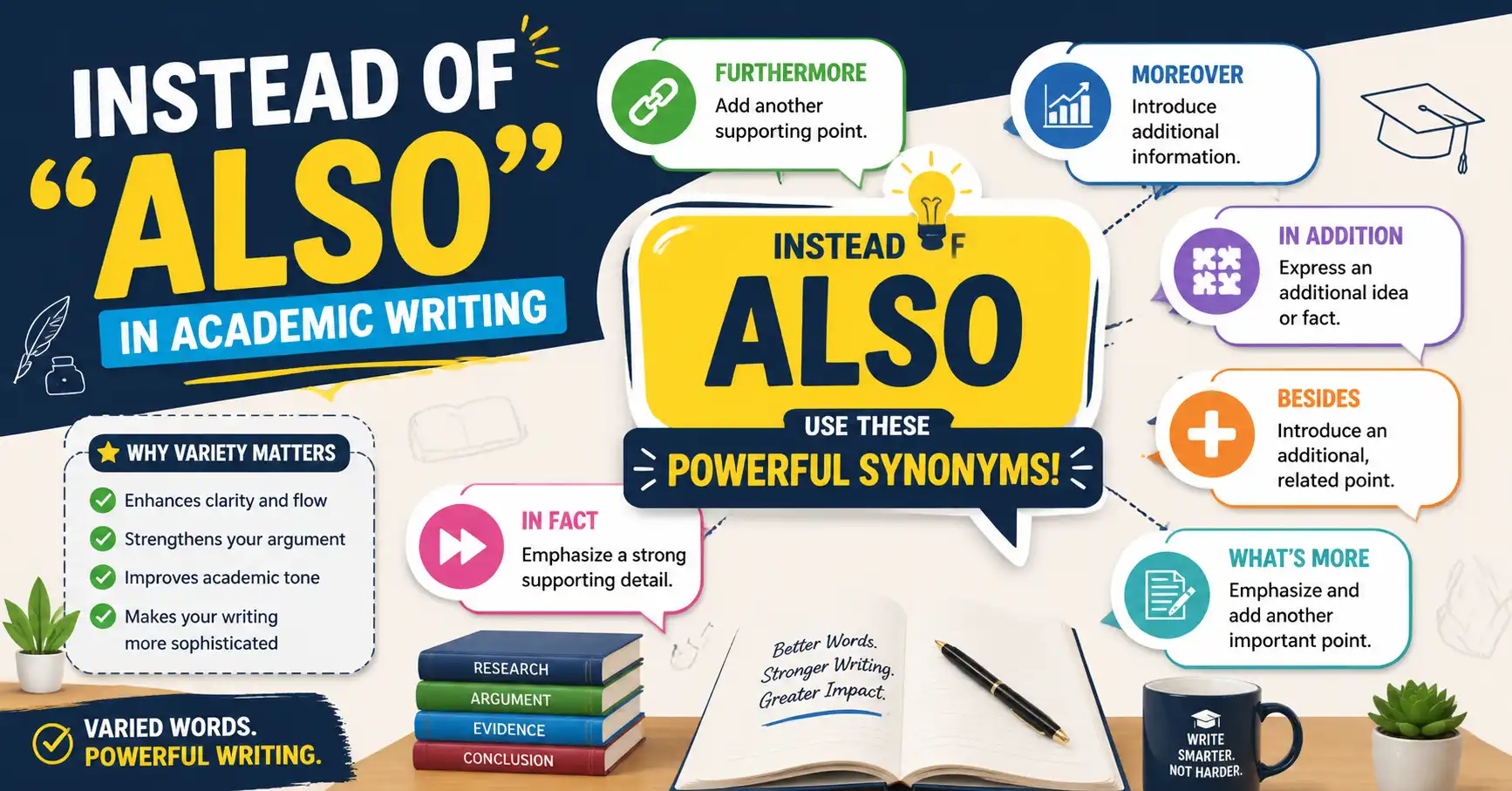
Instead of “also” in academic writing, use alternatives like “additionally,” “furthermore,” “moreover,” “in addition,” or “as well as,” depending on formality and sentence structure. These words improve flow, reduce repetition, and make your writing sound more professional and precise.
What does “also” mean?
“Also” is an additive linking word. It shows that you are adding information to a previous idea.
Example:
- The study examined climate change. It also analyzed economic impacts.
In academic writing, “also” is acceptable but often too basic and repetitive. According to academic writing conventions, higher-level writing requires varied linking devices to improve coherence and lexical range—especially important for IELTS Band 7+.
Complete Synonyms List (Instead of “Also”)
Here are strong alternatives you can use instead of also in academic writing:
- Additionally
- Furthermore
- Moreover
- In addition
- As well as
- Not only… but also
- Besides
- Equally important
- Another key point is
- Coupled with this
- Along with this
IELTS Tip:
Using advanced connectors like “moreover” and “furthermore” can help improve your Lexical Resource score, but only if used correctly and naturally.
Comparison Table
| Word/Phrase | Simple Meaning | Best Used When | Avoid When |
| Additionally | Adds extra information | Formal essays, reports | Casual writing |
| Furthermore | Strong addition | Academic arguments | Simple lists |
| Moreover | Emphasized addition | Supporting a strong claim | Weak or unrelated points |
| In addition | Adds another idea | General academic writing | Overused repeatedly |
| As well as | Combines two elements | Within a sentence | Starting sentences formally |
| Besides | Adds extra point casually | Semi-formal writing | Formal essays |
| Not only…but also | Adds emphasis | Highlighting dual importance | Simple statements |
| Equally important | Highlights significance | Arguments and discussions | Minor points |
Formal vs Informal Synonyms
| Formal Alternatives | Informal Alternatives |
| Additionally | Also |
| Furthermore | Plus |
| Moreover | And |
| In addition | As well |
| Not only…but also | Too |
Key insight: Academic writing favors formal connectors. Avoid informal ones like “plus” or “too” in essays.
Real Example Sentences
Here are practical examples using instead of also in academic writing:
- The research focuses on education. Additionally, it examines healthcare systems.
- Climate change affects agriculture. Furthermore, it impacts global economies.
- The policy is costly. Moreover, it lacks public support.
- The study analyzed data from Europe. In addition, it included Asian markets.
- The course improves writing skills as well as critical thinking.
- Not only does technology improve efficiency, but it also reduces costs.
- The method is effective. Equally important, it is easy to implement.
- The company expanded its services. Along with this, it increased its workforce.
IELTS Tip:
Avoid using the same connector twice in one paragraph. Variety shows control and sophistication.
When to Use vs When NOT to Use
When to Use Alternatives to “Also”
Use these alternatives when:
- You want to avoid repetition
- You are writing formal academic essays
- You need to connect ideas clearly
- You aim for a higher IELTS band score
When NOT to Use
Do NOT replace “also” blindly:
- When the sentence structure doesn’t fit (e.g., “as well as” misuse)
- When the meaning changes unintentionally
- When overusing complex connectors makes writing unnatural
In our experience helping writers, students often overcomplicate sentences by forcing advanced words. Clarity always comes first.
Common Mistakes Writers Make
1. Overusing “Furthermore” and “Moreover”
Using them in every paragraph makes writing sound mechanical.
2. Incorrect Sentence Position
❌ Furthermore the study shows…
✅ Furthermore, the study shows…
3. Mixing Formal and Informal Words
❌ Moreover, the results improved and also got better
✅ Moreover, the results improved significantly
4. Misusing “As Well As”
❌ The study as well as examines data
✅ The study examines data as well as trends
5. Using Complex Words Without Purpose
Advanced vocabulary should enhance clarity, not confuse the reader.
Tips and Best Practices
1. Match the Connector to Your Sentence
- Use “Additionally” at the start of sentences
- Use “as well as” within sentences
2. Avoid Repetition
Do not use the same connector more than twice in one essay.
3. Focus on Clarity First
Simple and clear writing scores higher than complex but confusing sentences.
4. Use Variety Strategically
Mix different connectors across paragraphs.
5. Practice with Real Essays
Rewrite your old essays and replace “also” with better alternatives.
IELTS Tip:
Band 7+ writers demonstrate flexible and accurate use of cohesive devices. This includes using alternatives to “also” naturally.
Frequently Asked Questions
Q1: What is the best alternative to “also” in academic writing?
A: The best alternative depends on context. “Additionally,” “furthermore,” and “in addition” are the most commonly used in formal writing. Each adds information, but “furthermore” and “moreover” are stronger and used for emphasis in arguments.
Q2: Can I still use “also” in academic essays?
A: Yes, you can use “also,” but sparingly. Overusing it makes writing repetitive. Academic standards encourage varied linking words to improve coherence and demonstrate a wider vocabulary range, especially in IELTS and university assignments.
Q3: Is “as well as” formal enough for essays?
A: Yes, “as well as” is acceptable in academic writing. However, it works best within sentences rather than at the beginning. It connects ideas smoothly but should not replace sentence-level connectors like “furthermore.”
Q4: What is the difference between “furthermore” and “moreover”?
A: Both are formal and used to add information. “Moreover” adds stronger emphasis, often supporting a key argument. “Furthermore” is slightly more neutral and commonly used in structured academic writing.
Q5: How can I avoid repeating “also” in essays?
A: Use a variety of connectors such as “additionally,” “in addition,” and “moreover.” Plan your essay structure in advance so you can distribute linking words naturally instead of repeating the same one.
Q6: Do synonyms of “also” improve IELTS scores?
A: Yes, using varied and accurate linking words improves your Lexical Resource and Coherence scores. However, misuse or overuse can lower your score, so focus on correct and natural usage rather than complexity alone.
CONCLUSION
Using instead of also in academic writing is a simple but powerful way to improve your essays. By replacing “also” with more precise connectors like “additionally,” “furthermore,” and “in addition,” you enhance clarity, flow, and professionalism.
Remember, variety matters—but only when used correctly. Focus on context, sentence structure, and meaning. Writers we work with often see immediate improvement just by reducing repetition and choosing better linking words.
You might also want to read our guide on “however in academic writing” to further strengthen your essay skills.
Keep practicing, and your writing will become more confident and polished with every essay.

Andrew Collins is an academic English educator with over 12 years of experience helping university students, IELTS candidates, and ESL learners improve their writing vocabulary.