In academic writing, using sophisticated synonyms for said in essays is essential for any student aiming to demonstrate a professional vocabulary. While “said” is a clear and functional word, overusing it can make your research paper feel repetitive and elementary.
By replacing it with more precise reporting verbs, you not only improve the flow of your writing but also clearly communicate the strength and intent behind every argument you cite.
This guide provides a deep dive into professional alternatives, categorizing them by intent, usage, and academic weight.
Quick Answer: What are Sophisticated Synonyms for “Said”?
Sophisticated synonyms are verbs that not only indicate speech but also convey the tone, strength, and purpose of a statement.
- Most Common Academic Alternatives: Stated, Argued, Claimed, Asserted.
- For Strong Evidence: Corroborated, Substantiated, Validated.
- For Opposing Views: Contended, Disputed, Refuted.
- For Suggestions: Proposed, Postulated, Insinuated.
When to Use Synonyms for “Said” (and When NOT to)
When to Use:
- Introducing a Source: When you quote or paraphrase a researcher, use a synonym that shows their stance (e.g., “Johnson contends that…”).
- Analyzing Arguments: Use synonyms to show how one point relates to another (e.g., “The data corroborates previous findings”).
- Varying Sentence Structure: To avoid starting every paragraph with “The author said.”
- Conveying Tone: If a researcher is being cautious, use “suggested” or “hypothesized” instead of a neutral word.
NOT to Use:
- Over-complication: Do not use a “big word” just for the sake of it if it doesn’t fit the context. (e.g., don’t use “explicated” if the person simply gave a brief answer).
- Fictional Dialogue Tags: In an academic essay, avoid creative writing tags like “shouted,” “whispered,” or “gasped” unless you are analyzing a piece of literature.
- Distorting Meaning: “Said” is neutral. If you use “claimed,” you are implying the statement might be false. If you aren’t sure, stick to “stated.”
The Master List: 80+ Sophisticated Synonyms for “Said”
Neutral Reporting Verbs (For Facts and Observations)
Use these when an author is presenting information without a strong emotional or argumentative bias.
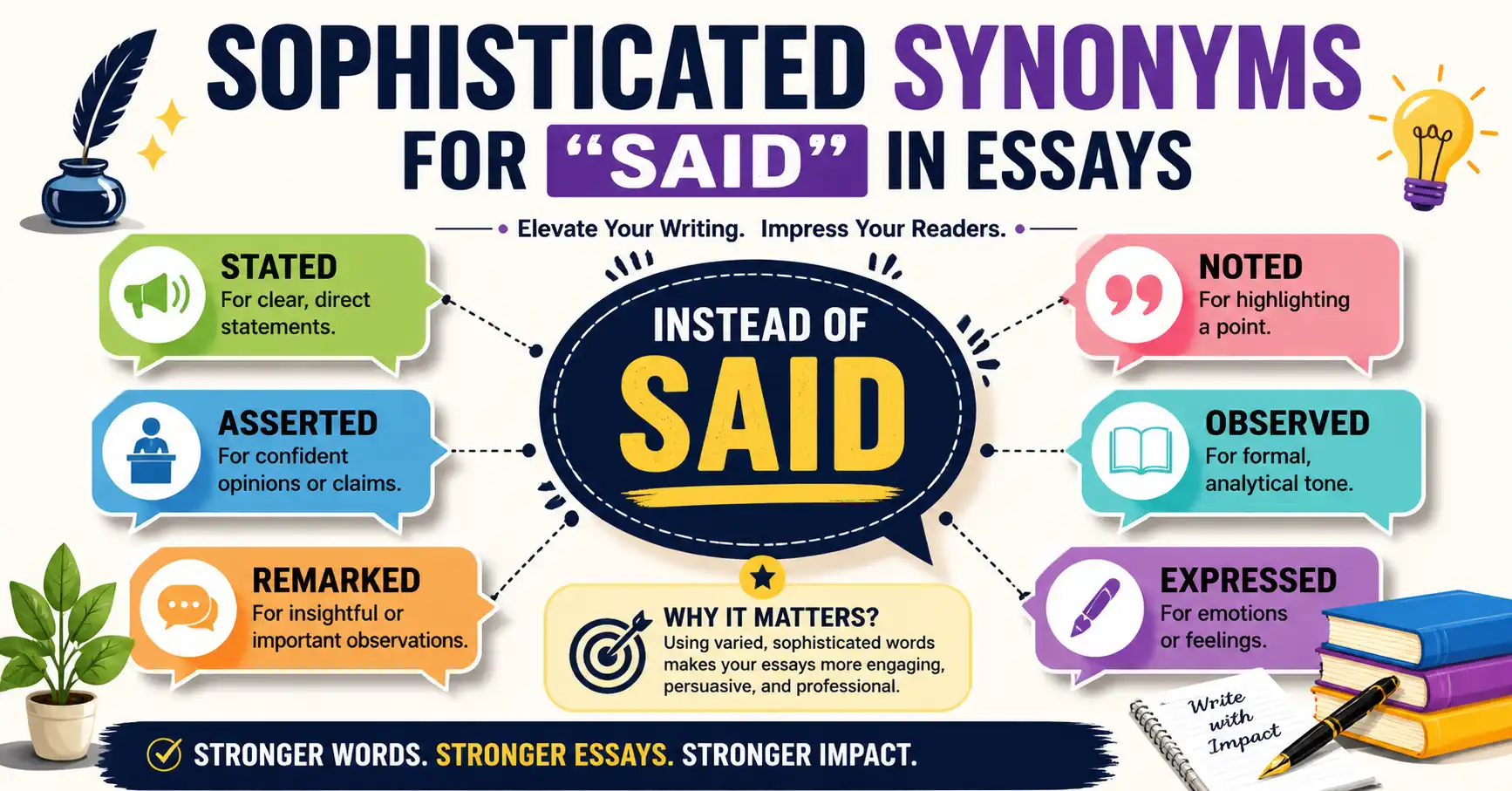
- Stated: A direct, formal expression of facts.
- Noted: Highlighting a specific, often overlooked detail.
- Remarked: Making a casual but relevant observation.
- Observed: Drawing a conclusion based on seen evidence.
- Reported: Giving an account of findings (common in science).
- Mentioned: A brief or incidental reference.
- Commented: Providing a brief opinion or reaction.
- Articulated: Expressing a complex idea clearly.
- Enunciated: Stating a theory or plan with extreme clarity.
- Related: Giving an account of a sequence of events.
- Communicated: Sharing information or data.
- Clarified: Making a previous statement more understandable.
- Described: Giving a detailed account of characteristics.
Analytical & Argumentative Verbs (For Building a Thesis)
These words show that the author is actively trying to persuade or prove a point.
14. Argued: Providing a systematic set of reasons.
15. Asserted: Stating a belief with confidence and authority.
16. Maintained: Continuing to hold a position despite opposition.
17. Contended: Engaging in a debate or a “clash” of ideas.
18. Claimed: Asserting something as a fact (often implies a need for proof).
19. Insisted: Firmly demanding that a point be accepted.
20. Posited: Putting forward a theory as a basis for argument.
21. Postulated: Suggesting a fundamental principle for reasoning.
22. Advanced: Putting forward an idea for consideration.
23. Proclaimed: A bold, public declaration of a stance.
24. Affirmed: Strongly stating the truth of a position.
25. Averred: A very formal way to state a fact confidently.
26. Reasoned: Using logic to arrive at a conclusion.
Evidentiary Verbs (For Proving & Supporting)
Essential for the “Evidence” part of your essay. These words show how a source backs up a claim.
27. Corroborated: Confirming someone else’s findings with new data.
28. Substantiated: Providing physical or logical proof for a claim.
29. Validated: Giving official or logical weight to a statement.
30. Confirmed: Proving that a previous assumption was correct.
31. Verified: Checking and proving the accuracy of a statement.
32. Demonstrated: Showing how something works through evidence.
33. Exemplified: Using a specific case to represent a broader point.
34. Illustrated: Making a point clear using examples or charts.
35. Evidenced: Showing that the evidence itself “speaks.”
36. Manifested: Making a quality or fact clear through action.
37. Upheld: Supporting a decision or a previous theory.
38. Endorsed: Formally supporting a specific person or idea.
39. Advocated: Recommending a certain path or belief.
Critical & Opposing Verbs (For Counter-Arguments)
Use these when you are discussing authors who disagree or challenge the status quo.
40. Refuted: Proving an argument to be objectively wrong.
41. Disputed: Questioning whether a statement is true.
42. Countered: Offering a direct response to an opposing view.
43. Contradicted: Stating the exact opposite of a claim.
44. Challenged: Questioning the authority or foundation of an idea.
45. Demurred: Raising polite but firm doubts.
46. Objected: Stating a disagreement based on logic or ethics.
47. Dismissed: Refusing to consider an idea because it lacks merit.
48. Repudiated: Refusing to be associated with an idea.
49. Controverted: Actively denying or opposing a theory.
50. Admonished: Firmly warning against a specific viewpoint.
51. Castigated: Severely criticizing a flawed argument.
52. Chided: Expressing mild disapproval of a source’s logic.
Tentative Verbs (For “Hedging” and Theories)
Use these when the author is being cautious or the evidence is not 100% conclusive.
53. Suggested: Putting an idea forward gently.
54. Hypothesized: Proposing an explanation as a starting point.
55. Speculated: Making a guess without complete evidence.
56. Proposed: Offering a possible plan or explanation.
57. Surmised: Supposing something is true based on intuition.
58. Insinuated: Hinting at something (usually negative) indirectly.
59. Intimated: Making a subtle or indirect hint.
60. Projected: Estimating a future trend based on current data.
61. Envisaged: Imagining a possible future scenario.
62. Conjectured: Forming an opinion based on incomplete info.
Explanatory & Elaborative Verbs (For Deep Analysis)
Use these when an author is breaking down a complex topic.
63. Elucidated: Shedding light on a difficult or dark topic.
64. Explicated: Analyzing a text or idea in extreme detail.
65. Delineated: Describing the exact boundaries of a concept.
66. Expounded: Setting forth a theory in great detail.
67. Detailed: Providing a point-by-point breakdown.
68. Clarified: Removing ambiguity from a statement.
69. Illuminated: Making a complex point easy to understand.
70. Interpreted: Explaining the meaning of a particular set of data.
71. Simplified: Breaking a complex idea into digestible parts.
72. Unpacked: (Modern academic) Analyzing the hidden layers of an idea.
Verbs of Admission & Acceptance
Use these when an author acknowledges a point made by the other side.
73. Conceded: Admitting a point is true after initial resistance.
74. Acknowledged: Accepting that a fact exists or is valid.
75. Granted: Agreeing with a point to move the argument forward.
76. Recognized: Showing awareness of a specific contribution.
77. Acquiesced: Agreeing reluctantly without further protest.
78. Accepted: Taking a statement as true.
79. Confessed: Admitting a personal bias or error (literary).
80. Yielded: Giving up a position in favor of a stronger argument.
The “Grammar Trap”: Why “Said” Synonyms Can Lower Your Grade
Most students make the mistake of using a thesaurus without checking connotations.
- Example A: “The scientist claimed that gravity exists.” (Incorrect: “Claimed” suggests doubt).
- Example B: “The scientist demonstrated that gravity exists.” (Correct: Shows evidence).
Frequently Asked Questions (FAQs)
Q1: Is “said” ever okay to use in an essay?
Yes. “Said” is invisible to the reader. It is perfectly fine to use it once or twice in a paragraph. The goal is to avoid using it in every sentence.
Q2: What is the most formal synonym for said?
“Stated,” “Asserted,” and “Contended” are considered highly formal and are preferred in university-level assignments.
Q3: Can I use “shouted” or “screamed” in an essay?
These are emotive verbs. You are writing a narrative essay or analysing a character in a book, keep your verbs professional.
Q4: How do I choose between “Argued” and “Suggested”?
Ans: Use “Argued” when the author provides strong evidence and a firm stance. Use “Suggested” when the author is being cautious or the data is not yet 100% conclusive.
Q5: What is the difference between “Claimed” and “Asserted”? Ans: “Asserted” conveys confidence and academic authority. Claimed is often used when there is a lack of solid proof or when the statement’s validity is being questioned.
Conclusion
Mastering sophisticated synonyms for said in essays is not about using the biggest words in the dictionary; it is about choosing the right word for the context.
By categorising your verbs into “Supporting,” “Challenging,” or “Neutral,” you demonstrate to your readers (and Google’s ranking algorithms) that you have a deep understanding of academic discourse.
For more English language resources and writing tips, stay tuned to SynonymVirl.com.

Andrew Collins is an academic English educator with over 12 years of experience helping university students, IELTS candidates, and ESL learners improve their writing vocabulary.