Do you find yourself using “however” too often in your essays? You’re not alone. Many students and ESL learners rely on this one transition word, but repeating it can weaken your writing style and reduce your academic impact. If you’re searching for another word for however in formal writing, you’re already on the right track to improving your vocabulary.
In academic writing, variety and precision matter. Examiners—especially in IELTS and university assessments—expect you to demonstrate a wide range of cohesive devices. Overusing “however” can make your writing sound repetitive and limit your score.
In this guide, you’ll learn powerful alternatives to “however,” when to use each one, and when to avoid them. I’ll also share practical tips based on real classroom experience, so you can confidently apply these words in essays, reports, and formal arguments.
Quick Answer:
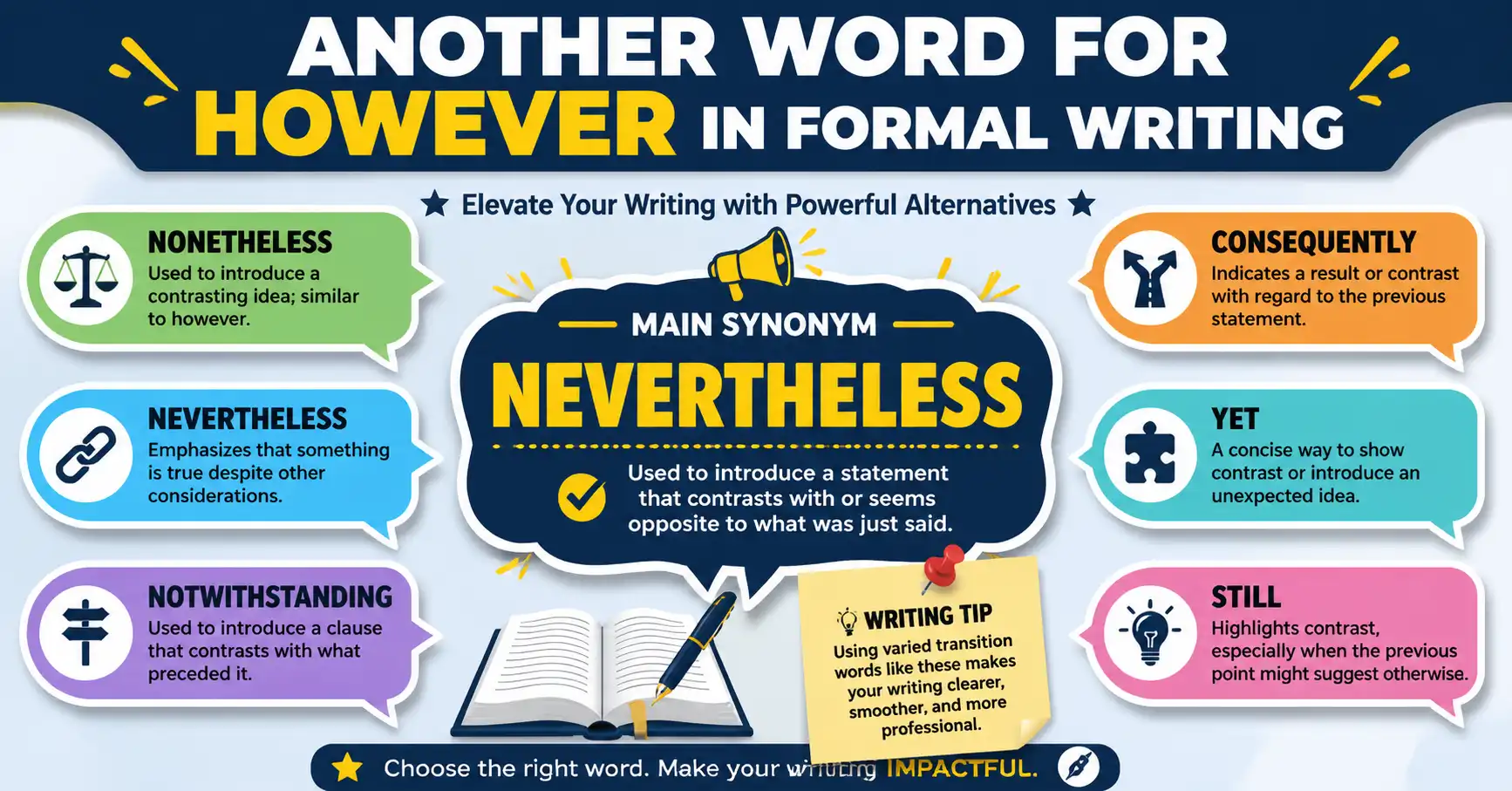
Another word for “however” in formal writing includes: nevertheless, nonetheless, however, on the other hand, in contrast, yet, still, conversely, notwithstanding, and albeit.
These alternatives help you express contrast or contradiction more precisely, improving clarity and variety in academic and IELTS writing.
What Does “However” Mean?
In academic writing, “however” is a contrast transition word. It signals that the second idea contrasts with or limits the first.
Example:
- The results were promising. However, further research is needed.
According to academic writing conventions, such connectors are essential for coherence and cohesion, which directly affect IELTS Writing scores (Band 7+ requires varied linking devices).
Complete Synonyms List (Formal Alternatives)
Here are strong alternatives you can use instead of “however”:
- Nevertheless
- Nonetheless
- On the other hand
- In contrast
- Conversely
- Yet
- Still
- Notwithstanding
- Albeit
- Even so
- That said
- By contrast
IELTS Tip:
Using a variety of connectors like nevertheless and conversely can help you achieve higher Lexical Resource scores.
Comparison Table
| Word | Simple Meaning | Best Used When | Avoid When |
| Nevertheless | Despite that | Strong formal contrast | Informal writing |
| Nonetheless | In spite of that | Academic essays | Casual conversations |
| On the other hand | Showing alternative view | Comparing two sides | Single-idea arguments |
| In contrast | Showing clear difference | Academic comparisons | Emotional writing |
| Conversely | Opposite perspective | Logical, structured arguments | Simple sentences |
| Yet | But | Short formal sentences | Overuse in long paragraphs |
| Still | Despite that | Emphasizing persistence | Highly formal reports |
| Notwithstanding | In spite of | Legal or very formal writing | IELTS basic essays |
| Albeit | Although | Concise formal writing | Beginner-level writing |
Formal vs Informal Synonyms
| Formal Synonyms | Informal Alternatives |
| Nevertheless | But |
| Nonetheless | Still |
| Conversely | On the flip side |
| In contrast | Compared to that |
| Notwithstanding | Even so |
| Albeit | Though |
In academic writing, always prefer formal options. Informal phrases like “on the flip side” can reduce your credibility.
Real Example Sentences
Here are practical examples you can use in essays:
- The experiment failed; nevertheless, valuable data was collected.
- The theory is widely accepted. Nonetheless, some scholars disagree.
- Urban areas are crowded. In contrast, rural regions are less populated.
- The company made profits. Conversely, its competitors suffered losses.
- The policy is effective. Yet, it requires further refinement.
- The results were unexpected. Still, they provide useful insights.
- The method is efficient, albeit slightly complex.
- The argument is strong. Even so, it lacks supporting evidence.
In our experience helping writers:
Students who actively replace “however” with precise alternatives tend to write more cohesive and professional essays, especially in IELTS Task 2.
When to Use vs When NOT to Use
When to Use Alternatives
Use these synonyms when you want to:
- Show contrast between ideas
- Add sophistication to your writing
- Avoid repetition
- Improve academic tone
When NOT to Use
Avoid replacing “however” when:
- You are unsure of the exact meaning
- The sentence becomes unclear
- The synonym feels too advanced for your level
- You are writing informal content
Example mistake:
- Incorrect: The study was successful, notwithstanding, more research is needed.
- Correct: The study was successful; nevertheless, more research is needed.
Common Mistakes Writers Make
1. Using synonyms incorrectly
Many learners confuse “nevertheless” and “on the other hand.” These are not interchangeable.
2. Overusing complex words
Using “notwithstanding” too often can make your writing sound unnatural.
3. Wrong punctuation
“However” and its alternatives often require:
- A semicolon before
- A comma after
4. Mixing informal and formal tone
Avoid combining:
- “Nevertheless” + “kids nowadays” (tone mismatch)
5. Lack of clarity
Replacing “however” just for variety can harm clarity if the meaning changes.
Tips and Best Practices
1. Match the level to your writing
Use:
- “Yet” or “still” for simpler essays
- “Nevertheless” or “conversely” for advanced writing
2. Focus on meaning, not just variety
Each synonym has a slightly different nuance.
3. Practice with rewriting
Take one paragraph and replace “however” with:
- “In contrast”
- “Nevertheless”
- “Yet”
See how the tone changes.
4. Keep sentences clear
Clarity always beats complexity.
5. Use sparingly
Even advanced words lose impact if overused.
IELTS Tip:
Examiners reward accurate use of linking devices, not just variety. One correct “however” is better than five incorrect alternatives.
Frequently Asked Questions
Q1: What is the best formal synonym for however?
A: The best synonym depends on context, but “nevertheless” and “nonetheless” are the most reliable in academic writing. They clearly show contrast and are widely accepted in essays, reports, and IELTS responses.
Q2: Can I use “yet” instead of however in essays?
A: Yes, “yet” can replace “however” in shorter sentences. However, it is less formal and should be used carefully in academic writing, especially in high-level IELTS or university assignments.
Q3: Is “on the other hand” formal?
A: Yes, it is formal enough for academic writing. It works best when comparing two opposing ideas. Avoid using it if you are not presenting a clear alternative viewpoint.
Q4: What is the difference between nevertheless and however?
A: “Nevertheless” emphasizes contrast more strongly than “however.” It suggests that despite the previous point, the second idea still holds true. It is slightly more formal and often used in academic arguments.
Q5: Can overusing “however” lower my IELTS score?
A: Yes. Overusing “however” shows limited vocabulary range, which can affect your Lexical Resource score. IELTS examiners expect varied and accurate use of cohesive devices.
Q6: Is “notwithstanding” good for IELTS writing?
A: While “notwithstanding” is formal, it is rarely needed in IELTS essays. It can sound overly complex and unnatural if used incorrectly. Simpler alternatives like “nevertheless” are usually safer and more effective.
CONCLUSION
Finding another word for however in formal writing is more than just improving vocabulary—it’s about writing with precision and confidence. By using alternatives like “nevertheless,” “in contrast,” and “conversely,” you can make your essays more engaging and academically strong.
Remember, variety matters, but clarity matters more. Choose the right word for the right context.
You might also want to read our guide on “words to express contrast in essays” to deepen your skills.
Keep practicing, and your writing will improve faster than you think.

Andrew Collins is an academic English educator with over 12 years of experience helping university students, IELTS candidates, and ESL learners improve their writing vocabulary.