Do your academic essays sound repetitive or too simple? You’re not alone. Many students struggle to move beyond basic words like “good,” “bad,” or “important,” which weakens the impact of their writing. If you want higher grades, especially in university or IELTS exams, your vocabulary must sound precise and sophisticated.
In this guide, you’ll learn the best strong adjectives for academic essays and how to use them effectively. I’ll show you not only what words to use, but also when and why they work. You’ll see real examples, common mistakes, and expert tips based on years of teaching academic writing.
By the end, you’ll be able to replace weak vocabulary with powerful, formal adjectives that improve clarity, tone, and scoring potential—especially in academic and IELTS contexts.
Quick Answer:
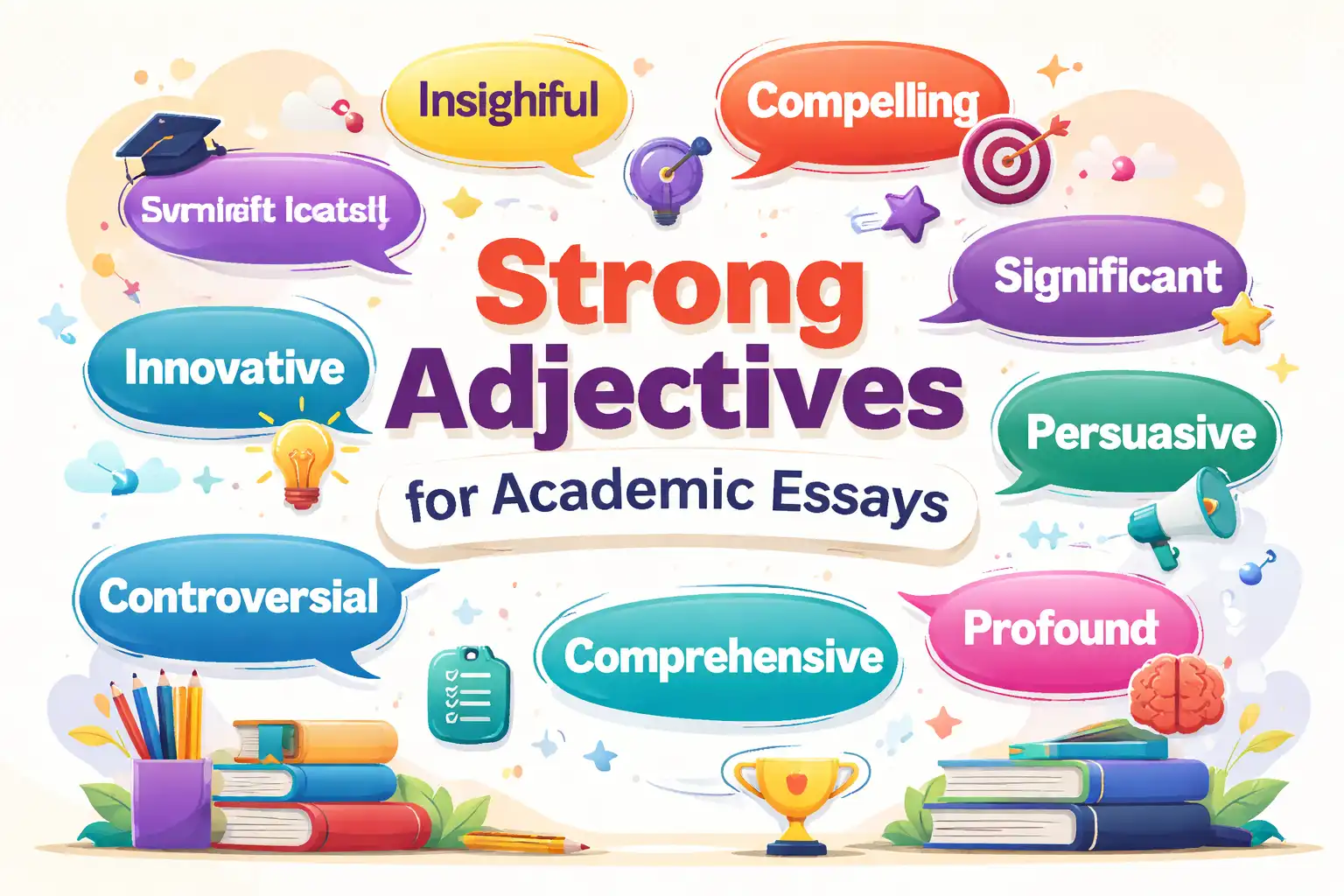
Strong adjectives for academic essays are precise, formal words that add clarity and authority to your writing. Instead of basic terms, use words like significant, substantial, compelling, robust, and critical. These adjectives help you present arguments more effectively and meet academic writing standards. For example: “a significant issue,” “a compelling argument,” “robust evidence,” and “a critical analysis.”
What Does “Strong Adjectives for Academic Essays” Mean?
Strong adjectives are formal, specific, and impactful descriptive words used in academic writing to replace vague or weak terms.
Instead of saying:
- “This is a good study”
You write:
- “This is a comprehensive and rigorous study”
According to academic writing conventions, strong adjectives should:
- Be precise
- Maintain a formal tone
- Avoid emotional exaggeration
- Add clarity and authority
In IELTS writing, examiners look for Lexical Resource, and using advanced vocabulary appropriately can help push your score toward Band 7 or higher.
Complete Synonyms List
Here are powerful alternatives you can use in place of weak adjectives:
- Significant
- Substantial
- Compelling
- Robust
- Critical
- Comprehensive
- Rigorous
- Profound
- Notable
- Essential
- Convincing
- Plausible
- Extensive
- Valid
- Influential
IELTS Tip:
Use these adjectives when explaining data, arguments, or research findings. Avoid overusing one word—variety improves your score.
Comparison Table
| Word | Simple Meaning | Best Used When | Avoid When |
| Significant | Very important | Highlighting key findings | Overusing in every paragraph |
| Substantial | Large in amount | Data, changes, impact | Small or unclear effects |
| Compelling | Very convincing | Arguments or opinions | Weak evidence |
| Robust | Strong and reliable | Research or methods | Informal essays |
| Critical | Extremely important | Analysis or evaluation | Casual contexts |
| Comprehensive | Complete and detailed | Reports or studies | Short explanations |
| Rigorous | Strict and careful | Research methods | General writing |
| Profound | Deep or intense | Social or philosophical topics | Simple descriptions |
Formal vs Informal Synonyms
| Formal (Academic) | Informal (Avoid in Essays) |
| Significant | Big |
| Substantial | A lot |
| Compelling | Really good |
| Robust | Strong (basic use) |
| Critical | Very important |
| Comprehensive | Full |
| Rigorous | Tough |
| Notable | Cool |
Why this matters: Academic writing requires precision and neutrality. Informal words weaken your credibility.
Real Example Sentences
Here are strong adjectives used correctly in academic contexts:
- The study revealed a significant increase in student performance.
- There is substantial evidence supporting this theory.
- The author presents a compelling argument for policy reform.
- The research methodology is rigorous and well-structured.
- Climate change has a profound impact on global ecosystems.
- The report provides a comprehensive analysis of economic trends.
- This finding is critical to understanding the issue.
- The experiment produced robust and reliable results.
- The results offer a convincing explanation of the phenomenon.
- The study highlights a notable shift in public opinion.
When to Use vs When NOT to Use
When to Use Strong Adjectives
Use them when:
- You are analyzing data
- You are evaluating arguments
- You need to emphasize importance
- Writing IELTS Task 2 or academic essays
When NOT to Use Them
Avoid using strong adjectives when:
- You lack evidence (e.g., don’t say “compelling” without proof)
- Writing informal assignments
- You are repeating the same adjective
- The context is neutral or descriptive only
In our experience helping writers, overusing “significant” is the most common issue. It weakens your writing instead of strengthening it.
Common Mistakes Writers Make
1. Overusing One Adjective
Using “significant” in every paragraph reduces impact.
2. Using Informal Words
Words like “huge” or “awesome” are not suitable for academic essays.
3. Misusing Meaning
For example:
- “Robust argument” is correct
- But “robust opinion” sounds unnatural
4. Exaggeration
Avoid overly dramatic words like:
- “incredible,” “amazing”
5. Lack of Context
Strong adjectives must be supported by evidence or explanation.
Tips and Best Practices
1. Choose Precision Over Complexity
Don’t use difficult words just to sound smart. Use the right word.
2. Match the Tone
Academic writing requires a formal and neutral tone.
3. Use Variety
Rotate between:
- Significant
- Substantial
- Notable
4. Support Your Claims
Always follow strong adjectives with:
- Evidence
- Examples
- Data
5. Learn in Context
Memorizing lists is not enough. Practice using these adjectives in full sentences.
IELTS Tip:
Examiners reward accurate usage, not just advanced vocabulary. A simple correct word is better than a complex incorrect one.
Frequently Asked Questions
Q1: What are strong adjectives in academic writing?
A: Strong adjectives are formal, precise words that improve clarity and impact in essays. They replace vague terms like “good” or “bad” with more specific words such as “significant,” “robust,” and “compelling,” helping you meet academic standards.
Q2: Why are strong adjectives important for IELTS essays?
A: Strong adjectives improve your Lexical Resource score. IELTS examiners look for a range of vocabulary used accurately. Using words like “substantial” or “critical” shows advanced language control, which can help you achieve Band 7 or higher.
Q3: Can I use strong adjectives in every sentence?
A: No. Overusing strong adjectives makes your writing sound forced and repetitive. Use them only when emphasis is needed. Balance is key in academic writing to maintain clarity and readability.
Q4: What is the difference between “significant” and “substantial”?
A: “Significant” refers to importance or meaning, while “substantial” refers to size or amount. For example, “significant impact” vs “substantial increase.” Choosing the correct word improves accuracy.
Q5: Are strong adjectives always formal?
A: Yes, in academic writing, strong adjectives should be formal. Informal alternatives like “huge” or “really good” should be avoided as they reduce the quality and professionalism of your essay.
Q6: How can I learn to use strong adjectives correctly?
A: Practice writing sentences and reading academic texts. Writers we work with improve fastest when they rewrite simple sentences using stronger vocabulary and check usage in context rather than memorizing lists.
Q7: What are the most common mistakes with strong adjectives?
A: The most common mistakes include overuse, incorrect meaning, lack of supporting evidence, and mixing formal and informal language. These errors can lower your academic writing score.
Q8: Do strong adjectives guarantee a high score in essays?
A: No. They help improve vocabulary quality, but scores depend on structure, grammar, and coherence too. Strong adjectives are one part of effective academic writing, not the only factor.
Conclusion
Using strong adjectives for academic essays can transform your writing from basic to advanced. Words like significant, robust, and compelling add clarity, authority, and precision when used correctly. Remember to avoid overuse, match the tone, and always support your claims with evidence.
You might also want to read our guide on advanced academic vocabulary for IELTS writing to further improve your essays. Keep practicing, and your writing will become more confident and effective with every attempt.

Andrew Collins is an academic English educator with over 12 years of experience helping university students, IELTS candidates, and ESL learners improve their writing vocabulary.