Have you ever written an essay and felt like you were using “because” too often? You’re not alone. Many students struggle to find a formal alternative to “because” in essays, especially when aiming for higher academic standards or IELTS Band 7+. Overusing “because” can make your writing sound repetitive and less sophisticated.
In academic writing, variety and precision matter. Examiners and professors expect you to use a range of formal linking words and phrases to express cause and reason clearly. This article will show you exactly how to replace “because” with stronger, more formal alternatives that improve your writing instantly.
You’ll learn the meaning, synonyms, comparisons, real examples, and common mistakes. By the end, you’ll feel confident using advanced vocabulary naturally in your essays.
Quick Answer:
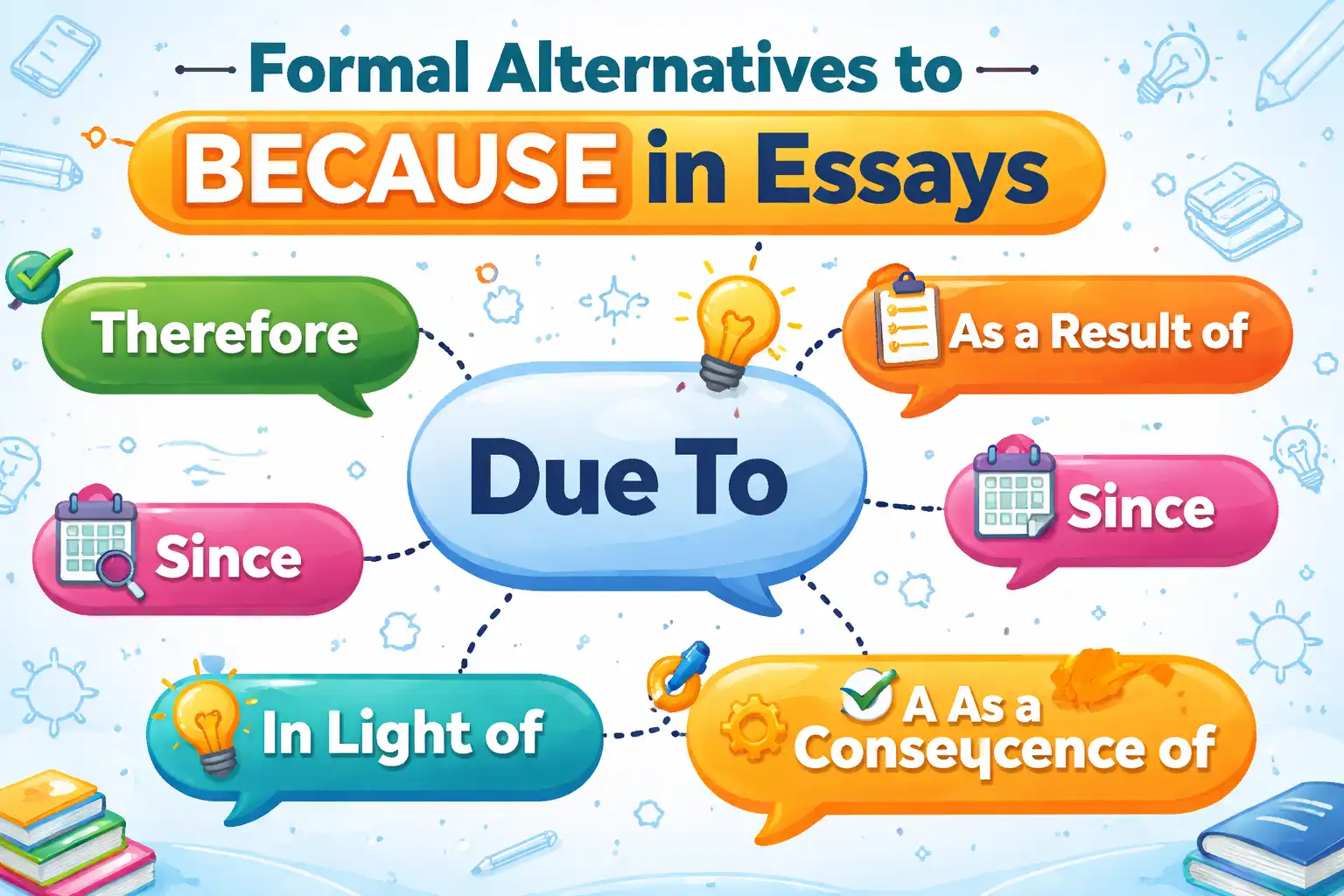
The best formal alternatives to “because” in essays include “since,” “as,” “due to,” “owing to,” and “because of.” These phrases express cause more formally and improve academic tone.
Examples:
- The event was canceled due to bad weather.
- Since the data was incomplete, results were unreliable.
- The project failed owing to poor planning.
What Does “Because” Mean?
“Because” is a conjunction used to explain reason or cause. It connects two ideas where one explains why the other happens.
In everyday English, “because” is perfectly acceptable. However, in academic writing, relying only on “because” can make your work sound basic.
According to academic writing conventions, especially in IELTS and university essays, using a variety of cause-and-effect connectors demonstrates higher language proficiency and lexical resource.
Complete Synonyms List
Here are formal alternatives to because in essays you should know:
- Since
- As
- Due to
- Because of
- Owing to
- On account of
- In view of
- Given that
- Seeing that (semi-formal)
- As a result of
- Thanks to (positive tone)
👉 In our experience helping writers, students who use at least 3–4 different connectors in one essay often score higher in lexical variety.
Comparison Table
| Word/Phrase | Simple Meaning | Best Used When | Avoid When |
| Because | Gives reason | Informal writing | Academic essays (overuse) |
| Since | Because | Formal tone | Time meaning confusion |
| As | Because | Smooth flow | Ambiguous sentences |
| Due to | Caused by | Noun phrases | With full clauses |
| Owing to | Because of | Formal essays | Casual writing |
| Because of | Reason for | Everyday + formal | Overuse |
| Given that | Considering | Arguments | Simple sentences |
| As a result of | Result of | Emphasis on outcome | Short writing |
Formal vs Informal Synonyms
| Formal Alternatives | Informal Alternatives |
| Due to | Because |
| Owing to | Since |
| On account of | As |
| In view of | Cause |
| Given that | Seeing that |
👉 IELTS Tip:
Using formal alternatives like “due to” and “owing to” can help boost your Lexical Resource score, especially in Writing Task 2.
Real Example Sentences
Here are practical examples you can use in essays:
- The experiment failed due to insufficient data.
- Since the policy was unclear, many employees were confused.
- The match was postponed owing to heavy rain.
- Students performed better as they had more preparation time.
- The company suffered losses because of poor management.
- Given that the deadline was tight, the team worked overtime.
- The results improved as a result of new strategies.
- The decision was made in view of recent developments.
👉 Writers we work with often improve clarity simply by switching “because” to “due to” in formal reports.
When to Use vs When NOT to Use
✅ When to Use Formal Alternatives
Use them when:
- Writing academic essays
- Preparing IELTS or TOEFL responses
- Creating research papers
- Aiming for higher vocabulary scores
❌ When NOT to Use
Avoid formal alternatives when:
- Writing casual emails
- Speaking informally
- Clarity becomes confusing
- Sentence structure does not match (e.g., “due to” needs a noun phrase)
Example mistake:
❌ Due to he was late
✔ Due to his lateness
Common Mistakes Writers Make
1. Mixing Grammar Structures
- ❌ Due to he was sick
- ✔ Due to his illness
2. Overusing One Alternative
Using “due to” repeatedly defeats the purpose of variety.
3. Confusing “Since” (time vs reason)
- Ambiguous: Since he arrived late… (time or reason?)
4. Using Informal Phrases in Academic Writing
Avoid “seeing that” in formal essays.
5. Incorrect Sentence Position
Some phrases fit better at the beginning of sentences.
👉 In our teaching experience, this is one of the top errors among IELTS Band 6 writers.
Tips and Best Practices
1. Match Structure Carefully
- Use “due to” + noun
- Use “since/as” + clause
2. Vary Your Language
Don’t repeat the same connector.
3. Keep Clarity First
Formal words should not confuse your reader.
4. Practice Rewriting Sentences
Take a simple sentence and rewrite it 3 ways.
Example:
- Because it rained, the game stopped
- Due to rain, the game stopped
- The game stopped as it rained
5. Use Formal Tone Consistently
Don’t mix casual and academic language.
👉 IELTS Tip:
Band 8 writers show flexible use of linking devices without overusing them.
Frequently Asked Questions
Q1: What is the best formal alternative to because in essays?
A: The best options are “due to,” “since,” and “as.” These are widely accepted in academic writing. “Due to” is especially strong in formal contexts, while “since” and “as” work well in flowing sentences. Choose based on sentence structure.
Q2: Can I use “since” instead of “because” in essays?
A: Yes, “since” is a good formal alternative. However, be careful because it can also refer to time. Make sure your meaning is clear to avoid confusion in academic writing.
Q3: Is “due to” more formal than “because”?
A: Yes, “due to” is considered more formal and is preferred in academic writing. It also improves sentence variety, which is important for higher IELTS or academic scores.
Q4: What is the difference between “because of” and “due to”?
A: Both express cause, but “due to” is slightly more formal. Grammatically, both are followed by noun phrases, not full clauses. The difference is subtle, and they are often interchangeable in essays.
Q5: Can I use “as” in formal writing?
A: Yes, “as” is acceptable in formal writing. However, it can sometimes be unclear, especially in complex sentences. Use it carefully to ensure your meaning is precise.
Q6: How many alternatives to “because” should I use in one essay?
A: Aim to use at least 3–4 different alternatives naturally. This shows vocabulary range without overcomplicating your writing. Avoid forcing variety if it reduces clarity.
Q7: Is “owing to” too formal for IELTS essays?
A: No, “owing to” is perfectly acceptable in IELTS essays. It adds a formal tone and demonstrates advanced vocabulary, which can help improve your score.
Q8: Why is replacing “because” important in essays?
A: Replacing “because” improves your lexical variety, which is a key scoring factor in academic writing. It also makes your writing sound more professional and less repetitive.
Conclusion
Using a formal alternative to because in essays is one of the easiest ways to improve your academic writing. Words like “due to,” “since,” and “owing to” add variety, clarity, and professionalism. The key is to choose the right phrase based on structure and context.
In our experience, small vocabulary upgrades like this can significantly boost your IELTS writing score. Practice regularly and focus on clarity first.
You might also want to read our guide on linking words for essays to strengthen your writing even further. Keep practising—you’re closer to advanced writing than you think.

Andrew Collins is an academic English educator with over 12 years of experience helping university students, IELTS candidates, and ESL learners improve their writing vocabulary.