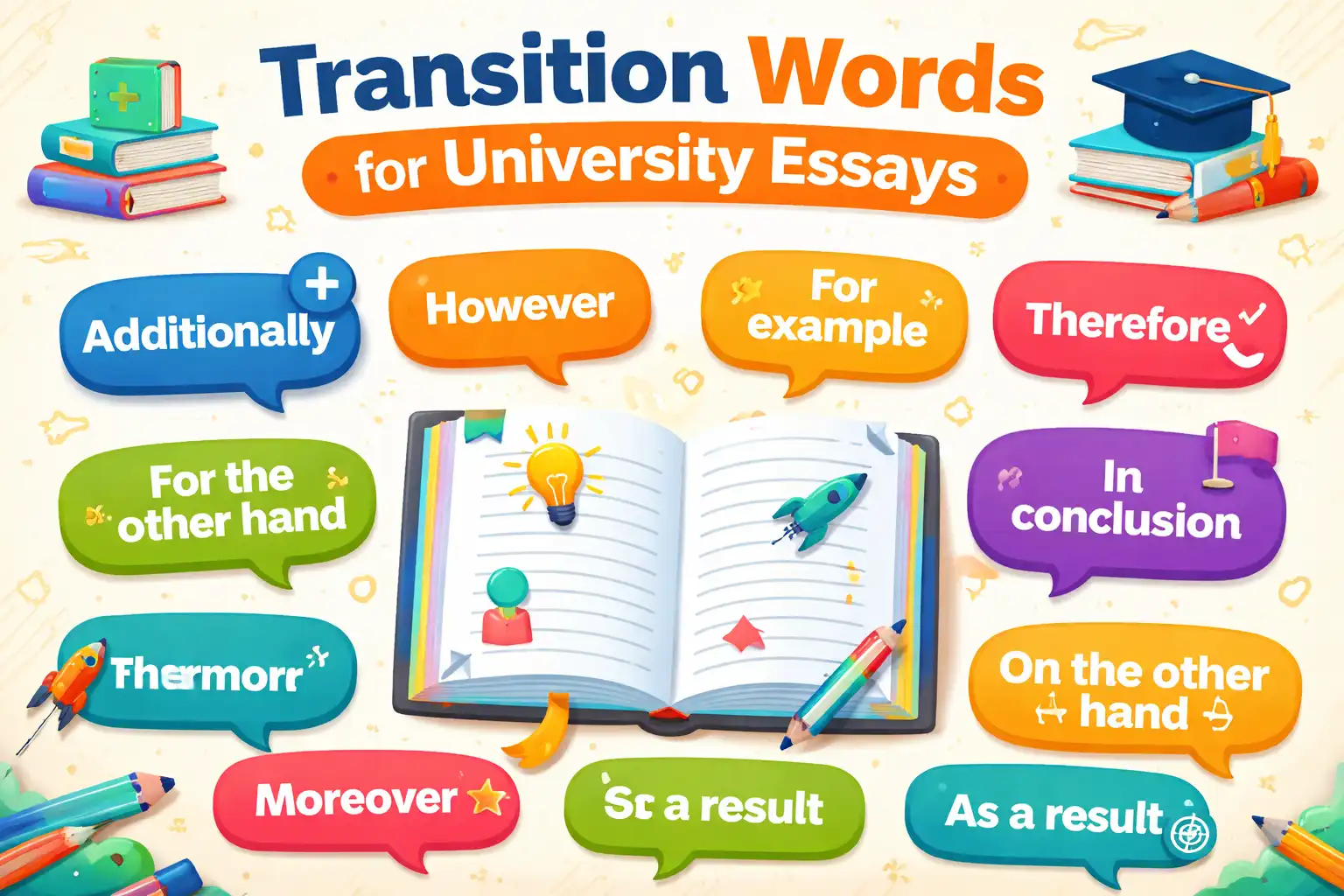
Have you ever read an academic paper that felt like a bumpy car ride? One moment you are on a smooth highway, and the next, you crash into a wall. This happens when sentences do not connect well. To fix this, we use special linking tools. These tools are transition words for university essays. They are words that act like bridges between your thoughts. They show how one sentence relates to the next.
Learning about transition words for university essays is very useful. Students get higher marks on their papers. Bloggers and content writers can keep readers on their websites longer. Even daily English users can speak and write with more confidence. Let us look at fifty great words to make your writing smooth and easy to read!
1. Therefore
Meaning: To show that one thing happens because of another thing.
Examples:
- The library was closed early today. Therefore, we had to study at home.
- She worked hard all semester. Therefore, she earned a great grade.
2. However
Meaning: To show a different or surprising side of an idea.
Examples:
- He studied all night for the test. However, he still felt very nervous.
- The sun was shining brightly. However, the wind was very cold.
3. Furthermore
Meaning: To add more helpful information to what you just said.
Examples:
- Eating apples is good for your teeth. Furthermore, they give you energy.
- The team won the championship game. Furthermore, they broke a school record.
4. Consequently
Meaning: To show the direct result of an action.
Examples:
- The school bus broke down. Consequently, many students arrived late.
- I forgot my warm jacket. Consequently, I caught a cold in the rain.
5. Moreover
Meaning: To introduce an extra point that supports your main idea.
Examples:
- Reading books helps you learn new words. Moreover, it relaxes your mind.
- The new park is beautiful. Moreover, it is very close to our house.
6. Additionally
Meaning: To give one more fact or point to your list.
Examples:
- We need to buy fresh milk. Additionally, we must get some bread.
- She plays the piano very well. Additionally, she sings in the choir.
7. Thus
Meaning: To explain how something leads to a logical result.
Examples:
- He lost his wallet on the train. Thus, he could not buy lunch.
- The snow fell for twelve hours. Thus, the roads were too icy to drive.
8. Hence
Meaning: To show the reason for a current situation.
Examples:
- The engine is making a loud noise. Hence, we must fix it today.
- She grew up in Paris. Hence, she speaks French perfectly.
9. Instead
Meaning: To choose one thing in place of another thing.
Examples:
- Do not drink sweet soda. Instead, choose a cold glass of water.
- We did not go to the cinema. Instead, we played a fun game at home.
10. Conversely
Meaning: To show the exact opposite of a statement.
Examples:
- Some people love hot summer days. Conversely, others prefer cold winters.
- Fast cars can be very dangerous. Conversely, slow travel is much safer.
11. Alternatively
Meaning: To suggest another option or choice.
Examples:
- You can write your essay tonight. Alternatively, you can do it tomorrow morning.
- We could walk to the museum. Alternatively, we could take the bus.
12. Nonetheless
Meaning: To say that something is true even though there is a problem.
Examples:
- The hike was very long and tiring. Nonetheless, we enjoyed the beautiful view.
- She was quite tired. Nonetheless, she finished her chores.
13. Nevertheless
Meaning: To show contrast, similar to saying “all the same.”
Examples:
- The math problem was very hard. Nevertheless, the boy solved it quickly.
- It started to rain during our picnic. Nevertheless, we stayed outside.
14. Similarly
Meaning: To show that two things are alike.
Examples:
- Cats love to sleep in warm spots. Similarly, dogs like cozy beds.
- Exercise makes your body strong. Similarly, reading keeps your brain sharp.
15. Likewise
Meaning: To say that something is done in the same way.
Examples:
- My brother loves to paint pictures. Likewise, my sister enjoys drawing.
- Teachers must arrive on time. Likewise, students must be in their seats.
16. Specifically
Meaning: To talk about one exact thing in a clear way.
Examples:
- We need to buy fresh fruit. Specifically, we need sweet red apples.
- She enjoys reading old stories. Specifically, she loves tales about castles.
17. Especially
Meaning: To point out something that is more important than others.
Examples:
- The air is very cold today, especially near the lake.
- I love eating fresh vegetables, especially green sweet peas.
18. Notably
Meaning: To highlight an important example that people should notice.
Examples:
- Many wild animals live in this forest, notably brown bears.
- She won several awards, notably the first prize in science.
19. Significantly
Meaning: To show that a change or point is large and important.
Examples:
- The temperature dropped significantly after the sun went down.
- Your writing will improve significantly if you practice every day.
20. Particularly
Meaning: To focus on one special member of a group.
Examples:
- He likes outdoor sports, particularly soccer and running.
- The test was very difficult, particularly the last three questions.
21. Indeed
Meaning: To agree with a statement or make it stronger.
Examples:
- The hot soup tasted very good indeed on a cold day.
- It was indeed a wonderful surprise to see my old friend.
22. Actually
Meaning: To tell the truth about a situation, sometimes surprising.
Examples:
- I thought the test was tomorrow, but it is actually today.
- He looks very quiet, but he is actually very funny.
23. Granted
Meaning: To admit that something is true before making another point.
Examples:
- Granted, the car is old, but it still runs very well.
- Granted, she is young, but she is highly skilled at chess.
24. Admittedly
Meaning: To accept a fact that might go against your argument.
Examples:
- Admittedly, the movie was quite long, but the ending was great.
- Admittedly, I made a mistake on the first page of my essay.
25. Ultimately
Meaning: To show what happens at the very end of a process.
Examples:
- You can ask for advice, but ultimately the choice is yours.
- The team struggled at first, but ultimately they won the gold medal.
26. Basically
Meaning: To explain something in the most simple way.
Examples:
- The game is basically a race to the finish line.
- He basically told us that the project was done.
27. Essentially
Meaning: To describe the core or most important part of something.
Examples:
- Good health is essentially about eating well and moving your body.
- The two plans are essentially the same.
28. Meanwhile
Meaning: To talk about something happening at the same time as another event.
Examples:
- My mom cooked dinner. Meanwhile, my dad set the wooden table.
- The boys played soccer. Meanwhile, the girls painted a picture.
29. Subsequently
Meaning: To say that something happened after a specific event.
Examples:
- He finished his college degree and subsequently found a great job.
- The dry wood caught fire, and the cabin was subsequently destroyed.
30. Previously
Meaning: To talk about something that happened before now.
Examples:
- She now lives in London, but previously she lived in Paris.
- The building is a museum, but previously it was a school.
31. Simultaneously
Meaning: To show that two actions happen at the exact same moment.
Examples:
- The lightning flashed and the thunder boomed simultaneously.
- She can sing and play the guitar simultaneously.
32. Primarily
Meaning: To show the main reason or purpose of something.
Examples:
- The club is primarily for kids who love science.
- We eat food primarily to get energy and stay strong.
33. Chiefly
Meaning: To talk about the most important part of a group.
Examples:
- The book is chiefly about the history of trains.
- We love camping, chiefly because we enjoy being in nature.
34. Overall
Meaning: To look at the whole situation instead of small details.
Examples:
- The food was late, but overall it was a good dinner.
- She made a few mistakes, but her overall grade was high.
35. Briefly
Meaning: To say something using only a few quick words.
Examples:
- Let me briefly explain how this machine works.
- We stopped briefly at the store to buy fresh milk.
36. Accordingly
Meaning: To do something in a way that fits the situation.
Examples:
- The weather forecast predicted heavy rain, so we dressed accordingly.
- He knew the rules of the house and acted accordingly.
37. Besides
Meaning: To add an extra reason or point to your argument.
Examples:
- I do not want to go to the park, and besides, it is raining.
- She speaks Spanish, and besides, she knows a bit of Italian.
38. Otherwise
Meaning: To show what will happen if you do not do something.
Examples:
- You must study hard, otherwise you might fail the test.
- Put on your coat, otherwise you will feel very cold.
39. Whereas
Meaning: To compare two things and show how they are different.
Examples:
- He loves to read books, whereas his brother loves video games.
- My boots are very heavy, whereas my running shoes are light.
40. Regardless
Meaning: To say that something will happen no matter what else exists.
Examples:
- The game will go on regardless of the cold rain.
- He decided to climb the mountain regardless of the danger.
41. Rather
Meaning: To choose or prefer one thing instead of another.
Examples:
- I would rather drink tea than have cold soda.
- She did not walk to school, but rather rode her bike.
42. Surely
Meaning: To say that you are very sure about something.
Examples:
- Surely you know the answer to this easy question.
- If we leave right now, surely we will arrive on time.
43. Truly
Meaning: To say that something is completely honest and real.
Examples:
- It was truly a beautiful day to spend outside.
- He is truly a kind person who loves to help others.
44. Clearly
Meaning: To point out something that is easy for anyone to see.
Examples:
- The path is clearly marked with bright red signs.
- He clearly worked very hard on his science project.
45. Naturally
Meaning: To say that something happens in a normal or expected way.
Examples:
- Naturally, we want to win the soccer game today.
- If you do not water the plant, naturally it will die.
46. Typically
Meaning: To describe what usually happens in a normal situation.
Examples:
- We typically eat dinner together at six o’clock.
- The weather is typically very hot during the month of July.
47. Generally
Meaning: To talk about what is true in most cases.
Examples:
- Children generally love to play outside in the sunshine.
- The train is generally on time, but today it is late.
48. Firstly
Meaning: To introduce the very first point in your list.
Examples:
- Firstly, we must wash our hands before we eat dinner.
- Firstly, I want to thank everyone for coming to my party.
49. Secondly
Meaning: To introduce the second point in your list.
Examples:
- Secondly, we need to gather all the dry wood for the fire.
- Secondly, you must add two cups of water to the pot.
50. Finally
Meaning: To introduce the very last point or end of a process.
Examples:
- Finally, we reached the top of the tall mountain.
- He worked all day and finally finished his long essay.
Conclusion
Using these transition words for university essays will make your writing shine. It helps you share your ideas in a clear and beautiful way. When your words flow well, people love to read what you write. We hope you will practice using these fifty words in your next university paper, daily work emails, and chats with friends. The more you use them, the easier your writing will become. Keep practicing, and watch your skills grow!

Andrew Collins is an academic English educator with over 12 years of experience helping university students, IELTS candidates, and ESL learners improve their writing vocabulary.