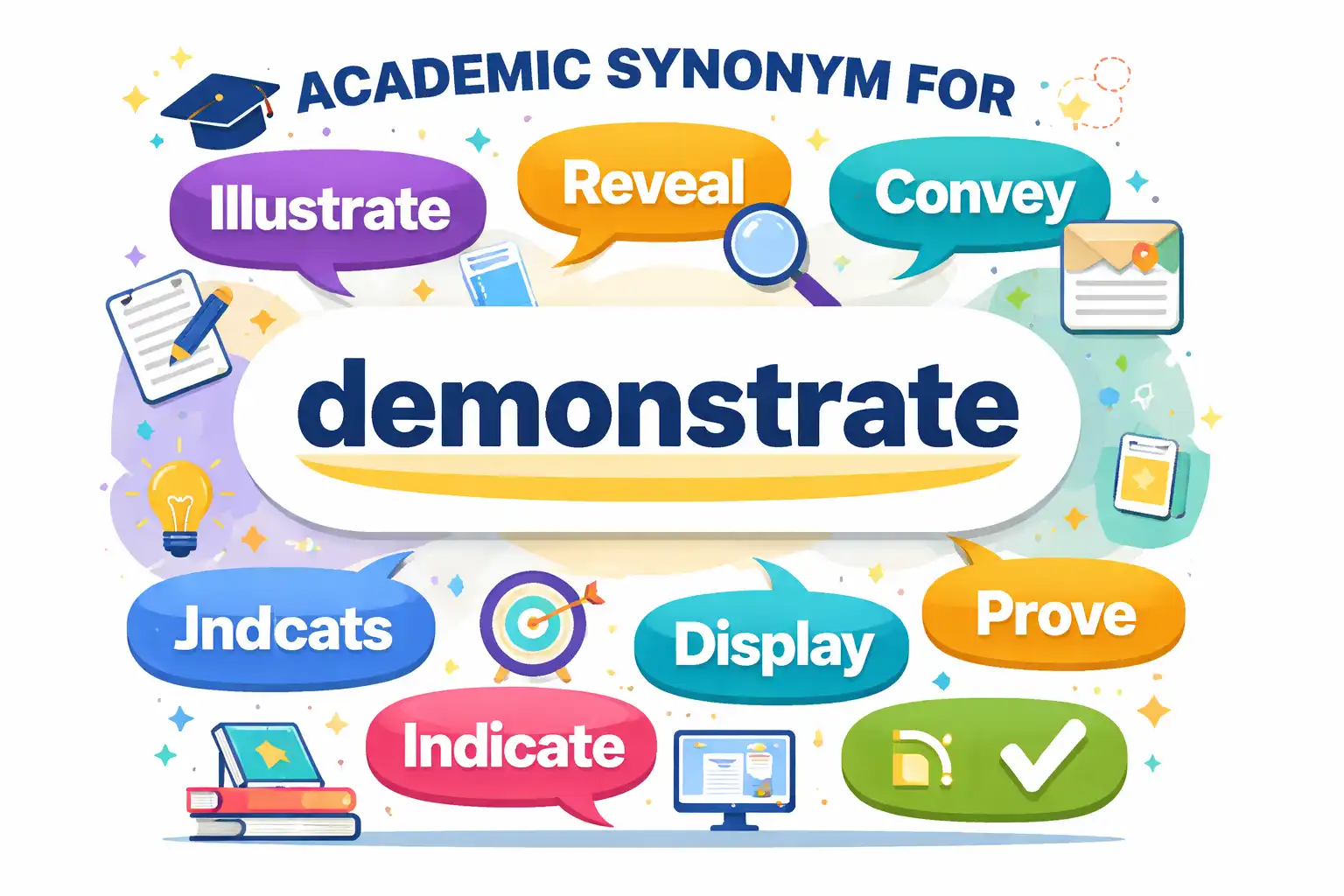
When you’re writing an essay, one of the most common problems is repeating simple words like “show.” It feels easy—but in academic writing, it can weaken your argument and reduce your clarity. If you’ve ever wondered what an academic synonym for show in essays is, you’re not alone. Many students struggle to replace everyday verbs with more formal alternatives.
In this guide, you’ll learn exactly how to upgrade your vocabulary with precise, academic expressions. You’ll discover not just a list of synonyms, but also when and how to use them correctly. As an academic English educator, I’ve helped thousands of students improve their IELTS and university essays by mastering these small but powerful word choices.
By the end, you’ll confidently replace “show” with stronger academic verbs that improve your tone, clarity, and overall score.
Quick Answer:
The best academic synonyms for “show” in essays are: demonstrate, illustrate, indicate, and reveal. These words sound more formal and precise in academic contexts. For example:
- “The data demonstrates a clear trend.”
- “This study indicates significant results.”
- “The graph illustrates the increase.”
What Does “Show” Mean?
In simple terms, “show” means to present, display, or make something clear. In everyday English, it works fine. But in academic writing, it often sounds too basic.
According to academic writing conventions, essays should use formal, precise verbs. Words like “show” lack specificity. They don’t explain how something is shown or what kind of evidence is used.
For example:
- Weak: The results show improvement.
- Strong: The results demonstrate improvement.
Why this matters: In IELTS Writing Task 2, using precise vocabulary can directly impact your Lexical Resource score. Examiners expect variety and accuracy.
Complete Synonyms List
Here are strong academic alternatives to “show” you can use in essays:
- Demonstrate
- Illustrate
- Indicate
- Reveal
- Present
- Highlight
- Exhibit
- Establish
- Confirm
- Display
- Suggest
- Outline
IELTS Tip:
Use “demonstrate” and “indicate” in Task 1 (graphs, charts), and “suggest” or “highlight” in Task 2 (arguments and opinions).
Comparison Table
| Word | Simple Meaning | Best Used When | Avoid When |
| Demonstrate | Prove clearly | Strong evidence or research | Opinion-based writing |
| Illustrate | Explain with examples | Describing data or examples | Abstract arguments |
| Indicate | Point out indirectly | Data trends or findings | Strong conclusions |
| Reveal | Make something known | New or surprising information | Neutral descriptions |
| Highlight | Emphasize importance | Key points in arguments | Formal research reports |
| Suggest | Imply or propose | Opinions or interpretations | Proven facts |
| Establish | Prove firmly | Academic research conclusions | Early-stage discussion |
| Exhibit | Display clearly | Visual or observable evidence | Abstract ideas |
Formal vs Informal Synonyms
| Informal Word | Formal Academic Alternative |
| Show | Demonstrate |
| Show | Illustrate |
| Show | Indicate |
| Show | Reveal |
| Show | Highlight |
Key Insight:
In academic writing, you should almost always replace “show” with a more formal synonym unless you’re writing very simple explanations.
Real Example Sentences
Here are practical examples you can copy and adapt:
- The results demonstrate a significant increase in productivity.
- This graph illustrates the growth of urban populations.
- The data indicates a strong correlation between diet and health.
- The findings reveal important insights into human behavior.
- The study highlights the importance of early education.
- These results suggest a need for further research.
- The experiment establishes a clear cause-and-effect relationship.
- The chart displays fluctuations in temperature over time.
In our experience helping writers, students who actively replace “show” with precise verbs improve both clarity and academic tone almost immediately.
When to Use vs When NOT to Use
When to Use Academic Synonyms
Use alternatives to “show” when:
- Writing academic essays
- Describing data or research
- Presenting arguments
- Writing IELTS Task 1 or Task 2
When NOT to Use Them
Avoid overusing formal synonyms when:
- Writing informal texts
- Explaining very simple ideas
- You are unsure of the exact meaning
For example:
- Incorrect: The picture demonstrates a cat.
- Correct: The picture shows a cat.
Why? Academic synonyms require the right context. Misuse can reduce clarity.
Common Mistakes Writers Make
Here are frequent errors I see in student writing:
1. Using “Demonstrate” Without Evidence
- Incorrect: The essay demonstrates that exercise is good.
- Fix: Use “suggests” unless strong evidence is provided.
2. Overusing One Synonym
Repeating “demonstrate” too often can sound unnatural.
3. Using Formal Words Incorrectly
- Incorrect: The data suggests a proven fact.
- Fix: Use “confirms” or “establishes.”
4. Ignoring Context
Each synonym has a slightly different meaning. Choose carefully.
Tips and Best Practices
Here’s how you can master academic synonyms effectively:
1. Match the Word to the Evidence
- Strong evidence → demonstrate, establish
- Weak evidence → suggest, indicate
2. Use Variety
Avoid repeating the same word in one paragraph.
3. Practice with IELTS Tasks
Rewrite sample answers by replacing “show” with better verbs.
4. Read Academic Articles
Notice how researchers use precise verbs.
5. Keep It Natural
Don’t force complex words. Clarity comes first.
IELTS Tip:
Band 7+ essays often use a range of precise verbs instead of basic ones like “show.” This improves your lexical score.
Frequently Asked Questions
Q: What is the best academic synonym for “show”?
A: The best synonym depends on context, but “demonstrate,” “illustrate,” and “indicate” are the most widely used. “Demonstrate” works for strong evidence, while “indicate” suits trends or data patterns.
Q: Can I always replace “show” in essays?
A: No. While replacing “show” improves formality, you should only do so when the context matches the meaning. Some simple descriptions still require “show” for clarity.
Q: Which synonym is best for IELTS Writing Task 1?
A: “Illustrate” and “indicate” are ideal for describing graphs and charts. They sound natural and align with academic reporting style expected by examiners.
Q: Is “demonstrate” stronger than “show”?
A: Yes. “Demonstrate” implies clear proof or strong evidence. That’s why it is commonly used in research papers and high-level academic writing.
Q: What synonym should I use for opinions?
A: Use “suggest” when expressing opinions or interpretations. It sounds more balanced and academic than “show,” especially when evidence is not definitive.
Q: Why do examiners prefer academic synonyms?
A: According to IELTS band descriptors, lexical variety and precision are key scoring criteria. Using academic synonyms shows a higher level of language control and sophistication.
Q: Can using too many synonyms lower my score?
A: Yes. Overusing complex words or using them incorrectly can reduce clarity. Always prioritize accuracy over variety in your writing.
Q: How can I practice using these synonyms?
A: Rewrite your old essays and replace “show” with appropriate alternatives. This active practice helps you understand context and improves long-term vocabulary use.
Conclusion
Replacing “show” with a precise academic synonym can significantly improve your writing. Words like demonstrate, illustrate, indicate, and reveal help you sound more formal and accurate. The key is choosing the right word for the right context.
You’ve also learned when to use these synonyms—and when not to. That balance is what separates average writing from strong academic work.
You might also want to read our guide on academic synonym for “important.” Keep practising, and your vocabulary will grow naturally.

Andrew Collins is an academic English educator with over 12 years of experience helping university students, IELTS candidates, and ESL learners improve their writing vocabulary.