Do you often repeat the word “use” in your essays and feel your writing sounds too basic? You’re not alone. Many students struggle to find a formal synonym for use in academic writing, especially when aiming for higher IELTS or university-level standards. Repetition weakens your argument and lowers the perceived quality of your vocabulary.
In academic contexts, word choice matters. Examiners and professors expect precise, varied language. Simply replacing “use” with a stronger, more formal alternative can immediately improve clarity and tone.
In this guide, you’ll learn the best formal alternatives to “use,” when to apply them, and when to avoid them. I’ll also show you real examples, common mistakes, and practical tips based on my 12+ years teaching academic English. By the end, you’ll feel confident choosing the right word for any essay or report.
Quick Answer:
The best formal synonyms for “use” in academic writing include “utilize,” “employ,” “apply,” “implement,” and “adopt.”
Each word carries a slightly different meaning. For example, “utilize” suggests efficient use, while “implement” refers to putting a plan into action. Choosing the right synonym depends on context, tone, and purpose.
What Does “Use” Mean?
In simple terms, “use” means to take something and apply it for a purpose. However, in academic writing, this word is often considered too general or informal.
According to academic writing conventions, precise vocabulary improves clarity and demonstrates higher-level thinking. That’s why replacing “use” with a more specific synonym is essential for essays, research papers, and IELTS writing tasks.
Complete Synonyms List
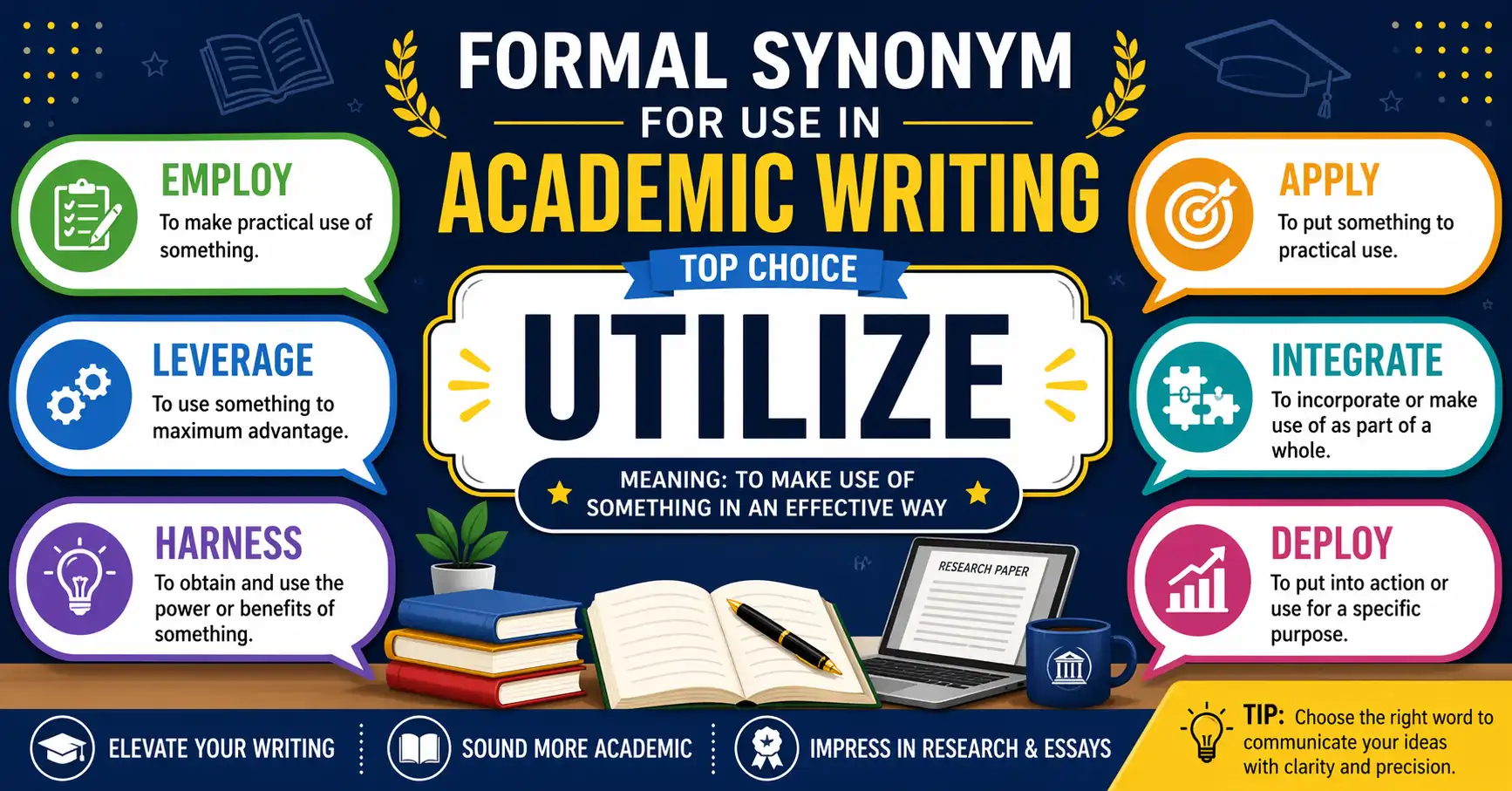
Here are strong formal synonyms for use in academic writing:
- Utilize
- Employ
- Apply
- Implement
- Adopt
- Execute
- Operate
- Administer
- Deploy
- Exploit (use carefully — see notes below)
- Leverage (formal but context-dependent)
IELTS Tip:
Using varied vocabulary like “implement” or “apply” can help you reach Band 7+ in Lexical Resource, according to IELTS scoring criteria.
Comparison Table
| Word | Simple Meaning | Best Used When | Avoid When |
| Utilize | Use efficiently | Tools, resources, systems | Simple everyday actions |
| Employ | Use for a purpose | Methods, strategies | Casual writing |
| Apply | Put into action | Theories, knowledge | Physical objects |
| Implement | Carry out a plan | Policies, systems | Small or simple actions |
| Adopt | Choose and start using | Ideas, approaches | Temporary use |
| Execute | Carry out precisely | Technical or formal tasks | Informal contexts |
| Deploy | Position for use | Technology, military, systems | General writing |
Formal vs Informal Synonyms
| Formal Word | Informal Alternative |
| Utilize | Use |
| Employ | Use |
| Implement | Put into action |
| Apply | Use |
| Adopt | Take up |
| Execute | Do |
Key Insight:
Formal words add clarity and professionalism. Informal words are easier but less precise.
Real Example Sentences
Here are practical examples you can model in your writing:
- The researcher utilized advanced software to analyze the data.
- This study employs a mixed-method approach.
- Students should apply theoretical knowledge in real-life situations.
- The government implemented new policies to reduce pollution.
- Many companies adopt sustainable practices.
- The system was deployed across multiple regions.
- Teachers administer assessments to evaluate progress.
- The experiment executed a controlled procedure.
IELTS Tip:
Instead of writing “This study uses data…”, write:
➡️ “This study employs data collected from…”
This small change boosts your academic tone instantly.
When to Use vs When NOT to Use
When to Use Formal Synonyms
Use them when:
- Writing essays, reports, or research papers
- Answering IELTS Writing Task 2
- Describing processes or methods
- Presenting arguments or analysis
When NOT to Use
Avoid overusing formal synonyms when:
- The sentence becomes unnatural
- The word doesn’t match the context
- Simpler language improves clarity
Example Mistake:
❌ “I utilized my phone to call my friend.”
✔️ “I used my phone to call my friend.”
Common Mistakes Writers Make
In our experience helping writers, these are the most frequent errors:
1. Overusing “Utilize”
Many students think “utilize” is always better than “use.” It’s not. It sounds unnatural in simple contexts.
2. Choosing the Wrong Synonym
For example:
❌ “The teacher implemented a pen.”
✔️ “The teacher used a pen.”
3. Ignoring Context
Each synonym has a specific function. Misusing them weakens clarity.
4. Replacing Every “Use”
Writers we work with often replace every instance of “use,” making writing sound forced.
Tips and Best Practices
Here’s how to improve your vocabulary effectively:
1. Match the Context
Ask yourself: Is this a method, tool, idea, or system?
2. Learn Collocations
Certain words naturally go together:
- “apply knowledge”
- “implement policy”
- “utilize resources”
3. Keep It Natural
Clarity is always more important than complexity.
4. Practice with Real Sentences
Rewrite your essays by replacing “use” with better alternatives.
5. Focus on IELTS Band Criteria
Higher bands require lexical variety and precision.
Frequently Asked Questions
Q1: What is the best formal synonym for “use” in essays?
A: The best synonym depends on context. “Utilize” works for resources, “apply” for knowledge, and “implement” for systems or policies. Choosing the correct word improves clarity and academic tone significantly.
Q2: Is “utilize” always better than “use”?
A: No. “Utilize” is more formal but should only be used when efficiency or resource use is implied. In simple contexts, “use” is clearer and more natural.
Q3: Which synonym should I use in IELTS writing?
A: Words like “apply,” “employ,” and “implement” are ideal. They match academic tone and help improve your lexical resource score when used correctly and naturally.
Q4: Can I replace every “use” in my essay?
A: No. Over-replacing makes writing unnatural. Keep “use” where appropriate and only substitute when a more precise word adds clarity or formality.
Q5: What is the difference between “apply” and “implement”?
A: “Apply” refers to using knowledge or theory, while “implement” refers to putting a plan or system into action. The distinction is important in academic writing.
Q6: Are formal synonyms necessary for academic writing?
A: Yes. Academic writing requires precision and variety. Using appropriate formal synonyms improves readability, demonstrates vocabulary range, and aligns with university and IELTS standards.
Conclusion
Choosing the right formal synonym for use in academic writing can transform your essays. Words like “apply,” “employ,” and “implement” add precision and professionalism when used correctly. The key is understanding context—not just replacing words blindly.
In our experience, students who focus on accuracy rather than complexity improve faster and score higher. Keep your writing clear, natural, and purposeful.
You might also want to read our guide on “formal synonym for make” to further strengthen your academic vocabulary.
Keep practicing—you’re closer to advanced writing than you think.

Andrew Collins is an academic English educator with over 12 years of experience helping university students, IELTS candidates, and ESL learners improve their writing vocabulary.