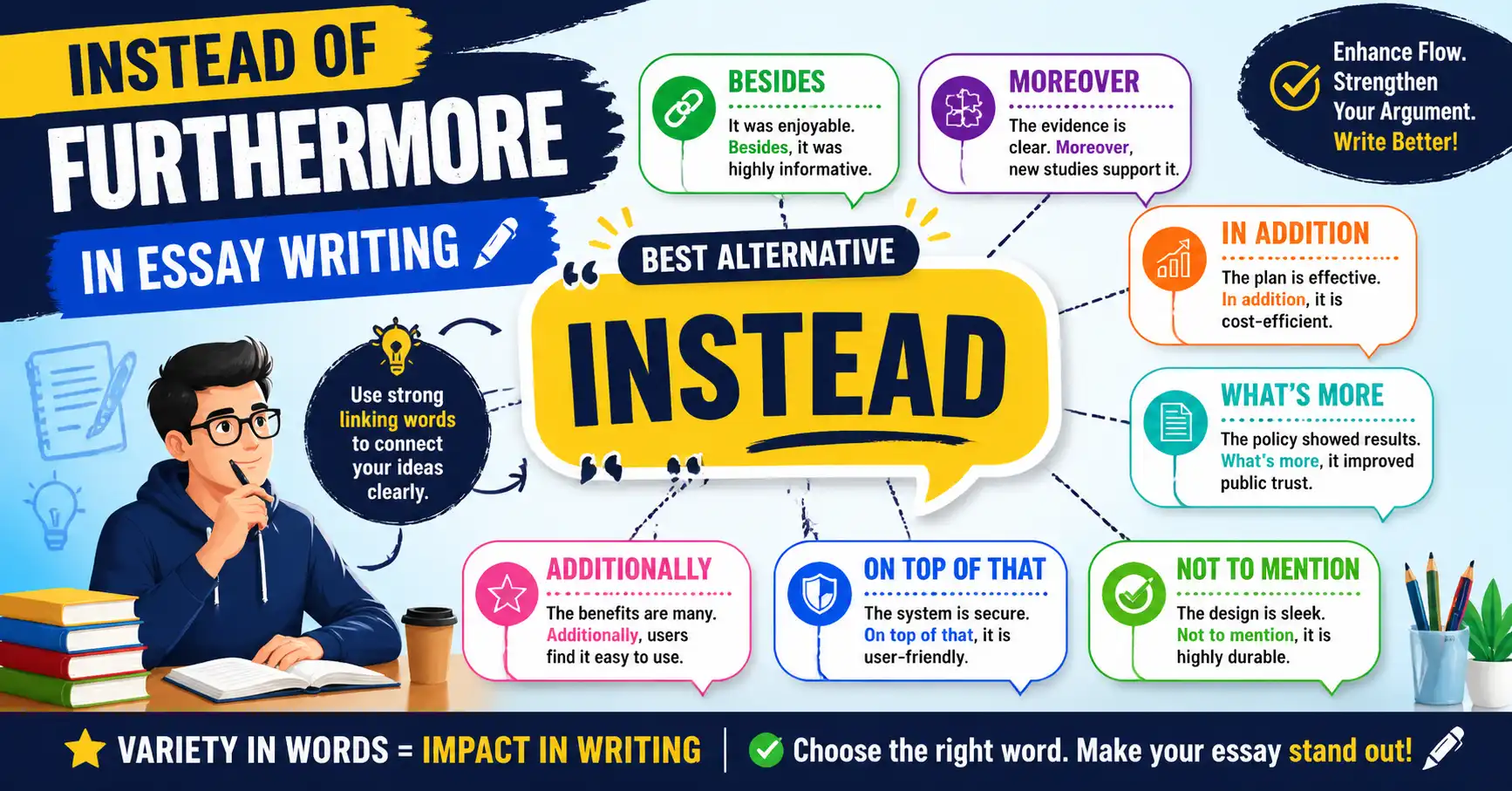
Have you ever written a paper and noticed you keep using the same transition words? Imagine reading a paper that uses the word “furthermore” in every single paragraph. It gets very boring to read! For example, a student might write: “The library is quiet. Furthermore, it has many great books.” Using a fresh word instead of furthermore in essay writing makes your work much more exciting.
The phrase “instead of furthermore in essay writing” means finding new ways to say “also” or “in addition.” Learning these new words is highly useful for students, bloggers, content writers, and daily English users. It helps make your sentences flow smoothly and keeps your readers happy. By using different terms instead of furthermore in essay writing, you can easily boost your grades and write better today.
Moreover
Meaning:
- This word means you want to add more facts to what you just said.
Examples:
- The house is very big. Moreover, it is close to my school.
- I do not want to go out tonight. Moreover, it is starting to rain.
Additionally
Meaning:
- You use this word to bring in one more extra detail.
Examples:
- We will paint the walls blue. Additionally, we will get a new rug.
- She speaks perfect Spanish. Additionally, she is learning French.
In addition
Meaning:
- This phrase shows you are putting another fact into your sentence.
Examples:
- The park has a nice playground. In addition, it has a clean lake.
- I need to buy some milk. In addition, I need to get some bread.
Also
Meaning:
- This is a very short word used to add another thing.
Examples:
- He likes to play video games. He also likes to read books.
- We went to the zoo. We also saw some huge elephants.
Besides
Meaning:
- This word means there is another reason or fact to think about.
Examples:
- I do not want to eat pizza. Besides, we had it yesterday.
- The path is too muddy. Besides, it is getting very dark.
Further
Meaning:
- You use this word to take your point a step ahead.
Examples:
- I want to say that we worked hard. Further, we finished on time.
- The company needs to save money. Further, we must work faster.
Plus
Meaning:
- This word acts like a plus sign to add more information.
Examples:
- The hotel room has a great view. Plus, the breakfast is free.
- I love this new coat because it is warm. Plus, it fits me well.
What’s more
Meaning:
- This phrase highlights an extra point that is even more interesting.
Examples:
- The test was very easy. What’s more, I got a perfect score.
- He bought a beautiful new car. What’s more, it runs on electricity.
On top of that
Meaning:
- This phrase means you are adding something else to a pile of facts.
Examples:
- My bike got a flat tire today. On top of that, I lost my keys.
- She won the big race. On top of that, she broke the school record.
As well
Meaning:
- This phrase means the same as “also” and goes at the end.
Examples:
- I brought some fresh fruit. I brought some sweet cookies as well.
- She can play the piano. She can sing very well as well.
Too
Meaning:
- This is a tiny word that means “also” at the end of a sentence.
Examples:
- My brother wants to play soccer. I want to play soccer too.
- The red shirt is pretty. I like the blue shirt too.
Likewise
Meaning:
- This word means you are adding something that is very similar.
Examples:
- My mom loves to cook. Likewise, my dad loves to bake bread.
- The first book was great. Likewise, the second book was amazing.
Similarly
Meaning:
- You use this word to add a point that matches the last one.
Examples:
- High school students need more sleep. Similarly, middle school kids need rest.
- The dogs love the new food. Similarly, the cats enjoy it.
Along with that
Meaning:
- This phrase means you are adding something to what is already there.
Examples:
- We need to clean the kitchen. Along with that, we must sweep the floor.
- The phone has a great camera. Along with that, it has a long battery life.
In the same way
Meaning:
- This phrase adds a new point that works just like the first one.
Examples:
- Eating vegetables keeps you healthy. In the same way, drinking water helps.
- Plants need sunlight to grow. In the same way, they need water.
Not to mention
Meaning:
- You use this to add a fact that is very obvious and strong.
Examples:
- The hotel was dirty. Not to mention, the staff was very rude.
- He is a great singer. Not to mention, he plays the guitar.
By the same token
Meaning:
- This phrase means you are making a similar point for the same reason.
Examples:
- If you work hard, you will win. By the same token, if you lazy, you will lose.
- Good food keeps you strong. By the same token, bad food makes you tired.
Over and above that
Meaning:
- This phrase means something is added beyond what you already have.
Examples:
- They gave us a free lunch. Over and above that, they paid for our ride.
- We got a big bonus today. Over and above that, we got a day off.
To boot
Meaning:
- This is a fun, short way to say “in addition.”
Examples:
- She is smart and funny. She is very kind to boot.
- The cake was huge and delicious. It was very cheap to boot.
Into the bargain
Meaning:
- This phrase means you got something extra that you did not expect.
Examples:
- He bought the computer and got a free mouse into the bargain.
- She got the job and a bigger office into the bargain.
Beside that
Meaning:
- This phrase means there is one more point to look at.
Examples:
- The car is too old. Beside that, it uses too much gas.
- I do not like the color. Beside that, the size is too small.
In addition to this
Meaning:
- This phrase introduces another fact to back up your first point.
Examples:
- The school has a big gym. In addition to this, it has a pool.
- We must study for math. In addition to this, we have history homework.
Apart from that
Meaning:
- This phrase means you are adding a new point besides the other.
Examples:
- The dinner was very tasty. Apart from that, the music was great.
- I finished my homework. Apart from that, I cleaned my room.
Aside from this
Meaning:
- You use this to add one more fact to your main topic.
Examples:
- The room has two beds. Aside from this, it has a large desk.
- We have three dogs. Aside from this, we have a small bird.
Beyond that
Meaning:
- This phrase means there is more information after the current point.
Examples:
- We need to fix the roof. Beyond that, the walls need paint.
- She is a great leader. Beyond that, she is a loyal friend.
Beyond this
Meaning:
- This phrase means you have one more thing to say.
Examples:
- The team needs more practice. Beyond this, we need a new coach.
- I want to visit Spain. Beyond this, I want to see Italy.
To add to that
Meaning:
- You use this phrase when you want to pile on more details.
Examples:
- The weather is very cold. To add to that, it is very windy.
- I lost my favorite pen. To add to that, my notebook is gone.
Along the same lines
Meaning:
- This phrase adds a point that is very close to the last.
Examples:
- Teachers need to listen to kids. Along the same lines, parents must listen.
- We want to reduce waste. Along the same lines, we want to recycle.
On the same note
Meaning:
- This phrase adds a thought that fits the same happy or sad feeling.
Examples:
- I want to thank my teacher. On the same note, I thank my friends.
- The movie had great action. On the same note, the music was cool.
Equally important
Meaning:
- This phrase adds a new point that has the exact same value.
Examples:
- You must eat good food. Equally important, you must get enough sleep.
- We need to save water. Equally important, we must protect trees.
Further to this
Meaning:
- This phrase means you are adding details to what you just wrote.
Examples:
- We sent the first email. Further to this, we called the client.
- The team made a plan. Further to this, they started the work.
More than that
Meaning:
- This phrase adds a point that is even stronger than the first.
Examples:
- He is a fast runner. More than that, he never gives up.
- The class is fun. More than that, it teaches us how to think.
Still further
Meaning:
- This phrase is used to add another point that goes even deeper.
Examples:
- We must clean the yard. Still further, we must paint the fence.
- The company will hire more staff. Still further, we will expand the office.
To cap it all
Meaning:
- This phrase introduces the final, most exciting or worst piece of news.
Examples:
- My keys broke in the lock. To cap it all, the rain started to pour.
- We got a free dinner and, to cap it all, free dessert!
To crown it all
Meaning:
- This phrase adds a final point that makes everything perfect or complete.
Examples:
- The show was amazing, and to crown it all, we met the actors.
- He finished his degree, and to crown it all, he got a job.
Along with this
Meaning:
- This phrase joins two ideas together in a very simple way.
Examples:
- You need to bring a coat. Along with this, bring your boots.
- We will study the map. Along with this, we will use a compass.
Supplementary to this
Meaning:
- This phrase adds extra information to help explain something.
Examples:
- The book has many maps. Supplementary to this, it has many photos.
- We offer a main course. Supplementary to this, we have side dishes.
Then
Meaning:
- This short word means “next” or “also” in a list of actions.
Examples:
- First, we will wash the car. Then, we will wax it.
- We had a nice lunch. Then, we went for a long walk.
Next
Meaning:
- This word introduces the very next point in your writing.
Examples:
- We must talk about the budget. Next, we will discuss the schedule.
- First, you heat the oil. Next, you add the chopped onions.
Secondly
Meaning:
- This word introduces your second point in a very clear way.
Examples:
- Firstly, we need more time. Secondly, we need a bigger budget.
- First, the car is too old. Secondly, it is too small.
In tandem with this
Meaning:
- This phrase means two things are happening or being added together.
Examples:
- We will launch a new website. In tandem with this, we will start a sale.
- Kids must learn to read. In tandem with this, they must learn to write.
Coupled with this
Meaning:
- This phrase means two facts are joined to make a stronger point.
Examples:
- He has great skills. Coupled with this, he has a very positive attitude.
- The rent is very low. Coupled with this, the location is perfect.
Together with this
Meaning:
- This phrase brings two related ideas together into your sentence.
Examples:
- We must buy some paint. Together with this, we need new brushes.
- She enjoys playing tennis. Together with this, she loves to swim.
In like manner
Meaning:
- This phrase adds a point that matches the style of the first.
Examples:
- The leader worked with passion. In like manner, the team worked hard.
- Trees need care to grow. In like manner, flowers need love.
As an extra point
Meaning:
- This phrase clearly shows you are adding one more small thought.
Examples:
- The gym is very clean. As an extra point, it has great music.
- The hotel is near the shop. As an extra point, it has a pool.
On another note
Meaning:
- You use this phrase to add a different but related topic.
Examples:
- The project is almost done. On another note, the office is moving.
- We need to buy fresh fruit. On another note, did you walk the dog?
For good measure
Meaning:
- This phrase means you are adding something extra just to be safe.
Examples:
- He checked the lock twice. Then, he checked the windows for good measure.
- She added some salt. Then, she put in some pepper for good measure.
In addition to everything else
Meaning:
- This phrase adds a final point after listing many other things.
Examples:
- We lost our bags and missed our train. In addition to everything else, it rained.
- She won a medal and a trophy. In addition to everything else, she got a prize.
At the same time
Meaning:
- This phrase adds another fact that is true along with the first.
Examples:
- The job is very hard. At the same time, it pays very well.
- He is a very busy man. At the same time, he always makes time for family.
Correspondingly
Meaning:
- This word adds a point that changes in the same way as the first.
Examples:
- As the weather gets colder, people correspondingly wear thicker coats.
- When food prices go up, families correspondingly spend more money.
Why Learning Synonyms Improves Your Writing
Learning transition words to use instead of furthermore in essay writing makes your work shine. It improves your overall writing, blogging, speaking, and daily communication. When you avoid repeating the same words, your reader stays interested. We encourage you to practice using these fresh new words in your emails, school essays, and daily conversations. You will see how easy it is to make your English sound clear and highly professional!

Andrew Collins is an academic English educator with over 12 years of experience helping university students, IELTS candidates, and ESL learners improve their writing vocabulary.