
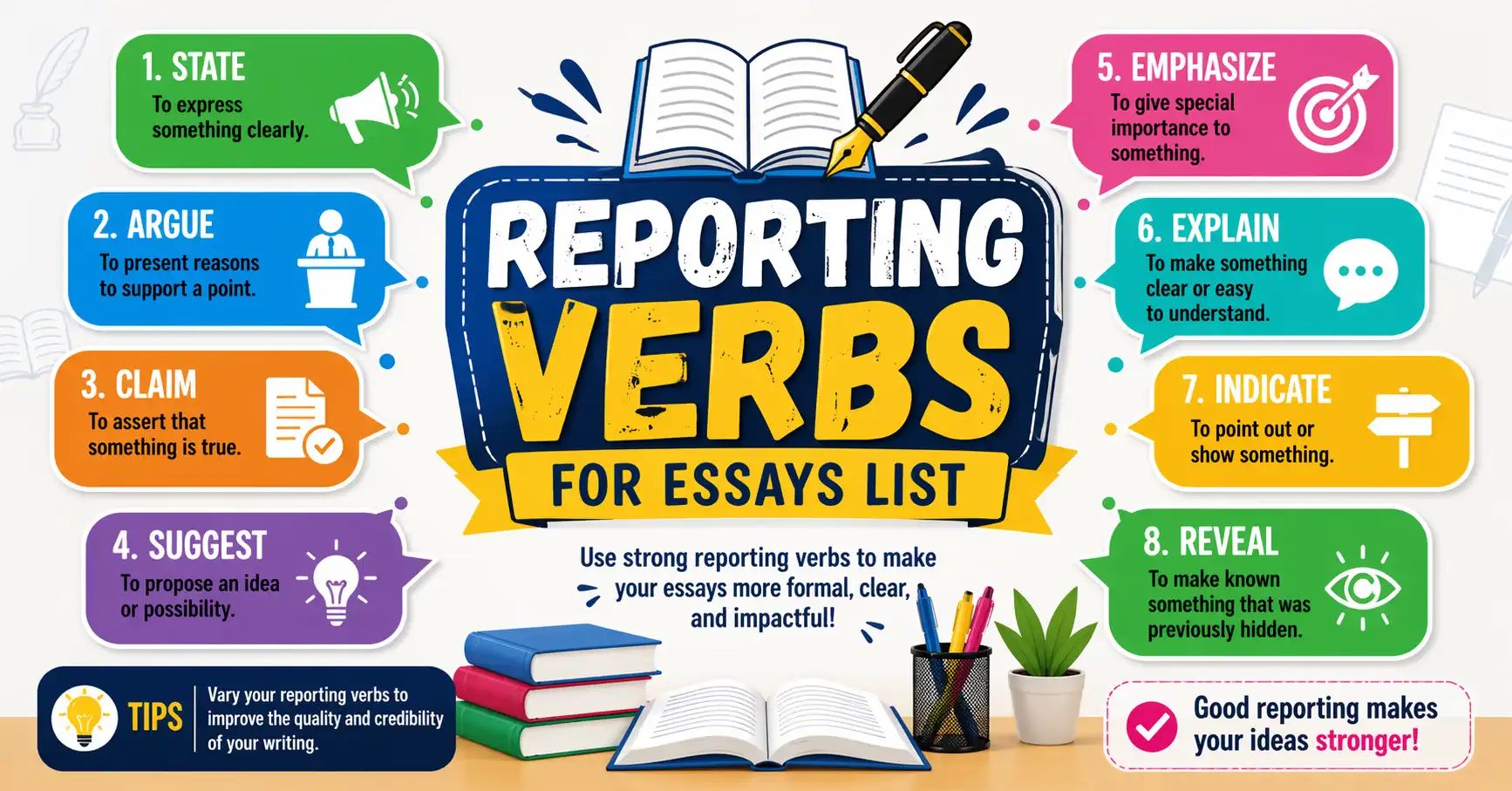
Do you struggle to vary your language when citing sources in essays? Many students repeat basic verbs like “say” or “tell,” which weakens academic writing and lowers clarity. If you’ve ever wondered how to sound more formal, precise, and confident, you’re in the right place.
This complete guide to a reporting verbs for essays list will help you upgrade your vocabulary and improve your academic writing instantly. You’ll learn not only which verbs to use, but when and why to use them—an essential skill for IELTS, university essays, and research writing.
As an academic English educator, I’ve seen how the right reporting verb can transform a weak paragraph into a strong, authoritative argument. In this article, you’ll get structured lists, comparison tables, real examples, and expert tips to help you use reporting verbs with confidence.
Quick Answer:
Reporting verbs for essays are verbs used to refer to what other authors say, think, or conclude. Common examples include argue, claim, suggest, state, emphasize, and demonstrate. Using a varied reporting verbs for essays list improves clarity, shows critical thinking, and helps you meet academic writing standards.
What Does “Reporting Verbs” Mean?
Reporting verbs are verbs used to describe or report someone else’s ideas, opinions, or research findings.
In academic writing, you rarely write only your own ideas. You refer to sources. That’s where reporting verbs matter.
Common functions:
- Presenting facts → state, report
- Showing opinion → argue, claim
- Indicating evidence → demonstrate, prove
- Expressing doubt → suggest, imply
According to academic writing conventions, using varied reporting verbs shows critical engagement, which is essential for higher IELTS band scores (Band 7+).
Complete Reporting Verbs for Essays List
Here is a carefully selected reporting verbs for essays list used in academic writing:
Common Academic Reporting Verbs:
- Argue
- Claim
- Suggest
- State
- Explain
- Describe
- Demonstrate
- Emphasize
- Highlight
- Indicate
- Propose
- Assert
- Conclude
- Observe
- Note
IELTS Tip:
Use stronger verbs like “argue” or “demonstrate” instead of weak ones like “say” to improve your Task 2 score.
Comparison Table: Reporting Verbs Explained
| Word | Simple Meaning | Best Used When | Avoid When |
| Argue | Give reasons for opinion | Presenting strong viewpoints | Neutral facts |
| Claim | Say something may be true | Discussing debatable ideas | Proven facts |
| Suggest | Indicate possibility | Offering cautious ideas | Strong conclusions |
| State | Say clearly | Presenting facts | Expressing opinion |
| Demonstrate | Show with evidence | Referring to research findings | Personal opinions |
| Explain | Make clear | Clarifying ideas | Strong arguments |
| Highlight | Emphasize importance | Drawing attention | Neutral reporting |
| Indicate | Point out | Suggesting trends or data | Strong claims |
| Assert | State firmly | Confident academic tone | Weak or uncertain ideas |
| Conclude | Summarize findings | Ending research discussion | Introducing ideas |
Formal vs Informal Reporting Verbs
| Formal Verbs | Informal Alternatives |
| Argue | Say |
| Demonstrate | Show |
| State | Tell |
| Suggest | Think |
| Claim | Say |
| Emphasize | Point out |
| Conclude | End with |
Key Insight:
Academic writing requires formal verbs. Avoid informal ones unless writing narratives.
Real Example Sentences
Here are practical examples using the reporting verbs for essays list:
- Smith argues that climate change requires urgent action.
- The study demonstrates a strong link between diet and health.
- Researchers suggest that sleep improves memory retention.
- The author claims that social media affects attention spans.
- Johnson emphasizes the importance of early education.
- The report states that unemployment has decreased.
- Brown concludes that policy changes are necessary.
- The data indicates a rise in global temperatures.
IELTS Tip:
Mix different verbs across your essay. Repetition reduces lexical resource scores.
When to Use vs When NOT to Use
When to Use Reporting Verbs
Use them when:
- Referring to research or studies
- Supporting your arguments
- Showing agreement or disagreement
- Summarizing sources
When NOT to Use Reporting Verbs
Avoid them when:
- Writing personal opinions without references
- Making simple statements
- Writing informal content
- Overloading sentences with multiple verbs
In our experience helping writers, overusing reporting verbs can make writing feel forced. Balance is key.
Common Mistakes Writers Make
1. Overusing “say”
Weak:
- The author says…
Better:
- The author argues, explains, or demonstrates
2. Using the Wrong Strength
Example mistake:
- “Smith suggests that the earth revolves around the sun.”
Correction:
- Use states or confirms for facts
3. Mixing Formal and Informal Tone
Wrong:
- The researcher says kids are tired
Correct:
- The researcher observes that children experience fatigue
4. Incorrect Grammar Patterns
Some verbs need specific structures:
- Argue + that clause
- Suggest + gerund or that clause
- Claim + that clause
Tips and Best Practices
1. Match Verb Strength to Evidence
Strong research → demonstrates
Weak idea → suggests
2. Use Variety Naturally
Don’t force synonyms. Use them where they fit meaning.
3. Learn Verb Patterns
Example:
- Suggest doing
- Argue that
4. Read Academic Sources
Notice how journal articles use reporting verbs.
5. Practice Rewriting Sentences
Replace “say” with better verbs daily.
IELTS Tip:
Examiners look for lexical range. A rich reporting verbs for essays list helps you score higher in vocabulary.
Frequently Asked Questions
Q1: What are reporting verbs in academic writing?
A: Reporting verbs are verbs used to describe what other writers or researchers say. They help present ideas, opinions, and evidence clearly. Examples include argue, suggest, claim, and demonstrate, which add precision and improve academic tone.
Q2: Why are reporting verbs important in essays?
A: They show your ability to engage with sources critically. Using varied reporting verbs improves clarity, avoids repetition, and meets academic standards. In IELTS writing, they contribute to a higher lexical resource score and overall coherence.
Q3: What is the difference between “argue” and “suggest”?
A: “Argue” shows a strong, confident opinion supported by evidence, while “suggest” expresses a weaker or more cautious idea. Choosing the correct verb helps reflect the strength of the original author’s claim accurately.
Q4: Can I use “say” in academic essays?
A: Yes, but it is not recommended frequently. Academic writing prefers more precise verbs like state, claim, or argue. Overusing “say” makes your writing repetitive and less formal, which can lower your score.
Q5: How can I learn reporting verbs quickly?
A: Practice using them in sentences, read academic articles, and focus on common verbs first. Creating your own reporting verbs for essays list and revising it regularly helps reinforce correct usage effectively.
Q6: Do reporting verbs affect IELTS writing scores?
A: Yes, significantly. IELTS band descriptors reward vocabulary range and precision. Using varied and accurate reporting verbs shows advanced language control, helping you achieve Band 7 or higher in writing tasks.
Conclusion
Mastering a strong reporting verbs for essays list is one of the fastest ways to improve your academic writing. These verbs help you present ideas clearly, show critical thinking, and meet formal writing standards.
Focus on choosing the right verb for the right context, avoid repetition, and practice regularly. Writers we work with often see noticeable improvement in clarity and scores within weeks.
You might also want to read our guide on academic linking words to further strengthen your essays.
Keep practicing—you’re closer to confident, high-level writing than you think.

Andrew Collins is an academic English educator with over 12 years of experience helping university students, IELTS candidates, and ESL learners improve their writing vocabulary.