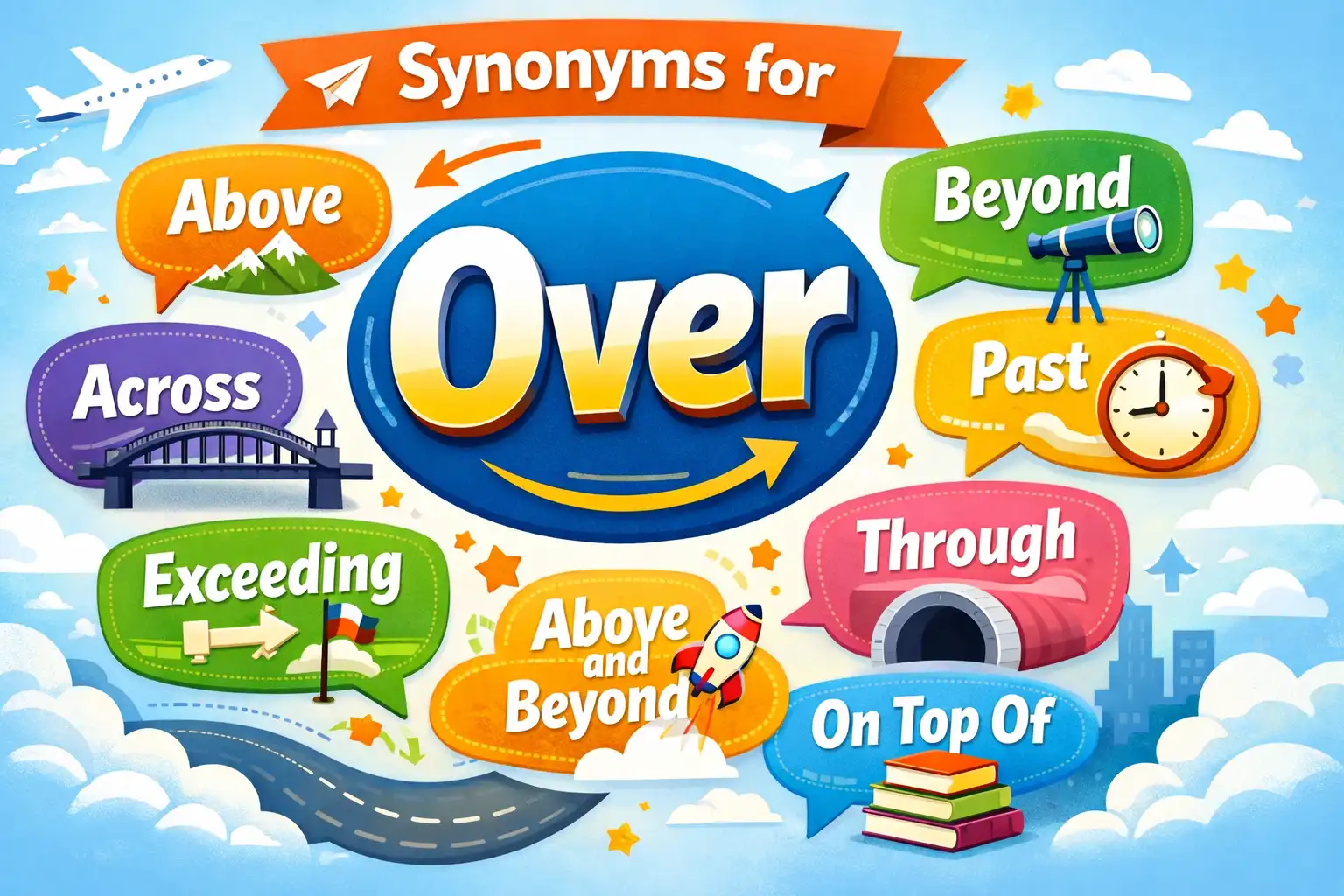
Finding the right synonyms for over can instantly make your writing sound more professional. When we talk about something being finished, completed, or positioned above, we often search for synonyms for over to avoid repeating the same word. Learning these synonyms for over helps you express different shades of meaning clearly.
Imagine sitting at your desk, trying to finish a big project. You write down that the meeting is over, the workday is over, and your energy is over. Reading that sentence back feels incredibly boring because the same tiny word keeps popping up. In simple English, “over” just means that something has reached its end, or that something is physically above another object.
Using fresh words makes your work sound natural and polished. Students need these terms to write high-scoring essays. Bloggers and content writers use them to keep readers sliding from one sentence to the next. Daily English users use them to tell stories clearly to their friends.
“Words are, of course, the most powerful drug used by mankind.” — Rudyard Kipling
“The limits of my language mean the limits of my world.” — Ludwig Wittgenstein
Linguistic Profile of “Over”
To truly understand how to use synonyms for over, let’s look at the linguistic makeup of the word itself.
- Connotative Meaning: “Over” has a highly functional, versatile, and neutral feeling. It can imply completion, physical height, or excess depending on how you use it.
- Etymology:
- Derived from the Old English word ofer (meaning above, beyond, or past).
- Cognate with the German word über and the Latin word super.
- Pronunciation: US:
/ˈoʊ.vɚ/| UK:/ˈəʊ.və/ - Syllables: o-ver ($2$ syllables)
- Affixation Pattern: Simple root word that can act as a preposition, adverb, adjective, or prefix.
Comparison of Core Synonyms
| Keyword | Meaning | Usage Type | Context |
|---|---|---|---|
| Over | Finished or physically higher than something else. | Neutral / Casual | Daily conversation, simple storytelling, and basic updates. |
| Finished | Having come to an end or being completely done. | Neutral / Casual | Household tasks, schoolwork, and casual projects. |
| Above | In a higher place or position than something else. | Neutral / Formal | Spatial descriptions, academic texts, and directions. |
| Terminated | Brought to an end in an official or abrupt way. | Professional / Formal | Legal agreements, employment contracts, and technical systems. |
| Beyond | Past a certain point, limit, or physical boundary. | Descriptive / Literary | Creative writing, travel logs, and deep discussions. |
50 Detailed Synonyms for Over
1. Finished
Pronunciation: US: /ˈfɪn.ɪʃt/ | UK: /ˈfɪn.ɪʃt/
Meaning: This means that an action or a project is completely done.
Examples:
- I am finally finished with my homework for the night.
- The painter finished the bedroom wall this morning.
2. Ended
Pronunciation: US: /ˈen.dɪd/ | UK: /ˈen.dɪd/
Meaning: This means that something has reached its final point.
Examples:
- The movie ended with a very happy surprise.
- Our long summer vacation ended last Monday.
3. Complete
Pronunciation: US: /kəmˈpliːt/ | UK: /kəmˈpliːt/
Meaning: This means having all the necessary parts with nothing missing.
Examples:
- My puzzle is complete now that I found the last piece.
- We need a complete list of your friends.
4. Done
Pronunciation: US: /dʌn/ | UK: /dʌn/
Meaning: This is a casual way to say that an activity is finished.
Examples:
- Are you done playing that fun video game yet?
- She is done cooking dinner for the family.
5. Terminated
Pronunciation: US: /ˈtɝː.mə.neɪ.t̬ɪd/ | UK: /ˈtɜː.mɪ.neɪ.tɪd/
Meaning: This means bringing something to an official or sudden end.
Examples:
- The company terminated the old contract last week.
- He terminated the phone call because he was busy.
6. Concluded
Pronunciation: US: /kənˈkluː.dɪd/ | UK: /kənˈkluː.dɪd/
Meaning: This means that a meeting or event has formally finished.
Examples:
- The president concluded his speech with a warm thank you.
- The trial concluded after three long days.
“Simplicity is the ultimate sophistication.” — Leonardo da Vinci
7. Above
Pronunciation: US: /əˈbʌv/ | UK: /əˈbʌv/
Meaning: This means physically higher than something else.
Examples:
- The birds flew high above the green trees.
- Please hang the picture frame above the sofa.
8. Beyond
Pronunciation: US: /biˈjɑːnd/ | UK: /biˈjɒnd/
Meaning: This means on the farther side of a place or limit.
Examples:
- The small house lies just beyond those hills.
- His math skills are far beyond his grade level.
9. Overhead
Pronunciation: US: /ˌoʊ.vɚˈhed/ | UK: /ˌəʊ.vəˈhed/
Meaning: This means directly above your head in the sky or ceiling.
Examples:
- A loud helicopter flew overhead this afternoon.
- The lights overhead are very bright.
10. Past
Pronunciation: US: /pæst/ | UK: /pɑːst/
Meaning: This means further than a specific place or point in time.
Examples:
- Walk past the post office and turn right.
- It is already past my normal bedtime.
11. Upward of
Pronunciation: US: /ˈʌp.wɚd ʌv/ | UK: /ˈʌp.wəd ɒv/
Meaning: This means more than a certain number or amount.
Examples:
- Upward of fifty people showed up to the party.
- The repair will cost upward of one hundred dollars.
12. More than
Pronunciation: US: /mɔːr ðæn/ | UK: /mɔː ðæn/
Meaning: This means a larger amount or number than something.
Examples:
- I have more than ten books in my backpack.
- She spent more than three hours at the park.
13. Exceeding
Pronunciation: US: /ɪkˈsiː.dɪŋ/ | UK: /ɪkˈsiː.dɪŋ/
Meaning: This means going past a limit or being greater than.
Examples:
- Drivers face fines for exceeding the speed limit.
- The party was a success, exceeding all my hopes.
14. Surplus
Pronunciation: US: /ˈsɝː.pləs/ | UK: /ˈsɜː.pləs/
Meaning: This describes an extra amount that is left over.
Examples:
- We gave our surplus food to the local shelter.
- The shop has a surplus of winter coats.
15. Excess
Pronunciation: US: /ɪkˈses/ | UK: /ɪkˈses/
Meaning: This means an amount that is more than what you need.
Examples:
- Please pour the excess water into the sink.
- You must pay for your excess baggage at the airport.
16. Higher than
Pronunciation: US: /ˈhaɪ.ɚ ðæn/ | UK: /ˈhaɪ.ə ðæn/
Meaning: This means located at a greater height or level.
Examples:
- The temperature today is higher than it was yesterday.
- He can jump much higher than his brother.
17. At an end
Pronunciation: US: /æt æn end/ | UK: /æt æn end/
Meaning: This means that a period of time is completely finished.
Examples:
- The cold winter is finally at an end.
- I am glad my long work shift is at an end.
18. Through
Pronunciation: US: /θruː/ | UK: /θruː/
Meaning: This means that you have finished doing an activity.
Examples:
- Let me know when you are through with the newspaper.
- She was through with her chores by noon.
19. Wrapped up
Pronunciation: US: /ræpt ʌp/ | UK: /ræpt ʌp/
Meaning: This is a casual phrase that means finished or settled.
Examples:
- We wrapped up the meeting fifteen minutes early.
- I want to get this science project wrapped up tonight.
20. Finalized
Pronunciation: US: /ˈfaɪ.nə.laɪzd/ | UK: /ˈfaɪ.nə.laɪzd/
Meaning: This means making a plan or agreement completely official.
Examples:
- We finalized our travel plans for the summer trip.
- The team finalized the design for the new website.
21. Completed
Pronunciation: US: /kəmˈpliː.t̬ɪd/ | UK: /kəmˈpliː.tɪd/
Meaning: This means finishing a task successfully.
Examples:
- She completed her college application on Tuesday.
- The workers completed the new road in record time.
22. Across
Pronunciation: US: /əˈkrɑːs/ | UK: /əˈkrɒs/
Meaning: This means on the other side of a physical space.
Examples:
- He ran quickly across the wide street.
- There is a pretty park across the river.
23. Atop
Pronunciation: US: /əˈtɑːp/ | UK: /əˈtɒp/
Meaning: This means sitting directly on the very top of something.
Examples:
- A golden star sits atop the holiday tree.
- The castle stands proud atop the high mountain.
24. Aloft
Pronunciation: US: /əˈlɑːft/ | UK: /əˈlɒft/
Meaning: This is a formal word that means high up in the air.
Examples:
- The kids held their colorful balloons aloft.
- He carried the heavy trophy aloft for all to see.
25. Skyward
Pronunciation: US: /ˈskaɪ.wɚd/ | UK: /ˈskaɪ.wəd/
Meaning: This means pointing or moving toward the sky.
Examples:
- The tall rocket pointed skyward on the launchpad.
- She looked skyward to see the falling rain.
26. Overtop
Pronunciation: US: /ˌoʊ.vɚˈtɑːp/ | UK: /ˌəʊ.vəˈtɒp/
Meaning: This means to grow or rise higher than something else.
Examples:
- The giant sunflowers overtop the garden fence.
- These new buildings will overtop the old houses.
27. Extra
Pronunciation: US: /ˈek.strə/ | UK: /ˈek.strə/
Meaning: This means more than what is expected or normal.
Examples:
- I bought an extra pencil just in case.
- We need extra blankets for the cold night.
28. Additional
Pronunciation: US: /əˈdɪʃ.ən.əl/ | UK: /əˈdɪʃ.ən.əl/
Meaning: This means extra or added to what already exists.
Examples:
- You can find additional details on our website.
- He needs additional time to finish his test.
29. Leftover
Pronunciation: US: /ˈleft.oʊ.vɚ/ | UK: /ˈleft.əʊ.və/
Meaning: This describes food or materials that remain after use.
Examples:
- We ate leftover pizza for lunch today.
- Use the leftover paper to draw a picture.
30. Over and above
Pronunciation: US: /ˈoʊ.vɚ ænd əˈbʌv/ | UK: /ˈəʊ.və ænd əˈbʌv/
Meaning: This means in addition to something else.
Examples:
- He received a bonus over and above his salary.
- Over and above his chores, he washed the car.
31. Past the limit
Pronunciation: US: /pæst ðə ˈlɪm.ɪt/ | UK: /pɑːst ðə ˈlɪm.ɪt/
Meaning: This means going beyond what is allowed or safe.
Examples:
- The loud music is past the limit for this quiet neighborhood.
- He pushed his tired body past the limit.
32. Expired
Pronunciation: US: /ɪkˈspaɪɚd/ | UK: /ɪkˈspaɪəd/
Meaning: This means that a card, document, or food is no longer good to use.
Examples:
- My library card expired last month.
- Throw away that expired milk in the fridge.
33. Elapsed
Pronunciation: US: /ɪˈlæpst/ | UK: /ɪˈlæpst/
Meaning: This describes time that has passed or slipped by.
Examples:
- Two hours elapsed before the train finally arrived.
- Much time has elapsed since we last spoke.
34. Gone
Pronunciation: US: /ɡɑːn/ | UK: /ɡɒn/
Meaning: This means no longer present or completely used up.
Examples:
- All the delicious cookies are gone from the jar.
- The warm sunny days are gone now that winter is here.
35. Settled
Pronunciation: US: /ˈset.əld/ | UK: /ˈset.əld/
Meaning: This means that a problem or decision is finally resolved.
Examples:
- The argument was settled with a simple handshake.
- We settled the argument by taking a quick vote.
36. Resolved
Pronunciation: US: /rɪˈzɑːlvd/ | UK: /rɪˈzɒlvd/
Meaning: This means finding a successful solution to a problem.
Examples:
- The customer service team resolved my issue quickly.
- They resolved their differences and became friends again.
37. Finished up
Pronunciation: US: /ˈfɪn.ɪʃt ʌp/ | UK: /ˈfɪn.ɪʃt ʌp/
Meaning: This means completing the very last details of a task.
Examples:
- I finished up my homework and went to sleep.
- Let us finish up this meeting so we can eat.
38. Played out
Pronunciation: US: /pleɪd aʊt/ | UK: /pleɪd aʊt/
Meaning: This means that something has no energy or use left.
Examples:
- That old fashion trend is completely played out.
- After the long soccer match, the players were played out.
39. Spent
Pronunciation: US: /spent/ | UK: /spent/
Meaning: This means that your energy or money is completely used up.
Examples:
- I am too spent to go for a run tonight.
- All of our budget was spent on new books.
40. Exhausted
Pronunciation: US: /ɪɡˈzɑː.stɪd/ | UK: /ɪɡˈzɔː.stɪd/
Meaning: This means feeling extremely tired or completely empty.
Examples:
- The long hike left us feeling exhausted.
- We exhausted our supply of fresh drinking water.
41. Dead
Pronunciation: US: /ded/ | UK: /ded/
Meaning: This is a casual way to say a battery has no power left.
Examples:
- My phone is dead because I forgot my charger.
- The car battery was dead on winter morning.
42. Kaput
Pronunciation: US: /kəˈpʊt/ | UK: /kəˈpʊt/
Meaning: This is an informal word that means broken or finished.
Examples:
- My old television is kaput and will not turn on.
- The engine went kaput right in the middle of the road.
43. Run out
Pronunciation: US: /rʌn aʊt/ | UK: /rʌn aʊt/
Meaning: This means having nothing left of a specific supply.
Examples:
- We have run out of fresh milk for cereal.
- Make sure your time does not run out during the test.
44. Ceased
Pronunciation: US: /siːst/ | UK: /siːst/
Meaning: This means that an action has stopped happening completely.
Examples:
- The heavy rain ceased, and the bright sun came out.
- The noisy factory ceased operations late last night.
45. Discontinued
Pronunciation: US: /ˌdɪs.kənˈtɪn.juːd/ | UK: /ˌdɪs.kənˈtɪn.juːd/
Meaning: This means that a product is no longer being made.
Examples:
- The shop discontinued my favorite brand of shoes.
- This old model of phone has been discontinued.
46. Closed
Pronunciation: US: /kloʊzd/ | UK: /kləʊzd/
Meaning: This means that a shop or a business is not open.
Examples:
- The local grocery store is closed on Sundays.
- The bank closed early because of the heavy snow.
47. Out of time
Pronunciation: US: /aʊt ʌv taɪm/ | UK: /aʊt ɒv taɪm/
Meaning: This means having no more minutes left to finish a task.
Examples:
- Put your pens down because you are out of time.
- I ran out of time before I could finish the game.
48. Overpast
Pronunciation: US: /ˌoʊ.vɚˈpæst/ | UK: /ˌəʊ.vəˈpɑːst/
Meaning: This is a rare word that means a dark time or storm has gone by.
Examples:
- The long night is overpast, and morning is here.
- Once the danger was overpast, we felt safe.
49. Transcending
Pronunciation: US: /trænˈsen.dɪŋ/ | UK: /trænˈsen.dɪŋ/
Meaning: This means rising above normal limits or boundaries.
Examples:
- Her beautiful art is transcending normal styles.
- True friendship is capable of transcending distance.
50. Surpassing
Pronunciation: US: /sɚˈpæs.ɪŋ/ | UK: /səˈpɑːs.ɪŋ/
Meaning: This means being much better or greater than others.
Examples:
- She ran the race with surpassing speed and power.
- The views from the top of the mountain were surpassing.
Antonyms of Over
If you want to say the opposite of over, you can use these words:
- Beginning: Starting the very first part of an action.
- Below: Located in a lower physical position.
- Under: Directly beneath another object.
- Incomplete: Having parts that are still missing.
- Ongoing: Still happening right now without ending.
Prototype Meaning and Categorization of “Over”
Linguists categorize words to help us understand where they fit in our minds. Here is how “over” fits into English categories:
- Prototype Meaning: Spatial positioning directly above an object, or the transition of an event past its final boundary.
- Grammatical Category: Preposition, Adverb, Adjective, or Prefix.
- Semantic Domain: Spatial relationships, temporal endings, and quantity limits.
Frequently Asked Questions
1. What is the simple meaning of over?
The word “over” has two simple meanings. It means physically higher than something else, or it means that an action has reached its end.
2. Is over a preposition or an adverb?
It can be both. In the sentence “The cat jumped over the fence,” it is a preposition. In the sentence “The game is over,” it is an adverb.
3. How do you use synonyms for over in a formal email?
In a formal email, you should avoid casual words like “kaput” or “done.” Instead, use professional words like “concluded,” “completed,” or “terminated.”
4. What is the difference between above and over?
“Above” usually means something is higher than an object but not directly on top of it. “Over” often implies movement across or a direct vertical position.
5. Why do writers need synonyms for over?
Using synonyms for over keeps your sentences from sounding repetitive. It allows you to describe specific spaces, limits, and endings with high accuracy.
6. Can over be used as a prefix?
Yes. You can attach “over” to verbs and adjectives to show excess, such as “overeat” (eating too much) or “overjoyed” (extremely happy).
Conclusion
Expanding your vocabulary with synonyms for over is an incredibly rewarding step toward becoming a more confident writer. When you vary your transition words and descriptive terms, you instantly elevate your writing, blogging, speaking, and overall communication skills. Instead of relying on the same simple words over and over, you can weave a rich, engaging path of ideas that captures your audience’s attention and keeps them hooked.
We highly encourage you to start practicing these terms today. Slip a sophisticated phrase like “concluded” into your next professional workplace email, or try using “transcending” in an academic essay. Even in casual daily conversations, swapping out repetitive words for fresh alternatives will make you sound more articulate, polished, and creative. With just a little bit of intentional practice each day, you will find that your sentences flow with a beautiful, natural rhythm that feels completely effortless.
“To write is to write is to write is to write is to write is to write is to write.” — Gertrude Stein
“A different language is a different vision of life.” — Federico Fellini.

Andrew Collins is an academic English educator with over 12 years of experience helping university students, IELTS candidates, and ESL learners improve their writing vocabulary.