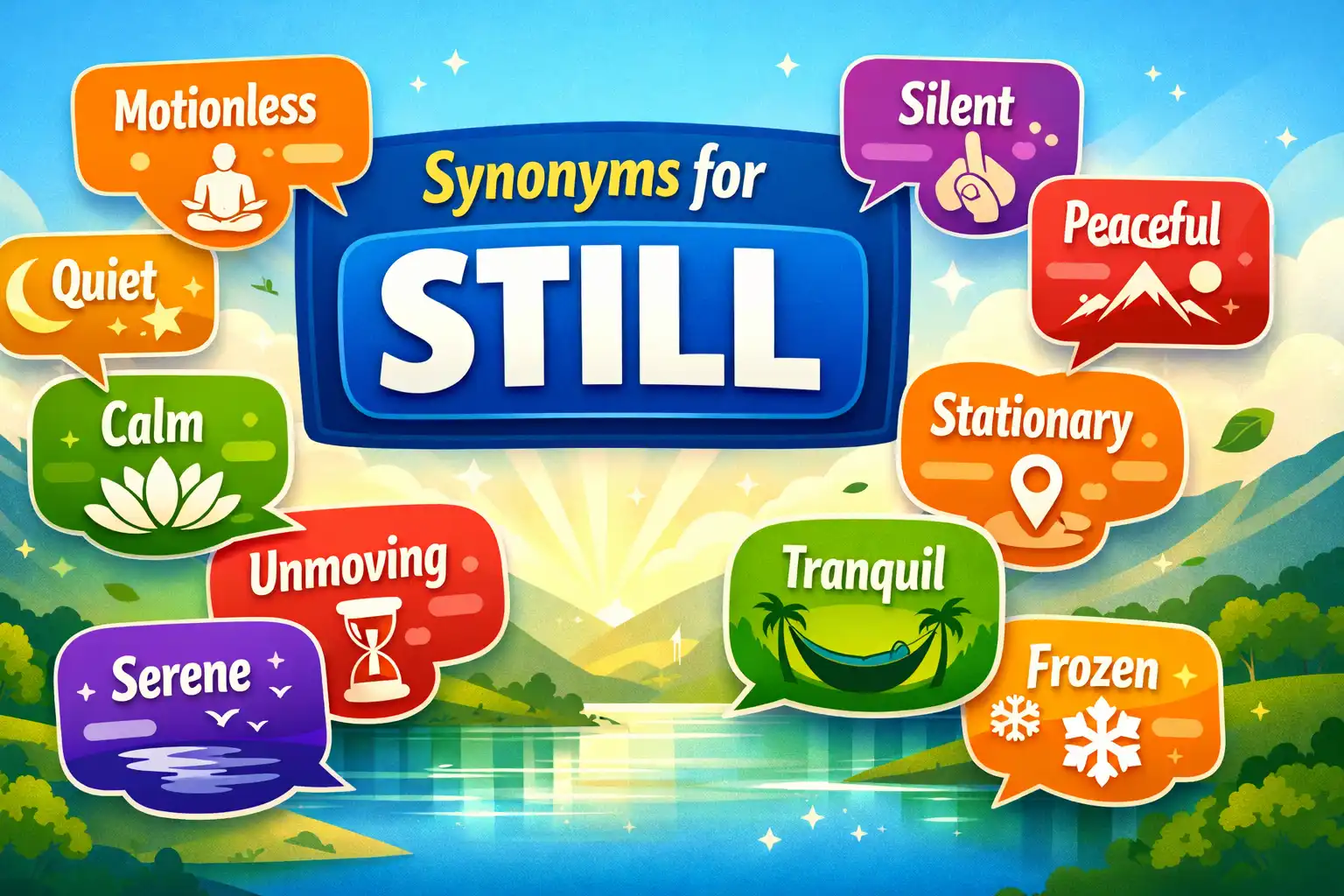
Learning the right synonyms for still can make your writing much more interesting and sharp. When you want to describe something that does not move, or something that continues to happen, using synonyms for still keeps your language from sounding repetitive. Finding strong synonyms for still helps you share your exact meaning with confidence.
Imagine sitting by a peaceful lake early in the morning, watching the water. You want to write a story about how quiet it is. If you only use the word “still” over and over, your sentences will feel weak and repetitive. For example, writing “the still water under the still sky made me feel still” sounds very boring. Instead, swapping those words for fresh options makes your ideas come alive instantly.
In very simple English, “still” means that something is quiet, not moving, or that an action is continuing to happen right now. Students need these terms to get better grades on their school essays. Bloggers and content writers use them to keep their articles exciting and easy to read. Daily English users use them to describe their feelings and plans clearly to friends.
“Silence is a source of great strength.” — Lao Tzu
“The quiet mind is the calling card of a wise soul.” — Unknown
Linguistic Profile of “Still”
To truly understand how to use synonyms for still, let’s look at the linguistic makeup of the word itself.
- Connotative Meaning: “Still” can feel very calm, peaceful, and deep when used as an adjective. As an adverb or conjunction, it shows strength, persistence, and continuous effort.
- Etymology:
- Derived from the Old English word stille (meaning quiet, stable, or motionless).
- Cognate with the Middle Dutch word stelle and Old High German stilli (meaning calm or quiet).
- Pronunciation: US:
/stɪl/| UK:/stɪl/ - Syllables: still ($1$ syllable)
- Affixation Pattern: Base word with no prefixes or suffixes.
Comparison of Core Synonyms
| Keyword | Meaning | Usage Type | Context |
|---|---|---|---|
| Still | Not moving, quiet, or continuing to happen. | Neutral / General | Describing nature, ongoing tasks, or polite debates. |
| Motionless | Completely without any movement. | Descriptive / Formal | Scientific observations, suspenseful stories, and art. |
| Nevertheless | In spite of what has just been said. | Formal / Professional | Academic papers, business reports, and formal essays. |
| Calm | Peaceful, quiet, and free from worry or excitement. | Emotional / Casual | Relationship talks, mental health, and weather descriptions. |
| Yet | Up to this time, or happening in the future. | Conversational | Everyday planning, casual check-ins, and fast updates. |
50 Detailed Synonyms for Still
1. Motionless
Pronunciation: US: /ˈmoʊ.ʃən.ləs/ | UK: /ˈməʊ.ʃən.ləs/
Meaning: This means that something is completely without any movement at all.
Examples:
- The deer stood motionless in the dark forest.
- She remained motionless while the painter drew her face.
2. Calm
Pronunciation: US: /kɑːm/ | UK: /kɑːm/
Meaning: This describes something that is peaceful, quiet, and free from worry.
Examples:
- A calm breeze blew through the open window.
- You must stay calm during the school test.
3. Quiet
Pronunciation: US: /ˈkwaɪ.ət/ | UK: /ˈkwaɪ.ət/
Meaning: This means making very little or no sound.
Examples:
- Please be quiet while the baby is sleeping.
- I love reading in a quiet room.
4. Silent
Pronunciation: US: /ˈsaɪ.lənt/ | UK: /ˈsaɪ.lənt/
Meaning: This means there is no sound happening at all.
Examples:
- The old library was completely silent.
- He gave a silent nod to show he understood.
5. Stagnant
Pronunciation: US: /ˈstæɡ.nənt/ | UK: /ˈstæɡ.nənt/
Meaning: This describes water or air that is not moving and often smells bad.
Examples:
- Mosquitoes love to lay eggs in stagnant ponds.
- The air in the closed closet felt stagnant.
6. Stationary
Pronunciation: US: /ˈsteɪ.ʃə.ner.i/ | UK: /ˈsteɪ.ʃən.ər.i/
Meaning: This describes something that is staying in one place and not moving.
Examples:
- I rode a stationary bicycle at the gym.
- The dark truck remained stationary at the red light.
7. Tranquil
Pronunciation: US: /ˈtræŋ.kwɪl/ | UK: /ˈtræŋ.kwɪl/
Meaning: This describes a place or feeling that is quiet, peaceful, and beautiful.
Examples:
- We took a walk around the tranquil lake.
- The garden is a tranquil place to think.
8. Peaceful
Pronunciation: US: /ˈpiːs.fəl/ | UK: /ˈpiːs.fəl/
Meaning: This means quiet and free from any war, fighting, or loud noise.
Examples:
- They want to live a peaceful life in the countryside.
- The sleepy puppy looked so peaceful on the rug.
9. Serene
Pronunciation: US: /səˈriːn/ | UK: /səˈriːn/
Meaning: This means calm, peaceful, and untroubled by any stress.
Examples:
- She had a serene smile on her face.
- The blue sky looked serene after the big storm.
10. Noise-free
Pronunciation: US: /ˈnɔɪz.friː/ | UK: /ˈnɔɪz.friː/
Meaning: This means that there is no loud or distracting sound.
Examples:
- I bought noise-free headphones for my flight.
- They searched for a noise-free spot to study.
11. Soundless
Pronunciation: US: /ˈsaʊnd.ləs/ | UK: /ˈsaʊnd.ləs/
Meaning: This describes something that makes no noise when it moves.
Examples:
- The owl made a soundless flight through the trees.
- She took a soundless step onto the thick carpet.
12. Inert
Pronunciation: US: /ˌɪnˈɝːt/ | UK: /ˌɪnˈɜːt/
Meaning: This describes something that does not have the power to move itself.
Examples:
- The chemical became inert and safe to touch.
- He lay inert on the couch after the long run.
13. Halcyon
Pronunciation: US: /ˈhæl.si.ən/ | UK: /ˈhæl.si.ən/
Meaning: This is a formal word for very peaceful and happy times in the past.
Examples:
- She often dreams of the halcyon days of her youth.
- We enjoyed a halcyon summer at the beach house.
14. Placid
Pronunciation: US: /ˈplæs.ɪd/ | UK: /ˈplæs.ɪd/
Meaning: This describes a person or body of water that does not get angry or upset easily.
Examples:
- The lake was placid and shiny like a mirror.
- He has a placid nature and never raises his voice.
15. Untroubled
Pronunciation: US: /ʌnˈtrʌb.əld/ | UK: /ʌnˈtrʌb.əld/
Meaning: This means free from any worry, pain, or problems.
Examples:
- She fell into a deep and untroubled sleep.
- His mind was untroubled by the bad news.
16. Restful
Pronunciation: US: /ˈrest.fəl/ | UK: /ˈrest.fəl/
Meaning: This describes something that helps you relax and feel calm.
Examples:
- The soft green walls made the bedroom feel restful.
- We had a restful weekend away from work.
17. Restrained
Pronunciation: US: /rɪˈstreɪnd/ | UK: /rɪˈstreɪnd/
Meaning: This means holding back your actions or feelings in a quiet way.
Examples:
- She showed restrained excitement when she won.
- The room was decorated in a restrained style.
18. Immobile
Pronunciation: US: /ɪˈmoʊ.bəl/ | UK: /ɪˈməʊ.baɪl/
Meaning: This describes something that is unable to move.
Examples:
- The broken leg made him completely immobile for weeks.
- She stood immobile with fear when she saw the spider.
19. Unmoving
Pronunciation: US: /ʌnˈmuː.vɪŋ/ | UK: /ʌnˈmuː.vɪŋ/
Meaning: This means staying in exactly the same position without shaking or drifting.
Examples:
- The toy soldier stood unmoving on the shelf.
- We watched the unmoving clouds in the hot sky.
20. Fixed
Pronunciation: US: /fɪkst/ | UK: /fɪkst/
Meaning: This describes something that is held fast in place and cannot be wiggled.
Examples:
- The old desk is fixed to the classroom floor.
- He kept his fixed gaze on the teacher.
21. Paralyzed
Pronunciation: US: /ˈper.ə.laɪzd/ | UK: /ˈpær.ə.laɪzd/
Meaning: This means being unable to move any part of your body.
Examples:
- The cold weather left the engine paralyzed.
- I was paralyzed with surprise when they yelled happy birthday.
22. Lifeless
Pronunciation: US: /ˈlaɪf.ləs/ | UK: /ˈlaɪf.ləs/
Meaning: This describes something that does not show any signs of life or energy.
Examples:
- The dry plant looked brown and lifeless.
- His hand felt cold and lifeless in mine.
23. Stiff
Pronunciation: US: /stɪf/ | UK: /stɪf/
Meaning: This means firm, hard, and very difficult to bend or flex.
Examples:
- My neck felt stiff after sleeping on the hard floor.
- The new leather shoes were very stiff.
24. Inactive
Pronunciation: US: /ˌɪnˈæk.tɪv/ | UK: /ˌɪnˈæk.tɪv/
Meaning: This means not doing any physical activity or work.
Examples:
- Volcanoes can stay inactive for hundreds of years.
- The bank account became inactive because she did not use it.
25. Static
Pronunciation: US: /ˈstæt̬.ɪk/ | UK: /ˈstæt.ɪk/
Meaning: This means staying in one condition or size without changing at all.
Examples:
- The prices of the items stayed static all year.
- He hates having a static job with no room to grow.
“In the midst of movement and chaos, keep stillness inside of you.” — Deepak Chopra
26. Breathless
Pronunciation: US: /ˈbreθ.ləs/ | UK: /ˈbreθ.ləs/
Meaning: This describes air that is completely still and has no wind blowing.
Examples:
- It was a hot, breathless summer afternoon.
- The breathless forest felt eerie and quiet.
27. Windless
Pronunciation: US: /ˈwɪnd.ləs/ | UK: /ˈwɪnd.ləs/
Meaning: This describes a day or place that has no moving air or breeze.
Examples:
- The flag hung down on the windless morning.
- It is easy to sail a boat when it is not a windless day.
28. Hushed
Pronunciation: US: /hʌʃt/ | UK: /hʌʃt/
Meaning: This describes a place or sound that has been made quiet on purpose.
Examples:
- The crowd spoke in hushed whispers during the play.
- A hushed silence fell over the classroom.
29. Yet
Pronunciation: US: /jet/ | UK: /jet/
Meaning: This shows that something has continued to happen up to this point.
Examples:
- I have not finished my lunch yet.
- There is hope for our team yet.
30. Even now
Pronunciation: US: /ˈiː.vən naʊ/ | UK: /ˈiː.vən naʊ/
Meaning: This means that something is still true at this exact second.
Examples:
- Even now, she remembers the song her mother sang.
- I can hear the loud music even now.
31. Hitherto
Pronunciation: US: /ˌhɪð.ɚˈtuː/ | UK: /ˌhɪð.əˈtuː/
Meaning: This is a formal word that means up to this point in time.
Examples:
- The secret was hitherto unknown to the public.
- Hitherto, we have used paper maps to travel.
32. Heretofore
Pronunciation: US: /ˌhɪr.tuːˈfɔːr/ | UK: /ˌhɪə.tuːˈfɔː/
Meaning: This formal word means before this time or up until now.
Examples:
- Heretofore, all students had to wear blue uniforms.
- The rule, heretofore ignored, will now be enforced.
33. Continuously
Pronunciation: US: /kənˈtɪn.ju.əs.li/ | UK: /kənˈtɪn.ju.əs.li/
Meaning: This means happening without any stops, breaks, or pauses.
Examples:
- The water flowed continuously from the broken pipe.
- She has worked continuously on her science project.
34. As yet
Pronunciation: US: /æz jet/ | UK: /æz jet/
Meaning: This means up to this present moment in time.
Examples:
- As yet, we have received no answers to our emails.
- The package has not arrived as yet.
35. Till now
Pronunciation: US: /tɪl naʊ/ | UK: /tɪl naʊ/
Meaning: This means from the past up until this current point.
Examples:
- Till now, I thought you lived in New York.
- We have been happy with our old car till now.
36. Up to now
Pronunciation: US: /ʌp tuː naʊ/ | UK: /ʌp tuː naʊ/
Meaning: This phrase means that something has stayed true until this moment.
Examples:
- Up to now, the game has been very easy to play.
- We have not had any rain up to now.
37. Always
Pronunciation: US: /ˈɑːl.weɪz/ | UK: /ˈɔːl.weɪz/
Meaning: This means at all times or without ever stopping.
Examples:
- I will always help you when you are in trouble.
- The sun always rises in the east.
38. Constantly
Pronunciation: US: /ˈkɑːn.stənt.li/ | UK: /ˈkɒn.stənt.li/
Meaning: This means happening all the time or very often.
Examples:
- She is constantly checking her phone for messages.
- The baby constantly smiles when his mother is near.
39. Perpetually
Pronunciation: US: /pɚˈpetʃ.u.ə.li/ | UK: /pəˈpetʃ.u.ə.li/
Meaning: This means continuing forever or for a very long time.
Examples:
- The mountain tops are perpetually covered in white snow.
- He seems perpetually happy and full of energy.
40. Steadily
Pronunciation: US: /ˈsted.əl.i/ | UK: /ˈsted.əl.i/
Meaning: This means moving or growing at a smooth, regular rate.
Examples:
- The rain fell steadily on the roof all night.
- Her English skills are steadily improving.
41. Nevertheless
Pronunciation: US: /ˌnev.ɚ.ðəˈles/ | UK: /ˌnev.ə.ðəˈles/
Meaning: This means in spite of a problem or fact that was just mentioned.
Examples:
- The test was hard; nevertheless, she got an A.
- It was cold, but we went for a walk nevertheless.
42. However
Pronunciation: US: /ˌhaʊˈev.ɚ/ | UK: /ˌhaʊˈev.ər/
Meaning: This is used to introduce a statement that contrasts with something.
Examples:
- I wanted to go to the park; however, it started to rain.
- He ran fast; however, he missed the yellow bus.
43. Nonetheless
Pronunciation: US: /ˌnʌn.ðəˈles/ | UK: /ˌnʌn.ðəˈles/
Meaning: This means despite what has just been said or done.
Examples:
- The food was expensive, but it was delicious nonetheless.
- She was tired but decided to study nonetheless.
44. Even so
Pronunciation: US: /ˈiː.vən soʊ/ | UK: /ˈiː.vən səʊ/
Meaning: This is used to say that something is true despite something else.
Examples:
- The movie was long; even so, I enjoyed it.
- I know you are busy; even so, please call me later.
45. Notwithstanding
Pronunciation: US: /ˌnɑːt.wɪθˈstæn.dɪŋ/ | UK: /ˌnɒt.wɪðˈstæn.dɪŋ/
Meaning: This formal word means in spite of or regardless of something.
Examples:
- Notwithstanding the bad weather, the plane landed safely.
- They won the game, our mistakes notwithstanding.
46. Regardless
Pronunciation: US: /rɪˈɡɑːrd.ləs/ | UK: /rɪˈɡɑːd.ləs/
Meaning: This means without being stopped by difficulty or danger.
Examples:
- He continued to walk home regardless of the heavy rain.
- We will carry out our plan regardless of what they say.
47. Anyway
Pronunciation: US: /ˈen.i.weɪ/ | UK: /ˈen.i.weɪ/
Meaning: This means that something happens despite other problems.
Examples:
- The water was cold, but we went swimming anyway.
- I do not have much money, but I will buy the book anyway.
48. Anyhow
Pronunciation: US: /ˈen.i.haʊ/ | UK: /ˈen.i.haʊ/
Meaning: This is another word for anyway, showing something happens regardless of other things.
Examples:
- It may rain, but we are going to the park anyhow.
- I did not know the way, but I found the house anyhow.
49. Still and all
Pronunciation: US: /stɪl ænd ɑːl/ | UK: /stɪl ænd ɔːl/
Meaning: This is an informal phrase that means nevertheless or anyway.
Examples:
- The car is old; still and all, it gets me to work.
- He made a mistake; still and all, he is a good friend.
50. All the same
Pronunciation: US: /ɔːl ðə seɪm/ | UK: /ɔːl ðə seɪm/
Meaning: This means that a fact does not change the situation.
Examples:
- It was a cheap gift, but I loved it all the same.
- They lost the match, but they played hard all the same.
Antonyms of “Still”
If you want to say the opposite of still, you can use these words:
- Active: Always moving, doing things, or working hard.
- Loud: Making a great deal of strong, noisy sound.
- Agitated: Feeling troubled, nervous, or physically shaken.
- Bustling: Full of lively activity, noise, and fast movement.
- Dynamic: Constantly changing, growing, or progressing.
Prototype Meaning and Categorization of “Still”
Linguists categorize words to help us understand where they fit in our minds. Here is how “still” fits into English categories:
- Prototype Meaning: Quiet stability, lack of motion, or the steady continuation of a state or action.
- Grammatical Category: Adverb, Adjective, Noun, Verb, and Conjunction.
- Semantic Domain: Modality, physical state, temporal continuity, and concession.
Frequently Asked Questions
1. What is the simple meaning of still?
The word “still” means that something is quiet, not moving, or that an action continues to happen up to this very moment.
2. Is still an adverb or an adjective?
It can be both! It is an adjective when describing “still water” (not moving), and an adverb when you say “he is still eating” (continuing).
3. What are the best synonyms for still in professional emails?
In workplace emails, use professional words like “nevertheless,” “however,” or “stationary” depending on what you mean.
4. How do you use “still” as a conjunction?
You can use it to connect two opposite ideas, like this: “The team was tired, still they kept running to win the game.”
5. Why do writers need synonyms for still?
Because “still” has so many different meanings, using synonyms helps you avoid confusing your readers and keeps your sentences sounding clean.
6. What is the difference between still and quiet?
“Still” means there is no physical movement, while “quiet” means there is very little or no sound.
Conclusion
Expanding your vocabulary with synonyms for still is a beautiful step toward becoming a more confident and fluent writer. When you learn to vary your words, you instantly improve your blogging, speaking, writing, and daily communication skills. Instead of repeating the same simple words, you can paint a clear and colorful picture with your sentences that will keep your readers hooked from the very first line to the last.
We encourage you to start practicing these new terms today. Try slipping a professional word like “nevertheless” into your next school essay, or use a warm word like “serene” in an email to a friend. Even in daily conversations, swapping out repetitive words for fresh options will make you sound more articulate and creative. With just a little bit of practice, your words will flow with a beautiful, natural rhythm that everyone will enjoy reading.
“By words the mind is winged.” — Aristophanes
“Words are, of course, the most powerful drug used by mankind.” — Rudyard Kipling

Andrew Collins is an academic English educator with over 12 years of experience helping university students, IELTS candidates, and ESL learners improve their writing vocabulary.