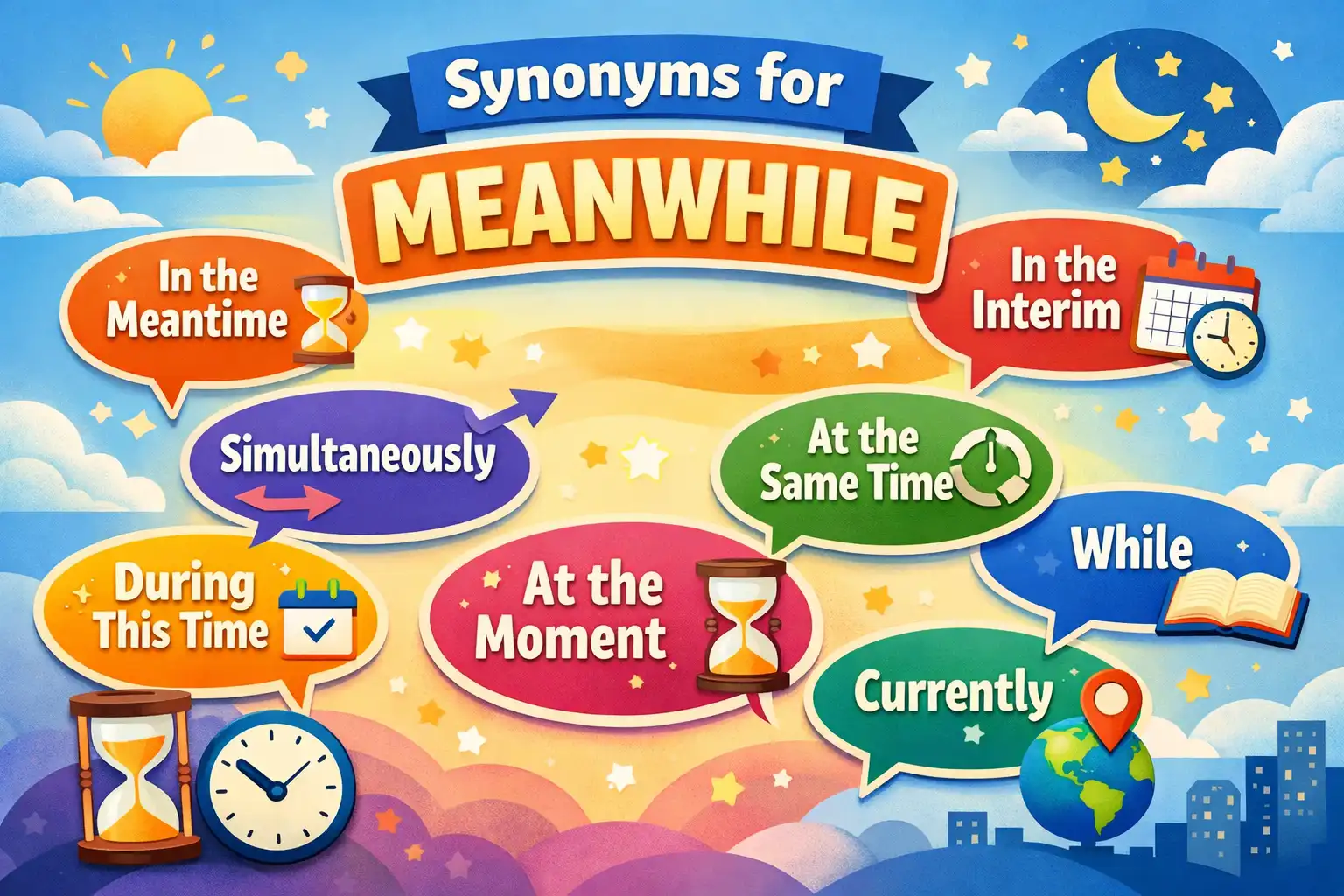
Finding synonyms for meanwhile can instantly boost the flow and professional quality of your writing. The word meanwhile is a transition word that helps us show that two different things are happening at the very same time. By learning some fresh synonyms for meanwhile, you can keep your sentences moving smoothly without sounding repetitive or dull to your readers.
Imagine you are baking a delicious chocolate cake in the kitchen. Inside the hot oven, the sweet batter begins to rise. Meanwhile, you quickly wash the dirty dishes in the sink so your kitchen stays clean. This simple word connects these two actions perfectly. In easy English, meanwhile just means “at the exact same time.”
Using this transition makes your work sound natural and polished. Students need these terms to connect ideas in high-scoring essays. Bloggers and content writers use them to keep readers sliding from one sentence to the next. Daily English users use them to tell stories clearly to their friends.
“Time is a created thing. To say ‘I don’t have time’ is to say ‘I don’t want to.'” — Lao Tzu
“The key is in not spending time, but in investing it.” — Stephen R. Covey
Linguistic Profile of “Meanwhile”
To truly understand how to use synonyms for meanwhile, let’s look at the linguistic makeup of the word itself.
- Connotative Meaning: “Meanwhile” has a neutral, logical, and transitional feeling. It acts as a bridge that shifts the reader’s attention to a different event happening during the same time frame.
- Etymology:
- Formed by combining the Middle English adjective mene (middle or intermediate).
- Derived from the noun while (a period of time).
- Pronunciation: US:
/ˈmiːn.waɪl/| UK:/ˈmiːn.waɪl/ - Syllables: mean-while ($2$ syllables)
- Affixation Pattern: Compound word formed by joining two distinct base words.
Comparison of Core Synonyms
| Keyword | Meaning | Usage Type | Context |
|---|---|---|---|
| Meanwhile | At the same time that something else is happening. | Neutral / Casual | Storytelling, daily updates, and news reports. |
| Simultaneously | Happening or existing at the exact same moment. | Professional / Technical | Scientific papers, technical manuals, and business reports. |
| In the interim | In the period of time between two main events. | Professional / Formal | Office emails, project management, and legal writing. |
| Meantime | During the intervening time before a specific event. | Casual / Neutral | Casual chats, friendly letters, and fiction. |
| While | During the time that something else is taking place. | Neutral / Casual | Conversation, essay writing, and creative blogging. |
50 Detailed Synonyms for Meanwhile
1. In the meantime
Pronunciation: US: /ɪn ðə ˈmiːn.taɪm/ | UK: /ɪn ðə ˈmiːn.taɪm/
Meaning: This means during the time before something else happens.
Examples:
- The movie starts in an hour, so in the meantime, let us grab some food.
- Your car will be ready tomorrow, but in the meantime, you can use this bike.
2. Simultaneously
Pronunciation: US: /ˌsaɪ.məlˈteɪ.ni.əs.li/ | UK: /ˌsɪm.əlˈteɪ.ni.əs.li/
Meaning: This means happening at the exact same moment.
Examples:
- She was typing an email and talking on the phone simultaneously.
- The two runners crossed the finish line simultaneously.
3. Concurrently
Pronunciation: US: /kənˈkɝː.ənt.li/ | UK: /kənˈkʌr.ənt.li/
Meaning: This means happening at the same time as a regular plan.
Examples:
- The university runs three different computer classes concurrently.
- My sister is working and going to school concurrently.
4. In the interim
Pronunciation: US: /ɪn ðə ˈɪn.tə.rɪm/ | UK: /ɪn ðə ˈɪn.tər.ɪm/
Meaning: This means during the gap of time between two actions.
Examples:
- Our regular teacher is sick, so in the interim, we have a helper.
- The new office opens next month; in the interim, we work from home.
5. Meantime
Pronunciation: US: /ˈmiːn.taɪm/ | UK: /ˈmiːn.taɪm/
Meaning: This is another simple way to say during the time in between.
Examples:
- The soup needs to simmer; meantime, we can set the dinner table.
- I will buy the tickets, and meantime, you should park the car.
6. At the same time
Pronunciation: US: /æt ðə seɪm taɪm/ | UK: /æt ðə seɪm taɪm/
Meaning: This means that two events are happening together.
Examples:
- You cannot speak and drink water at the same time.
- The alarm went off at the same time the phone rang.
7. While
Pronunciation: US: /waɪl/ | UK: /waɪl/
Meaning: This means during the time that an action is happening.
Examples:
- I like to listen to happy music while I clean my bedroom.
- Please watch the baby while I go to the restroom.
8. Whilst
Pronunciation: US: /waɪlst/ | UK: /waɪlst/
Meaning: This is a formal way to say while, mostly used in British English.
Examples:
- He fell asleep whilst reading a very long book.
- We must be quiet whilst the baby is sleeping in her crib.
9. In parallel
Pronunciation: US: /ɪn ˈpær.ə.lel/ | UK: /ɪn ˈpær.ə.lel/
Meaning: This means working on two things alongside each other.
Examples:
- We are running two different computer tests in parallel.
- She is writing a book and a screenplay in parallel.
10. Alongside
Pronunciation: US: /əˈlɑːŋ.saɪd/ | UK: /əˈlɒŋ.saɪd/
Meaning: This means next to or together with something else.
Examples:
- He worked alongside his father at the family store.
- The new road runs alongside the quiet blue river.
11. As
Pronunciation: US: /æz/ | UK: /æz/
Meaning: This shows that one action happens at the same moment as another.
Examples:
- She smiled brightly as she walked into the warm room.
- He waved goodbye as the train slowly pulled away.
12. During this time
Pronunciation: US: /ˈdʊr.ɪŋ ðɪs taɪm/ | UK: /ˈdjʊə.rɪŋ ðɪs taɪm/
Meaning: This means inside a specific period when things are happening.
Examples:
- The library is closed, and during this time, we cannot borrow books.
- She was in college, and during this time, she learned to cook.
13. At that moment
Pronunciation: US: /æt ðæt ˈmoʊ.mənt/ | UK: /æt ðæt ˈməʊ.mənt/
Meaning: This means at a very specific point in time.
Examples:
- The lights flickered, and at that moment, the door opened.
- He looked up, and at that moment, he saw a shooting star.
14. For the time being
Pronunciation: US: /fɔːr ðə taɪm ˈbiː.ɪŋ/ | UK: /fɔː ðə taɪm ˈbiː.ɪŋ/
Meaning: This means for now, until things change later.
Examples:
- We can use this old table for the time being.
- She is living with her aunt for the time being.
15. Synchronously
Pronunciation: US: /ˈsɪŋ.krə.nəs.li/ | UK: /ˈsɪŋ.krə.nəs.li/
Meaning: This means happening at the same speed and time together.
Examples:
- The dancers moved synchronously across the wide stage.
- The computer systems updated synchronously last night.
16. In that instant
Pronunciation: US: /ɪn ðæt ˈɪn.stənt/ | UK: /ɪn ðæt ˈɪn.stənt/
Meaning: This means in a very tiny split second of time.
Examples:
- The balloon popped, and in that instant, the cat jumped.
- She heard a loud noise and stopped running in that instant.
17. Coincidentally
Pronunciation: US: /koʊˌɪn.sɪˈden.t̬əl.i/ | UK: /kəʊˌɪn.sɪˈden.təl.i/
Meaning: This means happening at the same time by pure luck.
Examples:
- Coincidentally, we both wore the exact same red shirt today.
- I ran into my old friend coincidentally at the store.
18. In the background
Pronunciation: US: /ɪn ðə ˈbæk.ɡraʊnd/ | UK: /ɪn ðə ˈbæk.ɡraʊnd/
Meaning: This means happening behind the main action where you cannot easily see it.
Examples:
- Soft music played in the background while we talked.
- He worked quietly in the background to help us.
19. All the while
Pronunciation: US: /ɑːl ðə waɪl/ | UK: /ɔːl ðə waɪl/
Meaning: This means during the entire time that something else was happening.
Examples:
- She pretended to be happy, but all the while, she felt sad.
- I looked for my keys, and all the while, they were in my pocket.
20. As this happens
Pronunciation: US: /æz ðɪs ˈhæp.ənz/ | UK: /æz ðɪs ˈhæp.ənz/
Meaning: This means at the same time as a current action.
Examples:
- The snow is melting, and as this happens, the river rises.
- We press the button, and as this happens, the light turns green.
21. In the course of
Pronunciation: US: /ɪn ðə kɔːrs ʌv/ | UK: /ɪn ðə kɔːs ɒv/
Meaning: This means during the regular flow of a process.
Examples:
- In the course of our meeting, we solved three big problems.
- He made many good friends in the course of his trip.
22. On the side
Pronunciation: US: /ɑːn ðə saɪd/ | UK: /ɒn ðə saɪd/
Meaning: This means doing an extra activity while doing your main work.
Examples:
- She teaches piano on the side to make extra money.
- He writes funny stories on the side after school.
23. In the middle of this
Pronunciation: US: /ɪn ðə ˈmɪd.əl ʌv ðɪs/ | UK: /ɪn ðə ˈmɪd.əl ɒv ðɪs/
Meaning: This means right when something is already taking place.
Examples:
- It started to rain hard in the middle of this outdoor game.
- My phone rang loudly in the middle of this important test.
24. Along the way
Pronunciation: US: /əˈlɑːŋ ðə weɪ/ | UK: /əˈlɒŋ ðə weɪ/
Meaning: This means during a journey or a long process.
Examples:
- We stopped at two nice parks along the way to the beach.
- I learned many helpful coding lessons along the way.
25. Throughout
Pronunciation: US: /θruːˈaʊt/ | UK: /θruːˈaʊt/
Meaning: This means from the start to the end of a time period.
Examples:
- The baby slept peacefully throughout the entire loud movie.
- It rained heavily throughout the dark night.
“Simplicity is the ultimate sophistication.” — Leonardo da Vinci
26. At this juncture
Pronunciation: US: /æt ðɪs ˈdʒʌŋk.tʃɚ/ | UK: /æt ðɪs ˈdʒʌŋk.tʃə/
Meaning: This means at this specific point in time or event.
Examples:
- At this juncture, we must decide if we want to buy the house.
- It is too late to change our travel plans at this juncture.
27. For now
Pronunciation: US: /fɔːr naʊ/ | UK: /fɔː naʊ/
Meaning: This means for this short moment before something changes.
Examples:
- You can leave your heavy bags here for now.
- Let us stop running and rest for now.
28. In the process
Pronunciation: US: /ɪn ðə ˈprɑː.ses/ | UK: /ɪn ðə ˈprəʊ.ses/
Meaning: This means while you are doing a specific action.
Examples:
- He tried to fix the clock and broke it in the process.
- She was moving houses and lost her keys in the process.
29. Simultaneous
Pronunciation: US: /ˌsaɪ.məlˈteɪ.ni.əs/ | UK: /ˌsɪm.əlˈteɪ.ni.əs/
Meaning: This describes things that exist or happen together.
Examples:
- There was a simultaneous broadcast of the game on two channels.
- The software allows simultaneous users to work together.
30. Coexisting
Pronunciation: US: /ˌkoʊ.ɪɡˈzɪs.tɪŋ/ | UK: /ˌkəʊ.ɪɡˈzɪs.tɪŋ/
Meaning: This means living or being in the same place at the same time.
Examples:
- We saw two different bird species coexisting in the same nest.
- Peace is about different cultures coexisting happily.
31. Concomitantly
Pronunciation: US: /kənˈkɑː.mə.t̬ənt.li/ | UK: /kənˈkɒm.ɪ.tənt.li/
Meaning: This means happening naturally along with another thing.
Examples:
- The medicine lowers pain and, concomitantly, helps you sleep.
- Increased sales occurred concomitantly with our new ads.
32. In step
Pronunciation: US: /ɪn step/ | UK: /ɪn step/
Meaning: This means moving or working together in perfect timing.
Examples:
- The soldiers marched in step down the main street.
- We need to keep our business plans in step with the law.
33. Withal
Pronunciation: US: /wɪˈðɑːl/ | UK: /wɪˈðɔːl/
Meaning: This is an old-fashioned word that means at the same time or besides.
Examples:
- She was very smart and beautiful withal.
- The tasks were hard, but he was cheerful withal.
34. In tandem
Pronunciation: US: /ɪn ˈtæn.dəm/ | UK: /ɪn ˈtæn.dəm/
Meaning: This means working closely together as a team.
Examples:
- The two departments must work in tandem to finish the project.
- We rode our bikes in tandem down the quiet path.
35. During
Pronunciation: US: /ˈdʊr.ɪŋ/ | UK: /ˈdjʊə.rɪŋ/
Meaning: This means through the time that something is happening.
Examples:
- Please do not talk loudly during the school assembly.
- We went to see the beautiful stars during the night.
36. Interim
Pronunciation: US: /ˈɪn.tə.rɪm/ | UK: /ˈɪn.tər.ɪm/
Meaning: This describes something temporary that fills a time gap.
Examples:
- He is acting as the interim boss until we hire someone.
- The company released an interim report on its progress.
37. As we speak
Pronunciation: US: /æz wiː spiːk/ | UK: /æz wiː spiːk/
Meaning: This means happening at this very second while we talk.
Examples:
- The package is being delivered to your house as we speak.
- They are fixing the broken computer line as we speak.
38. On the fly
Pronunciation: US: /ɑːn ðə flaɪ/ | UK: /ɒn ðə flaɪ/
Meaning: This means doing something quickly while you are still moving or working.
Examples:
- He learned how to use the new software on the fly.
- She made a change to the meeting plan on the fly.
39. In real-time
Pronunciation: US: /ɪn ˈriːl.taɪm/ | UK: /ɪn ˈriːl.taɪm/
Meaning: This means showing or sending information instantly as it happens.
Examples:
- The map shows the location of your bus in real-time.
- We watched the news updates occur in real-time.
40. Co-occurringly
Pronunciation: US: /koʊ.əˈkɜː.ɪŋ.li/ | UK: /kəʊ.əˈkɜː.ɪŋ.li/
Meaning: This means happening at the same time as another event.
Examples:
- The two chemical reactions happened co-occurringly in the tube.
- High wind and rain fell co-occurringly during the storm.
41. Synchronic
Pronunciation: US: /sɪnˈkrɑː.nɪk/ | UK: /sɪnˈkrɒn.ɪk/
Meaning: This describes things that happen at one specific point in time.
Examples:
- The linguist did a synchronic study of the modern language.
- We observed a synchronic movement in the market.
42. At this point
Pronunciation: US: /æt ðɪs pɔɪnt/ | UK: /æt ðɪs pɔɪnt/
Meaning: This means right now during this step of a process.
Examples:
- At this point, we cannot accept any more applications.
- I am too tired to keep walking at this point.
43. Simultaneous with
Pronunciation: US: /ˌsaɪ.məlˈteɪ.ni.əs wɪð/ | UK: /ˌsɪm.əlˈteɪ.ni.əs wɪð/
Meaning: This means happening at the exact same moment as another action.
Examples:
- The bell ringing was simultaneous with the clock striking twelve.
- Her arrival was simultaneous with the start of the party.
44. Coincident
Pronunciation: US: /koʊˈɪn.sɪ.dənt/ | UK: /kəʊˈɪn.sɪ.dənt/
Meaning: This describes things that happen together in time.
Examples:
- The two events were coincident, which surprised everyone.
- We had coincident plans to visit the same city.
45. At the very moment
Pronunciation: US: /æt ðə ˈver.i ˈmoʊ.mənt/ | UK: /æt ðə ˈver.i ˈməʊ.mənt/
Meaning: This means at the exact point in time when something happens.
Examples:
- At the very moment he stood up, the phone started ringing.
- She opened her umbrella at the very moment it began to rain.
46. In the loop
Pronunciation: US: /ɪn ðə luːp/ | UK: /ɪn ðə luːp/
Meaning: This means knowing about plans and decisions as they happen.
Examples:
- Please keep me in the loop about the project updates.
- She was not in the loop about the secret party.
47. To the same beat
Pronunciation: US: /tuː ðə seɪm biːt/ | UK: /tuː ðə seɪm biːt/
Meaning: This means moving or working with the exact same rhythm.
Examples:
- The two drum sets were playing to the same beat.
- Our team members are all working to the same beat.
48. In union
Pronunciation: US: /ɪn ˈjuː.njən/ | UK: /ɪn ˈjuː.njən/
Meaning: This means doing an action together as one single group.
Examples:
- The students stood up in union when the principal walked in.
- They spoke in union to demand a longer recess.
49. Temporary
Pronunciation: US: /ˈtem.pə.rer.i/ | UK: /ˈtem.pər.ər.i/
Meaning: This means lasting for only a short, limited time.
Examples:
- This is just a temporary fix for our broken pipe.
- She got a temporary job for the busy summer season.
50. On the go
Pronunciation: US: /ɑːn ðə ɡoʊ/ | UK: /ɒn ðə ɡəʊ/
Meaning: This means being very active and busy moving around.
Examples:
- He is always on the go with his school sports.
- I like to eat quick snacks while I am on the go.
Antonyms of Meanwhile
If you want to say the opposite of meanwhile, you can use these words:
- Subsequently: Happening at a later time after an event is finished.
- Previously: Happening at an earlier time before the current action.
- Separately: Happening apart from other things, not at the same time.
- Beforehand: Doing something in advance before another action begins.
- Later: At a future time rather than right now.
Prototype Meaning and Categorization of “Meanwhile”
Linguists categorize words to help us understand where they fit in our minds. Here is how “meanwhile” fits into English categories:
- Prototype Meaning: Connecting two independent events that occur within the same temporal boundaries.
- Grammatical Category: Adverb / Conjunctive Adverb (it connects two clauses or ideas temporally).
- Semantic Domain: Narrative transitions, chronological structures, and temporal relations.
Frequently Asked Questions
1. What is the simple meaning of meanwhile?
“Meanwhile” simply means “at the same time.” It is a word we use to connect two things that are happening during the exact same period.
2. Is meanwhile a transition word?
Yes, meanwhile is a temporal transition word. It helps writers move smoothly from one event to another without confusing the reader about the timeline.
3. How do you use the word meanwhile in a sentence?
You can use it to connect two actions: “My brother was cleaning his bedroom; meanwhile, I was preparing dinner.”
4. What is the difference between meanwhile and in the meantime?
“Meanwhile” usually links two events happening at the same time. “In the meantime” is used to talk about a gap of time before a specific future event happens.
5. Why are synonyms for meanwhile important for SEO?
Using synonyms for meanwhile makes your articles sound more natural to search engine crawlers. It avoids keyword stuffing and helps your blog rank higher by showing rich language.
6. Can meanwhile start a sentence?
Yes. You can start a sentence with meanwhile to introduce a new action, but you must place a comma directly after it, like: “Meanwhile, the storm began to grow stronger.”
Conclusion
Expanding your vocabulary with synonyms for meanwhile is an incredibly rewarding step toward becoming a more confident writer. When you vary your transition words, you instantly elevate your writing, blogging, speaking, and overall communication skills. Instead of relying on the same simple words over and over, you can weave a rich, engaging path of ideas that captures your audience’s attention and keeps them hooked.
We highly encourage you to start practicing these terms today. Slip a sophisticated phrase like “in the interim” into your next professional workplace email, or try using “simultaneously” in an academic essay. Even in casual daily conversations, swapping out repetitive words for fresh alternatives will make you sound more articulate, polished, and creative. With just a little bit of intentional practice each day, you will find that your sentences flow with a beautiful, natural rhythm that feels completely effortless.
“To write is to write is to write is to write is to write is to write is to write.” — Gertrude Stein
“The limits of my language mean the limits of my world.” — Ludwig Wittgenstein

Andrew Collins is an academic English educator with over 12 years of experience helping university students, IELTS candidates, and ESL learners improve their writing vocabulary.