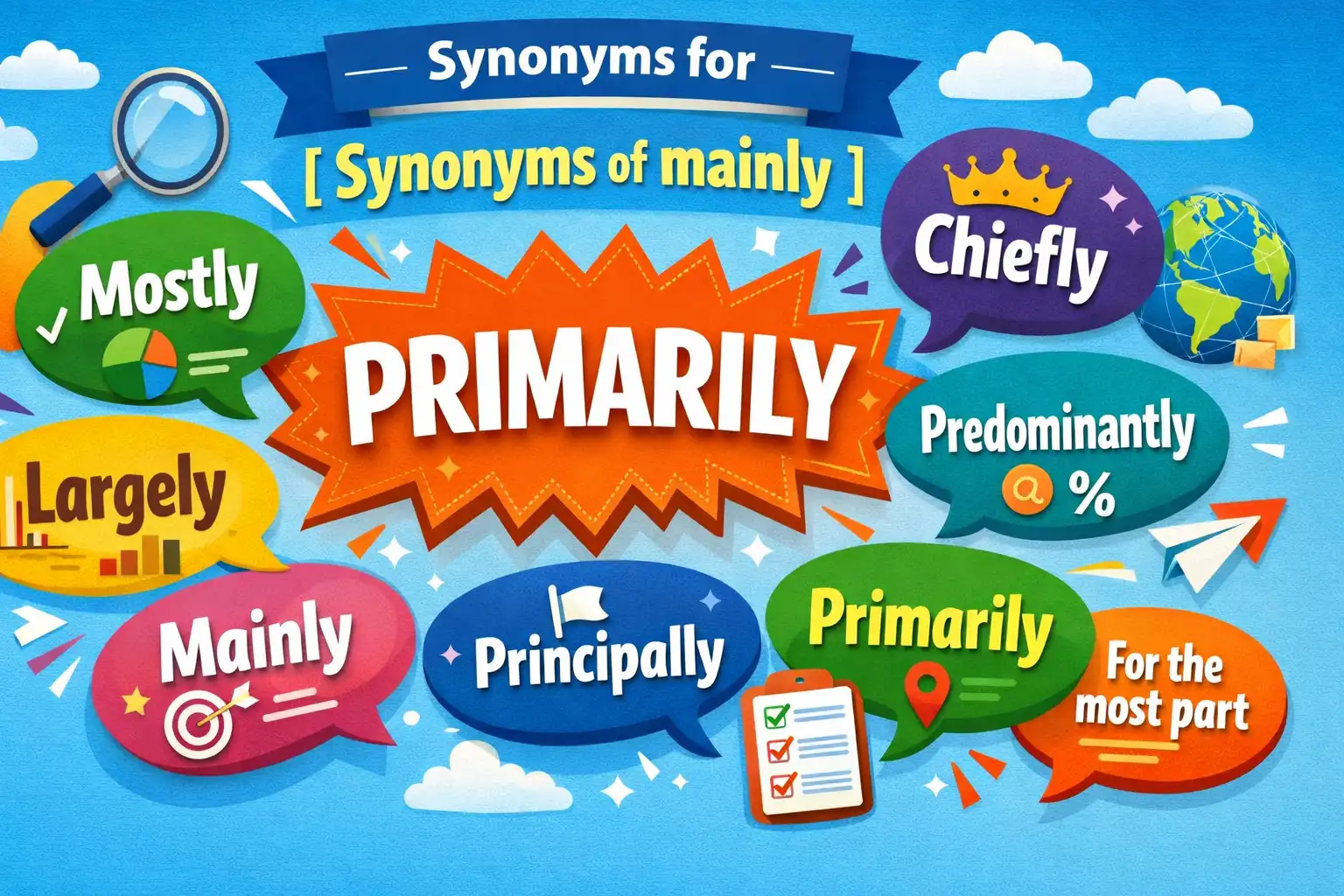
Finding synonyms for mainly is a great way to make your writing sound fresh and professional. The word “mainly” means that something is true most of the time or is the most important part of a situation. When you learn different synonyms for mainly, you can avoid repeating the same word and make your essays or blogs much more exciting to read.
Imagine baking a chocolate chip cookie. You use flour, sugar, eggs, and butter, but the final cookie is mostly made of chocolate. You could say the cookie is mainly chocolate. Instead of repeating that word over and over, you can use synonyms for mainly to explain your recipe with more variety. In simple English, “mainly” just means “mostly” or “more than anything else.”
Students need these terms to get higher grades on their writing tests. Bloggers and content writers use them to keep readers hooked and improve their search engine rankings. Daily English users can use them to share ideas clearly without sounding like a robot.
“The difference between the right word and the almost right word is the difference between lightning and a lightning bug.” — Mark Twain
“To write well is to express ideas clearly, simply, and with rich variety.” — Unknown
Linguistic Profile of “Mainly”
To truly understand how to use synonyms for mainly, let’s look at the linguistic makeup of the word itself.
- Connotative Meaning: “Mainly” has a neutral, logical, and practical feel. It highlights the primary focus of a sentence without adding extra drama.
- Etymology:
- Derived from the Middle English word meine, which means “force” or “power.”
- Comes from the Old English root mægen, meaning “strength.”
- Suffix -ly added to the adjective main to form an adverb.
- Pronunciation: US:
/ˈmeɪn.li/| UK:/ˈmeɪn.li/ - Syllables: main-ly (2 syllables)
- Affixation Pattern: Base adjective main + adverb-forming suffix -ly.
Comparison of Core Synonyms
| Keyword | Meaning | Usage Type | Context |
|---|---|---|---|
| Mainly | More than anything else or in most cases. | Neutral / Casual | Explaining everyday situations, school, or work tasks. |
| Primarily | For the most part or as a first step. | Professional / Formal | Business reports, science tasks, and academic papers. |
| Chiefly | Most importantly or above all other things. | Formal / Literary | Creative stories, formal speeches, and old texts. |
| Largely | To a great extent or mostly. | Neutral / Professional | Discussing data, general weather, or group behaviors. |
| Principally | Standing as the most important reason or item. | Formal / Academic | High-level essays, legal tasks, and deep discussions. |
50 Detailed Synonyms for Mainly
1. Mostly
Pronunciation: US: /ˈmoʊst.li/ & UK: /ˈməʊst.li/
Meaning: This means almost all of something or in most cases.
Examples:
- The school has $500$ kids, mostly from the local neighborhood.
- We spent the afternoon mostly talking about our upcoming trip.
2. Primarily
Pronunciation: US: /praɪˈmer.əl.i/ & UK: /praɪˈmər.əl.i/
Meaning: This means for the most important or first reason.
Examples:
- He completed $90\%$ of the homework, primarily the math section.
- This warm coat is designed primarily for very cold winter days.
3. Chiefly
Pronunciation: US: /ˈtʃiːf.li/ & UK: /ˈtʃiːf.li/
Meaning: This means most of all or above everything else.
Examples:
- She spent $3$ hours chiefly working on her science project.
- The local library is funded chiefly by donations from citizens.
4. Principally
Pronunciation: US: /ˈprɪn.sə.pəl.i/ & UK: /ˈprɪn.sə.pəl.i/
Meaning: This means being the main person, reason, or thing.
Examples:
- The meeting was held principally to discuss the new budget rules.
- He is principally known for his beautiful landscape paintings.
5. Largely
Pronunciation: US: /ˈlɑːrdʒ.li/ & UK: /ˈlɑːdʒ.li/
Meaning: This means to a very great or wide degree.
Examples:
- The game was successful largely because of your great effort.
- Her story is largely true, though she changed some names.
6. Predominantly
Pronunciation: US: /prɪˈdɑː.mə.nənt.li/ & UK: /prɪˈdɒm.ɪ.nənt.li/
Meaning: This means mostly or having the most power or numbers in a group.
Examples:
- The forest is made up of predominantly tall pine trees.
- The crowd was predominantly young students waiting for the music.
7. Generally
Pronunciation: US: /ˈdʒen.ər.əl.i/ & UK: /ˈdʒen.ər.əl.i/
Meaning: This means in most cases or by most people.
Examples:
- We generally go to bed before $10$ at night.
- The weather here is generally warm and sunny in the summer.
8. Essentially
Pronunciation: US: /ɪˈsen.ʃəl.i/ & UK: /ɪˈsen.ʃəl.i/
Meaning: This means at the most basic or important level.
Examples:
- This simple plan is essentially the same as our old one.
- The job is essentially about helping customers solve problems.
9. Basically
Pronunciation: US: /ˈbeɪ.sɪ.kəl.i/ & UK: /ˈbeɪ.sɪ.kəl.i/
Meaning: This means simply or in a very fundamental way.
Examples:
- We are basically done with the project except for the cover page.
- He is basically a very nice person once you get to know him.
10. Substantially
Pronunciation: US: /səbˈstæn.ʃəl.i/ & UK: /səbˈstæn.ʃəl.i/
Meaning: This means to a very large or important amount.
Examples:
- Our monthly sales have increased substantially since last spring.
- The new design is substantially better than the first draft.
11. Overall
Pronunciation: US: /ˌoʊ.vɚˈɑːl/ & UK: /ˌəʊ.vəˈrɔːl/
Meaning: This means looking at everything together as a whole.
Examples:
- The overall score was great, even though we lost one round.
- The health of the forest is good overall this year.
12. Particularly
Pronunciation: US: /pɚˈtɪk.jə.lɚ.li/ & UK: /pəˈtɪk.jə.lə.li/
Meaning: This means especially or more than other times or things.
Examples:
- I like sweet fruits, particularly ripe red strawberries.
- The morning was particularly cold so I wore my thick scarf.
13. Especially
Pronunciation: US: /ɪˈspeʃ.əl.i/ & UK: /ɪˈspeʃ.əl.i/
Meaning: This means to a great degree or for a special purpose.
Examples:
- This book is especially good for children learning to read.
- She loves outdoor sports, especially playing soccer with friends.
14. Fundamentally
Pronunciation: US: /ˌfʌn.dəˈmen.t̬əl.i/ & UK: /ˌfʌn.dəˈmen.təl.i/
Meaning: This means at the deepest, most basic level of truth.
Examples:
- The two friends have fundamentally different views on modern art.
- This new software is fundamentally different from the old version.
15. Cardinally
Pronunciation: US: /ˈkɑːr.dɪ.nəl.i/ & UK: /ˈkɑː.dɪ.nəl.i/
Meaning: This means in a way that is key or most important.
Examples:
- The rule is cardinally important for the safety of the team.
- His thoughts were cardinally linked to the success of the business.
16. Heavily
Pronunciation: US: /ˈhev.əl.i/ & UK: /ˈhev.ɪ.li/
Meaning: This means to a very great degree or with a lot of weight.
Examples:
- They rely heavily on public transit to get to school.
- It rained heavily for over $2$ hours last night.
17. Dominantly
Pronunciation: US: /ˈdɑː.mə.nənt.li/ & UK: /ˈdɒm.ɪ.nənt.li/
Meaning: This means in a way that is stronger or more common.
Examples:
- The team played dominantly during the second half of the game.
- The blue color showed dominantly in the sky during sunset.
18. Prevailingly
Pronunciation: US: /prɪˈveɪ.lɪŋ.li/ & UK: /prɪˈveɪ.lɪŋ.li/
Meaning: This means in a way that is most common or widespread.
Examples:
- The wind blew prevailingly from the west all through autumn.
- People held a prevailingly positive view of the new park.
19. First and foremost
Pronunciation: US: /fɝːst ænd ˈfɔːr.moʊst/ & UK: /fɜːst ænd ˈfɔː.məʊst/
Meaning: This means most importantly or as the very first point.
Examples:
- First and foremost, we must ensure everyone has clean water.
- He is, first and foremost, a teacher who loves his young pupils.
20. On the whole
Pronunciation: US: /ɑːn ðə hoʊl/ & UK: /ɒn ðə həʊl/
Meaning: This means taking everything into consideration generally.
Examples:
- On the whole, the class did an excellent job on the test.
- Our vacation was, on the whole, a very fun adventure.
21. For the most part
Pronunciation: US: /fɔːr ðə moʊst pɑːrt/ & UK: /fɔː ðə mʊst pɑːt/
Meaning: This means mostly or in most situations.
Examples:
- The job is, for the most part, very quiet and peaceful.
- For the most part, the children listened to their parents.
22. By and large
Pronunciation: US: /baɪ ænd lɑːrdʒ/ & UK: /baɪ ænd lɑːdʒ/
Meaning: This means in general or when looking at the whole picture.
Examples:
- By and large, the weather in spring is lovely here.
- The students are, by and large, ready to graduate.
23. In the main
Pronunciation: US: /ɪn ðə meɪn/ & UK: /ɪn ðə meɪn/
Meaning: This means mostly or on the whole.
Examples:
- The proposed changes are, in the main, very simple to make.
- His explanation was, in the main, easy for us to follow.
24. Materially
Pronunciation: US: /məˈtɪr.i.ə.li/ & UK: /məˈtɪə.ri.ə.li/
Meaning: This means to an important or visible degree.
Examples:
- Your generous help will materially improve our school project.
- The new facts did not materially change the final report.
“Simple writing is a sign of clear thinking.” — Robert Graves
25. Effectively
Pronunciation: US: /əˈfek.tɪv.li/ & UK: /ɪˈfek.tɪv.li/
Meaning: This means in a way that gets the actual result.
Examples:
- She managed the small team effectively during the busy sale.
- You can wash your hands effectively with warm water and soap.
26. Practically
Pronunciation: US: /ˈpræk.tɪ.kəl.i/ & UK: /ˈpræk.tɪ.kəl.i/
Meaning: This means almost completely or for all real purposes.
Examples:
- The project is practically finished, so we can go home now.
- He has lived in this old city for practically his entire life.
27. Virtually
Pronunciation: US: /ˈvɝː.tʃu.ə.li/ & UK: /ˈvɜː.tʃu.ə.li/
Meaning: This means almost entirely or in essence.
Examples:
- It is virtually impossible to climb the ice wall without ropes.
- The small room was virtually empty except for one wooden chair.
28. Simply
Pronunciation: US: /ˈsɪm.pli/ & UK: /ˈsɪm.pli/
Meaning: This means only or in a very plain and clear way.
Examples:
- I simply wanted to say thank you for your kind card.
- The recipe is simply a mix of fresh flour, water, and salt.
29. Solely
Pronunciation: US: /ˈsoʊl.li/ & UK: /ˈsəʊl.li/
Meaning: This means only or without any other person or thing.
Examples:
- She is solely responsible for walking the puppy every evening.
- The book was written solely to teach kids about wild birds.
30. Exclusively
Pronunciation: US: /ɪkˈskluː.sɪv.li/ & UK: /ɪkˈskluː.sɪv.li/
Meaning: This means only for one specific group, place, or person.
Examples:
- This playground is designed exclusively for toddlers under $4$.
- They sell shoes exclusively at their online store.
31. Specifically
Pronunciation: US: /spəˈsɪf.ɪ.kəl.i/ & UK: /spəˈsɪf.ɪ.kəl.i/
Meaning: This means for one exact reason or target.
Examples:
- I bought this red bucket specifically to wash the car.
- The teacher spoke specifically to the boys about the noise.
32. Centrally
Pronunciation: US: /ˈsen.trəl.i/ & UK: /ˈsen.trəl.i/
Meaning: This means at the middle point of importance or location.
Examples:
- The new library is centrally located in the middle of town.
- His ideas were centrally important to the planning committee.
33. Paramountly
Pronunciation: US: /ˈpær.ə.maʊnt.li/ & UK: /ˈpær.ə.maʊnt.li/
Meaning: This means in a way that is above all other concerns.
Examples:
- We must act paramountly to protect the wild forest animals.
- The safety rules are paramountly important for the workers.
34. Supremely
Pronunciation: US: /suːˈpriːm.li/ & UK: /suːˈpriːm.li/
Meaning: This means to the highest possible degree or level.
Examples:
- She felt supremely confident before she went on the big stage.
- The delicious cake was supremely light and sweet.
35. Notably
Pronunciation: US: /ˈnoʊ.t̬ə.bli/ & UK: /ˈnəʊ.tə.bli/
Meaning: This means in a way that is easy to notice or remember.
Examples:
- The weather became notably colder as the sun went down.
- Several students, notably the captain, spoke at the assembly.
36. Peculiarly
Pronunciation: US: /pɪˈkjuːl.jɚ.li/ & UK: /pɪˈkjuːl.jə.li/
Meaning: This means in a strange, special, or unique way.
Examples:
- The old house had a peculiarly sweet smell of fresh pine.
- This problem is peculiarly difficult for the young students.
37. Exceptionally
Pronunciation: US: /ɪkˈsep.ʃən.əl.i/ & UK: /ɪkˈsep.ʃən.əl.i/
Meaning: This means much better or more than is normal.
Examples:
- The young boy is exceptionally good at playing the violin.
- It was an exceptionally warm day for the middle of winter.
38. Broadly
Pronunciation: US: /ˈbrɔːd.li/ & UK: /ˈbrɔːd.li/
Meaning: This means in a general way without specific details.
Examples:
- The two plans are broadly similar in how they save money.
- She smiled broadly when she saw her friends at the gate.
39. Commonly
Pronunciation: US: /ˈkɑː.mən.li/ & UK: /ˈkɒm.ən.li/
Meaning: This means by most people or in most places.
Examples:
- This type of tree is commonly found near cold mountain streams.
- Cell phones are commonly used to take quick photos today.
40. Ordinarily
Pronunciation: US: /ˌɔːr.dəˈner.əl.i/ & UK: /ˌɔː.dən.ər.əl.i/
Meaning: This means under normal conditions or usually.
Examples:
- We ordinarily eat lunch at exactly noon every single day.
- Ordinarily, the bus arrives on time, but today it was late.
41. Usually
Pronunciation: US: /ˈjuː.ʒu.ə.li/ & UK: /ˈjuː.ʒu.ə.li/
Meaning: This means in the way that things happen most of the time.
Examples:
- I usually walk to the library after my classes finish.
- Heavy snow usually falls here during the month of January.
42. Customarily
Pronunciation: US: /ˌkʌs.təˈmer.əl.i/ & UK: /ˌkʌs.təˈmer.əl.i/
Meaning: This means according to the normal habits or traditions.
Examples:
- They customarily exchange small gifts on New Year’s Day.
- The host customarily greets guests at the front door.
43. Habitually
Pronunciation: US: /həˈbɪtʃ.u.əl.i/ & UK: /həˈbɪtʃ.u.əl.i/
Meaning: This means doing something regularly as a routine habit.
Examples:
- He is habitually late for our weekly morning meetings.
- She habitually drinks a cup of warm tea before sleeping.
44. Frequently
Pronunciation: US: /ˈfriː.kwənt.li/ & UK: /ˈfriː.kwənt.li/
Meaning: This means happening very often or many times.
Examples:
- They frequently visit their grandparents on the small farm.
- Lightning frequently strikes the top of the tall tower.
45. Overwhelmingly
Pronunciation: US: /ˌoʊ.vɚˈhwel.mɪŋ.li/ & UK: /ˌəʊ.vəˈhwel.mɪŋ.li/
Meaning: This means by a very large and powerful majority.
Examples:
- The town voted overwhelmingly to build the new school.
- The feedback on her design was overwhelmingly positive.
46. In large part
Pronunciation: US: /ɪn lɑːrdʒ pɑːrt/ & UK: /ɪn lɑːdʒ pɑːt/
Meaning: This means mostly or because of a big reason.
Examples:
- The party was successful, in large part, due to the fun music.
- The crops grew tall, in large part, because of the heavy rain.
47. Above all
Pronunciation: US: /əˈbʌv ɑːl/ & UK: /əˈbʌv ɔːl/
Meaning: This means most importantly of all things.
Examples:
- Above all, you must remember to be kind to other people.
- We want our new house to be safe and warm above all.
48. First of all
Pronunciation: US: /fɝːst ʌv ɑːl/ & UK: /fɜːst ɒv ɔːl/
Meaning: This means before doing or saying anything else.
Examples:
- First of all, let us write down our names on the paper.
- First of all, we must wash our hands before we cook lunch.
49. Most of all
Pronunciation: US: /moʊst ʌv ɑːl/ & UK: /məʊst ɒv ɔːl/
Meaning: This means more than any other option or thing.
Examples:
- He loves playing outside, but he likes swimming most of all.
- She missed her old friends most of all when she moved.
50. Majorly
Pronunciation: US: /ˈmeɪ.dʒɚ.li/ & UK: /ˈmeɪ.dʒə.li/
Meaning: This means to a very large and noticeable degree (casual).
Examples:
- I was majorly impressed by your beautiful art project.
- The flat tire majorly delayed our trip to the beach.
Antonyms of Mainly
If you want to say the opposite of mainly, you can use these words:
- Minimally: Doing only the smallest amount possible.
- Slightly: To a very small degree or of little importance.
- Barely: Only just enough, almost not at all.
- Partially: Only in part, not completely or fully.
- Secondary: Serving as a less important step or detail.
Prototype Meaning and Categorization of “Mainly”
Linguists categorize words to help us understand where they fit in our minds. Here is how “mainly” fits into English categories:
- Prototype Meaning: The state of being the most important, frequent, or principal part of a whole.
- Grammatical Category: Adverb (it modifies verbs, adjectives, or other adverbs).
- Semantic Domain: Quantitative emphasis, logical focus, and degree.
Frequently Asked Questions
1. What is the simple meaning of mainly?
The word mainly means “mostly,” “for the most part,” or “more than anything else.” It shows what the biggest or most important part of something is.
2. Is “mostly” the same as “mainly”?
Yes! “Mostly” and “mainly” are very close in meaning and can be exchanged in almost any sentence. For example, you can say “We are mainly done” or “We are mostly done.”
3. How do you use “mainly” in a sentence?
You can use it to highlight the main focus. For example: “The garden has flowers, but it is mainly filled with green grass.”
4. Why should I use synonyms for mainly in my writing?
Using different words stops your writing from sounding repetitive. It makes your paragraphs flow better, keeps your readers interested, and shows off your great vocabulary.
5. Can “mainly” be used at the beginning of a sentence?
While you can use it at the start, it is much more common and natural to place it in the middle of a sentence next to the verb or adjective it describes.
6. What is the difference between “mainly” and “principally”?
“Mainly” is a friendly word used in daily conversations. “Principally” is a formal word that you will mostly see in school textbooks, law papers, and business reports.
Conclusion
Learning synonyms for mainly is an excellent and easy way to upgrade your communication skills. When you expand your vocabulary, your essay writing, blogging, public speaking, and daily communication become much stronger. Instead of using the same basic terms over and over, you will sound articulate, creative, and highly professional to everyone who reads your work.
We encourage you to practice these words as often as you can. Try swapping “mainly” for “primarily” in your next school essay, or use “mostly” in your workplace emails. With just a little daily practice, your speaking and writing will feel much more natural, engaging, and powerful.
“Colors fade, temples crumble, empires fall, but words endure.” — Edward Thorndike
“By words the mind is excited and the spirit elevated.” — Aristophanes

Andrew Collins is an academic English educator with over 12 years of experience helping university students, IELTS candidates, and ESL learners improve their writing vocabulary.