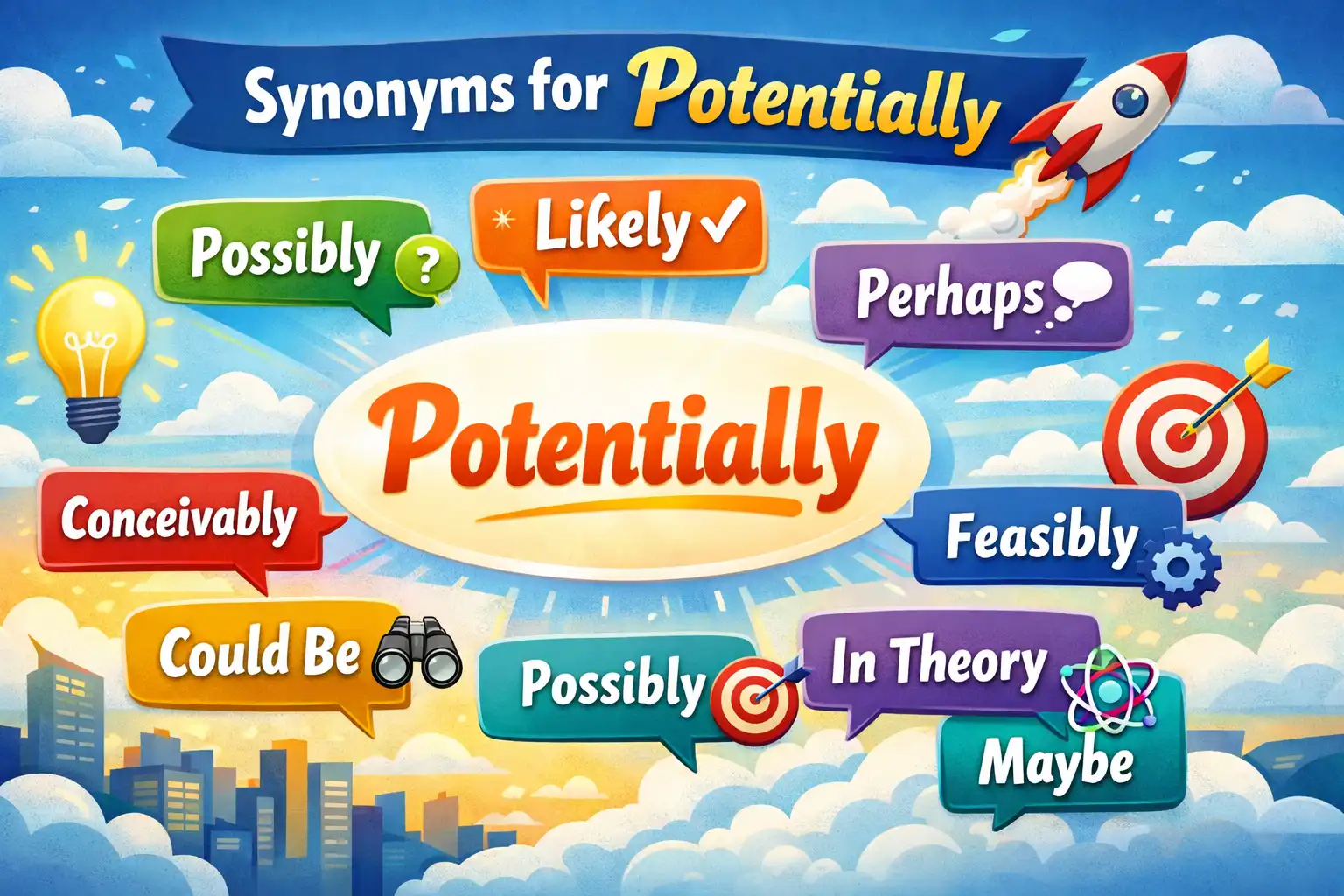
Finding the right synonyms for potentially can instantly make your writing sound more professional. When we talk about something that might happen or has the ability to develop in the future, we often search for synonyms for potentially to avoid repeating the same word. Learning these synonyms for potentially helps you express different levels of certainty and possibility clearly.
Imagine sitting at your desk, trying to pitch a brilliant new business idea. You write down that your project is potentially profitable, your team is potentially ready, and your market is potentially huge. Reading that sentence back feels incredibly boring because the same long word keeps popping up. In simple English, “potentially” just means that something has a chance to happen or become real in the future.
Using fresh words makes your work sound natural and polished. Students need these terms to write high-scoring essays. Bloggers and content writers use them to keep readers sliding from one sentence to the next. Daily English users use them to describe plans and possibilities clearly to their friends.
“The future belongs to those who believe in the beauty of their dreams.” — Eleanor Roosevelt
“Every secret of a writer’s soul, every experience of his life, every quality of his mind, is written large in his works.” — Virginia Woolf
Linguistic Profile of “Potentially”
To truly understand how to use synonyms for potentially, let’s look at the linguistic makeup of the word itself.
- Connotative Meaning: “Potentially” has a highly hopeful, forward-looking, and professional feeling. It implies latent ability, future growth, or logical capability.
- Etymology:
- Derived from the Late Latin word potentialis (meaning powerful or potent).
- Cognate with the French word potentiel and the Old French potence (meaning power).
- Pronunciation: US:
/poʊˈten.ʃəl.i/| UK:/pəˈten.ʃəl.i/ - Syllables: po-ten-tial-ly ($4$ syllables)
- Affixation Pattern: Formed by adding the suffix -ly to the adjective “potential” to create an adverb.
Comparison of Core Synonyms
| Keyword | Meaning | Usage Type | Context |
|---|---|---|---|
| Potentially | Having the capacity to develop into something in the future. | Professional / Analytical | Business pitches, scientific predictions, and essays. |
| Possibly | Able to happen or be true, though not certain. | Neutral / Casual | Everyday plans, quick updates, and general ideas. |
| Conceivably | Able to be imagined or believed. | Formal / Academic | Theoretical discussions, debates, and complex arguments. |
| Feasibly | Capable of being done or carried out practically. | Professional / Technical | Project planning, engineering, and logistics. |
| Perhaps | Used to express a faint possibility or polite suggestion. | Neutral / Conversational | Casual chats, polite emails, and storytelling. |
50 Detailed Synonyms for Potentially
1. Possibly
Pronunciation: US: /ˈpɑː.sə.bli/ | UK: /ˈpɒs.ə.bli/
Meaning: This means that something has a chance of being true or happening.
Examples:
- We could possibly go to the beach if the rain stops.
- She will possibly arrive before the movie starts.
2. Conceivably
Pronunciation: US: /kənˈsiː.və.bli/ | UK: /kənˈsiː.və.bli/
Meaning: This means that you can imagine or picture something happening.
Examples:
- The team could conceivably win the championship this year.
- We might conceivably finish the project by tomorrow morning.
3. Feasibly
Pronunciation: US: /ˈfiː.zə.bli/ | UK: /ˈfiː.zə.bli/
Meaning: This means that something can be done easily or practically.
Examples:
- You can feasibly paint the kitchen in one weekend.
- We could feasibly build the treehouse with these tools.
4. Probably
Pronunciation: US: /ˈprɑː.bə.bli/ | UK: /ˈprɒb.ə.bli/
Meaning: This means that something is very likely to happen.
Examples:
- It will probably rain later so take your umbrella.
- She is probably at home reading a book.
5. Maybe
Pronunciation: US: /ˈmeɪ.bi/ | UK: /ˈmeɪ.bi/
Meaning: This is a simple word to show that something might happen.
Examples:
- Maybe we can eat Italian food for dinner tonight.
- I will join the game, or maybe I will just watch.
6. Perhaps
Pronunciation: US: /pɚˈhæps/ | UK: /pəˈhæps/
Meaning: This is a polite way to say that something is possible.
Examples:
- Perhaps we can discuss this issue tomorrow morning.
- The package will arrive on Tuesday, or perhaps Wednesday.
“Inspiration exists, but it has to find you working.” — Pablo Picasso
7. Plausibly
Pronunciation: US: /ˈplɑː.zə.bli/ | UK: /ˈplɔː.zə.bli/
Meaning: This means that an idea sounds reasonable and easy to believe.
Examples:
- He could plausibly claim that he lost his keys.
- The story could plausibly have happened in real life.
8. Likely
Pronunciation: US: /ˈlaɪ.kli/ | UK: /ˈlaɪ.kli/
Meaning: This means that something is expected to happen.
Examples:
- The warm sun is likely to melt the white snow.
- They are likely to accept our invitation to the party.
9. Hopefully
Pronunciation: US: /ˈhoʊp.fəl.i/ | UK: /ˈhəʊp.fəl.i/
Meaning: This means that you want something good to happen.
Examples:
- Hopefully, the package will arrive in the mail today.
- She will hopefully pass her driver’s test on Monday.
10. Presumably
Pronunciation: US: /prɪˈzuː.mə.bli/ | UK: /prɪˈzjuː.mə.bli/
Meaning: This means that you assume something is true based on what you know.
Examples:
- The lights are off, so they are presumably asleep.
- He is late, so he is presumably stuck in traffic.
11. Theoretically
Pronunciation: US: /ˌθiː.əˈret̬.ɪ.kəl.i/ | UK: /ˌθɪəˈret.ɪ.kəl.i/
Meaning: This means that something is possible according to a theory or rule.
Examples:
- Theoretically, this new engine can run on water.
- We can theoretically finish the hike in three hours.
12. Hypothetically
Pronunciation: US: /ˌhaɪ.pəˈθet̬.ɪ.kəl.i/ | UK: /ˌhaɪ.pəˈθet.ɪ.kəl.i/
Meaning: This means imagining a situation that is not real yet.
Examples:
- Hypothetically, what would you do with a million dollars?
- If we hypothetically moved to Spain, we would learn Spanish.
13. Seemingly
Pronunciation: US: /ˈsiː.mɪŋ.li/ | UK: /ˈsiː.mɪŋ.li/
Meaning: This means that something appears to be true on the outside.
Examples:
- The test was seemingly easy, but many students failed.
- He solved the hard puzzle in a seemingly simple way.
14. Apparently
Pronunciation: US: /əˈpær.ənt.li/ | UK: /əˈpær.ənt.li/
Meaning: This means that something seems to be true based on the clues.
Examples:
- Apparently, the store is closed for the holiday today.
- She apparently forgot her coat at the restaurant.
15. Realistically
Pronunciation: US: /ˌriː.əˈlɪs.tɪ.kəl.i/ | UK: /ˌrɪəˈlɪs.tɪ.kəl.i/
Meaning: This means thinking about what is truly possible in real life.
Examples:
- Realistically, we cannot paint the whole house today.
- He can realistically expect to get the job.
16. Imaginably
Pronunciation: US: /ɪˈmædʒ.ɪ.nə.bli/ | UK: /ɪˈmædʒ.ɪ.nə.bli/
Meaning: This means in a way that can be thought of or imagined.
Examples:
- The party was the most fun imaginable event of the year.
- The weather could imaginably get much colder tonight.
17. Supposedly
Pronunciation: US: /səˈpoʊ.zɪd.li/ | UK: /səˈpəʊ.zɪd.li/
Meaning: This means that people say something is true, but it might not be.
Examples:
- The movie is supposedly the best film of the summer.
- This old house is supposedly haunted by a friendly ghost.
18. Doubtless
Pronunciation: US: /ˈdaʊt.ləs/ | UK: /ˈdaʊt.ləs/
Meaning: This means that something will almost certainly happen.
Examples:
- The new playground will doubtless make the children happy.
- She will doubtless succeed because she works very hard.
19. Conditional
Pronunciation: US: /kənˈdɪʃ.ən.əl/ | UK: /kənˈdɪʃ.ən.əl/
Meaning: This means that something will only happen if another thing happens first.
Examples:
- My promise to buy the game is conditional on your grades.
- The outdoor picnic is conditional on good sunny weather.
20. Prospective
Pronunciation: US: /prəˈspek.tɪv/ | UK: /prəˈspek.tɪv/
Meaning: This describes someone or something that is likely to happen in the future.
Examples:
- The college held a tour for prospective students today.
- She met with a prospective buyer for her car.
21. Latent
Pronunciation: US: /ˈleɪ.tənt/ | UK: /ˈleɪ.tənt/
Meaning: This describes a power or skill that is hidden but can grow.
Examples:
- He discovered his latent talent for painting in art class.
- The seed has a latent ability to grow into a tall tree.
22. In prospect
Pronunciation: US: /ɪn ˈprɑː.spekt/ | UK: /ɪn ˈprɒs.pekt/
Meaning: This means that something is expected or hoped for in the future.
Examples:
- A fun camping trip is in prospect for our family.
- There are many good job openings in prospect this month.
23. Promisingly
Pronunciation: US: /ˈprɑː.mɪ.sɪŋ.li/ | UK: /ˈprɒm.ɪ.sɪŋ.li/
Meaning: This means showing signs that something will be successful.
Examples:
- The young writer started her book very promisingly.
- The warm morning sun began promisingly for our outdoor picnic.
24. Imaginable
Pronunciation: US: /ɪˈmædʒ.ɪ.nə.bəl/ | UK: /ɪˈmædʒ.ɪ.nə.bəl/
Meaning: This describes anything that is possible to think of.
Examples:
- They sell ice cream in every imaginable flavor.
- We had the worst imaginable luck on our trip.
25. Achievably
Pronunciation: US: /əˈtʃiː.və.bli/ | UK: /əˈtʃiː.və.bli/
Meaning: This means doing something in a way that can be finished.
Examples:
- You can achievably complete the course in three weeks.
- The goals were achievably planned by the teacher.
26. Attainably
Pronunciation: US: /əˈteɪ.nə.bli/ | UK: /əˈteɪ.nə.bli/
Meaning: This means that a goal can be reached with effort.
Examples:
- The mountain top was attainably close for the hikers.
- She set her savings goal very attainably this year.
27. Expectedly
Pronunciation: US: /ɪkˈspek.tɪd.li/ | UK: /ɪkˈspek.tɪd.li/
Meaning: This means happening in the way that people thought it would.
Examples:
- The favorite team expectedly won the game easily.
- The rain expectedly fell after the dark clouds gathered.
28. Possibly so
Pronunciation: US: /ˈpɑː.sə.bli soʊ/ | UK: /ˈpɒs.ə.bli səʊ/
Meaning: This is a short phrase used to agree that something might be true.
Examples:
- It is possibly so that the train is running late.
- The store may close early, and that is possibly so.
29. Perchance
Pronunciation: US: /pɚˈtʃæns/ | UK: /pəˈtʃɑːns/
Meaning: This is an old, poetic word that means maybe.
Examples:
- If you go to the store, perchance buy some sweet fruit.
- Perchance we shall meet again under the stars.
30. Credibly
Pronunciation: US: /ˈkred.ə.bli/ | UK: /ˈkred.ə.bli/
Meaning: This means in a way that is easy to trust or believe.
Examples:
- The witness credibly explained what happened during the storm.
- He can credibly speak three different languages.
31. Predictably
Pronunciation: US: /prɪˈdɪk.tə.bli/ | UK: /prɪˈdɪk.tə.bli/
Meaning: This means happening in a way that is easy to guess before.
Examples:
- Predictably, the young child wanted to eat sweet candy.
- The dog predictably barked when the mailman arrived.
32. Ostensibly
Pronunciation: US: /ɑːˈsten.sə.bli/ | UK: /ɒˈsten.sə.bli/
Meaning: This means that something is done for a stated reason that might not be real.
Examples:
- He went to the kitchen, ostensibly to get water, but ate cake.
- She called her friend, ostensibly to talk about homework.
33. By chance
Pronunciation: US: /baɪ tʃæns/ | UK: /baɪ tʃɑːns/
Meaning: This means that something happens without any planning.
Examples:
- We met our old teacher by chance at the supermarket.
- The key was found by chance under the rug.
34. Contingently
Pronunciation: US: /kənˈtɪn.dʒənt.li/ | UK: /kənˈtɪn.dʒənt.li/
Meaning: This means that an action depends on something else happening first.
Examples:
- The company hired him contingently on his background check.
- We will buy the tickets contingently on getting the day off.
35. Tentatively
Pronunciation: US: /ˈten.t̬ə.t̬ɪv.li/ | UK: /ˈten.tə.tɪv.li/
Meaning: This means making a plan that is not yet certain.
Examples:
- We tentatively scheduled the meeting for next Thursday.
- She tentatively accepted the invite until she checked her calendar.
36. Maybe or maybe not
Pronunciation: US: /ˈmeɪ.bi ɔːr ˈmeɪ.bi nɑːt/ | UK: /ˈmeɪ.bi ɔː ˈmeɪ.bi nɒt/
Meaning: This is a phrase used to show total uncertainty.
Examples:
- We will go to the park, maybe or maybe not.
- The test will be hard, maybe or maybe not.
37. Arguably
Pronunciation: US: /ˈɑːrɡ.ju.ə.bli/ | UK: /ˈɑːɡ.ju.ə.bli/
Meaning: This means that you can give good reasons to support an idea.
Examples:
- This is arguably the best pizza place in the whole city.
- He is arguably the fastest runner on our school team.
38. Debatably
Pronunciation: US: /dɪˈbeɪ.t̬ə.bli/ | UK: /dɪˈbeɪ.tə.bli/
Meaning: This means that people can easily argue about whether it is true.
Examples:
- That was debatably the most exciting game of the year.
- The new rules are debatably better than the old ones.
39. Conceivable
Pronunciation: US: /kənˈsiː.və.bəl/ | UK: /kənˈsiː.və.bəl/
Meaning: This is an adjective that means possible to imagine.
Examples:
- The scientists explored every conceivable solution to the problem.
- There was no conceivable reason for him to leave early.
40. Feasible
Pronunciation: US: /ˈfiː.zə.bəl/ | UK: /ˈfiː.zə.bəl/
Meaning: This describes a plan that can be completed easily.
Examples:
- It is not feasible to walk to the next town in this storm.
- Building a new school is a highly feasible plan.
41. Possible
Pronunciation: US: /ˈpɑː.sə.bəl/ | UK: /ˈpɒs.ə.bəl/
Meaning: This describes something that can exist or happen.
Examples:
- It is possible that we will finish early today.
- Please come as soon as possible to help us.
42. Probable
Pronunciation: US: /ˈprɑː.bə.bəl/ | UK: /ˈprɒb.ə.bəl/
Meaning: This describes something that is very likely to happen.
Examples:
- The probable cause of the fire was an old wire.
- It is probable that she will win the art contest.
43. Likely to be
Pronunciation: US: /ˈlaɪ.kli tuː biː/ | UK: /ˈlaɪ.kli tuː biː/
Meaning: This means that something has a strong chance of becoming real.
Examples:
- The young puppy is likely to be very large.
- This book is likely to be a bestseller soon.
44. Imminent
Pronunciation: US: /ˈɪm.ə.nənt/ | UK: /ˈɪm.ɪ.nənt/
Meaning: This describes something that is about to happen very soon.
Examples:
- The dark clouds show that a rainstorm is imminent.
- The birds flew away because danger was imminent.
45. In the cards
Pronunciation: US: /ɪn ðə kɑːrdz/ | UK: /ɪn ðə kɑːdz/
Meaning: This is an idiom that means something is likely to happen.
Examples:
- A big promotion at work is in the cards for her.
- Winning the trophy was just not in the cards for us.
46. On the horizon
Pronunciation: US: /ɑːn ðə həˈraɪ.zən/ | UK: /ɒn ðə həˈraɪ.zən/
Meaning: This describes a future event that is coming soon.
Examples:
- Many exciting changes are on the horizon for our school.
- A new business partnership is on the horizon.
47. Pending
Pronunciation: US: /ˈpen.dɪŋ/ | UK: /ˈpen.dɪŋ/
Meaning: This means waiting for a decision or action to happen.
Examples:
- The sale of the house is pending until next week.
- Your application is pending approval by the main office.
48. Supposable
Pronunciation: US: /səˈpoʊ.zə.bəl/ | UK: /səˈpəʊ.zə.bəl/
Meaning: This describes an idea that can be assumed as true.
Examples:
- It is a supposable theory that the cat ate the food.
- This is a supposable explanation for the broken glass.
49. Verisimilar
Pronunciation: US: /ˌver.əˈsɪm.ə.lɚ/ | UK: /ˌver.ɪˈsɪm.ɪ.lə/
Meaning: This is a formal word that means having the appearance of truth.
Examples:
- The actor gave a highly verisimilar performance of the king.
- The fiction writer created a verisimilar world for her characters.
50. Within reach
Pronunciation: US: /wɪˈðɪn riːtʃ/ | UK: /wɪˈðɪn riːtʃ/
Meaning: This means that a goal or object is close enough to get.
Examples:
- The trophy was finally within reach for the hard-working team.
- Keep your emergency water supply within reach at all times.
Antonyms of Potentially
If you want to say the opposite of potentially, you can use these words:
- Definitely: Happening without any doubt or question.
- Impossible: Something that cannot happen or exist.
- Unlikely: Not expected to happen or be true.
- Never: At no time in the past or the future.
- Certainly: With absolute confidence and surety.
Prototype Meaning and Categorization of “Potentially”
Linguists categorize words to help us understand where they fit in our minds. Here is how “potentially” fits into English categories:
- Prototype Meaning: Future possibility or latent power that has the logical capability of turning into reality.
- Grammatical Category: Adverb.
- Semantic Domain: Modality, probability, future time, and capacity.
Frequently Asked Questions
1. What is the simple meaning of potentially?
The word “potentially” means that something has a chance to happen or become real in the future. It is all about future possibility.
2. Is potentially an adverb or an adjective?
It is an adverb. You can tell because it ends in -ly and describes how an action or quality might develop.
3. How do you use synonyms for potentially in business writing?
In professional settings, use strong words like “feasibly,” “prospectively,” or “arguably.” Avoid casual phrases like “maybe or maybe not.”
4. What is the difference between potentially and possibly?
“Potentially” means there is an inner ability or capacity to grow into something. “Possibly” just means there is a random chance of it happening.
5. Why do writers need synonyms for potentially?
Using synonyms for potentially keeps your sentences fresh and interesting. It allows you to explain exactly how likely an event is to happen.
6. Can potentially be used at the start of a sentence?
Yes. You can start a sentence with it to set a hypothetical tone, such as: “Potentially, the new project could save the company thousands of dollars.”
Conclusion
Expanding your vocabulary with synonyms for potentially is an incredibly rewarding step toward becoming a more confident writer. When you vary your transition words and descriptive terms, you instantly elevate your writing, blogging, speaking, and overall communication skills. Instead of relying on the same simple words over and over, you can weave a rich, engaging path of ideas that captures your audience’s attention and keeps them hooked.
We highly encourage you to start practicing these terms today. Slip a sophisticated phrase like “feasibly” into your next professional workplace email, or try using “conceivably” in an academic essay. Even in casual daily conversations, swapping out repetitive words for fresh alternatives will make you sound more articulate, polished, and creative. With just a little bit of intentional practice each day, you will find that your sentences flow with a beautiful, natural rhythm that feels completely effortless.
“By writing our stories, we make ourselves known.” — Sandra Cisneros
“To have another language is to possess a second soul.” — Charlemagne

Andrew Collins is an academic English educator with over 12 years of experience helping university students, IELTS candidates, and ESL learners improve their writing vocabulary.