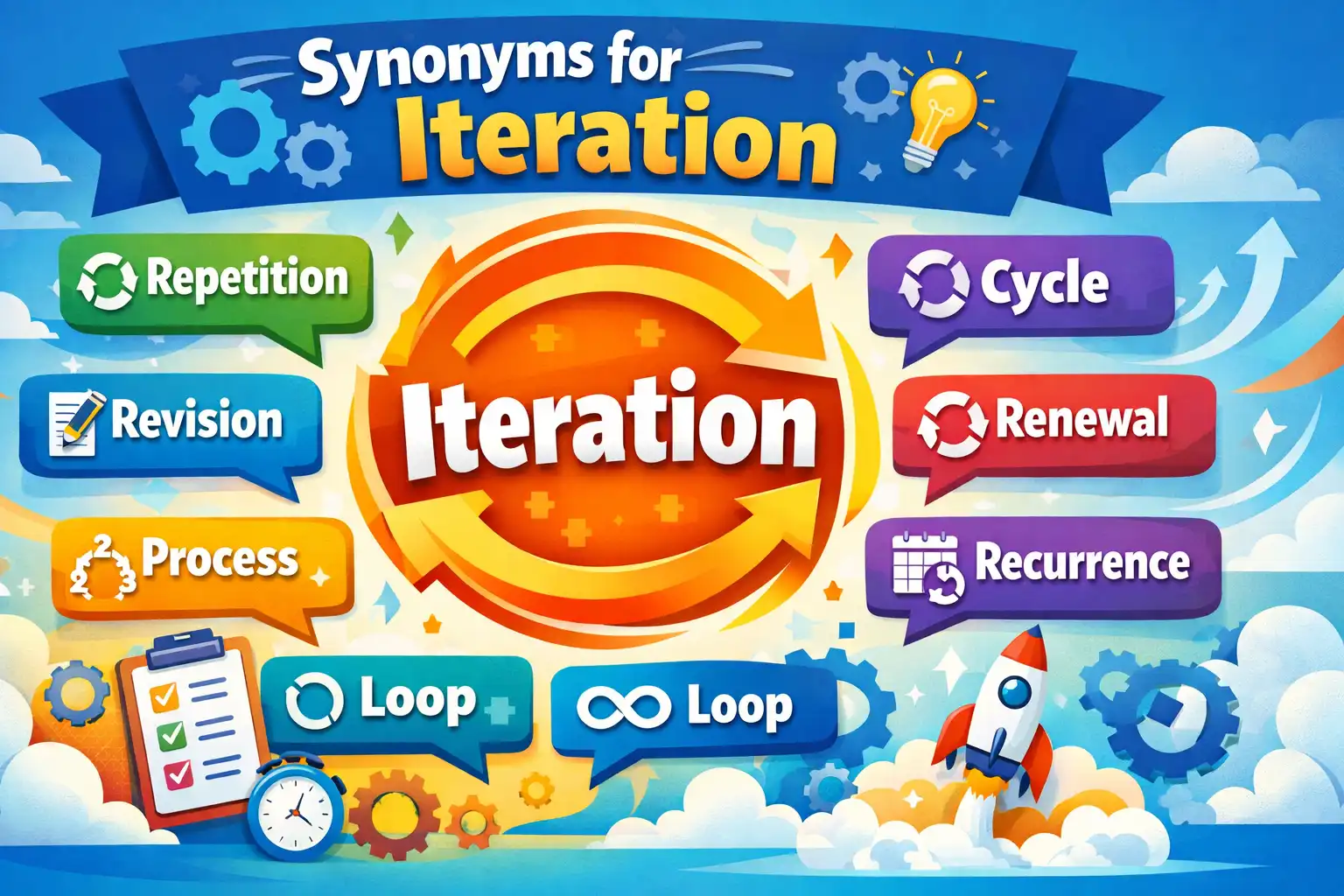
Finding synonyms for iteration can help you improve your writing. An iteration is when you do or say something again to make it better. When you use different synonyms for iteration, your sentences sound much more interesting and professional.
Imagine making a paper airplane. Your first attempt does not fly far. You fold the wings differently and try again. Each new attempt is an iteration. You keep repeating the process until the plane glides smoothly across the room. In simple English, an iteration is just one cycle of trying, learning, and improving.
Using the same word over and over makes your writing dry. Students need these terms to write high-scoring essays. Bloggers and content writers use them to keep readers engaged. Daily English users use them to explain their ideas clearly without sounding repetitive.
“To improve is to change; to be perfect is to change often.” — Winston Churchill
“In the world of writing, repetition is a silent killer of engagement.” — Unknown
Linguistic Profile of “Iteration”
To truly understand how to use synonyms for iteration, let’s look at the linguistic makeup of the word itself.
- Connotative Meaning: “Iteration” usually has a neutral, logical, or business-like feeling. It suggests a smart step in a cycle of improvement, rather than just repeating something mindlessly.
- Etymology:
- Originates from the Latin verb iterare, which means “to do a second time” or “repeat.”
- Derived from iterum, meaning “again.”
- Pronunciation: US:
/ˌɪt̬.əˈreɪ.ʃən/| UK:/ˌɪt.əˈreɪ.ʃən/ - Syllables: it-er-a-tion (4 syllables)
- Affixation Pattern: Base verb iterate + noun-forming suffix -ion.
Comparison of Core Synonyms
| Keyword | Meaning | Usage Type | Context |
|---|---|---|---|
| Iteration | One step in a cycle of active improvement. | Professional / Technical | Software, design, and business strategy. |
| Repetition | Doing or saying the exact same thing again. | Neutral / Casual | Study habits, speech patterns, and daily tasks. |
| Version | A specific form of something that is different from others. | Professional / Casual | Software releases, book drafts, and products. |
| Cycle | A series of events that happen regularly in order. | Technical / Scientific | Nature, economics, and recurring processes. |
| Rework | The act of fixing or changing something to improve it. | Casual / Professional | Creative drafts, building projects, and essays. |
50 Detailed Synonyms for Iteration
1. Repetition
Pronunciation: US: /ˌrep.əˈtɪʃ.ən/ & UK: /ˌrep.əˈtɪʃ.ən/
Meaning: This means saying or doing something again.
Examples:
- She learned the piano notes through simple repetition.
- Please avoid the repetition of the same mistake.
2. Version
Pronunciation: US: /ˈvɝː.ʒən/ & UK: /ˈvɜː.ʃən/
Meaning: This is a form of something that is a little different from other forms.
Examples:
- I am currently testing the newest version of the app.
- Let me read your first version of the story.
3. Cycle
Pronunciation: US: /ˈsaɪ.kəl/ & UK: /ˈsaɪ.kəl/
Meaning: This is a series of events that happen over and over in the same order.
Examples:
- The water cycle is a key topic in science class.
- We need to break this cycle of bad habits.
4. Round
Pronunciation: US: /raʊnd/ & UK: /raʊnd/
Meaning: This is one stage in a series of events or games.
Examples:
- Let us start another round of friendly negotiations.
- The team won the first round of the tournament.
5. Run
Pronunciation: US: /rʌn/ & UK: /rʌn/
Meaning: This is a single continuous test or performance of something.
Examples:
- The computer completed its first run of the program.
- Let us do a quick test run before we open the store.
6. Turn
Pronunciation: US: /tɝːn/ & UK: /tɜːn/
Meaning: This is the time when a person can do something in a game or order.
Examples:
- It is your turn to roll the dice.
- She waited patiently for her turn to speak.
7. Loop
Pronunciation: US: /luːp/ & UK: /luːp/
Meaning: This is a shape or path that starts and ends in the same place.
Examples:
- The music played on a continuous loop all night.
- The code got stuck in an endless loop.
8. Replay
Pronunciation: US: /ˈriː.pleɪ/ & UK: /ˈriː.pleɪ/
Meaning: This is playing a game, video, or sound over again.
Examples:
- The referee watched the instant replay to make the decision.
- I love this song, so let us play it on replay.
9. Update
Pronunciation: US: /ʌpˈdeɪt/ & UK: /ʌpˈdeɪt/
Meaning: This is a new form of something that has the latest changes.
Examples:
- I just installed the new system update on my phone.
- Can you give me an update on our project?
10. Copy
Pronunciation: US: /ˈkɑː.pi/ & UK: /ˈkɒp.i/
Meaning: This is something that looks exactly like another thing.
Examples:
- I made a paper copy of the main document.
- He tried to copy the artist’s unique style.
11. Recurrence
Pronunciation: US: /rɪˈkɝː.əns/ & UK: /rɪˈkʌr.əns/
Meaning: This is when something happens again after stopping.
Examples:
- We must prevent a recurrence of this technical issue.
- She was worried about the recurrence of her knee pain.
12. Replication
Pronunciation: US: /ˌrep.lɪˈkeɪ.ʃən/ & UK: /ˌrep.lɪˈkeɪ.ʃən/
Meaning: This is the act of copying or mimicking something exactly.
Examples:
- The lab team worked on the replication of the successful experiment.
- Perfect replication of old art is very hard.
13. Re-creation
Pronunciation: US: /ˌriː.kriˈeɪ.ʃən/ & UK: /ˌriː.kriˈeɪ.ʃən/
Meaning: This is making something exist again in a new way.
Examples:
- The museum had a wonderful re-creation of an old town.
- This painting is a modern re-creation of a classic piece.
14. Trial
Pronunciation: US: /ˈtraɪ.əl/ & UK: /ˈtraɪ.əl/
Meaning: This is a test to see if something works well.
Examples:
- They are running a clinical trial for the new medicine.
- We signed up for a free trial of the software.
15. Attempt
Pronunciation: US: /əˈtempt/ & UK: /əˈtempt/
Meaning: This is an effort to do or finish something.
Examples:
- This is my second attempt at baking sourdough bread.
- He made a brave attempt to climb the high wall.
16. Step
Pronunciation: US: /step/ & UK: /step/
Meaning: This is one action in a series of things you must do.
Examples:
- Following this step will make your work much easier.
- What is the next step in our plan?
17. Phase
Pronunciation: US: /feɪz/ & UK: /feɪz/
Meaning: This is a certain stage of development or growth.
Examples:
- We are starting the planning phase of the construction.
- My young son is just going through a messy phase.
18. Stage
Pronunciation: US: /steɪdʒ/ & UK: /steɪdʒ/
Meaning: This is a point or period in a process.
Examples:
- The business is in its early stage of growth.
- At this stage, we cannot make any major changes.
19. Duplicate
Pronunciation: US: /ˈduː.plə.keɪt/ & UK: /ˈdjuː.plɪ.keɪt/
Meaning: This is something that is an exact double of something else.
Examples:
- I had to make a duplicate key for my house.
- Please delete the duplicate files from your computer.
20. Remake
Pronunciation: US: /ˈriː.meɪk/ & UK: /ˈriː.meɪk/
Meaning: This is a new version of an old movie, song, or game.
Examples:
- The studio is filming a remake of that classic movie.
- I prefer the original song over the modern remake.
21. Revision
Pronunciation: US: /rɪˈvɪʒ.ən/ & UK: /rɪˈvɪʒ.ən/
Meaning: This is a changed form of a piece of writing.
Examples:
- The author sent the final revision to the publisher.
- Your essay needs a little more revision before tomorrow.
22. Generation
Pronunciation: US: /ˌdʒen.əˈreɪ.ʃən/ & UK: /ˌdʒen.əˈreɪ.ʃən/
Meaning: This is a group of things created around the same time.
Examples:
- This is the latest generation of smart television sets.
- Our generation loves to use technology for everything.
23. Variation
Pronunciation: US: /ˌver.iˈeɪ.ʃən/ & UK: /ˌveə.riˈeɪ.ʃən/
Meaning: This is a slight change in form, position, or condition.
Examples:
- We noticed a small variation in the daily temperatures.
- The chef cooked a tasty variation of the local dish.
24. Edition
Pronunciation: US: /ɪˈdɪʃ.ən/ & UK: /ɪˈdɪʃ.ən/
Meaning: This is a specific version of a printed book or newspaper.
Examples:
- I bought the limited edition of my favorite novel.
- This textbook is the updated third edition.
25. Echo
Pronunciation: US: /ˈek.oʊ/ & UK: /ˈek.əʊ/
Meaning: This is a sound or detail that repeats or reminds you of something else.
Examples:
- His words were a clear echo of his father’s advice.
- The old building had an echo in the empty halls.
“Consistency is the true foundation of virtue.” — Francis Bacon
26. Pattern
Pronunciation: US: /ˈpæt̬.ɚn/ & UK: /ˈpæt.ən/
Meaning: This is a regular or repeated way that something happens.
Examples:
- The weather pattern has been very dry this year.
- I noticed a regular pattern in her daily routine.
27. Routine
Pronunciation: US: /ruːˈtiːn/ & UK: /ruːˈtiːn/
Meaning: This is a normal list of things you do regularly.
Examples:
- Exercising is part of my morning routine.
- It is good to have a steady study routine.
28. Review
Pronunciation: US: /rɪˈvjuː/ & UK: /rɪˈvjuː/
Meaning: This is looking at something again to study or check it.
Examples:
- We need to do a quick review of the safety rules.
- She wrote a detailed review of the new restaurant.
29. Practice
Pronunciation: US: /ˈpræk.tɪs/ & UK: /ˈpræk.tɪs/
Meaning: This is doing an activity regularly to become good at it.
Examples:
- Piano practice takes at least one hour every afternoon.
- You need more practice to win the game.
30. Rehearsal
Pronunciation: US: /rɪˈhɝː.səl/ & UK: /rɪˈhɜː.səl/
Meaning: This is a practice session for a play or concert.
Examples:
- The actors are busy with the dress rehearsal today.
- We have choir rehearsal every Tuesday night.
31. Sequence
Pronunciation: US: /ˈsiː.kwəns/ & UK: /ˈsiː.kwəns/
Meaning: This is a specific order in which things follow each other.
Examples:
- Please follow the correct sequence of steps to build it.
- The movie has an exciting action sequence at the start.
32. Draft
Pronunciation: US: /dræft/ & UK: /drɑːft/
Meaning: This is a rough first piece of writing or drawing.
Examples:
- I need to write the first draft of my essay tonight.
- He showed me a rough draft of his house plan.
33. Rewrite
Pronunciation: US: /ˌriːˈraɪt/ & UK: /ˌriːˈraɪt/
Meaning: This is writing something again to make it better.
Examples:
- The script needed a complete rewrite before filming started.
- I had to rewrite my notes because they were messy.
34. Rework
Pronunciation: US: /ˌriːˈwɝːk/ & UK: /ˌriːˈwɜːk/
Meaning: This is changing or rebuilding something to improve it.
Examples:
- The artist had to rework the background of the painting.
- We must rework our budget to save more money.
35. Process
Pronunciation: US: /ˈprɑː.ses/ & UK: /ˈprəʊ.ses/
Meaning: This is a series of actions that lead to a result.
Examples:
- Learning a language is a long and slow process.
- The building process took almost six months.
36. Spin
Pronunciation: US: /spɪn/ & UK: /spɪn/
Meaning: This is a quick turn or a new way of showing an idea.
Examples:
- The writer put a modern spin on a classic fairy tale.
- Give the wheel a fast spin and see where it stops.
37. Circuit
Pronunciation: US: /ˈsɝː.kɪt/ & UK: /ˈsɜː.kɪt/
Meaning: This is a complete path that goes all the way around.
Examples:
- The runner completed one full circuit of the track.
- A broken wire stopped the electrical circuit from working.
38. Rotation
Pronunciation: US: /roʊˈteɪ.ʃən/ & UK: /rəʊˈteɪ.ʃən/
Meaning: This is turning around a central point or sharing tasks in order.
Examples:
- The rotation of the Earth creates day and night.
- We take turns doing chores on a weekly rotation.
39. Imitation
Pronunciation: US: /ˌɪm.əˈteɪ.ʃən/ & UK: /ˌɪm.ɪˈteɪ.ʃən/
Meaning: This is copying the behavior or sound of someone else.
Examples:
- The young boy did a funny imitation of his teacher.
- This cheap ring is just an imitation of real gold.
40. Clone
Pronunciation: US: /kloʊn/ & UK: /kləʊn/
Meaning: This is an exact copy of a living thing or digital file.
Examples:
- Scientists studied the clone of the sheep very carefully.
- This phone looks like a cheap clone of the popular brand.
41. Retake
Pronunciation: US: /ˈriː.teɪk/ & UK: /ˈriː.teɪk/
Meaning: This is taking a test or a camera shot over again.
Examples:
- The director called for a retake of the emotional scene.
- I hope I can retake the math test next week.
42. Recapitulation
Pronunciation: US: /ˌriː.kəˌpɪtʃ.əˈleɪ.ʃən/ & UK: /ˌriː.kəˌpɪtʃ.ʊˈleɪ.ʃən/
Meaning: This is a short summary of the main points.
Examples:
- The manager gave a quick recapitulation of our goals.
- At the end of class, we did a brief recapitulation of the lesson.
43. Renewal
Pronunciation: US: /rɪˈnuː.əl/ & UK: /rɪˈnjuː.əl/
Meaning: This is making something new, fresh, or active again.
Examples:
- Spring brings a wonderful renewal of life to nature.
- My passport is up for renewal next month.
44. Frequency
Pronunciation: US: /ˈfriː.kwən.si/ & UK: /ˈfriː.kwən.si/
Meaning: This is how often something happens during a period of time.
Examples:
- The frequency of the buses increases during rush hour.
- We should monitor the frequency of these errors.
45. Succession
Pronunciation: US: /səkˈseʃ.ən/ & UK: /səkˈseʃ.ən/
Meaning: This is a number of similar things coming one after another.
Examples:
- She won three tennis matches in quick succession.
- A succession of bad storms hit the coast this week.
46. Course
Pronunciation: US: /kɔːrs/ & UK: /kɔːs/
Meaning: This is a path, direction, or series of developments.
Examples:
- The disease ran its natural course over two weeks.
- We need to stay on our current course to succeed.
47. Wave
Pronunciation: US: /weɪv/ & UK: /weɪv/
Meaning: This is a sudden increase in activity or feeling that comes and goes.
Examples:
- A sudden wave of cold weather arrived this morning.
- I felt a deep wave of relief when the exam ended.
48. Beat
Pronunciation: US: /biːt/ & UK: /biːt/
Meaning: This is a regular, rhythmic sound or movement.
Examples:
- The steady beat of the drum kept the runners moving.
- My heart skipped a beat when she yelled.
49. Alternative
Pronunciation: US: /ɑːlˈtɝː.nə.t̬ɪv/ & UK: /ɒlˈtɜː.nə.tɪv/
Meaning: This is another choice or a different option.
Examples:
- We need to find an alternative route because of traffic.
- Is there an alternative plan if it rains?
50. Adjustment
Pronunciation: US: /əˈdʒʌst.mənt/ & UK: /əˈdʒʌst.mənt/
Meaning: This is a small change made to make something work better.
Examples:
- I made a minor adjustment to the height of my office chair.
- The recipe just needs a little adjustment of salt.
Antonyms of Iteration
If you want to say the opposite of iteration, you can use these words:
- Stagnation: Staying completely still without any progress or change.
- Cessation: A complete stop or end to an action.
- Original: The very first version before any changes or repeats.
- Termination: The act of ending a loop or process permanently.
- Finality: The state of being finished, where no more attempts can happen.
Prototype Meaning and Categorization of “Iteration”
Linguists categorize words to help us understand where they fit in our minds. Here is how “iteration” fits into English categories:
- Prototype Meaning: The act of repeating a process with the goal of getting closer to a desired target.
- Grammatical Category: Abstract Noun (it represents a concept or action, not a physical object).
- Semantic Domain: Computer Science, Mathematics, Product Design, and Linguistics.
Frequently Asked Questions
1. What is the simple meaning of iteration?
An iteration is just one repetition of a process. In school or work, it means trying something, checking what went wrong, and doing it again to make it better.
2. Is repetition the same as iteration?
No. Repetition is simply doing the exact same thing again. Iteration is doing something again with the goal of improving it each time.
3. How do you use the word iteration in a sentence?
You can say: “The designers created three iterations of the logo before finding the perfect design.”
4. What is an example of an iteration in coding?
In software engineering, an iteration is a loop. For example, a loop that counts from $1$ to $10$ runs ten iterations.
5. Why are synonyms for iteration important for SEO?
Using synonyms for iteration prevents your articles from looking repetitive to search engine crawlers. It shows search engines that your content is deep, natural, and helpful.
6. What is the adjective form of iteration?
The adjective form of iteration is iterative. You can use it to describe a step-by-step process of change, like “We used an iterative design process.”
Conclusion
Learning synonyms for iteration is a fantastic way to upgrade your communication skills. When you expand your vocabulary, your writing, blogging, speaking, and overall communication become much stronger. Instead of sounding repetitive, you will sound articulate, creative, and highly professional.
We encourage you to practice these words as often as you can. Try swapping “iteration” for “version” in your next school essay, or use “round” in your workplace emails. With just a little daily practice, your speaking and writing will feel much more natural and engaging to everyone around you.
“Words are, of course, the most powerful drug used by mankind.” — Rudyard Kipling
“The limits of my language mean the limits of my world.” — Ludwig Wittgenstein

Andrew Collins is an academic English educator with over 12 years of experience helping university students, IELTS candidates, and ESL learners improve their writing vocabulary.