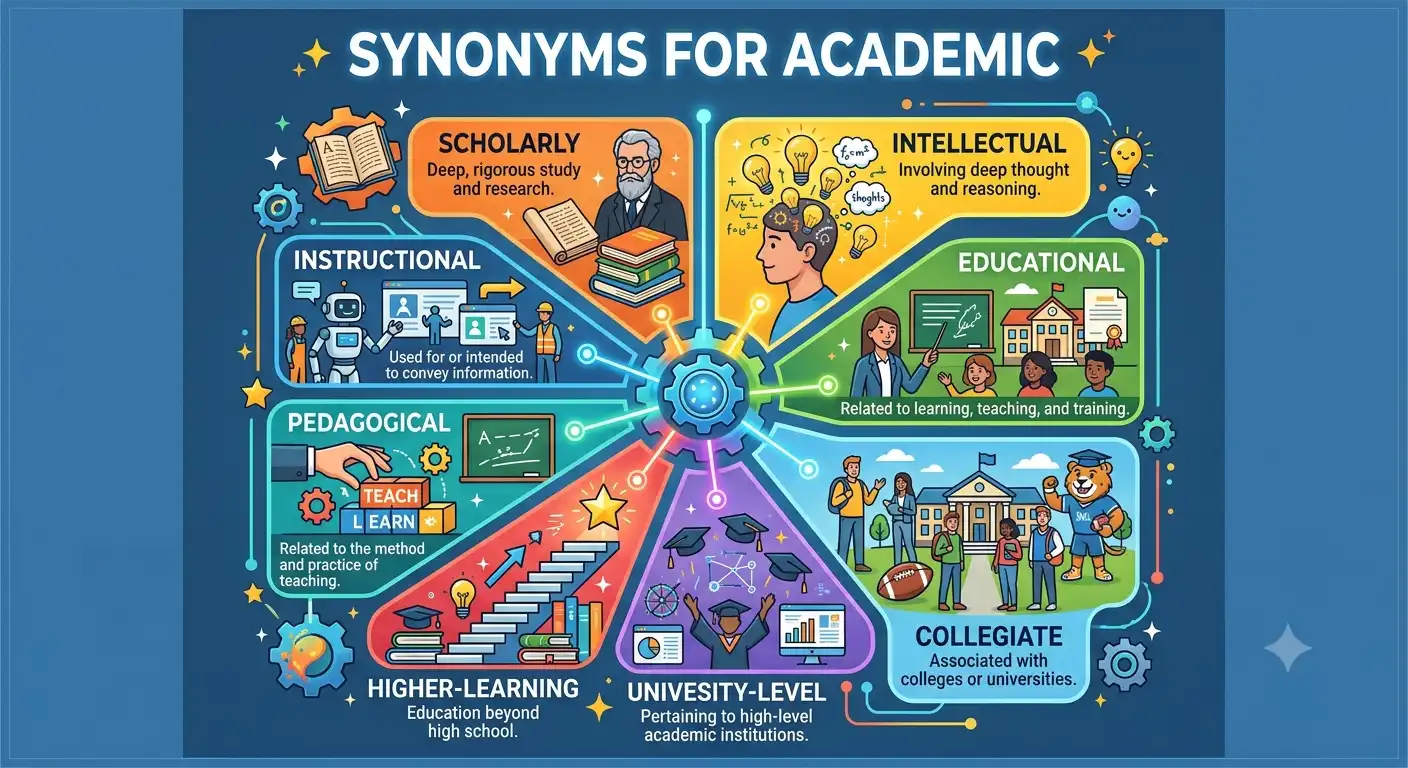
Finding the best synonyms for academic helps you elevate your writing with precision, clarity, and style. When writers search for synonyms for academic, they want clear words that describe learning, schools, research, and formal study. Learning rich synonyms for academic allows you to replace overused vocabulary with exact terms tailored to your audience.
A college student sits at a desk late at night, surrounded by stacks of research papers and open textbooks. She keeps typing the same word over and over in her essay, watching her text feel repetitive and flat. Replacing that single overused term with precise alternatives suddenly transforms her paper into an engaging, polished masterpiece.
“Education is not the learning of facts, but the training of the mind to think.” — Albert Einstein
The word academic simply means anything connected to school, college, studying, books, or deep mental ideas. Consider a high school teacher reviewing a student’s project on history. Calling the project academic shows that the work relies on serious research, study, and careful thinking.
“An investment in knowledge pays the best interest.” — Benjamin Franklin
Building a strong toolkit of synonyms for academic offers clear advantages across many areas:
- Students can write sharper essays, research papers, and assignments without relying on repetitive phrasing.
- Bloggers can create informative articles about career growth, education, and skill development that hold reader attention.
- Content writers can craft authoritative website copy, whitepapers, and promotional guides for educational brands.
- Daily English users can discuss courses, books, and formal topics with confidence in personal and professional chats.
Linguistic Breakdown of “Academic”
Connotative Meaning
The word academic carries formal, respectful, and intellectually serious connotations. It suggests deep study, scholarship, and logical reasoning. In some informal contexts, it can also describe something purely theoretical or not immediately practical.
Etymology
- Prefix: None.
- Root Word: Akadēmeia (Greek name for the grove near Athens where Plato taught his philosophical school).
- Historical Path: Passed from Greek through Latin academicus and French académique, entering English in the late 16th century to describe higher education and scholarly pursuits.
Pronunciation
- US IPA: /ˌæk.əˈdem.ɪk/
- UK IPA: /ˌæk.əˈdem.ɪk/
Syllables & Affixation Pattern
- Syllables: 4 (ac-a-dem-ic)
- Root Word: Academy
- Affixation: Root word academy + suffix -ic (forming an adjective).
Comparison Table of Key Synonyms
| Keyword | Meaning | Usage Type | Context |
|---|---|---|---|
| Scholarly | Involving serious study and detailed research | Formal / Professional | Academic papers, books, expert reviews |
| Educational | Related to teaching, learning, and school instruction | General / Functional | School programs, games, field trips |
| Scholastic | Pertaining to schools, students, and study activities | Formal / Administrative | Sports leagues, test scores, school records |
| Intellectual | Involving deep thought, reasoning, and mental activity | Professional / Reflective | Debates, articles, deep conversations |
| Theoretical | Based on ideas rather than practical experience | Formal / Technical | Science models, concepts, hypotheses |
| Pedagogical | Related to methods and practices of teaching | Technical / Professional | Teacher training, lesson planning |
| Collegiate | Connected to college or university life | Casual / Formal | Campus events, sports teams, alumni groups |
| Learned | Having vast knowledge gained through study | Formal / Respectful | Descriptions of scholars, judges, authors |
Main Content – 50 Synonyms for Academic
“The beautiful thing about learning is that no one can take it away from you.” — B.B. King
1. Scholarly
- Pronunciation: US: /ˈskɑː.lɚ.li/ | UK: /ˈskɒl.ə.li/
- Meaning: Scholarly means showing serious study and careful research.
- Examples:
- She wrote a scholarly essay on ancient history.
- The library collected many scholarly journals for students.
2. Educational
- Pronunciation: US: /ˌedʒ.əˈkeɪ.ʃən.əl/ | UK: /ˌedʒ.ʊˈkeɪ.ʃən.əl/
- Meaning: Educational means providing useful knowledge or teaching something new.
- Examples:
- The children watched an educational show about nature.
- Our class took an educational trip to the science museum.
3. Scholastic
- Pronunciation: US: /skəˈlæs.tɪk/ | UK: /skəˈlæs.tɪk/
- Meaning: Scholastic means related to schools, students, or studying.
- Examples:
- The boy received an award for his high scholastic achievements.
- Her school joined the national scholastic chess league.
4. Intellectual
- Pronunciation: US: /ˌɪn.t̬əlˈek.tʃu.əl/ | UK: /ˌɪn.təlˈek.tʃu.əl/
- Meaning: Intellectual means involving deep thinking, study, and mental effort.
- Examples:
- They enjoyed an intellectual talk about philosophy.
- Solving complex puzzles gives him intellectual satisfaction.
5. Theoretical
- Pronunciation: US: /ˌθiː.əˈret̬.kəl/ | UK: /ˌθɪəˈret.ɪ.kəl/
- Meaning: Theoretical means based on ideas rather than practical real-world actions.
- Examples:
- The physics lesson focused on theoretical ideas.
- She preferred practical work over theoretical reading.
6. Pedagogical
- Pronunciation: US: /ˌped.əˈɡɑː.dʒɪ.kəl/ | UK: /ˌped.əˈɡɒdʒ.ɪ.kəl/
- Meaning: Pedagogical means related to methods and principles of teaching.
- Examples:
- Teachers discuss new pedagogical methods every year.
- The school updated its pedagogical tools for digital learning.
7. Collegiate
- Pronunciation: US: /kəˈliː.dʒət/ | UK: /kəˈliː.dʒət/
- Meaning: Collegiate means connected to a college or university environment.
- Examples:
- He joined the collegiate basketball team during his freshman year.
- The town hosted a lively collegiate sports tournament.
8. Erudite
- Pronunciation: US: /ˈer.jə.daɪt/ | UK: /ˈer.ʊ.daɪt/
- Meaning: Erudite means having or showing great knowledge gained from books.
- Examples:
- The erudite professor explained the old text clearly.
- She gave an erudite speech at the international conference.
9. Learned
- Pronunciation: US: /ˈlɝː.nɪd/ | UK: /ˈlɜː.nɪd/
- Meaning: Learned means possessing much knowledge through deep reading and study.
- Examples:
- A learned judge reviewed the legal papers carefully.
- The group brought together many learned scholars.
10. Bookish
- Pronunciation: US: /ˈbʊk.ɪʃ/ | UK: /ˈbʊk.ɪʃ/
- Meaning: Bookish means enjoying reading and spending time studying books.
- Examples:
- The bookish boy spent his weekend at the library.
- She preferred bookish activities to loud outdoor parties.
11. Abstract
- Pronunciation: US: /ˈæb.strækt/ | UK: /ˈæb.strækt/
- Meaning: Abstract means relating to general ideas rather than real physical things.
- Examples:
- Math concepts can feel abstract to young children.
- The writer loves exploring abstract ideas in his novels.
12. Studious
- Pronunciation: US: /ˈstuː.di.əs/ | UK: /ˈstjuː.di.əs/
- Meaning: Studious means spending a lot of time reading and studying carefully.
- Examples:
- The studious girl always completes her homework early.
- He kept a studious routine throughout the entire term.
13. Lettered
- Pronunciation: US: /ˈlet̬.ɚd/ | UK: /ˈlet.əd/
- Meaning: Lettered means educated, highly cultured, and well-read.
- Examples:
- He was a lettered man who spoke five languages.
- Her lettered background helped her write clear books.
14. Highbrow
- Pronunciation: US: /ˈhaɪ.braʊ/ | UK: /ˈhaɪ.braʊ/
- Meaning: Highbrow means serious, artistic, and intended for educated people.
- Examples:
- The newspaper published highbrow reviews of classical music.
- He enjoys highbrow books about world history.
15. Literary
- Pronunciation: US: /ˈlɪt̬.ə.rer.i/ | UK: /ˈlɪt.ər.ər.i/
- Meaning: Literary means connected to literature, books, and formal writing.
- Examples:
- She joined a local literary club to discuss novel themes.
- The author won an award for her literary style.
16. Didactic
- Pronunciation: US: /daɪˈdæk.tɪk/ | UK: /daɪˈdæk.tɪk/
- Meaning: Didactic means intended to teach people a useful lesson.
- Examples:
- Children love stories that carry a helpful didactic message.
- The teacher used a didactic approach to explain science rules.
17. Instructional
- Pronunciation: US: /ɪnˈstrʌk.ʃən.əl/ | UK: /ɪnˈstrʌk.ʃən.əl/
- Meaning: Instructional means designed to give guidance and teach skills.
- Examples:
- He watched an instructional video on how to repair bikes.
- The book contains clear instructional steps for beginners.
18. Institutional
- Pronunciation: US: /ˌɪn.stəˈtuː.ʃən.əl/ | UK: /ˌɪn.stɪˈtjuː.ʃən.əl/
- Meaning: Institutional means related to an established school, college, or organization.
- Examples:
- The university introduced new institutional policies.
- They received institutional funding for their lab work.
19. Cerebral
- Pronunciation: US: /səˈriː.brəl/ | UK: /ˈser.ə.brəl/
- Meaning: Cerebral means requiring complex intelligence rather than quick emotion.
- Examples:
- The film offers a cerebral story that makes viewers think.
- He takes a cerebral approach to solving business issues.
20. Analytical
- Pronunciation: US: /ˌæn.əlˈɪt̬.ɪ.kəl/ | UK: /ˌæn.əlˈɪt.ɪ.kəl/
- Meaning: Analytical means using logical reasoning and systematic study to examine things.
- Examples:
- She used her analytical skills to solve the data problem.
- The team gave an analytical report on market trends.
21. Cultured
- Pronunciation: US: /ˈkʌl.tʃɚd/ | UK: /ˈkʌl.tʃəd/
- Meaning: Cultured means having good education, refined manners, and artistic knowledge.
- Examples:
- The cultured host talked about art and literature.
- They enjoyed a cultured evening at the museum exhibit.
22. Knowledgeable
- Pronunciation: US: /ˈnɑː.lɪ.dʒə.bəl/ | UK: /ˈnɒl.ɪ.dʒə.bəl/
- Meaning: Knowledgeable means understanding many facts and details about a topic.
- Examples:
- Our guide was very knowledgeable about local plants.
- She is knowledgeable in computer coding techniques.
23. Well-read
- Pronunciation: US: /ˌwelˈred/ | UK: /ˌwelˈred/
- Meaning: Well-read means having read many books and gained valuable information.
- Examples:
- A well-read student can discuss many historical events.
- He is a well-read person who loves classic literature.
24. Brainy
- Pronunciation: US: /ˈbreɪ.ni/ | UK: /ˈbreɪ.ni/
- Meaning: Brainy means very smart and quick at learning complex things.
- Examples:
- Her brainy brother won the school math contest easily.
- They hired a brainy engineer to build the new software.
25. Thoughtful
- Pronunciation: US: /ˈθɑːt.fəl/ | UK: /ˈθɔːt.fəl/
- Meaning: Thoughtful means showing careful, deep, and serious mental consideration.
- Examples:
- The student gave a thoughtful answer to the question.
- He wrote a thoughtful article about renewable energy.
26. Methodical
- Pronunciation: US: /məˈθɑː.dɪ.kəl/ | UK: /məˈθɒd.ɪ.kəl/
- Meaning: Methodical means doing work step by step in an organized way.
- Examples:
- She took a methodical approach to sorting research notes.
- The scientist followed methodical steps during the experiment.
27. Research-based
- Pronunciation: US: /ˈriː.sɝːtʃ beɪst/ | UK: /rɪˈsɜːtʃ beɪst/
- Meaning: Research-based means grounded in evidence collected through careful study.
- Examples:
- The doctor recommended a research-based medical treatment.
- Our school uses research-based methods to teach reading.
28. Formal
- Pronunciation: US: /ˈfɔːr.məl/ | UK: /ˈfɔː.məl/
- Meaning: Formal means following official rules, structured formats, or high standards.
- Examples:
- She received her formal education at a top academy.
- He wrote a formal letter requesting information.
29. Specialized
- Pronunciation: US: /ˈspeʃ.ə.laɪzd/ | UK: /ˈspeʃ.ə.laɪzd/
- Meaning: Specialized means concentrated on a specific area of study or skill.
- Examples:
- The university offers specialized courses in robotics.
- She earned a specialized degree in marine science.
30. Inquiring
- Pronunciation: US: /ɪnˈkwaɪ.rɪŋ/ | UK: /ɪnˈkwaɪ.ə.rɪŋ/
- Meaning: Inquiring means showing a strong desire to learn and understand facts.
- Examples:
- An inquiring mind asks thoughtful questions every day.
- The young girl had an inquiring interest in space.
31. Philosophical
- Pronunciation: US: /ˌfɪl.əˈsɑː.fɪ.kəl/ | UK: /ˌfɪl.əˈsɒf.ɪ.kəl/
- Meaning: Philosophical means searching for truth and deep understanding through reasoning.
- Examples:
- They had a philosophical debate about human nature.
- The book offers a philosophical view on world peace.
32. Educated
- Pronunciation: US: /ˈedʒ.ə.keɪ.t̬ɪd/ | UK: /ˈedʒ.ʊ.keɪ.tɪd/
- Meaning: Educated means having received schooling and acquired valuable knowledge.
- Examples:
- An educated society makes wise decisions for the future.
- She gave an educated opinion during the group discussion.
33. Scientific
- Pronunciation: US: /ˌsaɪənˈtɪf.ɪk/ | UK: /ˌsaɪənˈtɪf.ɪk/
- Meaning: Scientific means using structured testing and logic to learn truth.
- Examples:
- They followed a scientific method to test the plant growth.
- The journal published scientific discovery reports.
34. Systematic
- Pronunciation: US: /ˌsɪs.təˈmæt̬.ɪk/ | UK: /ˌsɪs.təˈmæt.ɪk/
- Meaning: Systematic means following a fixed plan or ordered system carefully.
- Examples:
- He made a systematic search for missing documents.
- The team took systematic steps to complete the study.
35. Curricular
- Pronunciation: US: /kəˈrɪk.jə.lɚ/ | UK: /kəˈrɪk.jə.lər/
- Meaning: Curricular means relating to courses of study taught in school.
- Examples:
- The principal announced several new curricular choices.
- Reading projects are part of our core curricular requirements.
36. Academician-like
- Pronunciation: US: /əˌkæd.əˈmɪʃ.ən laɪk/ | UK: /əˌkæd.əˈmɪʃ.ən laɪk/
- Meaning: Academician-like means behaving like a member of an official academy.
- Examples:
- He spoke with an academician-like focus during the lecture.
- Her academician-like approach produced accurate data.
37. Information-rich
- Pronunciation: US: /ˌɪn.fɚˈmeɪ.ʃən rɪtʃ/ | UK: /ˌɪn.fəˈmeɪ.ʃən rɪtʃ/
- Meaning: Information-rich means containing a large amount of useful facts.
- Examples:
- The student gave an information-rich talk on solar energy.
- This textbook is an information-rich resource for history class.
38. Studied
- Pronunciation: US: /ˈstʌd.id/ | UK: /ˈstʌd.id/
- Meaning: Studied means produced with careful thought, planning, and effort.
- Examples:
- She gave a studied reply after thinking for a moment.
- His studied choice of words kept the meeting calm.
39. Intellectualized
- Pronunciation: US: /ˌɪn.t̬əlˈek.tʃu.ə.laɪzd/ | UK: /ˌɪn.təlˈek.tʃu.ə.laɪzd/
- Meaning: Intellectualized means treated in a mental, logical, or theoretical way.
- Examples:
- The article offered an intellectualized review of art history.
- He gave an intellectualized explanation of human behavior.
40. Discursive
- Pronunciation: US: /dɪˈskɝː.sɪv/ | UK: /dɪˈskɜː.sɪv/
- Meaning: Discursive means passing smoothly from one academic topic to another.
- Examples:
- She wrote a discursive essay exploring multiple theories.
- The professor led a discursive conversation on world culture.
41. Doctrinal
- Pronunciation: US: /ˈdɑːk.trɪ.nəl/ | UK: /ˈdɒk.trɪ.nəl/
- Meaning: Doctrinal means relating to official principles or taught theories.
- Examples:
- Students studied the doctrinal rules of old legal systems.
- The book explores basic doctrinal theories in economics.
42. Conceptual
- Pronunciation: US: /kənˈsep.tʃu.əl/ | UK: /kənˈsep.tʃu.əl/
- Meaning: Conceptual means based on mental ideas rather than physical objects.
- Examples:
- The artist explained the conceptual meaning behind her painting.
- Math classes help students master conceptual thinking skills.
43. Hypothetical
- Pronunciation: US: /ˌhaɪ.pəˈθet̬.ɪ.kəl/ | UK: /ˌhaɪ.pəˈθet.ɪ.kəl/
- Meaning: Hypothetical means based on a suggested idea or possible situation.
- Examples:
- The teacher presented a hypothetical problem for us to solve.
- We discussed a hypothetical trip to Mars during science class.
44. Speculative
- Pronunciation: US: /ˈspek.jə.lə.t̬ɪv/ | UK: /ˈspek.jə.lə.tɪv/
- Meaning: Speculative means based on guessing or theoretical ideas without full proof.
- Examples:
- The report contained speculative ideas about future technology.
- Scientists avoided speculative claims before finishing testing.
45. Pedantic
- Pronunciation: US: /pəˈdæn.tɪk/ | UK: /pəˈdæn.tɪk/
- Meaning: Pedantic means giving too much attention to small, formal rules in studying.
- Examples:
- His pedantic correction of minor grammar errors annoyed his friends.
- She avoided a pedantic tone in her creative writing assignment.
46. Technical
- Pronunciation: US: /ˈtek.nɪ.kəl/ | UK: /ˈtek.nɪ.kəl/
- Meaning: Technical means involving specialized knowledge, rules, or practical scientific details.
- Examples:
- The manual explains technical steps for setting up computers.
- She has strong technical knowledge in environmental science.
47. Scholarlike
- Pronunciation: US: /ˈskɑː.lɚ.laɪk/ | UK: /ˈskɒl.ə.laɪk/
- Meaning: Scholarlike means having qualities typical of a dedicated researcher or student.
- Examples:
- He maintained a scholarlike focus while examining old documents.
- Her scholarlike curiosity earned praise from her teachers.
48. Literate
- Pronunciation: US: /ˈlɪt̬.ɚ.ət/ | UK: /ˈlɪt.ər.ət/
- Meaning: Literate means able to read, write, and understand complex ideas easily.
- Examples:
- A literate workforce drives innovation and economic progress.
- She is digitally literate and builds websites easily.
49. Mindful
- Pronunciation: US: /ˈmaɪnd.fəl/ | UK: /ˈmaɪnd.fəl/
- Meaning: Mindful means paying attentive thought and focus to learning process.
- Examples:
- A mindful student listens carefully during classroom lectures.
- She was mindful of evidence rules while preparing her paper.
50. Disciplinary
- Pronunciation: US: /ˌdɪs.ə.pləˈner.i/ | UK: /ˌdɪs.ɪ.plɪˈnər.i/
- Meaning: Disciplinary means related to a specific branch of knowledge or field of study.
- Examples:
- Professors set clear disciplinary standards for research papers.
- The university introduced new interdisciplinary degree tracks.
Antonyms of “Academic”
While academic focuses on formal learning, scholarship, and mental study, these antonyms reflect practical action, informal settings, or unstudied behavior:
- Practical: US: /ˈpræk.tɪ.kəl/ | UK: /ˈpræk.tɪ.kəl/ – Related to real-world action, actual experience, and doing things rather than studying theory.
- Informal: US: /ɪnˈfɔːr.məl/ | UK: /ɪnˈfɔː.məl/ – Casual, unofficial, and free from strict academic rules or requirements.
- Unscholarly: US: /ʌnˈskɑː.lɚ.li/ | UK: /ʌnˈskɒl.ə.li/ – Lacking serious study, thorough research, or careful scientific discipline.
- Ignorant: US: /ˈɪɡ.nɚ.ənt/ | UK: /ˈɪɡ.nər.ənt/ – Lacking knowledge, education, or awareness about a specific subject.
Prototype Meaning and Categorization of “Academic”
- Grammatical Category: Adjective (also used as a Noun referring to an educator or scholar).
- Prototype Meaning: Pertaining to higher education, formal scholarship, scientific research, and theoretical study.
- Semantic Field: Education, intellect, schools, research, pedagogy, literacy, and mental development.
Frequently Asked Questions (FAQ)
1. What is the most common synonym for academic?
The most common everyday synonym for academic is scholarly. Both terms refer to serious learning, structured study, and research.
2. Can “academic” have a negative meaning?
Yes, in informal situations, academic can describe a question or point that is purely theoretical with no practical real-world importance (for example, “That point is purely academic now”).
3. Which synonym for academic should I use in formal essays?
In formal essays, terms like scholarly, intellectual, pedagogical, or educational work best because they convey authority and precision.
4. What is the difference between “academic” and “scholastic”?
While academic applies broadly to research, higher education, and scholarship, scholastic usually focuses directly on schools, schoolwork, and student activities.
5. How does learning synonyms for academic help bloggers and writers?
Using diverse synonyms for academic prevents repetitive language, keeps readers engaged, improves readability, and optimizes content for search engines.
6. Is “bookish” the same as “academic”?
Not completely. Bookish describes a personal trait of loving to read books, whereas academic refers to formal educational systems and institutional study.
Conclusion
Expanding your command of synonyms for academic opens up new possibilities for clear, impactful, and expressive communication in English. Choosing words like scholarly, intellectual, pedagogical, or conceptual gives your writing authority and polish. Replacing basic terms with precise vocabulary transforms dry paragraphs into compelling content that informs and inspires readers.
Whether you write academic essays, publish engaging blog articles, draft professional emails, or lead discussions, selecting exact synonyms builds your confidence. Make it a practice to incorporate these fresh words into your daily writing routine, and watch your vocabulary flourish.
“Live as if you were to die tomorrow. Learn as if you were to live forever.” — Mahatma Gandhi
“Words are, in my not-so-humble opinion, our most inexhaustible source of magic.” — J.K. Rowling

Andrew Collins is an academic English educator with over 12 years of experience helping university students, IELTS candidates, and ESL learners improve their writing vocabulary.