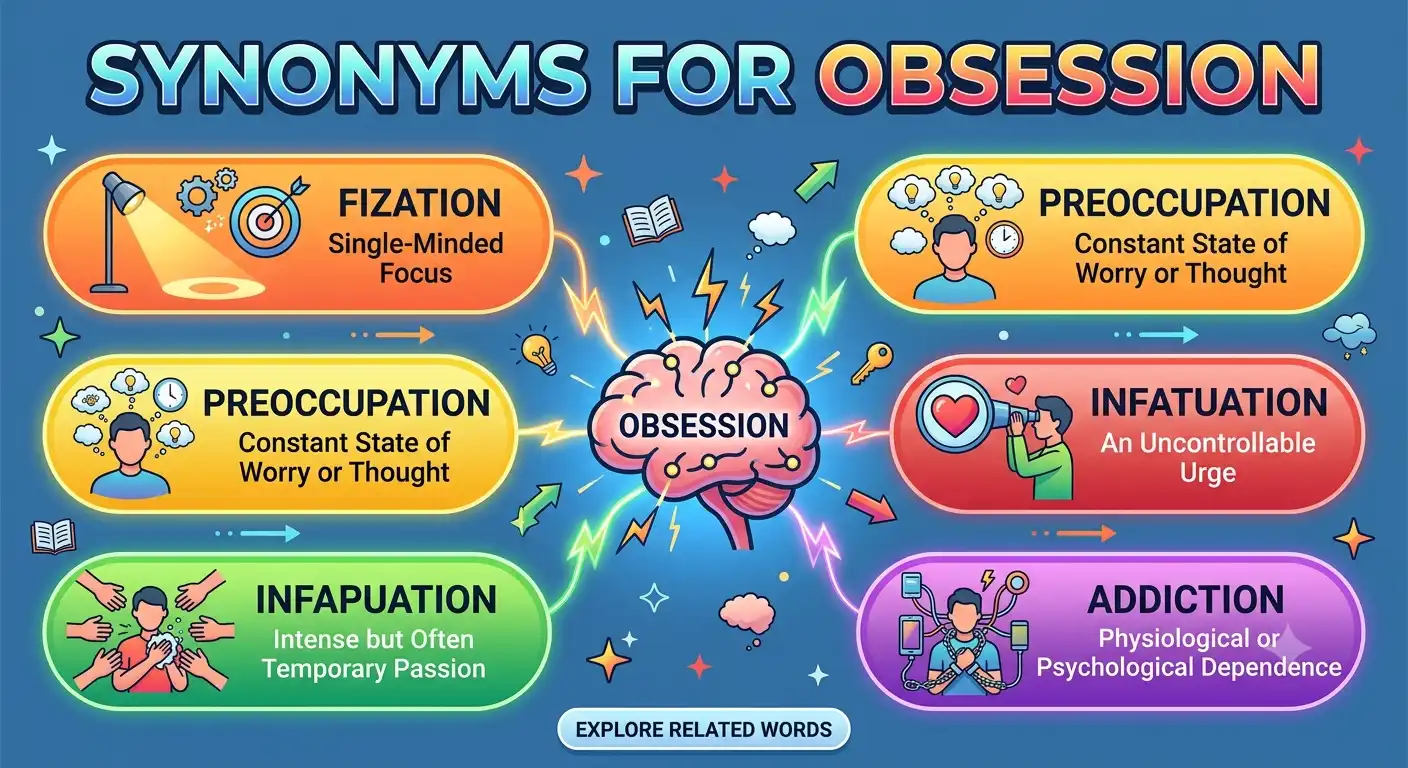
Searching for the right synonyms for obsession helps you express deep intense feelings with exact words. When you explore synonyms for obsession, you unlock better ways to describe passion, fixation, and strong desire. Learning strong synonyms for obsession gives your vocabulary clarity and impact in any conversation or essay.
Late at night, an artist stands in front of a giant canvas, painting the same ocean sunrise for the tenth time this week. She forgets her dinner and ignores her tiredness because one single idea fills her whole mind. That intense emotional drive happens to all of us when something captures our heart.
“Passion is energy. Feel the power that comes from focusing on what excites you.” — Oprah Winfrey
Think of a gamer who plays a new video game for ten hours straight, thinking about the next level even while eating lunch. That total mental focus is an obsession. An obsession simply means an idea, image, or feeling that fills your mind so completely that you cannot stop thinking about it.
“To succeed, your desire for success should be greater than your fear of failure.” — Bill Cosby
Building a strong collection of synonyms for obsession helps many different people communicate with impact:
- Students can write vivid essays and research papers without repeating basic terms.
- Bloggers can tell gripping stories about hobbies, goals, and human behavior that hook readers.
- Content writers can craft compelling marketing messages that tap into customer enthusiasm.
- Daily English users can describe personal interests, habits, and moods with precision.
Linguistic Breakdown of “Obsession”
Connotative Meaning
The word obsession carries strong emotional weight. It can suggest intense dedication, positive enthusiasm, or uncontrollable mental fixation depending on the context.
Etymology
- Prefix: ob- (towards, against, over).
- Root Word: sedēre (Latin word meaning “to sit”).
- Historical Path: Originates from Latin obsessio (a besieging or blockading), entering English in the 16th century to mean being besieged by an idea.
Pronunciation
- US IPA: /əbˈseʃ.ən/
- UK IPA: /əbˈseʃ.ən/
Syllables & Affixation Pattern
- Syllables: 3 (ob-ses-sion)
- Root Word: Obsess
- Affixation: Root verb obsess + noun suffix -ion.
Comparison Table of Key Synonyms
| Keyword | Meaning | Usage Type | Context |
|---|---|---|---|
| Fixation | An unhealthy or total focus on one thing | Formal / Psychological | Mental focus, personal habits |
| Passion | A powerful positive feeling of excitement or love | Emotional / General | Hobbies, careers, relationships |
| Infatuation | A short-lived intense passion for someone | Emotional / Casual | Romance, crushes, early love |
| Compulsion | An irresistible urge to act in a certain way | Formal / Psychological | Habits, behavior, health |
| Fascination | Deep interest and wonder about a topic | Casual / Professional | Learning, nature, science |
| Mania | Extreme enthusiasm or excessive excitement | Casual / Informal | Trends, crowds, crazes |
| Preoccupation | A state where your mind is full of thoughts | General / Professional | Work tasks, personal worries |
| Addiction | A powerful physical or mental dependence | Formal / Serious | Health, habits, behavior |
Main Content – 50 Synonyms for Obsession
“The only way to do great work is to love what you do.” — Steve Jobs
1. Fixation
- Pronunciation: US: /fɪkˈseɪ.ʃən/ | UK: /fɪkˈseɪ.ʃən/
- Meaning: Fixation means a strong focus on one single thing.
- Examples:
- His fixation on clean shoes made him polish them every day.
- Her fixation with puzzle games kept her awake all night.
2. Passion
- Pronunciation: US: /ˈpæʃ.ən/ | UK: /ˈpæʃ.ən/
- Meaning: Passion means a very strong feeling of love or excitement for something.
- Examples:
- She has a great passion for painting flowers.
- Cooking delicious meals is his lifelong passion.
3. Infatuation
- Pronunciation: US: /ɪnˌfætʃ.uˈeɪ.ʃən/ | UK: /ɪnˌfætʃ.uˈeɪ.ʃən/
- Meaning: Infatuation means intense attraction that usually lasts for a short time.
- Examples:
- His romantic infatuation faded after a few weeks.
- The movie star caused widespread teenage infatuation.
4. Compulsion
- Pronunciation: US: /kəmˈpʌl.ʃən/ | UK: /kəmˈpʌl.ʃən/
- Meaning: Compulsion means a strong urge that is hard to control.
- Examples:
- He felt a strong compulsion to check his lock again.
- Her compulsion to buy books filled her tiny room.
5. Fascination
- Pronunciation: US: /ˌfæs.ənˈeɪ.ʃən/ | UK: /ˌfæs.ɪˈneɪ.ʃən/
- Meaning: Fascination means being extremely interested in something amazing.
- Examples:
- The child stared at the fish with complete fascination.
- She showed a fascination for ocean biology at a young age.
6. Mania
- Pronunciation: US: /ˈmeɪ.ni.ə/ | UK: /ˈmeɪ.ni.ə/
- Meaning: Mania means an extreme excitement or wild enthusiasm for something popular.
- Examples:
- The new toy started a shopping mania in town.
- Soccer mania spread across the whole country during summer.
7. Preoccupation
- Pronunciation: US: /priːˌɑː.kjəˈpeɪ.ʃən/ | UK: /priːˌɒk.jʊˈpeɪ.ʃən/
- Meaning: Preoccupation means thinking so much about something that you ignore other things.
- Examples:
- Her main preoccupation was passing her final exam.
- His constant preoccupation with work made him forget lunch.
8. Craze
- Pronunciation: US: /kreɪz/ | UK: /kreɪz/
- Meaning: Craze means something that many people suddenly get excited about.
- Examples:
- The dance craze swept through every school in the city.
- Fitness crazes come and go every year.
9. Addiction
- Pronunciation: US: /əˈdɪk.ʃən/ | UK: /əˈdɪk.ʃən/
- Meaning: Addiction means a strong habit that is very difficult to stop.
- Examples:
- His addiction to smartphone games wasted many hours.
- Sugar addiction is a common problem for young children.
10. Enthusiasm
- Pronunciation: US: /ɪnˈθuː.zi.æz.əm/ | UK: /ɪnˈθjuː.zi.æz.əm/
- Meaning: Enthusiasm means a lively feeling of interest and eager happiness.
- Examples:
- She joined the school play with great enthusiasm.
- His natural enthusiasm made everyone smile during the trip.
11. Monomania
- Pronunciation: US: /ˌmɑː.noʊˈmeɪ.ni.ə/ | UK: /ˌmɒn.əʊˈmeɪ.ni.ə/
- Meaning: Monomania means being focused on only one single idea or goal.
- Examples:
- His monomania about winning the race consumed his entire morning.
- The collector showed monomania regarding rare silver coins.
12. Fetish
- Pronunciation: US: /ˈfet̬.ɪʃ/ | UK: /ˈfet.ɪʃ/
- Meaning: Fetish means an excessive devotion or attachment to an object.
- Examples:
- He has an unusual fetish for collecting old keys.
- She made a fetish of keeping her desk spotless.
13. Overinvolvement
- Pronunciation: US: /ˌoʊ.vɚ.ɪnˈvɑːlv.mənt/ | UK: /ˌəʊ.vər.ɪnˈvɒlv.mənt/
- Meaning: Overinvolvement means getting far too deeply involved in a situation.
- Examples:
- Her overinvolvement in her brother’s life caused small arguments.
- The manager avoided overinvolvement in daily minor tasks.
14. Enthrallment
- Pronunciation: US: /ɪnˈθrɑːl.mənt/ | UK: /ɪnˈθrɔːl.mənt/
- Meaning: Enthrallment means being completely held by charm or deep interest.
- Examples:
- The story held the children in complete enthrallment.
- She watched the magician with silent enthrallment.
15. Single-mindedness
- Pronunciation: US: /ˌsɪŋ.ɡəlˈmaɪn.dɪd.nəs/ | UK: /ˌsɪŋ.ɡəlˈmaɪn.dɪd.nəs/
- Meaning: Single-mindedness means focusing all your attention on one goal.
- Examples:
- Her single-mindedness helped her win the math trophy.
- He built the startup business with pure single-mindedness.
16. Fanaticism
- Pronunciation: US: /fəˈnæt̬.ə.sɪz.əm/ | UK: /fəˈnæt.ɪ.sɪz.əm/
- Meaning: Fanaticism means extreme and unreasonable enthusiasm for a belief or group.
- Examples:
- Sports fanaticism can lead fans to cheer loudly for hours.
- The leader spoke with intense political fanaticism.
17. Intoxication
- Pronunciation: US: /ɪnˌtɑːk.səˈkeɪ.ʃən/ | UK: /ɪnˌtɒk.sɪˈkeɪ.ʃən/
- Meaning: Intoxication means a state of feeling overwhelmed with wild excitement.
- Examples:
- The intoxication of success made him feel super happy.
- She enjoyed the sweet intoxication of her victory speech.
18. Zeal
- Pronunciation: US: /ziːl/ | UK: /ziːl/
- Meaning: Zeal means great energy and eagerness to achieve something.
- Examples:
- The new volunteer worked with amazing zeal.
- He defended his team with burning zeal.
19. Madness
- Pronunciation: US: /ˈmæd.nəs/ | UK: /ˈmæd.nəs/
- Meaning: Madness means foolish or wild behavior driven by intense emotion.
- Examples:
- Spending all his savings on shoes was pure madness.
- The excitement in the stadium turned into wild madness.
20. Delirium
- Pronunciation: US: /dɪˈlɪr.i.əm/ | UK: /dɪˈlɪr.i.əm/
- Meaning: Delirium means wild mental excitement or uncontrollable happiness.
- Examples:
- Winning the final match created total delirium among fans.
- The happy crowd cheered in a state of delirium.
21. Craving
- Pronunciation: US: /ˈkreɪ.vɪŋ/ | UK: /ˈkreɪ.vɪŋ/
- Meaning: Craving means a strong and urgent desire to have something.
- Examples:
- She had a strong craving for chocolate cake after dinner.
- His craving for adventure led him to hike the mountains.
22. Urge
- Pronunciation: US: /ɝːdʒ/ | UK: /ɜːdʒ/
- Meaning: Urge means a sudden strong wish to do something quickly.
- Examples:
- He felt an urge to call his mother immediately.
- She resisted the urge to open the birthday present early.
23. Attachment
- Pronunciation: US: /əˈtætʃ.mənt/ | UK: /əˈtætʃ.mənt/
- Meaning: Attachment means a strong feeling of affection and closeness to something.
- Examples:
- The boy had a deep attachment to his old teddy bear.
- Her attachment to her childhood home made moving hard.
24. Devotion
- Pronunciation: US: /dɪˈvoʊ.ʃən/ | UK: /dɪˈvəʊ.ʃən/
- Meaning: Devotion means great love, loyalty, and care for a person or activity.
- Examples:
- Her devotion to her dog showed in how well she cared for him.
- He studied music with endless devotion every afternoon.
25. Captivation
- Pronunciation: US: /ˌkæp.təˈveɪ.ʃən/ | UK: /ˌkæp.tɪˈveɪ.ʃən/
- Meaning: Captivation means a feeling of being completely charmed and interested.
- Examples:
- The beauty of the artwork filled her with captivation.
- His storytelling created instant captivation in the room.
26. Haunting
- Pronunciation: US: /ˈhɑːn.tɪŋ/ | UK: /ˈhɔːn.tɪŋ/
- Meaning: Haunting means a feeling or memory that stays in your mind continuously.
- Examples:
- The song had a beautiful haunting melody.
- Her persistent haunting thought was about the lost puppy.
27. Idolatry
- Pronunciation: US: /aɪˈdɑː.lə.tri/ | UK: /aɪˈdɒl.ə.tri/
- Meaning: Idolatry means loving or admiring someone or something far too much.
- Examples:
- Young fans showed near idolatry toward the famous pop star.
- The biography warns against blind celebrity idolatry.
28. Infatuation-like
- Pronunciation: US: /ɪnˌfætʃ.uˈeɪ.ʃən laɪk/ | UK: /ɪnˌfætʃ.uˈeɪ.ʃən laɪk/
- Meaning: Infatuation-like means resembling a quick and sudden passion.
- Examples:
- He showed an infatuation-like interest in his new bike.
- Her sudden infatuation-like fondness for painting faded fast.
29. Partiality
- Pronunciation: US: /ˌpɑːr.ʃiˈæl.ə.t̬i/ | UK: /ˌpɑː.ʃiˈæl.ə.ti/
- Meaning: Partiality means a special liking or preference for a particular thing.
- Examples:
- She has a strong partiality for sweet fruit tea.
- The teacher showed no partiality toward any student.
30. Possession
- Pronunciation: US: /pəˈzeʃ.ən/ | UK: /pəˈzeʃ.ən/
- Meaning: Possession means a state of being completely controlled by an idea or spirit.
- Examples:
- A strange feeling of artistic possession came over the writer.
- He worked on the puzzle as if under total possession.
31. Besottedness
- Pronunciation: US: /bɪˈsɑː.t̬ɪd.nəs/ | UK: /bɪˈsɒt.ɪd.nəs/
- Meaning: Besottedness means the state of being blindly in love or deeply fascinated.
- Examples:
- His besottedness made him smile at every picture of her.
- Her besottedness with the cute kitten was obvious.
32. Hunger
- Pronunciation: US: /ˈhʌŋ.ɡɚ/ | UK: /ˈhʌŋ.ɡər/
- Meaning: Hunger means a strong continuous desire to achieve or gain something.
- Examples:
- The young athlete had a real hunger for victory.
- Her hunger for knowledge led her to read every book.
33. Thirst
- Pronunciation: US: /θɝːst/ | UK: /θɜːst/
- Meaning: Thirst means a deep eager wish for learning, success, or adventure.
- Examples:
- He has a constant thirst for exploring new cities.
- Her thirst for truth made her a great reporter.
34. Drive
- Pronunciation: US: /draɪv/ | UK: /draɪv/
- Meaning: Drive means energy and strong determination to reach a goal.
- Examples:
- Her personal drive helped her finish the marathon easily.
- The student showed great drive during the science fair.
35. Habit
- Pronunciation: US: /ˈhæb.ɪt/ | UK: /ˈhæb.ɪt/
- Meaning: Habit means a regular action that you do almost automatically.
- Examples:
- Reading before bed is a healthy evening habit.
- He formed a bad habit of biting his nails when nervous.
36. Hysteria
- Pronunciation: US: /hɪˈster.i.ə/ | UK: /hɪˈstɪə.ri.ə/
- Meaning: Hysteria means uncontrollable wild excitement or panic among people.
- Examples:
- Concert hysteria broke out when the band took the stage.
- The scary movie caused sudden hysteria in the cinema.
37. Fondness
- Pronunciation: US: /ˈfɑːnd.nəs/ | UK: /ˈfɒnd.nəs/
- Meaning: Fondness means a gentle feeling of liking or affection.
- Examples:
- She recalled her grandmother with warm fondness.
- He has a strong fondness for chocolate ice cream.
38. Immersiveness
- Pronunciation: US: /ɪˈmɝː.sɪv.nəs/ | UK: /ɪˈmɜː.sɪv.nəs/
- Meaning: Immersiveness means being completely surrounded and absorbed by an activity.
- Examples:
- The video game offers amazing total immersiveness.
- She loved the deep immersiveness of reading historical fiction.
39. Fever
- Pronunciation: US: /ˈfiː.vɚ/ | UK: /ˈfiː.vər/
- Meaning: Fever means a state of intense excitement or activity.
- Examples:
- Gold fever made many people travel west in old times.
- Election fever filled the town with bright colorful banners.
40. Obsessiveness
- Pronunciation: US: /əbˈses.ɪv.nəs/ | UK: /əbˈses.ɪv.nəs/
- Meaning: Obsessiveness means the state of being overly focused on details.
- Examples:
- His obsessiveness with clean floors kept him sweeping daily.
- Her obsessiveness about grammar made her paper perfect.
41. Adoration
- Pronunciation: US: /ˌæd.əˈreɪ.ʃən/ | UK: /ˌæd.əˈreɪ.ʃən/
- Meaning: Adoration means deep love, worship, and great respect for someone.
- Examples:
- The small child looked at her hero with pure adoration.
- He showered his wife with endless affection and adoration.
42. Charm
- Pronunciation: US: /tʃɑːrm/ | UK: /tʃɑːm/
- Meaning: Charm means a pleasant quality that attracts and holds attention easily.
- Examples:
- The old cottage had a quiet natural charm.
- His funny stories brought instant charm to the dinner party.
43. Fancy
- Pronunciation: US: /ˈfæn.si/ | UK: /ˈfæn.si/
- Meaning: Fancy means a sudden feeling of liking or desire for something.
- Examples:
- She took a sudden fancy to the blue dress in the window.
- He bought the painting just on a passing fancy.
44. Spell
- Pronunciation: US: /spel/ | UK: /spel/
- Meaning: Spell means a strong attractive power that holds someone completely focused.
- Examples:
- The music cast a magic spell over the quiet audience.
- She fell under the spell of mountain climbing last summer.
45. Infiltration
- Pronunciation: US: /ˌɪn.fɪlˈtreɪ.ʃən/ | UK: /ˌɪn.fɪlˈtreɪ.ʃən/
- Meaning: Infiltration means slowly filling your thoughts and taking over attention.
- Examples:
- The constant noise had an annoying infiltration into his thoughts.
- Her new ideas saw a gradual infiltration into company work.
46. Domination
- Pronunciation: US: /ˌdɑː.məˈneɪ.ʃən/ | UK: /ˌdɒm.ɪˈneɪ.ʃən/
- Meaning: Domination means having full power and control over someone’s focus.
- Examples:
- The topic held total domination over our family dinner chat.
- Her thoughts suffered from the domination of fear.
47. Absorption
- Pronunciation: US: /əbˈsɔːrp.ʃən/ | UK: /əbˈzɔːp.ʃən/
- Meaning: Absorption means full mental concentration and deep involvement in a task.
- Examples:
- His total absorption in his drawing made time fly fast.
- She read the science chapter with intense absorption.
48. Grip
- Pronunciation: US: /ɡrɪp/ | UK: /ɡrɪp/
- Meaning: Grip means strong mental control or hold over your emotions.
- Examples:
- The scary mystery novel kept a tight grip on her attention.
- Fear lost its firm grip once the lights turned back on.
49. Mindset
- Pronunciation: US: /ˈmaɪnd.set/ | UK: /ˈmaɪnd.set/
- Meaning: Mindset means a fixed way of thinking that influences all your actions.
- Examples:
- A positive mindset helps you solve difficult problems calmly.
- Her competitive mindset pushed her to train every morning.
50. Yearning
- Pronunciation: US: /ˈjɝː.nɪŋ/ | UK: /ˈjɜː.nɪŋ/
- Meaning: Yearning means a deep nostalgic feeling of wanting something distant.
- Examples:
- He felt a gentle yearning for his childhood home town.
- Her heart held a deep yearning for peaceful travel.
Antonyms of “Obsession”
While obsession describes intense focus, deep passion, or mental fixation, these antonyms express indifference, calm balance, or lack of interest:
- Indifference: US: /ɪnˈdɪf.ɚ.əns/ | UK: /ɪnˈdɪf.ər.əns/ – A complete lack of interest, concern, or excitement about something.
- Apathy: US: /ˈæp.ə.θi/ | UK: /ˈæp.ə.θi/ – A feeling of not caring or having no enthusiasm at all.
- Unconcern: US: /ˌʌn.kənˈsɝːn/ | UK: /ˌʌn.kənˈsɜːn/ – A relaxed state of not worrying or caring about a situation.
- Disinterest: US: /dɪsˈɪn.trɪst/ | UK: /dɪsˈɪn.trəst/ – Being completely neutral and free from personal involvement.
Prototype Meaning and Categorization of “Obsession”
- Grammatical Category: Abstract Noun (plural: obsessions).
- Prototype Meaning: A persistent, overpowering mental fixation or emotional drive that dominates thoughts and actions.
- Semantic Field: Psychology, human emotion, motivation, focus, desire, and mental habits.
Frequently Asked Questions (FAQ)
1. What is the most common synonym for obsession?
The most common everyday synonyms for obsession are fixation, passion, and fascination. These words describe intense mental focus or strong personal interest.
2. Is “obsession” always a negative word?
No, obsession can be positive when it refers to healthy dedication, creative passion, or hard work toward achieving a goal. However, in medical contexts, it describes uncontrollable anxiety or harmful fixations.
3. What is the difference between “passion” and “obsession”?
Passion usually brings joy, energy, and positive satisfaction, whereas obsession can feel overpowering, compulsory, and difficult to turn off.
4. Which synonym for obsession should I use in formal writing?
In academic or professional writing, words like preoccupation, fixation, compulsion, or single-mindedness fit best because they sound precise and professional.
5. Can “addiction” be used as a synonym for obsession?
Yes, addiction works as a synonym when describing an intense, hard-to-break mental habit or dependence on an activity like gaming or shopping.
6. How does using synonyms for obsession improve content writing?
Using various synonyms for obsession prevents repetitive phrasing, adds emotional tone, engages readers, and improves search engine visibility across your content.
Conclusion
Expanding your knowledge of synonyms for obsession unlocks new depth and tone in your English communication. Choosing exact words like fixation, passion, preoccupation, or single-mindedness gives your sentences strong emotional clarity and professional polish. Replacing overused terms makes your stories, essays, and articles far more engaging to read.
“Words are a powerful tool. Use them to express your thoughts with precision and beauty.” — Unknown
“The limit of your language means the limits of your world.” — Ludwig Wittgenstein
Whether you write professional emails, compose college essays, blog about lifestyle topics, or chat with friends, building a rich vocabulary builds your confidence. Take time to practice these fresh synonyms in your daily writing routine, and watch your communication skills flourish.

Andrew Collins is an academic English educator with over 12 years of experience helping university students, IELTS candidates, and ESL learners improve their writing vocabulary.