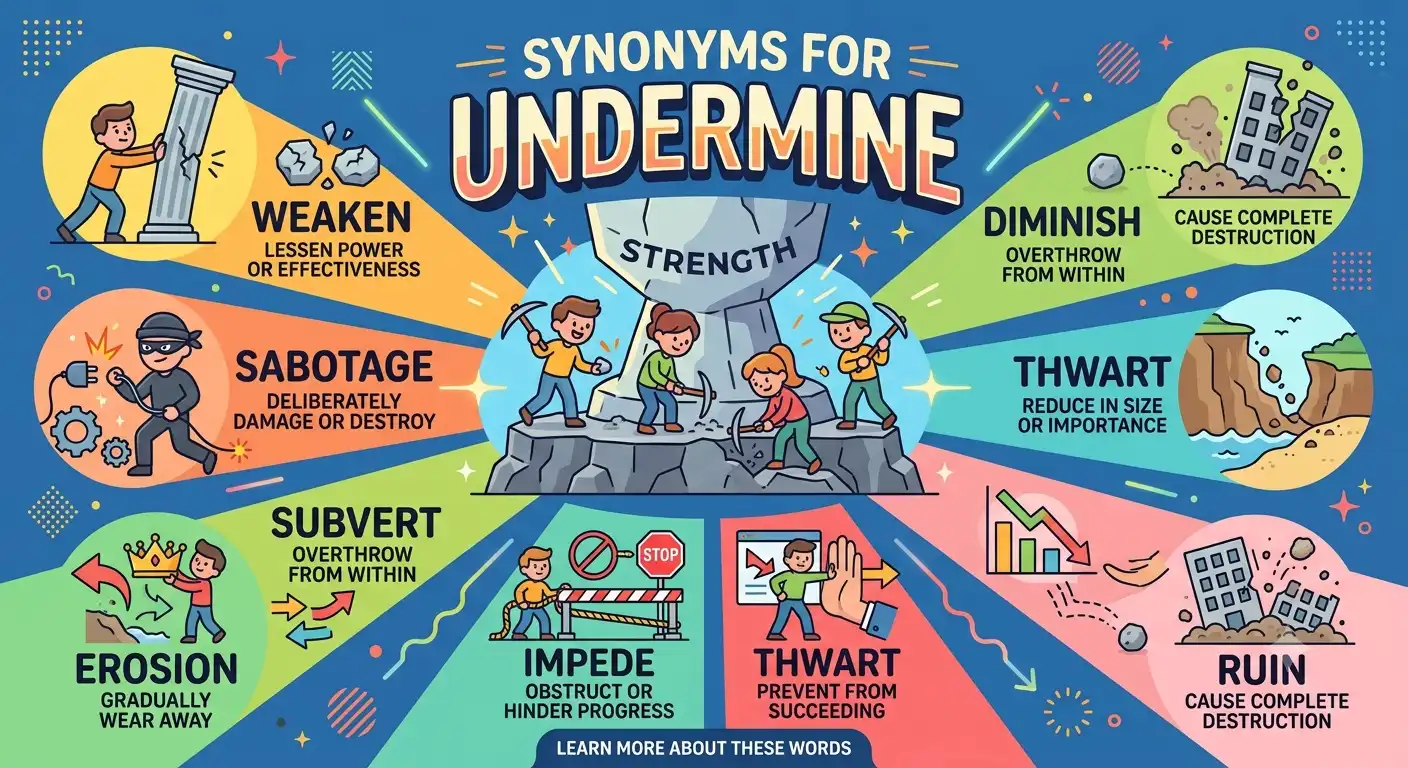
Finding the right synonyms for undermine helps you describe how actions, words, or habits slowly weaken trust and success. When you learn synonyms for undermine, you expand your vocabulary to explain how confidence or authority breaks down over time. Exploring effective synonyms for undermine gives your daily writing and spoken English far greater precision and impact.
Imagine a dedicated team working on a major school project for three weeks. Just before presentation day, one group member repeatedly criticizes the team plan in private, making everyone lose confidence in their work. That quiet, hidden action slowly weakens the foundation of the whole group. An undermine process happens whenever someone or something secretly weakens, damages, or hurts a foundation, belief, or effort step by step.
“Trust is built with consistency, but small careless actions can undermine years of effort.” — Unknown
In plain English, to undermine simply means to make something weaker or less effective in a slow, secret, or gradual way.
“The secret of change is to focus all of your energy not on fighting the old, but on building the new.” — Socrates
Building a strong collection of synonyms for undermine helps many different people communicate with impact:
- Students can write sharper essays and analysis papers without repeating basic terms.
- Bloggers can describe workplace struggles, personal relationships, and social habits with emotional clarity.
- Content writers can craft persuasive marketing copy that highlights hidden risks and solutions.
- Daily English users can express subtle feelings of doubt, betrayal, or reduced confidence accurately.
Linguistic Breakdown of “Undermine”
Connotative Meaning
The verb undermine carries a negative or cautionary emotional weight. It implies sneaky, indirect, or continuous damage that destroys stability or confidence from underneath.
Etymology
- Prefix: under- (Old English word meaning “beneath” or “below”).
- Root Word: mine (Middle English/Old French miner, meaning “to dig under the ground”).
- Historical Path: Emerged in the 14th century to describe digging military tunnels beneath walls to weaken castle defenses, later evolving into a metaphor for secret sabotage.
Pronunciation
- US IPA: /ˌʌn.dɚˈmaɪn/
- UK IPA: /ˌʌn.dəˈmaɪn/
Syllables & Affixation Pattern
- Syllables: 3 (un-der-mine)
- Root Word: Mine
- Affixation: Prefix under- + verb mine.
Comparison Table of Key Synonyms
| Keyword | Meaning | Usage Type | Context |
|---|---|---|---|
| Subvert | To secretly damage an established authority or system | Formal / Political | Governance, institutions, power structures |
| Weaken | To reduce the strength or energy of something | Casual / General | Health, structures, arguments, confidence |
| Sabotage | To deliberately destroy or ruin a process or plan | Formal / Serious | Workplace, military, group projects |
| Erode | To wear away or destroy something very slowly | Technical / Descriptive | Relationships, trust, soil, confidence |
| Undercut | To offer lower prices or weaken someone’s position | Professional / Business | Economics, debates, authority |
| Compromise | To expose something to risk, harm, or doubt | Formal / Professional | Security, safety, reputation |
| Impair | To lessen the quality, power, or value of something | Formal / Medical | Health, senses, mental abilities |
| Destabilize | To make a system or situation shaky and unsteady | Formal / Strategic | Politics, economy, emotions |
Main Content – 50 Synonyms for Undermine
“Lies do not destroy truth, but they undermine our ability to live within it.” — Unknown
1. Subvert
- Pronunciation: US: /səbˈvɝːt/ | UK: /səbˈvɜːt/
- Meaning: Subvert means to secretly weaken or destroy authority or rules.
- Examples:
- Dishonest actions subvert team trust very quickly.
- The fake news tried to subvert public confidence in the vote.
2. Weaken
- Pronunciation: US: /ˈwiː.kən/ | UK: /ˈwiː.kən/
- Meaning: Weaken means to make something less strong or less powerfull.
- Examples:
- Rain will weaken the dirt roads near the farm.
- Cold weather can weaken your body defenses.
3. Sabotage
- Pronunciation: US: /ˈsæb.ə.tɑːʒ/ | UK: /ˈsæb.ə.tɑːʒ/
- Meaning: Sabotage means to intentionally break or spoil a plan on purpose.
- Examples:
- Jealous thoughts can sabotage a great friendship.
- Fear of failing will sabotage your personal progress.
4. Threaten
- Pronunciation: US: /ˈθret.ən/ | UK: /ˈθret.ən/
- Meaning: Threaten means to cause danger or risk to something valuable.
- Examples:
- High storm waves threaten the small wooden pier.
- Bad eating habits threaten your long long-term health.
5. Impair
- Pronunciation: US: /ɪmˈper/ | UK: /ɪmˈpeər/
- Meaning: Impair means to damage or lessen normal ability or strength.
- Examples:
- Loud music can impair your delicate hearing over time.
- Lack of sleep will impair your focus during tests.
6. Damage
- Pronunciation: US: /ˈdæm.ɪdʒ/ | UK: /ˈdæm.ɪdʒ/
- Meaning: Damage means to harm or spoil the value of something.
- Examples:
- Falling rocks can damage your green car easily.
- Harsh words damage friendly relationships very deeply.
7. Erode
- Pronunciation: US: /ɪˈroʊd/ | UK: /ɪˈrəʊd/
- Meaning: Erode means to slowly wear away something piece by piece.
- Examples:
- River water will erode the soft clay bank.
- Repeated lies erode personal trust completely.
8. Destabilize
- Pronunciation: US: /diːˈsteɪ.bəl.aɪz/ | UK: /diːˈsteɪ.bəl.aɪz/
- Meaning: Destabilize means to make a steady situation unsafe and shaky.
- Examples:
- Sudden price changes destabilize small local businesses.
- Angry arguments destabilize a calm working team.
9. Undercut
- Pronunciation: US: /ˌʌn.dɚˈkʌt/ | UK: /ˌʌn.dəˈkʌt/
- Meaning: Undercut means to weaken someone’s power or offer lower prices.
- Examples:
- Rude remarks undercut the speaker confidence on stage.
- The new store tried to undercut market prices today.
10. Compromise
- Pronunciation: US: /ˈkɑːm.prə.maɪz/ | UK: /ˈkɒm.prə.maɪz/
- Meaning: Compromise means to put safety or reputation into real danger.
- Examples:
- Sharing passwords can compromise your private online accounts.
- Cheating will compromise your clean academic record.
11. Torpedo
- Pronunciation: US: /tɔːrˈpiː.doʊ/ | UK: /tɔːˈpiː.dəʊ/
- Meaning: Torpedo means to destroy a plan or effort suddenly and completely.
- Examples:
- Bad weather threatens to torpedo our beach vacation plans.
- Last minute budget cuts torpedoed the new art project.
12. Ruin
- Pronunciation: US: /ˈruː.ɪn/ | UK: /ˈruː.ɪn/
- Meaning: Ruin means to spoil or destroy something completely beyond repair.
- Examples:
- Heavy rain will ruin our outdoor picnic today.
- Spilling juice can ruin your white silk shirt.
13. Demolish
- Pronunciation: US: /dɪˈmɑː.lɪʃ/ | UK: /dɪˈmɒl.ɪʃ/
- Meaning: Demolish means to break down or destroy a structure or idea.
- Examples:
- Workers use big trucks to demolish old empty houses.
- Her clear logic helped demolish his false claims easily.
14. Dismantle
- Pronunciation: US: /dɪsˈmæn.t̬əl/ | UK: /dɪsˈmæn.təl/
- Meaning: Dismantle means to take apart something piece by piece.
- Examples:
- He helped dismantle the large metal camping tent.
- New laws were made to dismantle dangerous illegal gangs.
15. Unsettle
- Pronunciation: US: /ʌnˈset̬.əl/ | UK: /ʌnˈset.əl/
- Meaning: Unsettle means to make someone feel worried or less confident.
- Examples:
- Strange loud noises night can unsettle young children.
- Sudden schedule shifts unsettle office workers quickly.
16. Sink
- Pronunciation: US: /sɪŋk/ | UK: /sɪŋk/
- Meaning: Sink means to cause something to fail or go down lower.
- Examples:
- High unexpected costs can sink a small local store.
- One silly mistake might sink the entire sports deal.
17. Hurt
- Pronunciation: US: /hɝːt/ | UK: /hɜːt/
- Meaning: Hurt means to cause pain, damage, or harm to someone.
- Examples:
- Mean rumors hurt people feelings very easily.
- Bad posture can hurt your lower back over time.
18. Harm
- Pronunciation: US: /hɑːrm/ | UK: /hɑːm/
- Meaning: Harm means to cause injury, damage, or bad results.
- Examples:
- Smoking tobacco will harm your healthy lungs.
- Harsh sunshine can harm delicate garden plants.
19. Cripple
- Pronunciation: US: /ˈkrɪp.əl/ | UK: /ˈkrɪp.əl/
- Meaning: Cripple means to severely damage ability or cause total weakness.
- Examples:
- High debt can cripple a young company early.
- Snow storms cripple city traffic during winter mornings.
20. Disable
- Pronunciation: US: /dɪˈseɪ.bəl/ | UK: /dɪˈseɪ.bəl/
- Meaning: Disable means to stop something from working or functioning properly.
- Examples:
- Computer viruses can disable your phone security fast.
- A flat tire will disable your car on the highway.
21. Shatter
- Pronunciation: US: /ˈʃæt̬.ɚ/ | UK: /ˈʃæt.ər/
- Meaning: Shatter means to break into many pieces or destroy hope completely.
- Examples:
- Dropping glass cups will shatter them on ceramic floors.
- Bad news can shatter high hopes for success.
22. Minimize
- Pronunciation: US: /ˈmɪn.ə.maɪz/ | UK: /ˈmɪn.ɪ.maɪz/
- Meaning: Minimize means to make something seem smaller or less important.
- Examples:
- Do not minimize your great skills in public.
- Good helmet protection helps minimize head injuries.
23. Debase
- Pronunciation: US: /dɪˈbeɪs/ | UK: /dɪˈbeɪs/
- Meaning: Debase means to lower the quality, value, or dignity of something.
- Examples:
- Cheap materials debase the quality of handmade shoes.
- Cheating in games will debase your true victory.
24. Enfeeble
- Pronunciation: US: /ɪnˈfiː.bəl/ | UK: /ɪnˈfiː.bəl/
- Meaning: Enfeeble means to make weak or deprive of physical or mental energy.
- Examples:
- A long sickness can enfeeble a strong athlete.
- Continuous self-doubt will enfeeble your clear focus.
25. Devastate
- Pronunciation: US: /ˈdev.ə.steɪt/ | UK: /ˈdev.ə.steɪt/
- Meaning: Devastate means to cause severe destruction and total sadness.
- Examples:
- Forest fires devastate large natural animal habitats.
- Losing a beloved pet can devastate a family.
26. Wreck
- Pronunciation: US: /rek/ | UK: /rek/
- Meaning: Wreck means to destroy or ruin something completely by accident or force.
- Examples:
- Loud party noises can wreck a restful night sleep.
- Texting while driving can wreck your shiny vehicle.
27. Hollow
- Pronunciation: US: /ˈhɑː.loʊ/ | UK: /ˈhɒl.əʊ/
- Meaning: Hollow means to remove the inside support or make something empty.
- Examples:
- Termites hollow out old wooden tree trunks over time.
- Empty promises hollow out true personal trust fast.
28. Attenuate
- Pronunciation: US: /əˈten.ju.eɪt/ | UK: /əˈten.ju.eɪt/
- Meaning: Attenuate means to reduce the force, thickness, or value of something.
- Examples:
- Thick walls attenuate loud noise from busy city streets.
- Good medicine can attenuate strong physical pain.
29. Lessen
- Pronunciation: US: /ˈles.ən/ | UK: /ˈles.ən/
- Meaning: Lessen means to make something smaller, weaker, or less in amount.
- Examples:
- Drinking fresh water helps lessen painful summer headaches.
- Daily practice will lessen your fear of public speaking.
30. Diminish
- Pronunciation: US: /dɪˈmɪn.ɪʃ/ | UK: /dɪˈmɪn.ɪʃ/
- Meaning: Diminish means to make something appear smaller, less, or less important.
- Examples:
- Continuous rain does not diminish her happy mood today.
- Poor lighting can diminish the beauty of art paintings.
31. Corrode
- Pronunciation: US: /kəˈroʊd/ | UK: /kəˈrəʊd/
- Meaning: Corrode means to slowly eat away or destroy metal and materials.
- Examples:
- Ocean salt air will corrode iron gates quickly.
- Bitterness can corrode quiet happiness inside your heart.
32. Poison
- Pronunciation: US: /ˈpɔɪ.zən/ | UK: /ˈpɔɪ.zən/
- Meaning: Poison means to harm or spoil feelings, thoughts, or relationships.
- Examples:
- Unfounded jealousy can poison a sweet romance fast.
- Toxic gossip will poison the entire office culture.
33. Bleed
- Pronunciation: US: /bliːd/ | UK: /bliːd/
- Meaning: Bleed means to slowly drain away resources, money, or strength.
- Examples:
- Unnecessary monthly subscriptions bleed your bank savings.
- Constant minor errors bleed project momentum over time.
34. Shake
- Pronunciation: US: /ʃeɪk/ | UK: /ʃeɪk/
- Meaning: Shake means to make something unstable, insecure, or full of doubt.
- Examples:
- Hard challenges shake your self confidence temporarily.
- Earthquakes shake tall city buildings during severe tremors.
35. Vitiate
- Pronunciation: US: /ˈvɪʃ.i.eɪt/ | UK: /ˈvɪʃ.i.eɪt/
- Meaning: Vitiate means to destroy or spoil the legal purity or quality of something.
- Examples:
- A single mistake can vitiate a formal legal contract.
- Poor logic will vitiate an otherwise strong argument.
36. Mar
- Pronunciation: US: /mɑːr/ | UK: /mɑː/
- Meaning: Mar means to spoil or ruin the perfection or appearance of something.
- Examples:
- A deep scratch will mar the smooth wooden table top.
- Small arguments mar an otherwise lovely evening dinner.
37. Spoil
- Pronunciation: US: /spɔɪl/ | UK: /spɔɪl/
- Meaning: Spoil means to ruin the quality, enjoyment, or freshness of something.
- Examples:
- Leaving fresh milk out in heat will spoil it fast.
- Bad attitudes spoil fun team games for everyone.
38. Blight
- Pronunciation: US: /blaɪt/ | UK: /blaɪt/
- Meaning: Blight means to spoil, damage, or destroy hopes and future prospects.
- Examples:
- Extreme weather can blight early spring crop harvests.
- Neglect will blight bright young career opportunities.
39. Maim
- Pronunciation: US: /meɪm/ | UK: /meɪm/
- Meaning: Maim means to severely injure or reduce the strength and function of something.
- Examples:
- Harsh budget cuts maim crucial public library services.
- Serious accidents can maim physical athletic performance.
40. Overthrow
- Pronunciation: US: /ˌoʊ.vɚˈθroʊ/ | UK: /ˌəʊ.vəˈθrəʊ/
- Meaning: Overthrow means to defeat or remove a ruler, system, or authority completely.
- Examples:
- Citizens rose up to overthrow the cruel ruling leader.
- New creative ideas often overthrow old traditional methods.
41. Neutralize
- Pronunciation: US: /ˈnuː.trə.laɪz/ | UK: /ˈnjuː.trə.laɪz/
- Meaning: Neutralize means to cancel out or make an action harmless and ineffective.
- Examples:
- Fresh water helps neutralize strong spicy hot food.
- Calm diplomacy can neutralize high tense arguments quickly.
42. Invalidate
- Pronunciation: US: /ɪnˈvæl.ə.deɪt/ | UK: /ɪnˈvæl.ɪ.deɪt/
- Meaning: Invalidate means to prove that an idea or contract is officially wrong.
- Examples:
- Missing official signatures will invalidate your legal agreement.
- New scientific facts invalidate old historical theories.
43. Nullify
- Pronunciation: US: /ˈnʌl.ə.faɪ/ | UK: /ˈnʌl.ɪ.faɪ/
- Meaning: Nullify means to make something legally void or completely without value.
- Examples:
- The judge ruled to nullify the unfair contract today.
- Honest apologize can nullify past foolish mistakes.
44. Discredit
- Pronunciation: US: /dɪsˈkred.ɪt/ | UK: /dɪsˈkred.ɪt/
- Meaning: Discredit means to harm the good reputation or trust of someone.
- Examples:
- False gossip tries to discredit hard working news reporters.
- Flawed data will discredit the scientific research paper.
45. Blemish
- Pronunciation: US: /ˈblem.ɪʃ/ | UK: /ˈblem.ɪʃ/
- Meaning: Blemish means to spoil the clean appearance or flawless record of something.
- Examples:
- One bad mark can blemish a perfect student report card.
- Dark grease spots blemish the clean white carpet floor.
46. Deface
- Pronunciation: US: /dɪˈfeɪs/ | UK: /dɪˈfeɪs/
- Meaning: Deface means to ruin or spoil the surface appearance of something.
- Examples:
- Vandals try to deface public brick walls with spray paint.
- Do not deface library books with red ink pens.
47. Overturn
- Pronunciation: US: /ˌoʊ.vɚˈtɝːn/ | UK: /ˌəʊ.vəˈtɜːn/
- Meaning: Overturn means to reverse, invalidate, or ruin an established decision.
- Examples:
- The high court decided to overturn the lower court ruling.
- Strong winds can overturn light plastic garden chairs.
48. Tarnish
- Pronunciation: US: /ˈtɑːr.nɪʃ/ | UK: /ˈtɑː.nɪʃ/
- Meaning: Tarnish means to make metal dull or spoil a good personal reputation.
- Examples:
- Water droplets tarnish polished silver spoons over time.
- Rude behavior will tarnish your good family name.
49. Disrupt
- Pronunciation: US: /dɪsˈrʌpt/ | UK: /dɪsˈrʌpt/
- Meaning: Disrupt means to interrupt or break the normal flow and order of events.
- Examples:
- Loud phone calls disrupt quiet library reading sessions.
- Unexpected roadwork will disrupt morning traffic schedules.
50. Break
- Pronunciation: US: /breɪk/ | UK: /breɪk/
- Meaning: Break means to separate into pieces or stop something from working normally.
- Examples:
- Be careful not to break fragile glass drinking cups.
- Constant delays break momentum during sports games.
Antonyms of “Undermine”
While undermine describes secret damage, gradual weakening, or destruction, these antonyms express support, strengthening, and reinforcement:
- Reinforce: US: /ˌriː.ɪnˈfɔːrs/ | UK: /ˌriː.ɪnˈfɔːs/ – To make something stronger by adding extra support, facts, or material.
- Strengthen: US: /ˈstreŋ.θən/ | UK: /ˈstreŋ.θən/ – To increase physical power, confidence, or stability.
- Bolster: US: /ˈboʊl.stɚ/ | UK: /ˈbəʊl.stər/ – To support, encourage, or build up a person or structure.
- Support: US: /səˈpɔːrt/ | UK: /səˈpɔːt/ – To hold up, give help to, or maintain the stability of something.
Prototype Meaning and Categorization of “Undermine”
- Grammatical Category: Transitive Verb (past tense: undermined, present participle: undermining).
- Prototype Meaning: To secretly or gradually weaken, erode, or damage a foundation, authority, confidence, or plan.
- Semantic Field: Power dynamics, conflict, psychology, structural integrity, communication, and strategy.
Frequently Asked Questions (FAQ)
1. What is the most common synonym for undermine?
The most common everyday synonyms for undermine are weaken, subvert, and sabotage. These words describe reducing strength or damaging progress.
2. Is “undermine” always used in a negative way?
Yes, undermine almost always carries a negative meaning because it describes secret damage, erosion of trust, or weakening stability.
3. What is the difference between “undermine” and “weaken”?
While weaken describes any loss of strength, undermine specifically implies that the damage happens gradually, secretly, or from beneath the surface.
4. Which synonym for undermine works best in business writing?
In professional or corporate settings, words like undercut, compromise, destabilize, or impair fit best due to their formal tone.
5. Can “sabotage” be used as an exact synonym for undermine?
Yes, sabotage works well as a synonym when the action is deliberate, planned, and intended to ruin a goal or process.
6. How does using synonyms for undermine improve your writing?
Using various synonyms for undermine prevents repetitive phrasing, sharpens emotional clarity, engages readers, and improves search engine visibility across blog content.
Conclusion
Expanding your collection of synonyms for undermine gives you the precise words needed to describe complex personal and professional situations. Choosing exact terms like subvert, weaken, sabotage, or undercut adds strong emotional clarity and authoritative polish to your writing and speech. Replacing overused vocabulary keeps your content engaging and dynamic for every audience.
“The difference between the right word and the almost right word is the difference between lightning and a lightning bug.” — Mark Twain
“Words are, in my not-so-humble opinion, our most inexhaustible source of magic.” — J.K. Rowling
Whether you draft business emails, compose college research papers, or write insightful blog articles, expanding your vocabulary builds communication confidence. Take time to practice these versatile synonyms in your daily writing routines, and watch your expression flourish.

Andrew Collins is an academic English educator with over 12 years of experience helping university students, IELTS candidates, and ESL learners improve their writing vocabulary.