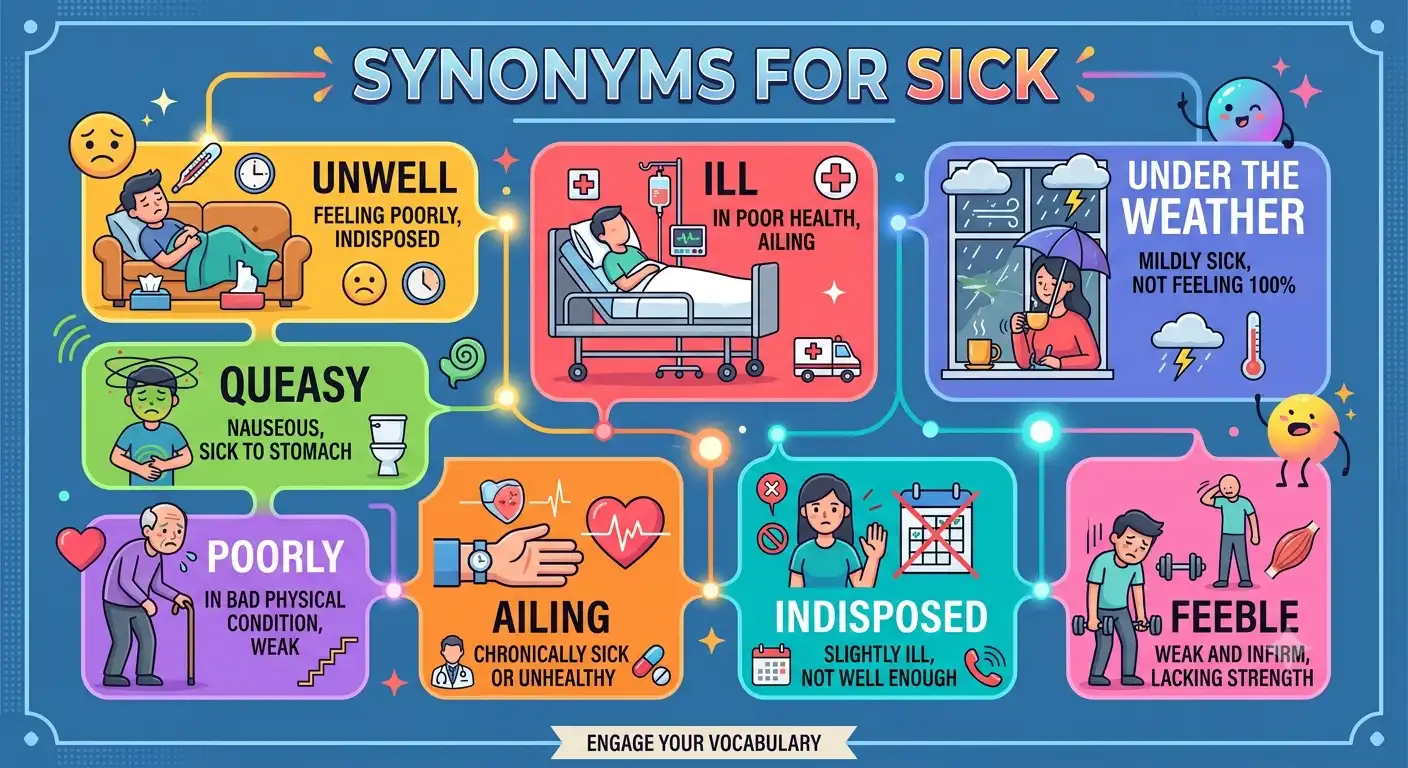
Exploring diverse synonyms for sick allows you to describe physical illnesses, feelings of nausea, or emotional fatigue with precise clarity. When writers search for synonyms for sick, they want exact terms that reflect anything from a mild cold to serious physical ailments. Learning varied synonyms for sick expands your vocabulary and keeps your everyday writing engaging.
Imagine waking up on a cold Monday morning with a scratchy throat, a heavy head, and zero energy. You need to send a message to your manager or teacher to explain why you cannot attend. Simply saying you are sick gets the message across, but it does not convey whether you have a fever, feel nauseous, or just feel tired. The word sick means feeling unwell, suffering from a disease, or experiencing nausea.
Mastering a rich variety of synonyms for sick offers key advantages for different readers:
- Students can enhance descriptive essays and avoid repeating basic words.
- Bloggers can create lively, relatable health and lifestyle posts.
- Content writers can choose exact terms for medical or wellness articles.
- Daily English users can explain personal health conditions accurately to friends and doctors.
“It is health that is real wealth and not pieces of gold and silver.” — Mahatma Gandhi
“The art of medicine consists of amusing the patient while nature cures the disease.” — Voltaire
Linguistic Breakdown of “Sick”
Connotative Meaning
The word sick carries physical, emotional, and social connotations. Physically, it denotes bodily discomfort or illness. Emotionally, it can describe feelings of disgust, boredom, or deep affection loss (such as being heartsick). Informally, it can also describe something cool or impressive, though its core meaning relates to illness.
Etymology
- Prefix: None.
- Root Word: Seoc (Old English for “ill, diseased, or feeble”).
- Historical Path: Originating from Proto-Germanic seuka-, passing into Middle English as sik or syk, before settling into modern English sick.
Pronunciation
- US IPA: /sɪk/
- UK IPA: /sɪk/
Syllables & Affixation Pattern
- Syllables: 1 (sick)
- Root Word: Sick
- Affixation: Monosyllabic root word without prefixes or suffixes.
Comparison Table of Key Synonyms
| Keyword | Meaning | Usage Type | Context |
|---|---|---|---|
| Ill | Suffering from a disease or bad health | Formal / General | Medical notes, official letters, general talk |
| Unwell | Not feeling healthy or in good condition | Polite / Gentle | Workplace emails, casual chats, family updates |
| Ailing | Experiencing long-term poor health | Descriptive / Soft | Healthcare stories, family history, elderly care |
| Poorly | Feeling sick or slightly unwell | Informal / Regional | Home conversations, casual text messages |
| Nauseous | Feeling like you want to vomit | Physical / Specific | Travel reports, medical symptoms, food reactions |
| Indisposed | Slightly ill and unable to attend events | Formal / Polite | Event cancellations, business decline letters |
| Bedridden | Forced to stay in bed due to illness | Serious / Descriptive | Medical reports, caregiving descriptions |
| Feverish | Having a high body temperature | Physical / Sensory | Doctor visits, child care, health tracking |
Main Content – 50 Synonyms for Sick
1. Ill
- Pronunciation: US: /ɪl/ | UK: /ɪl/
- Meaning: Ill means feeling bad because of a disease or physical health issue.
- Examples:
- My sister stayed home because she felt ill.
- The cold winter weather made several students ill.
2. Unwell
- Pronunciation: US: /ʌnˈwel/ | UK: /ʌnˈwel/
- Meaning: Unwell means not feeling healthy or normal in your body.
- Examples:
- Mark sent an email to his boss because he felt unwell.
- She drank hot tea after feeling unwell all morning.
3. Ailing
- Pronunciation: US: /ˈeɪ.lɪŋ/ | UK: /ˈeɪ.lɪŋ/
- Meaning: Ailing means weak and suffering from sickness for a long time.
- Examples:
- He stayed home to take care of his ailing grandmother.
- The doctor visited the ailing patient at his home.
4. Poorly
- Pronunciation: US: /ˈpʊr.li/ | UK: /ˈpɔː.li/
- Meaning: Poorly means feeling slightly sick or not in good health.
- Examples:
- The young child felt poorly after eating too many sweets.
- She looks a bit poorly today, so she is resting.
5. Nauseous
- Pronunciation: US: /ˈnɑː.ʃəs/ | UK: /ˈnɔː.zi.əs/
- Meaning: Nauseous means feeling like your stomach wants to throw up food.
- Examples:
- Long car rides always make him feel nauseous.
- She felt nauseous after stepping off the boat ride.
6. Nauseated
- Pronunciation: US: /ˈnɑː.zi.eɪ.t̬ɪd/ | UK: /ˈnɔː.zi.eɪ.tɪd/
- Meaning: Nauseated means suffering from discomfort in the stomach.
- Examples:
- The strong smell of smoke made her nauseated.
- He felt nauseated during the bumpy flight.
7. Queasy
- Pronunciation: US: /ˈkwiː.zi/ | UK: /ˈkwiː.zi/
- Meaning: Queasy means feeling slightly sick in the stomach.
- Examples:
- She felt queasy before standing up to give her speech.
- The bumpy elevator ride made him a little queasy.
8. Infirm
- Pronunciation: US: /ɪnˈfɝːm/ | UK: /ɪnˈfɜːm/
- Meaning: Infirm means weak and sick due to old age or illness.
- Examples:
- The clinic provides extra support for infirm residents.
- He grew infirm as he reached his nineties.
9. Indisposed
- Pronunciation: US: /ˌɪn.dɪˈspoʊzd/ | UK: /ˌɪn.dɪˈspəʊzd/
- Meaning: Indisposed means slightly sick and unable to do regular duties.
- Examples:
- The speaker is indisposed today, so the meeting is canceled.
- She missed the dinner party because she was indisposed.
10. Bedridden
- Pronunciation: US: /ˈbed.rɪd.ən/ | UK: /ˈbed.rɪd.ən/
- Meaning: Bedridden means forced to stay in bed because of severe sickness.
- Examples:
- The bad flu kept him bedridden for a week.
- She was bedridden while recovering from her ankle injury.
11. Feverish
- Pronunciation: US: /ˈfiː.vɚ.ɪʃ/ | UK: /ˈfiː.vər.ɪʃ/
- Meaning: Feverish means having a unusually hot body temperature from sickness.
- Examples:
- The toddler felt feverish, so his mother gave him medicine.
- He woke up feeling cold and feverish.
12. Sickly
- Pronunciation: US: /ˈsɪk.li/ | UK: /ˈsɪk.li/
- Meaning: Sickly means frequently getting sick or looking weak and pale.
- Examples:
- He was a sickly boy who caught every winter cold.
- The plant looks sickly because it needs more light.
13. Unhealthy
- Pronunciation: US: /ʌnˈhel.θi/ | UK: /ʌnˈhel.θi/
- Meaning: Unhealthy means not enjoying good health or strength in body.
- Examples:
- Eating poor food makes people feel unhealthy over time.
- She looked unhealthy after working late every night.
14. Under the weather
- Pronunciation: US: /ˈʌn.dɚ ðə ˈweð.ɚ/ | UK: /ˈʌn.də ðə ˈweð.ər/
- Meaning: Under the weather means feeling slightly sick or tired.
- Examples:
- I am feeling under the weather today, so I will rest.
- Tom skipped football practice because he was under the weather.
15. Afflicted
- Pronunciation: US: /əˈflɪk.tɪd/ | UK: /əˈflɪk.tɪd/
- Meaning: Afflicted means suffering from a painful physical or mental condition.
- Examples:
- He was afflicted with a harsh winter cough.
- The clinic treats people afflicted by allergy issues.
16. Unsound
- Pronunciation: US: /ʌnˈsaʊnd/ | UK: /ʌnˈsaʊnd/
- Meaning: Unsound means not healthy or strong in physical condition.
- Examples:
- His health remained unsound following his long trip.
- The doctor checked her unsound knee after the fall.
17. Feeble
- Pronunciation: US: /ˈfiː.bəl/ | UK: /ˈfiː.bəl/
- Meaning: Feeble means lacking physical strength due to age or sickness.
- Examples:
- The patient felt feeble after surviving a high fever.
- She gave a feeble smile from her hospital bed.
18. Frail
- Pronunciation: US: /freɪl/ | UK: /freɪl/
- Meaning: Frail means delicate and easily hurt due to poor health.
- Examples:
- Her frail body needed gentle medical attention.
- He looked frail after fighting a bad infection.
19. Weakened
- Pronunciation: US: /ˈwiː.kənd/ | UK: /ˈwiː.kənd/
- Meaning: Weakened means made less strong by sickness or injury.
- Examples:
- The virus left her body feeling very weakened.
- His weakened immune system needed extra vitamins.
20. Impaired
- Pronunciation: US: /ɪmˈperd/ | UK: /ɪmˈpeəd/
- Meaning: Impaired means damaged or weakened in normal health functions.
- Examples:
- His vision was temporarily impaired by the eye infection.
- Sickness left her hearing slightly impaired for a week.
21. Diseased
- Pronunciation: US: /dɪˈziːzd/ | UK: /dɪˈziːzd/
- Meaning: Diseased means affected by a serious illness or infection.
- Examples:
- The doctor removed the diseased tissue safely.
- Farmers cut down the diseased trees to protect the forest.
22. Invalided
- Pronunciation: US: /ˈɪn.və.lɪ.dɪd/ | UK: /ˈɪn.və.li.deɪ.tɪd/
- Meaning: Invalided means made weak or disabled by injury or sickness.
- Examples:
- He was invalided home after catching a rare virus.
- The soldier was invalided due to a long health recovery.
23. Run-down
- Pronunciation: US: /ˌrʌnˈdaʊn/ | UK: /ˌrʌnˈdaʊn/
- Meaning: Run-down means tired and sick from working too hard.
- Examples:
- She felt run-down after studying all weekend without sleep.
- Taking vitamins helps when you feel run-down.
24. Laid-up
- Pronunciation: US: /ˌleɪdˈʌp/ | UK: /ˌleɪdˈʌp/
- Meaning: Laid-up means forced to stay home or in bed from illness.
- Examples:
- He was laid-up with the flu for three full days.
- She spent her vacation laid-up with a broken foot.
25. Peakish
- Pronunciation: US: /ˈpiː.kɪʃ/ | UK: /ˈpiː.kɪʃ/
- Meaning: Peakish means looking pale, sickly, or physically tired.
- Examples:
- You look a bit peakish, so sit down and rest.
- The child looked peakish after her long fever.
26. Off-color
- Pronunciation: US: /ˌɑːfˈkʌl.ɚ/ | UK: /ˌɒfˈkʌl.ər/
- Meaning: Off-color means looking or feeling slightly sick or unwell.
- Examples:
- He felt off-color and skipped his morning workout.
- She looked off-color after working under bright sun.
27. Green around the gills
- Pronunciation: US: /ɡriːn əˈraʊnd ðə ɡɪlz/ | UK: /ɡriːn əˈraʊnd ðə ɡɪlz/
- Meaning: Green around the gills means looking pale and nauseous.
- Examples:
- The sailor looked green around the gills during the storm.
- He was green around the gills after riding the rollercoaster.
28. Disordered
- Pronunciation: US: /dɪsˈɔːr.dɚd/ | UK: /dɪsˈɔː.dəd/
- Meaning: Disordered means experiencing upset health or bodily balance.
- Examples:
- Sickness gave him a disordered stomach for days.
- Her sleep schedule became disordered during her flu.
29. Discomforted
- Pronunciation: US: /dɪsˈkʌm.fɚ.t̬ɪd/ | UK: /dɪsˈkʌm.fə.tɪd/
- Meaning: Discomforted means feeling physical uneasiness or mild pain.
- Examples:
- The tight bandage made his injured leg feel discomforted.
- She felt discomforted after eating spicy street food.
30. Out of sorts
- Pronunciation: US: /aʊt əv sɔːrts/ | UK: /aʊt əv sɔːts/
- Meaning: Out of sorts means feeling mildly sick, irritable, or unwell.
- Examples:
- He has been out of sorts since catching a cold.
- She felt out of sorts and decided to take a nap.
31. Pukey
- Pronunciation: US: /ˈpjuː.ki/ | UK: /ˈpjuː.ki/
- Meaning: Pukey means feeling close to throwing up or nauseous.
- Examples:
- The bad smell made her feel pukey right away.
- He felt pukey after eating spoiled dairy.
32. Squeamish
- Pronunciation: US: /ˈskwiː.mɪʃ/ | UK: /ˈskwiː.mɪʃ/
- Meaning: Squeamish means easily made sick by unpleasant sights or smells.
- Examples:
- He gets squeamish whenever he sees blood.
- She felt squeamish during the science dissection lab.
“The greatest of follies is to sacrifice health for any other kind of happiness.” — Arthur Schopenhauer
33. Hurt
- Pronunciation: US: /hɝːt/ | UK: /hɜːt/
- Meaning: Hurt means feeling physical pain or bodily injury.
- Examples:
- My back hurts after lifting those heavy boxes.
- She hurt her knee while running in the park.
34. Infected
- Pronunciation: US: /ɪnˈfek.tɪd/ | UK: /ɪnˈfek.tɪd/
- Meaning: Infected means affected by harmful bacteria or a virus.
- Examples:
- Clean the cut so it does not become infected.
- His infected sore throat made swallowing very painful.
35. Contagious
- Pronunciation: US: /kənˈteɪ.dʒəs/ | UK: /kənˈteɪ.dʒəs/
- Meaning: Contagious means able to spread sickness to other people easily.
- Examples:
- Stay home while your bad cold is still contagious.
- Chickenpox is a highly contagious childhood disease.
36. Pathological
- Pronunciation: US: /ˌpæθ.əˈlɑː.dʒɪ.kəl/ | UK: /ˌpæθ.əˈlɒdʒ.ɪ.kəl/
- Meaning: Pathological means caused by or relating to a physical disease.
- Examples:
- The blood test showed a pathological condition.
- Doctors studied the pathological tissue under a microscope.
37. Valetudinary
- Pronunciation: US: /ˌvæl.əˈtuː.də.ner.i/ | UK: /ˌvæl.ɪˈtjuː.dɪ.nər.i/
- Meaning: Valetudinary means sickly or overly worried about weak health.
- Examples:
- The valetudinary man carried medicine everywhere he went.
- She took valetudinary precautions during cold season.
38. Morbid
- Pronunciation: US: /ˈmɔːr.bɪd/ | UK: /ˈmɔː.bɪd/
- Meaning: Morbid means relating to or caused by a disease.
- Examples:
- The doctor examined the morbid chest condition.
- Symptoms showed a morbid state in his lungs.
39. Pale
- Pronunciation: US: /peɪl/ | UK: /peɪl/
- Meaning: Pale means light in skin color due to feeling sick.
- Examples:
- Her face turned pale when her fever started rising.
- He looked pale after his stomach started hurting.
40. Wan
- Pronunciation: US: /wɑːn/ | UK: /wɒn/
- Meaning: Wan means looking pale and weak because of sickness.
- Examples:
- She gave a wan smile from her bedroom window.
- His face was wan after spending days with a cold.
41. Washy
- Pronunciation: US: /ˈwɑː.ʃi/ | UK: /ˈwɒʃ.i/
- Meaning: Washy means lacking strength, color, or health vigor.
- Examples:
- He looked washy and weak after the long stomach bug.
- Her face turned washy after working late hours.
42. Bedfast
- Pronunciation: US: /ˈbed.fæst/ | UK: /ˈbed.fɑːst/
- Meaning: Bedfast means unable to leave bed due to bad illness.
- Examples:
- The elderly patient remained bedfast for weeks.
- She was bedfast while recovering from serious flu.
43. Bedbound
- Pronunciation: US: /ˈbed.baʊnd/ | UK: /ˈbed.baʊnd/
- Meaning: Bedbound means confined to bed because of sickness or injury.
- Examples:
- Caregivers support bedbound patients with meals and care.
- He became bedbound during his long recovery period.
44. Convalescent
- Pronunciation: US: /ˌkɑːn.vəˈles.ənt/ | UK: /ˌkɒn.vəˈles.ənt/
- Meaning: Convalescent means recovering strength after being sick recently.
- Examples:
- The convalescent child rested on the sunny porch.
- She spent two weeks in a convalescent home.
45. Nauseant
- Pronunciation: US: /ˈnɑː.zi.ənt/ | UK: /ˈnɔː.zi.ənt/
- Meaning: Nauseant means causing or experiencing a feeling of sickness.
- Examples:
- The foul smell had a nauseant effect on everyone.
- He swallowed nauseant liquid that upset his stomach.
46. Seasick
- Pronunciation: US: /ˈsiː.sɪk/ | UK: /ˈsiː.sɪk/
- Meaning: Seasick means feeling nauseous caused by the movement of a boat.
- Examples:
- Many passengers became seasick on the ocean waves.
- She took medication so she would not get seasick.
47. Carsick
- Pronunciation: US: /ˈkɑːr.sɪk/ | UK: /ˈkɑː.sɪk/
- Meaning: Carsick means feeling sick in the stomach from riding in cars.
- Examples:
- The kid gets carsick if he reads while riding.
- Sitting in the front seat helps him avoid getting carsick.
48. Airsick
- Pronunciation: US: /ˈer.sɪk/ | UK: /ˈeə.sɪk/
- Meaning: Airsick means feeling nauseous due to airplane movement.
- Examples:
- The flight attendant gave her water when she felt airsick.
- He felt airsick during the sudden plane turbulence.
49. Homesick
- Pronunciation: US: /ˈhoʊm.sɪk/ | UK: /ˈhəʊm.sɪk/
- Meaning: Homesick means feeling sad and uneasy from being away from home.
- Examples:
- The college student felt homesick during his first week.
- She called her parents whenever she felt homesick.
50. Heartsick
- Pronunciation: US: /ˈhɑːrt.sɪk/ | UK: /ˈhɑːt.sɪk/
- Meaning: Heartsick means deeply sad or sickened by disappointment or grief.
- Examples:
- She was heartsick after hearing the tragic news.
- He felt heartsick when his old pet passed away.
Antonyms of “Sick”
While sick refers to poor health, bodily pain, or nausea, these antonyms describe vitality, health, and strength:
- Healthy: US: /ˈhel.θi/ | UK: /ˈhel.θi/ – Experiencing good physical state without any disease.
- Well: US: /wel/ | UK: /wel/ – In good bodily health and free from sickness.
- Robust: US: /roʊˈbʌst/ | UK: /rəʊˈbʌst/ – Strong, healthy, and full of vigor.
- Wholesome: US: /ˈhoʊl.səm/ | UK: /ˈhəʊl.səm/ – Promoting good health and general bodily well-being.
Prototype Meaning and Categorization of “Sick”
- Grammatical Category: Adjective (comparative: sicker; superlative: sickest).
- Prototype Meaning: Suffering from physical illness, disease, bodily pain, or stomach nausea.
- Semantic Field: Medicine, health, bodily sensations, pathology, emotions, and well-being.
Frequently Asked Questions (FAQ)
1. What is the most common formal synonym for sick?
In formal writing, the best synonyms for sick are ill, unwell, or indisposed. These words sound professional and polite in emails or medical documents.
2. Is “under the weather” an acceptable synonym for sick in business emails?
Yes. Under the weather is a widely accepted idiom in professional settings to describe a mild cold or general unwellness without sharing personal details.
3. What is the difference between “nauseous” and “sick”?
While sick is a general term for any physical illness, nauseous specifically describes feeling like you need to vomit or throw up.
4. How does “sick” differ from “ill”?
In British English, ill is preferred for physical diseases, while sick often implies nausea or throwing up. In American English, both words are frequently used interchangeably.
5. What are good synonyms for sick when describing mental or emotional distress?
When describing emotional distress, words like heartsick, homesick, out of sorts, or distressed work much better than standard physical terms.
6. Can “sick” be used as slang?
Yes. In informal slang, sick can describe something exceptionally cool, impressive, or exciting (e.g., “That skateboard trick was sick!”).
Conclusion
Expanding your knowledge of synonyms for sick transforms how you express personal health, write descriptive stories, and communicate in professional spaces. Replacing basic terms with precise words like unwell, indisposed, queasy, or feverish gives your writing clarity and nuance. Whether you write academic papers, compose business messages, or draft blog posts, choosing the exact right synonym makes your communication far more effective.
Make a habit of using these fresh vocabulary choices in your daily communication. Try swapping generic phrasing for expressive terms in your next email, school assignment, or casual conversation to experience the difference.
“Health is not valued till sickness comes.” — Thomas Fuller
“To keep the body in good health is a duty… otherwise we shall not be able to keep our mind strong and clear.” — Buddha

Andrew Collins is an academic English educator with over 12 years of experience helping university students, IELTS candidates, and ESL learners improve their writing vocabulary.