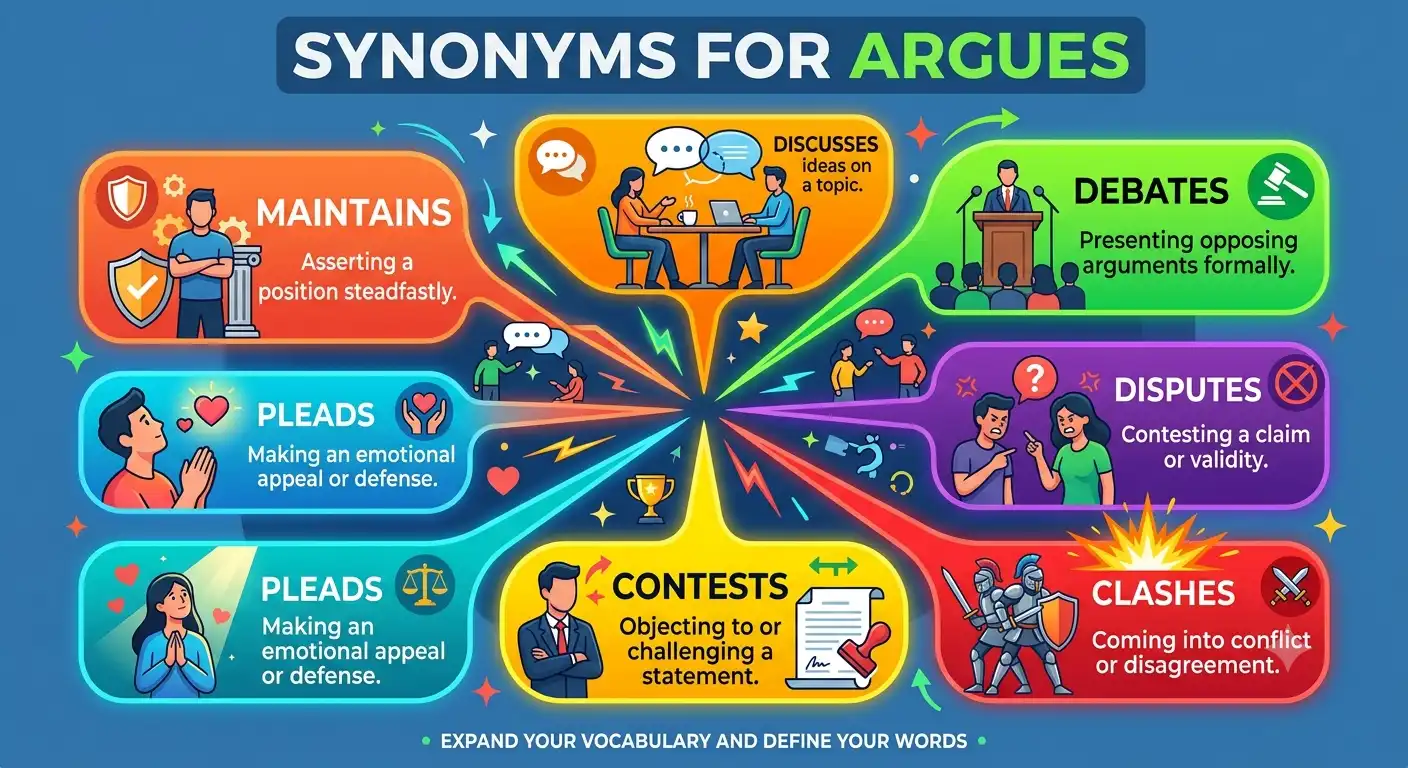
Exploring distinct synonyms for argues helps you express debates, logical reasoning, and disagreements with exact clarity. When writers search for synonyms for argues, they look for precise terms that describe quiet logic, passionate defense, or verbal conflicts. Learning fresh synonyms for argues gives your essays, blog posts, and daily talks greater precision and emotional impact.
Picture two colleagues sitting in a conference room reviewing annual project budgets. One person presents clear facts to prove a point, while another opposes the idea with strong passion. We often say each person argues their side, but using the same word repeatedly weakens your writing. To argue means to give reasons for or against something, or to exchange angry words with someone.
Mastering a rich list of synonyms for argues empowers every communicator across various fields:
- Students can write stronger persuasive essays by using formal academic terms.
- Bloggers can keep readers engaged with active, varied verb choices.
- Content writers can craft sharp product reviews and opinion pieces.
- Daily English users can describe personal conversations and workplace debates naturally.
“Aim above morality. Be not simply good; be good for something.” — Henry David Thoreau
“The aim of argument, or of discussion, should not be victory, but progress.” — Joseph Joubert
Linguistic Breakdown of “Argues”
Connotative Meaning
The verb argues can carry either an intellectual, logical tone (presenting evidence) or a contentious, emotional tone (fighting with words). The exact tone depends entirely on whether the speaker is offering reasoning or expressing conflict.
Etymology
- Prefix: None.
- Root Word: Arguere (Latin for “to make clear, prove, or accuse”).
- Historical Path: Derived from Latin arguere, entering Old French as arguer, and passing into Middle English to describe logical proof and verbal dispute.
Pronunciation
- US IPA: /ˈɑːrɡ.juːz/
- UK IPA: /ˈɑːɡ.juːz/
Syllables & Affixation Pattern
- Syllables: 2 (ar-gues)
- Root Word: Argue
- Affixation: Formed with root argue plus third-person singular present inflectional suffix -s.
Comparison Table of Key Synonyms
| Keyword | Meaning | Usage Type | Context |
|---|---|---|---|
| Claims | States that something is true, often without full proof | Neutral / Direct | News articles, everyday talk, academic papers |
| Contends | Asserts something firmly in an argument or debate | Formal / Strategic | Academic essays, legal debates, politics |
| Asserts | States a fact or belief forcefully and confidently | Professional / Confident | Business meetings, formal speeches |
| Maintains | Continues to express a strong belief over time | Formal / Persistent | Research reports, ongoing discussions |
| Insists | Demands or states something firmly without backing down | Emotional / Persuasive | Family talks, urgent requests, negotiations |
| Reasons | Thinks or explains something using logical facts | Analytical / Calm | Science essays, problem-solving, philosophy |
| Debates | Discusses a topic by presenting opposing views | Formal / Structured | Classrooms, parliaments, public forums |
| Disputes | Questions or fights against the truth of something | Professional / Conflict | Legal cases, contracts, disagreement |
Main Content – 50 Synonyms for Argues
1. Claims
- Pronunciation: US: /kleɪmz/ | UK: /kleɪmz/
- Meaning: Claims means to state that something is true.
- Examples:
- She claims her new plan saves money.
- The report claims that exercise improves sleep.
2. Contends
- Pronunciation: US: /kənˈtendz/ | UK: /kənˈtendz/
- Meaning: Contends means to argue a point firmly during a debate.
- Examples:
- The lawyer contends that his client is innocent.
- He contends that hard work brings success.
3. Asserts
- Pronunciation: US: /əˈsɝːts/ | UK: /əˈsɜːts/
- Meaning: Asserts means to state a belief with strong confidence.
- Examples:
- The manager asserts that the project will finish on time.
- She asserts her rights during the meeting.
4. Maintains
- Pronunciation: US: /meɪnˈteɪnz/ | UK: /meɪnˈteɪnz/
- Meaning: Maintains means to keep stating a belief continuously.
- Examples:
- He maintains that he made the correct choice.
- The scientist maintains her main theory despite criticism.
5. Insists
- Pronunciation: US: /ɪnˈsɪsts/ | UK: /ɪnˈsɪsts/
- Meaning: Insists means to say something firmly without giving up.
- Examples:
- Mom insists that we eat dinner together.
- He insists on paying for the coffee.
6. Reasons
- Pronunciation: US: /ˈriː.zənz/ | UK: /ˈriː.zənz/
- Meaning: Reasons means to explain something using clear logic.
- Examples:
- The teacher reasons that practice helps student memory.
- She reasons through every tough choice carefully.
7. Debates
- Pronunciation: US: /dɪˈbeɪts/ | UK: /dɪˈbeɪts/
- Meaning: Debates means to discuss opposing ideas in public or private.
- Examples:
- The panel debates new city budget plans today.
- Our class debates the benefits of uniform rules.
8. Disputes
- Pronunciation: US: /dɪˈspjuːts/ | UK: /dɪˈspjuːts/
- Meaning: Disputes means to question or fight against an idea.
- Examples:
- The driver disputes the unfair parking ticket.
- She disputes the results of the research test.
9. Challenges
- Pronunciation: US: /ˈtʃæl.ən.dʒəz/ | UK: /ˈtʃæl.ɪn.dʒɪz/
- Meaning: Challenges means to question whether a statement is true.
- Examples:
- The researcher challenges the old scientific theory.
- He challenges his opponent to prove the facts.
10. Quarrels
- Pronunciation: US: /ˈkwɑː.rəlz/ | UK: /ˈkwɒr.əlz/
- Meaning: Quarrels means to have an angry verbal fight with someone.
- Examples:
- The siblings quarrel over the television remote control.
- He rarely quarrels with his neighbors.
11. Bickers
- Pronunciation: US: /ˈbɪk.ɚz/ | UK: /ˈbɪk.əz/
- Meaning: Bickers means to argue over small, unimportant things.
- Examples:
- The kids bicker about who gets the front seat.
- They often bicker about household chores.
12. Squabbles
- Pronunciation: US: /ˈskwɑː.bəlz/ | UK: /ˈskwɒb.əlz/
- Meaning: Squabbles means to argue noisily over minor matters.
- Examples:
- Players squabble over the referee call on the field.
- Neighbors squabble about the garden fence line.
13. Alleges
- Pronunciation: US: /əˈledʒ.əz/ | UK: /əˈledʒ.ɪz/
- Meaning: Alleges means to state something without giving final proof.
- Examples:
- The newspaper alleges that the company hid costs.
- She alleges that the contract was signed incorrectly.
14. Affirms
- Pronunciation: US: /əˈfɝːmz/ | UK: /əˈfɜːmz/
- Meaning: Affirms means to state that something is true and valid.
- Examples:
- The witness affirms the story in court today.
- He affirms his loyalty to the team.
15. Declares
- Pronunciation: US: /dɪˈklerz/ | UK: /dɪˈkleəz/
- Meaning: Declares means to announce a belief clearly and openly.
- Examples:
- The mayor declares that the city is safe.
- She declares her intention to run for office.
16. Posits
- Pronunciation: US: /ˈpɑː.zɪts/ | UK: /ˈpɒz.ɪts/
- Meaning: Posits means to suggest an idea as a basic fact.
- Examples:
- The writer posits that technology changes social habits.
- He posits a new solution to the problem.
17. Submits
- Pronunciation: US: /səbˈmɪts/ | UK: /səbˈmɪts/
- Meaning: Submits means to offer an argument for consideration.
- Examples:
- The lawyer submits that the evidence is weak.
- She submits her final proposal to the committee.
18. Holds
- Pronunciation: US: /hoʊldz/ | UK: /həʊldz/
- Meaning: Holds means to possess a deep opinion or belief.
- Examples:
- He holds that honesty is the best policy.
- The court holds that the rule remains active.
19. Questions
- Pronunciation: US: /ˈkwes.tʃənz/ | UK: /ˈkwes.tʃənz/
- Meaning: Questions means to express doubt about an idea.
- Examples:
- The student questions the answer in the book.
- She questions the need for extra meetings.
20. Contests
- Pronunciation: US: /kənˈtests/ | UK: /kənˈtests/
- Meaning: Contests means to oppose an idea or decision formally.
- Examples:
- The team contests the official match results.
- He contests the terms of the new agreement.
21. Counters
- Pronunciation: US: /ˈkaʊn.t̬ɚz/ | UK: /ˈkaʊn.təz/
- Meaning: Counters means to reply to an argument with an opposing point.
- Examples:
- She counters his objection with solid sales figures.
- He counters the criticism with a warm smile.
22. Clashes
- Pronunciation: US: /ˈklæʃ.əz/ | UK: /ˈklæʃ.ɪz/
- Meaning: Clashes means to come into sharp disagreement with others.
- Examples:
- The manager clashes with staff over schedule changes.
- Her opinion clashes with traditional views.
23. Wrangles
- Pronunciation: US: /ˈræŋ.ɡəlz/ | UK: /ˈræŋ.ɡəlz/
- Meaning: Wrangles means to argue in a noisy or complicated way.
- Examples:
- The committee wrangles over minor details for hours.
- They wrangle about budget limits every year.
24. Altercates
- Pronunciation: US: /ˈɑːl.tɚ.keɪts/ | UK: /ˈɒl.tə.keɪts/
- Meaning: Altercates means to engage in a loud public dispute.
- Examples:
- The angry driver altercates with the traffic guard.
- Customers altercate over the last sale item.
25. Protests
- Pronunciation: US: /prəˈtests/ | UK: /prəˈtests/
- Meaning: Protests means to object strongly to a rule or action.
- Examples:
- Workers protest against lower daily wages.
- She protests the unfair decision made by judges.
26. Objects
- Pronunciation: US: /əbˈdʒekts/ | UK: /əbˈdʒekts/
- Meaning: Objects means to state disagreement or disapproval.
- Examples:
- The resident objects to noisy night construction.
- He objects to the proposed policy change.
27. Refutes
- Pronunciation: US: /rɪˈfjuːts/ | UK: /rɪˈfjuːts/
- Meaning: Refutes means to prove that an argument is false.
- Examples:
- Science refutes old claims about flat earth.
- She refutes the rumor with clear facts.
28. Rebuts
- Pronunciation: US: /rɪˈbʌts/ | UK: /rɪˈbʌts/
- Meaning: Rebuts means to offer evidence that counters an accusation.
- Examples:
- The speaker rebuts opponent claims point by point.
- He rebuts the false news report quickly.
“Silence is one of the hardest arguments to refute.” — Josh Billings
29. Advocates
- Pronunciation: US: /ˈæd.və.keɪts/ | UK: /ˈæd.və.keɪts/
- Meaning: Advocates means to argue publicly in favor of a cause.
- Examples:
- The doctor advocates for healthy daily habits.
- She advocates for animal safety laws.
30. Champions
- Pronunciation: US: /ˈtʃæm.pi.ənz/ | UK: /ˈtʃæm.pi.ənz/
- Meaning: Champions means to defend or support an idea passionately.
- Examples:
- The group champions equal education for all children.
- He champions green energy in his town.
31. Defends
- Pronunciation: US: /dɪˈfendz/ | UK: /dɪˈfendz/
- Meaning: Defends means to give reasons to protect an idea.
- Examples:
- She defends her choice to change careers.
- The writer defends his original storyline.
32. Proposes
- Pronunciation: US: /prəˈpoʊ.zəz/ | UK: /prəˈpəʊ.zɪz/
- Meaning: Proposes means to suggest a plan or argument for discussion.
- Examples:
- The team proposes a new work schedule.
- He proposes a fresh strategy for sales.
33. Expounds
- Pronunciation: US: /ɪkˈspaʊndz/ | UK: /ɪkˈspaʊndz/
- Meaning: Expounds means to explain an argument or idea in detail.
- Examples:
- The professor expounds on historical event causes.
- She expounds her philosophy during the lecture.
34. Professes
- Pronunciation: US: /prəˈfes.əz/ | UK: /prəˈfes.ɪz/
- Meaning: Professes means to state a belief openly, sometimes doubtfully.
- Examples:
- He professes his belief in open team dialogue.
- She professes strong interest in art history.
35. Avows
- Pronunciation: US: /əˈvaʊz/ | UK: /əˈvaʊz/
- Meaning: Avows means to state an opinion openly and without shame.
- Examples:
- The leader avows his dedication to peace.
- She avows her support for the new project.
36. Testifies
- Pronunciation: US: /ˈtes.tə.faɪz/ | UK: /ˈtes.tɪ.faɪz/
- Meaning: Testifies means to give a formal statement based on personal facts.
- Examples:
- The witness testifies about what he saw.
- Her success testifies to her constant effort.
37. Feuds
- Pronunciation: US: /fjuːdz/ | UK: /fjuːdz/
- Meaning: Feuds means to carry on a long and bitter disagreement.
- Examples:
- The two families feud over land boundaries.
- Companies feud over patent ownership in court.
38. Spars
- Pronunciation: US: /spɑːrz/ | UK: /spɑːz/
- Meaning: Spars means to engage in light, playful verbal argument.
- Examples:
- The reporters spar with the press secretary playfully.
- Friends spar good-naturedly about sport teams.
39. Haggles
- Pronunciation: US: /ˈhæɡ.əlz/ | UK: /ˈhæɡ.əlz/
- Meaning: Haggles means to argue over prices or agreement terms.
- Examples:
- The buyer haggles over market price details.
- She haggles with vendors for lower costs.
40. Dissents
- Pronunciation: US: /dɪˈsents/ | UK: /dɪˈsents/
- Meaning: Dissents means to disagree with official opinions or popular rules.
- Examples:
- One judge dissents from the majority ruling.
- He dissents from common industry practices.
41. Opposes
- Pronunciation: US: /əˈpoʊ.zəz/ | UK: /əˈpəʊ.zɪz/
- Meaning: Opposes means to speak or act against an idea or plan.
- Examples:
- The group opposes building a highway near parks.
- She opposes higher taxes on local businesses.
42. Deliberates
- Pronunciation: US: /dɪˈlɪb.ə.reɪts/ | UK: /dɪˈlɪb.ə.reɪts/
- Meaning: Deliberates means to discuss facts carefully before making decisions.
- Examples:
- The jury deliberates the evidence in private.
- The board deliberates future investment choices.
43. Discusses
- Pronunciation: US: /dɪˈskʌs.əz/ | UK: /dɪˈskʌs.ɪz/
- Meaning: Discusses means to talk about something with another person.
- Examples:
- The team discusses project options together.
- She discusses her research paper with advisors.
44. Pleads
- Pronunciation: US: /pliːdz/ | UK: /pliːdz/
- Meaning: Pleads means to present an urgent emotional argument.
- Examples:
- The driver pleads his case before the court.
- She pleads for better safety measures at work.
45. Demonstrates
- Pronunciation: US: /ˈdem.ən.streɪts/ | UK: /ˈdem.ən.streɪts/
- Meaning: Demonstrates means to prove an argument using clear facts or actions.
- Examples:
- The test demonstrates that the machine works safely.
- He demonstrates the truth of his claims clearly.
46. Establishes
- Pronunciation: US: /ɪˈstæb.lɪʃ.əz/ | UK: /ɪˈstæb.lɪʃ.ɪz/
- Meaning: Establishes means to prove an argument beyond any doubt.
- Examples:
- The study establishes a clear link between food and health.
- She establishes her points with solid evidence.
47. Pronounces
- Pronunciation: US: /prəˈnaʊn.səz/ | UK: /prəˈnaʊn.sɪz/
- Meaning: Pronounces means to state an official decision or opinion publicly.
- Examples:
- The judge pronounces the official verdict in court.
- He pronounces his final stance on the topic.
48. Rationalizes
- Pronunciation: US: /ˈræʃ.ən.əl.aɪ.zəz/ | UK: /ˈræʃ.ən.əl.aɪ.zɪz/
- Meaning: Rationalizes means to attempt to justify an argument logically.
- Examples:
- He rationalizes his late arrival with heavy traffic.
- She rationalizes the expense as necessary learning.
49. Articulates
- Pronunciation: US: /ɑːrˈtɪk.jə.leɪts/ | UK: /ɑːˈtɪk.jə.leɪts/
- Meaning: Articulates means to state an argument clearly with good words.
- Examples:
- The speaker articulates his vision for the company.
- She articulates complex ideas in simple terms.
50. Urges
- Pronunciation: US: /ˈɝː.dʒəz/ | UK: /ˈɜː.dʒɪz/
- Meaning: Urges means to persuade or argue strongly for a specific action.
- Examples:
- The doctor urges patients to drink more water.
- She urges the committee to vote on the issue today.
Antonyms of “Argues”
While argues refers to stating opposing points or engaging in verbal conflict, these antonyms represent harmony, agreement, and acceptance:
- Agrees: US: /əˈɡriːz/ | UK: /əˈɡriːz/ – Shares the exact same opinion or approves of a decision.
- Concedes: US: /kənˈsiːdz/ | UK: /kənˈsiːdz/ – Admits that another person’s argument is true or valid.
- Concurs: US: /kənˈkɝːz/ | UK: /kənˈkɜːz/ – Reaches mutual agreement or shares identical conclusions.
- Accepts: US: /əkˈsepts/ | UK: /əkˈsepts/ – Receives or agrees to an idea without opposition.
Prototype Meaning and Categorization of “Argues”
- Grammatical Category: Verb (third-person singular present: argues; infinitive: to argue).
- Prototype Meaning: Presenting reasons to support or oppose a proposition, or engaging in a verbal disagreement with another person.
- Semantic Field: Debate, persuasion, logic, public speaking, rhetoric, law, and personal relationships.
Frequently Asked Questions (FAQ)
1. What is the most common synonym for argues in formal essays?
In formal essays, the best synonyms for argues are contends, asserts, maintains, and posits. These words show strong logic without sounding aggressive.
2. Is “bickers” a direct replacement for “argues”?
No. Bickers refers specifically to minor, petty, or playful arguments, whereas argues can describe serious intellectual or logical debates.
3. When should I use “refutes” instead of “argues”?
Use refutes when the speaker is actively proving that another person’s argument or statement is completely wrong using facts.
4. What is the difference between “argues” and “debates”?
While argues can describe an individual stating a point or having a personal quarrel, debates refers to a structured discussion where two sides exchange opposing views.
5. Can “claims” be used interchangeably with “argues”?
Yes, but claims implies stating a point that might not yet have full supporting proof, whereas argues usually involves presenting reasons and evidence.
6. Why is expanding your vocabulary for “argues” important in writing?
Replacing repetitive uses of argues with precise synonyms improves readability, highlights subtle nuances in your tone, and keeps readers fully engaged.
Conclusion
Expanding your command of synonyms for argues transforms the way you communicate across every medium. Choosing words like contends, asserts, debates, or articulates keeps your writing fresh, precise, and persuasive. Whether you write academic papers, blog posts, or daily emails, using varied verbs elevates your message.
Practice using these new vocabulary choices in your daily communication. Try swapping generic phrasing for expressive terms in your next assignment, work report, or casual chat to experience the difference.
“Better than a thousand hollow words, is one word that brings peace.” — Buddha
“Words exert a magical power. They can bring either the greatest happiness or deepest despair.” — Sigmund Freud

Andrew Collins is an academic English educator with over 12 years of experience helping university students, IELTS candidates, and ESL learners improve their writing vocabulary.