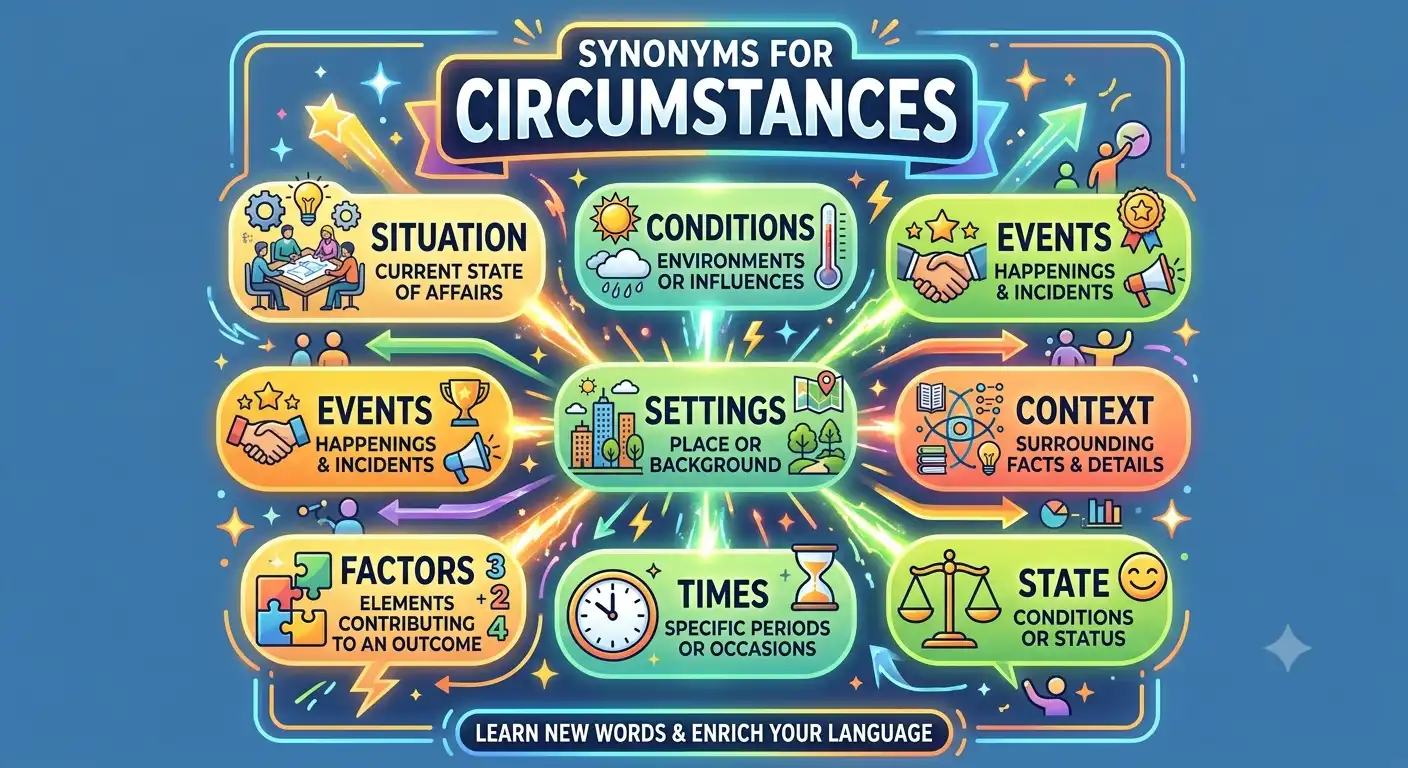
Finding the right synonyms for circumstances helps you describe life events, unique settings, and changing situations with clarity. When writers search for synonyms for circumstances, they want precise words that go beyond generic vocabulary. Using diverse synonyms for circumstances allows you to convey specific conditions, professional contexts, and emotional moments effortlessly.
Imagine a young graduate landing a job offer in a new city while caring for an aging parent at home. Her decision depends on her financial status, her family needs, and her living space. All these facts together make up her personal circumstances. Circumstances mean the facts, conditions, or events that surround a person or a situation.
Mastering a rich list of synonyms for circumstances empowers every communicator across various fields:
- Students can craft compelling essays by using exact academic terms for historical and social settings.
- Bloggers can write engaging headers that highlight real-life conditions and relatable life events.
- Content writers can describe market conditions and professional scenarios with sharp accuracy.
- Daily English users can explain their daily life and personal moments with natural confidence.
“Circumstances do not make the man, they reveal him.” — James Allen
“Adaptability is about the powerful difference between adapting to cope and adapting to win.” — Max McKeown
Linguistic Breakdown of “Circumstances”
Connotative Meaning
The word circumstances carries an analytical, descriptive, and often objective tone. It refers to the surrounding conditions, facts, or events that influence an outcome or shape a person’s choices.
Etymology
- Prefix: Circum- (Latin for “around” or “about”).
- Root Word: Stare (Latin for “to stand”).
- Historical Path: Derived from Latin circumstantia (“standing around”), passing through Old French circumstance, and entering Middle English to describe surrounding conditions.
Pronunciation
- US IPA: /ˈsɝː.kəm.stæn.səz/
- UK IPA: /ˈsɜː.kəm.stɑːn.sɪz/
Syllables & Affixation Pattern
- Syllables: 4 (cir-cum-stan-ces)
- Root Word: Circumstance
- Affixation: Formed with prefix circum- attached to root -stan- (stand), with nominal suffix -ce pluralized as -ces.
Comparison Table of Key Synonyms
| Keyword | Meaning | Usage Type | Context |
|---|---|---|---|
| Situations | Sets of conditions and events existing at a particular time | Neutral / General | Everyday life, workplace, news reporting |
| Conditions | The state of something or factors affecting how people live | Formal / Analytical | Science, medicine, contracts, weather |
| Environments | The physical or social surroundings in which someone lives | Neutral / Descriptive | Nature, office culture, childhood growth |
| Contexts | The background or circumstances forming the setting for an event | Academic / Professional | Literature, history, data analysis |
| Factors | Facts or influences that contribute to a specific result | Technical / Formal | Business decisions, research, economics |
| Scenarios | Imagined or real sequences of possible future events | Professional / Strategic | Planning, military, business forecasts |
| Predicaments | Difficult, unpleasant, or tricky situations | Emotional / Expressive | Personal struggles, storytelling, advice |
| Surroundings | The physical things and conditions around a person | Casual / Sensory | Travel, interior design, nature walks |
Main Content – 50 Synonyms for Circumstances
1. Situations
- Pronunciation: US: /ˌsɪtʃ.uˈeɪ.ʃənz/ | UK: /ˌsɪtʃ.uˈeɪ.ʃənz/
- Meaning: Situations are sets of conditions and events that exist at a specific time.
- Examples:
- We must adapt quickly to new business situations.
- Calm thinking helps solve difficult family situations.
2. Conditions
- Pronunciation: US: /kənˈdɪʃ.ənz/ | UK: /kənˈdɪʃ.ənz/
- Meaning: Conditions are the state of facts or rules that affect how things happen.
- Examples:
- Harsh weather conditions delayed our morning flight.
- Safe working conditions protect every team member.
3. Environments
- Pronunciation: US: /ɪnˈvaɪ.rən.mənts/ | UK: /ɪnˈvaɪ.rən.mənts/
- Meaning: Environments are the surroundings or conditions where people live and work.
- Examples:
- Quiet study environments help students focus better.
- Clean work environments boost overall office morale.
4. Contexts
- Pronunciation: US: /ˈkɑːn.teksts/ | UK: /ˈkɒn.teksts/
- Meaning: Contexts are the background details that help explain why something happened.
- Examples:
- Teachers explain word meanings using simple contexts.
- Historical contexts reveal why ancient laws were made.
5. Events
- Pronunciation: US: /ɪˈvents/ | UK: /ɪˈvents/
- Meaning: Events are things that happen, especially important or planned activities.
- Examples:
- Recent political events changed public opinion quickly.
- Unexpected life events can alter your weekend plans.
6. Incidents
- Pronunciation: US: /ˈɪn.sə.dənts/ | UK: /ˈɪn.sɪ.dənts/
- Meaning: Incidents are individual events or happenings, often unexpected or negative.
- Examples:
- Safety guards reported two minor incidents today.
- Careful drivers avoid traffic incidents on busy roads.
7. Occurrences
- Pronunciation: US: /əˈkɝː.ən.səz/ | UK: /əˈkʌr.ən.sɪz/
- Meaning: Occurrences are events that take place or exist in a situation.
- Examples:
- Power outages are rare occurrences in this city.
- Daily occurrences in nature show changing seasons.
8. Factors
- Pronunciation: US: /ˈfæk.tɚz/ | UK: /ˈfæk.təz/
- Meaning: Factors are facts or circumstances that influence a final result.
- Examples:
- Price and location are key factors when buying a home.
- Stress factors can impact your sleeping habits.
9. Surroundings
- Pronunciation: US: /səˈraʊn.dɪŋz/ | UK: /səˈraʊn.dɪŋz/
- Meaning: Surroundings are the physical things and space present around a person.
- Examples:
- Green park surroundings make walking very pleasant.
- Young children learn quickly from their immediate surroundings.
10. States
- Pronunciation: US: /steɪts/ | UK: /steɪts/
- Meaning: States are the temporary conditions or ways that things exist right now.
- Examples:
- Water can exist in solid, liquid, or gas states.
- Emotional states can shift throughout a busy day.
11. Affairs
- Pronunciation: US: /əˈferz/ | UK: /əˈfeəz/
- Meaning: Affairs are personal or professional matters and events taking place.
- Examples:
- She managed her personal financial affairs with care.
- Foreign affairs dominate international news reports.
12. Settings
- Pronunciation: US: /ˈset̬.ɪŋz/ | UK: /ˈset.ɪŋz/
- Meaning: Settings are the positions, places, or times where actions occur.
- Examples:
- Small classroom settings encourage active group participation.
- The story takes place in romantic seaside settings.
13. Positions
- Pronunciation: US: /pəˈzɪʃ.ənz/ | UK: /pəˈzɪʃ.ənz/
- Meaning: Positions are the circumstances or situations someone finds themselves in.
- Examples:
- Hard work put him in favorable career positions.
- Tough choices force leaders into difficult positions.
14. Realities
- Pronunciation: US: /riˈæl.ə.t̬iːz/ | UK: /riˈæl.ə.tiːz/
- Meaning: Realities are true facts and real conditions as they actually exist.
- Examples:
- New managers must face budget realities quickly.
- Daily life realities differ across world regions.
15. Elements
- Pronunciation: US: /ˈel.ə.mənts/ | UK: /ˈel.ɪ.mənts/
- Meaning: Elements are basic parts or conditions that make up a whole situation.
- Examples:
- Trust and respect are essential elements of friendship.
- Weather elements like wind and rain affect building plans.
16. Backgrounds
- Pronunciation: US: /ˈbæk.ɡraʊndz/ | UK: /ˈbæk.ɡraʊndz/
- Meaning: Backgrounds are the past events and circumstances shaping a current state.
- Examples:
- Team members come from diverse cultural backgrounds.
- Knowing family backgrounds helps doctors give better care.
17. Scenarios
- Pronunciation: US: /səˈner.i.oʊz/ | UK: /səˈnɑː.ri.əʊz/
- Meaning: Scenarios are possible situations or descriptions of events that could happen.
- Examples:
- Planners prepared for worst-case weather scenarios.
- Roleplay scenarios help trainees build confidence.
18. Contingencies
- Pronunciation: US: /kənˈtɪn.dʒən.siːz/ | UK: /kənˈtɪn.dʒən.siːz/
- Meaning: Contingencies are possible future events or circumstances that might occur.
- Examples:
- Smart businesses save money for emergency contingencies.
- Travel plans should account for unexpected delay contingencies.
“Life is 10% what happens to you and 90% how you react to it.” — Charles R. Swindoll
19. Fortunes
- Pronunciation: US: /ˈfɔːr.tʃənz/ | UK: /ˈfɔː.tʃuːnz/
- Meaning: Fortunes are the good or bad circumstances that happen to a person.
- Examples:
- Changing fortunes made the young company industry leaders.
- He accepted life’s shifting fortunes with courage.
20. Happenings
- Pronunciation: US: /ˈhæp.ən.ɪŋz/ | UK: /ˈhæp.ən.ɪŋz/
- Meaning: Happenings are events or unusual occurrences taking place in a community.
- Examples:
- Local newspapers report on daily community happenings.
- Strange happenings at night kept the neighbors awake.
21. Statuses
- Pronunciation: US: /ˈstæt̬.əs.əz/ | UK: /ˈsteɪ.təs.ɪz/
- Meaning: Statuses are official positions or social conditions at a given time.
- Examples:
- Legal statuses determine work permissions for new arrivals.
- Marital statuses appear on official government forms.
22. Contextures
- Pronunciation: US: /kənˈstek.stʃɚz/ | UK: /kənˈstek.stʃəz/
- Meaning: Contextures are structural arrangements or sets of connected circumstances.
- Examples:
- Analysts studied social contextures shaping urban life.
- Complex historical contextures influenced the treaty terms.
23. Plights
- Pronunciation: US: /plaɪts/ | UK: /plaɪts/
- Meaning: Plights are sad, difficult, or dangerous situations.
- Examples:
- Charities highlight the plights of homeless families.
- News stories raised awareness about wildlife plights.
24. Predicaments
- Pronunciation: US: /prəˈdɪk.ə.mənts/ | UK: /prɪˈdɪk.ə.mənts/
- Meaning: Predicaments are tricky or awkward situations that are hard to solve.
- Examples:
- Forgetting keys creates annoying daily predicaments.
- Financial predicaments require careful budgeting steps.
25. Junctures
- Pronunciation: US: /ˈdʒʌŋk.tʃɚz/ | UK: /ˈdʒʌŋk.tʃəz/
- Meaning: Junctures are critical points in time or specific decision moments.
- Examples:
- At this juncture, we must choose our strategy.
- Critical junctures in history changed trade routes.
26. Cases
- Pronunciation: US: /ˈkeɪ.səz/ | UK: /ˈkeɪ.sɪz/
- Meaning: Cases are specific instances, examples, or conditions under review.
- Examples:
- Doctors examine emergency cases with great urgency.
- In most cases, simple rest helps speed recovery.
27. Experiences
- Pronunciation: US: /ɪkˈspɪr.i.ən.səz/ | UK: /ɪkˈspɪə.ri.ən.sɪz/
- Meaning: Experiences are events and conditions that a person lives through.
- Examples:
- Travel brings memorable cultural experiences to young people.
- Work experiences build valuable practical skills over time.
28. Climates
- Pronunciation: US: /ˈklaɪ.mətts/ | UK: /ˈklaɪ.məts/
- Meaning: Climates are general trends, moods, or surrounding social conditions.
- Examples:
- Economic climates influence how businesses invest capital.
- Friendly office climates encourage open team communication.
29. Exigencies
- Pronunciation: US: /ˈek.sə.dʒən.siːz/ | UK: /ekˈsɪd.ʒən.siːz/
- Meaning: Exigencies are urgent needs or demanding circumstances that require quick action.
- Examples:
- Financial exigencies forced immediate budget cuts across teams.
- Medical exigencies demand fast action from emergency personnel.
30. Milieus
- Pronunciation: US: /mɪlˈjɜːz/ | UK: /mɪlˈjɜːz/
- Meaning: Milieus are social or cultural environments in which events occur.
- Examples:
- Artists thrive in vibrant creative milieus.
- Academic milieus encourage debate and deep study.
31. Standings
- Pronunciation: US: /ˈstæn.dɪŋz/ | UK: /ˈstæn.dɪŋz/
- Meaning: Standings are ranks, positions, or social statuses within a system.
- Examples:
- Good financial standings help people secure home loans.
- Team standings determine playoff spots at season end.
32. Frameworks
- Pronunciation: US: /ˈfreɪm.wɝːks/ | UK: /ˈfreɪm.wɜːks/
- Meaning: Frameworks are basic supporting structures or sets of surrounding rules.
- Examples:
- Legal frameworks protect consumer rights in digital markets.
- Strong project frameworks help teams finish tasks smoothly.
33. Atmospheres
- Pronunciation: US: /ˈæt.məs.fɪrz/ | UK: /ˈæt.məs.fɪəz/
- Meaning: Atmospheres are general feelings, moods, or conditions in a place.
- Examples:
- Warm lighting creates cozy atmospheres in quiet cafes.
- Tense atmospheres filled the room during negotiation talks.
34. Pressures
- Pronunciation: US: /ˈpreʃ.ɚz/ | UK: /ˈpreʃ.əz/
- Meaning: Pressures are demanding conditions or forces that push for action.
- Examples:
- Peer pressures can affect choices made by teenagers.
- Deadline pressures test how teams manage work stress.
35. Variables
- Pronunciation: US: /ˈver.i.ə.bəlts/ | UK: /ˈveə.ri.ə.bəlz/
- Meaning: Variables are conditions or facts that can change or vary over time.
- Examples:
- Weather conditions remain unpredictable variables during outdoor trips.
- Price changes add new variables to family budgeting.
36. Influences
- Pronunciation: US: /ˈɪn.flu.ən.səz/ | UK: /ˈɪn.flu.ən.sɪz/
- Meaning: Influences are power factors or conditions that affect people or results.
- Examples:
- Social influences affect fashion choices among young adults.
- Early childhood influences shape long-term adult habits.
37. Developments
- Pronunciation: US: /dɪˈvel.əp.mənts/ | UK: /dɪˈvel.əp.mənts/
- Meaning: Developments are new events or changes that alter a current situation.
- Examples:
- Recent technological developments changed how people communicate daily.
- Reporters track new developments during live news breaks.
38. Episodes
- Pronunciation: US: /ˈep.ə.soʊdz/ | UK: /ˈep.ɪ.səʊdz/
- Meaning: Episodes are distinct events or periods in a larger series of conditions.
- Examples:
- Flu episodes peak during cold winter months.
- Stressful work episodes pass quickly with proper rest.
39. Occasions
- Pronunciation: US: /əˈkeɪ.ʒənz/ | UK: /əˈkeɪ.ʒənz/
- Meaning: Occasions are particular times, events, or favorable circumstances.
- Examples:
- Family gatherings are happy occasions for celebration.
- Formal occasions require elegant attire and careful planning.
40. Turnouts
- Pronunciation: US: /ˈtɝːn.aʊts/ | UK: /ˈtɜːn.aʊts/
- Meaning: Turnouts are final outcomes or general conditions resulting from events.
- Examples:
- High voter turnouts reflected strong public interest.
- Positive event turnouts pleased all community organizers.
41. Matters
- Pronunciation: US: /ˈmæt̬.ɚz/ | UK: /ˈmæt.əz/
- Meaning: Matters are topics, facts, or personal conditions under consideration.
- Examples:
- Legal matters require professional advice from trained lawyers.
- Personal health matters deserve immediate medical attention.
42. Conjunctures
- Pronunciation: US: /kənˈdʒʌŋk.tʃɚz/ | UK: /kənˈdʒʌŋk.tʃəz/
- Meaning: Conjunctures are combinations of events or circumstances occurring together.
- Examples:
- Economic conjunctures caused unexpected stock price drops.
- Rare political conjunctures enabled major reform policies.
43. Vicissitudes
- Pronunciation: US: /vɪˈsɪs.ə.tuːdz/ | UK: /vɪˈsɪs.ɪ.tjuːdz/
- Meaning: Vicissitudes are natural changes or shifts in fortune and circumstances.
- Examples:
- Experienced business leaders navigate economic vicissitudes calmly.
- Life brings continuous growth through varied vicissitudes.
44. Particulars
- Pronunciation: US: /pɚˈtɪk.jə.lɚz/ | UK: /pəˈtɪk.jə.ləz/
- Meaning: Particulars are specific facts, details, or conditions of a situation.
- Examples:
- Police officers noted every detail in legal particulars.
- Contract particulars explain terms clearly before signature.
45. Providences
- Pronunciation: US: /ˈprɑː.və.dəns.əz/ | UK: /ˈprɒv.ɪ.dəns.ɪz/
- Meaning: Providences are lucky, protective, or timely circumstances in life.
- Examples:
- Travelers viewed sudden shelter as welcome providences.
- Timely providences helped the team avoid disaster.
46. Lots
- Pronunciation: US: /lɑːts/ | UK: /lɒts/
- Meaning: Lots are general fortunes, life conditions, or assigned circumstances.
- Examples:
- Hardworking citizens improve their overall life lots.
- Acceptance helps people find peace with difficult lots.
47. Details
- Pronunciation: US: /ˈdiː.teɪlz/ | UK: /ˈdiː.teɪlz/
- Meaning: Details are individual facts, items, or small circumstances of an event.
- Examples:
- Attention to small details ensures project success.
- Event details appear clearly on printed invitations.
48. Stipulations
- Pronunciation: US: /ˌstɪp.jəˈleɪ.ʃənz/ | UK: /ˌstɪp.jəˈleɪ.ʃənz/
- Meaning: Stipulations are specified conditions or required terms in an agreement.
- Examples:
- Rental stipulations outline rules regarding house pets.
- Contract stipulations protect both buyer and seller.
49. Aspects
- Pronunciation: US: /ˈæs.pekts/ | UK: /ˈæs.pekts/
- Meaning: Aspects are particular features, sides, or parts of a situation.
- Examples:
- Safety is one of the most important aspects of driving.
- Writers consider all aspects of a story before drafting.
50. Contingents
- Pronunciation: US: /kənˈtɪn.dʒənts/ | UK: /kənˈtɪn.dʒənts/
- Meaning: Contingents are conditional events or groups dependent on surrounding facts.
- Examples:
- Travel plans depend heavily on weather contingents.
- Budget allocations adjust for financial contingents.
Antonyms of “Circumstances”
While circumstances refers to external factors, events, or surrounding conditions, these antonyms describe certainty, internal choices, or fixed constants:
- Certainties: US: /ˈsɝː.tən.tiːz/ | UK: /ˈsɜː.tən.tiːz/ – States or facts that are completely sure and unchanging.
- Intentions: US: /ɪnˈten.ʃənz/ | UK: /ɪnˈten.ʃənz/ – Internal goals, plans, or deliberate purpose independent of surroundings.
- Constants: US: /ˈkɑːn.stənts/ | UK: /ˈkɒn.stənts/ – Things that remain identical and fixed despite changing surroundings.
- Absolutes: US: /ˈæb.sə.luːts/ | UK: /ˈæb.sə.luːts/ – Facts or principles that hold true without dependence on any condition.
Prototype Meaning and Categorization of “Circumstances”
- Grammatical Category: Plural Noun (singular: circumstance).
- Prototype Meaning: Surrounding conditions, facts, or events that influence, shape, or explain a person’s life or a specific state of affairs.
- Semantic Field: General description, environment, decision-making, sociology, legal terms, and strategic planning.
Frequently Asked Questions (FAQ)
1. What is the most common synonym for circumstances?
The most common synonyms for circumstances are situations, conditions, environments, and contexts. These words are versatile and fit naturally into daily conversations, news, and formal writing.
2. When should I use “conditions” instead of “circumstances”?
Use conditions when referring to physical states, weather patterns, health status, or mandatory rules within formal agreements and contracts.
3. Is “predicament” a direct synonym for circumstances?
Yes, but predicament specifically highlights a difficult, unpleasant, or awkward circumstance rather than a neutral one.
4. What is the main difference between “circumstances” and “situations”?
While “situations” refers to the broader combination of events happening at a given time, circumstances focuses on the specific surrounding facts or influences that shape those events.
5. Can “circumstance” be used in singular form?
Yes. The singular form is circumstance, which refers to a single detail, event, or condition (An unexpected circumstance changed our plans).
6. Why should writers use varied synonyms for circumstances in essays?
Using varied synonyms for circumstances prevents repetitive phrasing. Alternating between words like contexts, contingencies, and scenarios adds depth, clarity, and precision to academic and professional writing.
Conclusion
Expanding your knowledge of synonyms for circumstances equips you to express complex ideas clearly across all forms of communication. Replacing repetitive terms with precise choices like situations, contexts, scenarios, or contingencies enriches your vocabulary and sharpens your writing. Whether you are drafting a university essay, crafting a compelling blog post, or leading a business meeting, selecting the exact word ensures your message resonates effectively.
Make a conscious effort to integrate these dynamic words into your daily language practice. Try incorporating a few new synonyms into your next emails, essay drafts, or everyday discussions, and notice how your speech becomes clearer, more expressive, and far more persuasive.
“The ultimate measure of a man is not where he stands in moments of comfort and convenience, but where he stands at times of challenge and controversy.” — Martin Luther King Jr.
“Words are, in my not-so-humble opinion, our most inexhaustible source of magic.” — J.K. Rowling

Andrew Collins is an academic English educator with over 12 years of experience helping university students, IELTS candidates, and ESL learners improve their writing vocabulary.