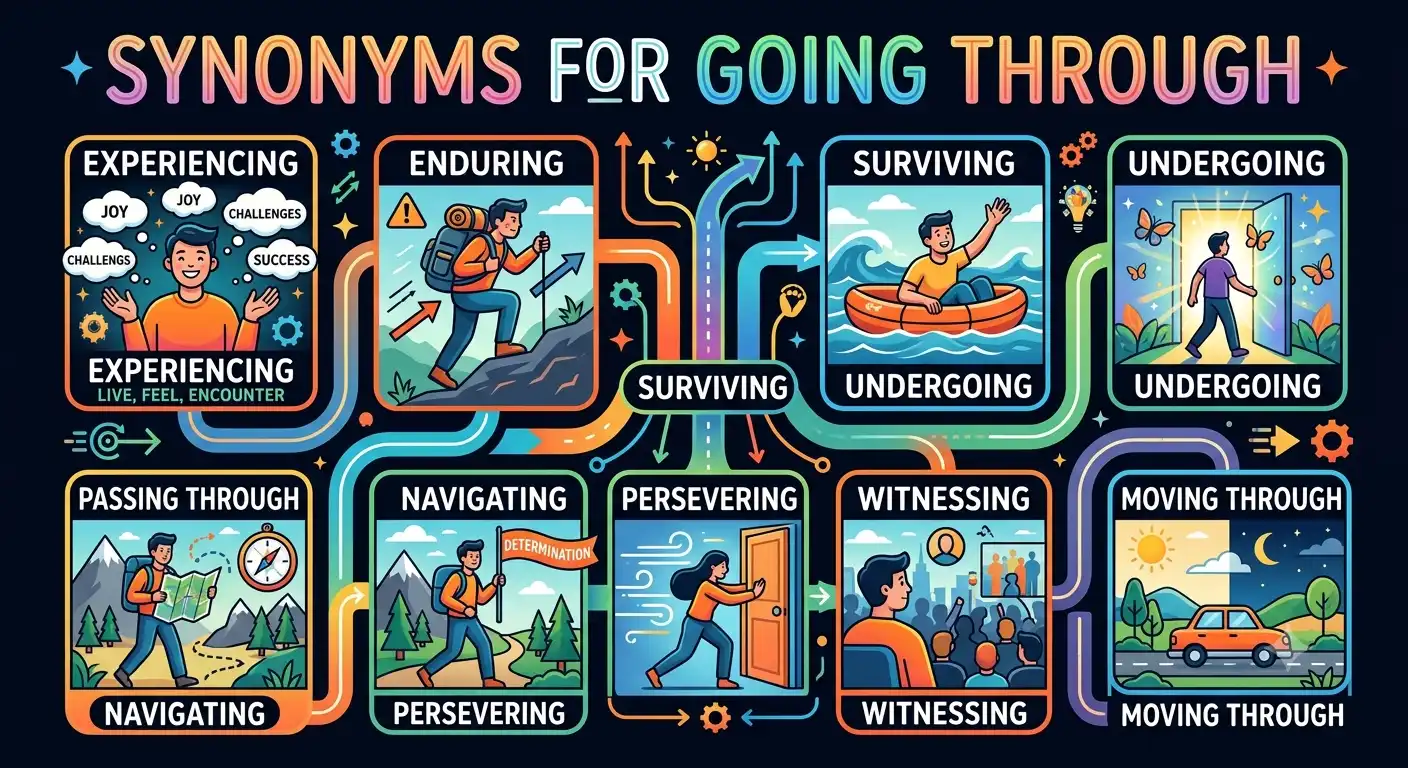
Learning synonyms for going through is a wonderful way to improve your writing and speaking skills. When you study synonyms for going through, you can easily explain physical tasks, emotional times, or deep searches. Using diverse synonyms for going through makes your sentences sound much more natural and clear to your audience.
Imagine waking up to find your desk covered in a wild pile of tax forms, letters, and old bills. You need to find one small receipt from last summer before your business meeting starts. To find it, you must look deep inside every single folder on the desk. In simple English, to go through means to search inside something, to experience a hard time, or to travel through an open space.
This vocabulary guide is a highly useful tool for many different groups of people. Students can use these terms to write smart history essays and science reports. Bloggers can use these emotional words to share deep personal stories with their readers. Content writers can build deep professional trust by using exact terms for business reviews and processes. Daily English users can easily express their feelings and talk with greater precision. Let us dive in and learn these fresh words!
“Every struggle you go through is a lesson that makes you stronger.” — Unknown
“We must look deep inside our thoughts to find clear paths forward.” — Unknown
Lexical Profile of “Going Through”
- Connotative Meaning: Experiencing trouble, investigating details, sorting physical items, or transitioning.
- Etymology:
- Origins: Combined from the Old English verb gān (meaning to walk, move, or proceed) and the preposition þurh (meaning from end to end).
- Evolution: By the 14th century, the phrasal verb “go through” was used to describe completing a task or experiencing a physical journey, later developing the emotional sense of enduring a hardship.
- Pronunciation:
- US IPA: /ˈɡoʊ.ɪŋ θruː/
- UK IPA: /ˈɡəʊ.ɪŋ θruː/
- Syllables: 3 syllables (go-ing through).
- Affixation Pattern: Phrasal verb made of the root verb go with the progressive suffix -ing, followed by the preposition through.
Comparison Table of Key Synonyms
| Keyword | Meaning | Usage Type | Context |
|---|---|---|---|
| Endure | To experience pain or hardship without giving up | Emotional / Professional | Hard times, military, fitness, family |
| Examine | To look at something very closely to learn about it | Professional / Casual | Science labs, schoolwork, business reports |
| Experience | To live through an event or feel an emotion | Casual / Professional | Work history, travel, life changes |
| Inspect | To look for flaws or check if rules are followed | Formal | Factories, safety checks, police work |
| Tolerate | To put up with something annoying or painful | Casual / Emotional | Relationships, workplace habits, noise |
| Suffer | To feel physical pain or deep sadness | Emotional | Illness, bad luck, loss |
| Penetrate | To force a way through a physical barrier | Professional / Creative | Forests, solid walls, business markets |
| Review | To read or study something to make a decision | Professional | Exams, book evaluations, business plans |
“To seek is to find, but to search with care is to understand.” — Unknown
50 Synonyms for Going Through
1. Experiencing
- Pronunciation: US: /ɪkˈspɪr.i.ən.sɪŋ/ & UK: /ɪkˈspɪə.ri.ən.sɪŋ/
- Meaning: This word means living through an event or feeling a specific emotion.
- Examples:
- We are experiencing a very cold winter this year.
- She is experiencing great joy in her new job.
2. Enduring
- Pronunciation: US: /ɪnˈdʊr.ɪŋ/ & UK: /ɪnˈdjʊə.rɪŋ/
- Meaning: This word means holding up under a painful or difficult situation for a long time.
- Examples:
- The runners are enduring a lot of heat during the race.
- He is enduring the long wait with a quiet smile.
3. Examining
- Pronunciation: US: /ɪɡˈzæm.ɪ.nɪŋ/ & UK: /ɪɡˈzæm.ɪ.nɪŋ/
- Meaning: This word means looking at something very closely to find details or mistakes.
- Examples:
- The doctor is examining the patient’s sore arm.
- We spent hours examining the old map for clues.
4. Searching
- Pronunciation: US: /ˈsɝː.tʃɪŋ/ & UK: /ˈsɜː.tʃɪŋ/
- Meaning: This word means trying to find something by looking carefully.
- Examples:
- They are searching the dark forest for the lost dog.
- He is searching his room for his car keys.
5. Suffering
- Pronunciation: US: /ˈsʌf.ɚ.ɪŋ/ & UK: /ˈsʌf.ər.ɪŋ/
- Meaning: This word means feeling physical pain or deep mental sadness.
- Examples:
- Many small plants are suffering from the lack of rain.
- He is suffering from a bad headache today.
6. Inspecting
- Pronunciation: US: /ɪnˈspek.tɪŋ/ & UK: /ɪnˈspek.tɪŋ/
- Meaning: This word means checking something officially to make sure it is safe or correct.
- Examples:
- Safety officers are inspecting the new school building.
- She is inspecting the clean plates before the guests arrive.
7. Tolerating
- Pronunciation: US: /ˈtɑː.lə.reɪ.tɪŋ/ & UK: /ˈtɒl.ə.reɪ.tɪŋ/
- Meaning: This word means accepting something unpleasant without complaining.
- Examples:
- I am tolerating the loud music from next door tonight.
- The teacher is tolerating the noisy classroom for now.
8. Scanning
- Pronunciation: US: /ˈskæn.ɪŋ/ & UK: /ˈskæn.ɪŋ/
- Meaning: This word means looking over a text or area quickly to find a specific part.
- Examples:
- She is scanning the newspaper to find the sports scores.
- The guard is scanning the crowd for any trouble.
9. Reviewing
- Pronunciation: US: /rɪˈvjuː.ɪŋ/ & UK: /rɪˈvjuː.ɪŋ/
- Meaning: This word means checking or studying something again to make sure it is right.
- Examples:
- We are reviewing our science notes before the big test.
- The manager is reviewing the sales reports from last week.
10. Undergoing
- Pronunciation: US: /ˌʌn.dɚˈɡoʊ.ɪŋ/ & UK: /ˌʌn.dəˈɡəʊ.ɪŋ/
- Meaning: This word means experiencing a necessary process, change, or medical treatment.
- Examples:
- The historic bridge is undergoing some major repairs.
- He is undergoing training to become a professional pilot.
11. Sorting
- Pronunciation: US: /ˈsɔːr.tɪŋ/ & UK: /ˈsɔː.tɪŋ/
- Meaning: This word means putting a group of items into neat order or groups.
- Examples:
- I am sorting the mail into piles of bills and cards.
- The children are sorting their colorful plastic blocks.
12. Penetrating
- Pronunciation: US: /ˈpen.ə.treɪ.tɪŋ/ & UK: /ˈpen.ɪ.treɪ.tɪŋ/
- Meaning: This word means passing deep into or through a solid barrier.
- Examples:
- The bright sunlight is penetrating the thick forest leaves.
- Water is penetrating the old basement walls.
13. Facing
- Pronunciation: US: /ˈfeɪ.sɪŋ/ & UK: /ˈfeɪ.sɪŋ/
- Meaning: This word means dealing directly with a scary problem or difficult situation.
- Examples:
- Our team is facing a very strong opponent tomorrow.
- She is bravely facing her fear of public speaking.
14. Checking
- Pronunciation: US: /ˈtʃek.ɪŋ/ & UK: /ˈtʃek.ɪŋ/
- Meaning: This word means testing or looking at something to make sure it is safe or correct.
- Examples:
- He is checking the oil level in his car.
- Please make sure you are checking your answers twice.
15. Living
- Pronunciation: US: /ˈlɪv.ɪŋ/ & UK: /ˈlɪv.ɪŋ/
- Meaning: This word means experiencing life in a certain way or through specific events.
- Examples:
- They are living through a very exciting time in history.
- She is living her dream of traveling the world.
16. Sifting
- Pronunciation: US: /ˈsɪf.tɪŋ/ & UK: /ˈsɪf.tɪŋ/
- Meaning: This word means sorting through a pile of items to find the useful parts.
- Examples:
- The chef is sifting the white flour into a bowl.
- We are sifting through the old box of photos.
17. Braving
- Pronunciation: US: /ˈbreɪ.vɪŋ/ & UK: /ˈbreɪ.vɪŋ/
- Meaning: This word means dealing with dangerous or unpleasant conditions with courage.
- Examples:
- The hikers are braving the heavy snow to reach the cabin.
- She is braving the cold wind to walk her dog.
18. Analyzing
- Pronunciation: US: /ˈæn.ə.laɪ.zɪŋ/ & UK: /ˈæn.əl.aɪ.zɪŋ/
- Meaning: This word means studying the small parts of something to understand how it works.
- Examples:
- Scientists are analyzing the clean water samples.
- We are analyzing the data to find the mistake.
19. Navigating
- Pronunciation: US: /ˈnæv.ə.ɡeɪ.tɪŋ/ & UK: /ˈnæv.ɪ.ɡeɪ.tɪŋ/
- Meaning: This word means finding a safe path through a tricky physical or mental space.
- Examples:
- The captain is navigating the ship through the storm.
- She is navigating her first week at the new high school.
20. Exploring
- Pronunciation: US: /ɪkˈsplɔːr.ɪŋ/ & UK: /ɪkˈsplɔː.rɪŋ/
- Meaning: This word means traveling through a new place to learn more about it.
- Examples:
- The kids are exploring the grassy backyard.
- We are exploring different ideas for our next vacation.
21. Scrutinizing
- Pronunciation: US: /ˈskruː.t̬ən.aɪ.zɪŋ/ & UK: /ˈskruː.tɪ.naɪ.zɪŋ/
- Meaning: This word means examining something with extreme care and detail.
- Examples:
- The lawyer is scrutinizing the fine print on the paper.
- The judge is scrutinizing the artistic details of the painting.
22. Surviving
- Pronunciation: US: /sɚˈvaɪ.vɪŋ/ & UK: /səˈvaɪ.vɪŋ/
- Meaning: This word means staying alive or safe during a very dangerous event.
- Examples:
- The wild birds are surviving the freezing winter weather.
- They are surviving on very little food in the jungle.
23. Investigating
- Pronunciation: US: /ɪnˈves.tə.ɡeɪ.tɪŋ/ & UK: /ɪnˈves.tɪ.ɡeɪ.tɪŋ/
- Meaning: This word means searching for facts to solve a mystery or crime.
- Examples:
- Police are investigating the strange noise down the street.
- The reporter is investigating the secret company plans.
24. Bearing
- Pronunciation: US: /ˈber.ɪŋ/ & UK: /ˈbeə.rɪŋ/
- Meaning: This word means carrying a heavy physical or emotional load without failing.
- Examples:
- He is bearing the heavy weight of the boxes.
- She is bearing the sad news with great dignity.
25. Auditing
- Pronunciation: US: /ˈɑː.dɪ.tɪŋ/ & UK: /ˈɔː.dɪ.tɪŋ/
- Meaning: This word means examining financial records or processes officially.
- Examples:
- The expert is auditing the school’s money records.
- They are auditing the factory safety steps this week.
26. Ransacking
- Pronunciation: US: /ˈræn.sæk.ɪŋ/ & UK: /ˈræn.sæk.ɪŋ/
- Meaning: This word means searching through a place in a wild, messy, or destructive way.
- Examples:
- The playful puppy is ransacking the laundry basket.
- Thieves were ransacking the old house looking for gold.
27. Traversing
- Pronunciation: US: /trəˈvɝː.sɪŋ/ & UK: /trəˈvɜː.sɪŋ/
- Meaning: This word means traveling across or through a physical space.
- Examples:
- The trains are traversing the high mountain pass.
- We are traversing the sandy desert on camels.
28. Sustaining
- Pronunciation: US: /səˈsteɪ.nɪŋ/ & UK: /səˈsteɪ.nɪŋ/
- Meaning: This word means suffering a physical injury or supporting a heavy weight over time.
- Examples:
- The football player is sustaining a minor leg injury.
- The wooden pillars are sustaining the heavy house roof.
29. Combing
- Pronunciation: US: /ˈkoʊ.mɪŋ/ & UK: /ˈkəʊ.mɪŋ/
- Meaning: This word means searching an area very thoroughly to find an item.
- Examples:
- Rescue teams are combing the beach for clues.
- I am combing through my closet to find my blue hat.
30. Overcoming
- Pronunciation: US: /ˌoʊ.vɚˈkʌm.ɪŋ/ & UK: /ˌəʊ.vəˈkʌm.ɪŋ/
- Meaning: This word means successfully beating a difficult challenge or emotion.
- Examples:
- She is slowly overcoming her fear of deep water.
- He is overcoming a very tough cold this week.
31. Piercing
- Pronunciation: US: /ˈpɪr.sɪŋ/ & UK: /ˈpɪə.sɪŋ/
- Meaning: This word means cutting through a physical object with a sharp point.
- Examples:
- The sharp nail is piercing the leather shoe.
- A cold wind is piercing our light winter coats.
32. Passing
- Pronunciation: US: /ˈpæs.ɪŋ/ & UK: /ˈpɑː.sɪŋ/
- Meaning: This word means moving from one side of a space to the other.
- Examples:
- The cars are passing through the dark concrete tunnel.
- A peaceful cloud is passing over the sunny hill.
33. Feeling
- Pronunciation: US: /ˈfiː.lɪŋ/ & UK: /ˈfiː.lɪŋ/
- Meaning: This word means experiencing a physical sensation or emotional state.
- Examples:
- She is feeling the soft texture of the green blanket.
- He is feeling a lot of stress about his new job.
34. Probing
- Pronunciation: US: /ˈproʊ.bɪŋ/ & UK: /ˈprəʊ.bɪŋ/
- Meaning: This word means asking deep questions or searching a space physically to get facts.
- Examples:
- The detective is probing the witness for more secrets.
- The dentist is gently probing my teeth with a tool.
35. Weathering
- Pronunciation: US: /ˈweð.ɚ.ɪŋ/ & UK: /ˈweð.ər.ɪŋ/
- Meaning: This word means surviving a difficult situation or bad storm successfully.
- Examples:
- The little ship is weathering the rough sea waves.
- Our local business is weathering the poor economy.
36. Browsing
- Pronunciation: US: /ˈbraʊ.zɪŋ/ & UK: /ˈbraʊ.zɪŋ/
- Meaning: This word means looking through a collection of books or items in a relaxed way.
- Examples:
- She is browsing the library shelves for a funny book.
- We spent the afternoon browsing the local clothing shops.
37. Encountering
- Pronunciation: US: /ɪnˈkaʊn.t̬ɚ.ɪŋ/ & UK: /ɪnˈkaʊn.tər.ɪŋ/
- Meaning: This word means meeting or facing an unexpected obstacle or situation.
- Examples:
- We are encountering some unexpected traffic on the highway.
- The project is encountering a few technical issues.
38. Vetting
- Pronunciation: US: /ˈvet̬.ɪŋ/ & UK: /ˈvet.ɪŋ/
- Meaning: This word means checking someone’s background or facts very carefully.
- Examples:
- The team is vetting the new job candidates.
- They are vetting the news story before they print it.
39. Standing
- Pronunciation: US: /ˈstæn.dɪŋ/ & UK: /ˈstæn.dɪŋ/
- Meaning: This word means enduring or putting up with a tough physical condition.
- Examples:
- I am standing the heat as best as I can.
- She cannot bear standing the cold winter wind today.
40. Cataloging
- Pronunciation: US: /ˈkæt̬.ə.lɑː.ɡɪŋ/ & UK: /ˈkæt.əl.ɒɡ.ɪŋ/
- Meaning: This word means listing and organizing items systematically.
- Examples:
- The museum worker is cataloging the ancient clay pots.
- I am cataloging my digital music collection on the computer.
41. Rummaging
- Pronunciation: US: /ˈrʌm.ɪ.dʒɪŋ/ & UK: /ˈrʌm.ɪ.dʒɪŋ/
- Meaning: This word means searching through a drawer or box in a messy way.
- Examples:
- He is rummaging through his desk drawer to find a pen.
- The raccoon is rummaging in the green trash can.
42. Eyeballing
- Pronunciation: US: /ˈaɪ.bɑː.lɪŋ/ & UK: /ˈaɪ.bɔː.lɪŋ/
- Meaning: This word means looking at or estimating something visually.
- Examples:
- The cook is eyeballing the amount of salt needed.
- He is eyeballing the distances before he cuts the wood.
43. Meeting
- Pronunciation: US: /ˈmiː.tɪŋ/ & UK: /ˈmiː.tɪŋ/
- Meaning: This word means coming face-to-face with a challenge, person, or requirement.
- Examples:
- They are meeting the tight deadlines for the project.
- We are meeting our new neighbors for dinner tonight.
44. Crossing
- Pronunciation: US: /ˈkrɑː.sɪŋ/ & UK: /ˈkrɒs.ɪŋ/
- Meaning: This word means traveling across a line, border, or road.
- Examples:
- The hikers are crossing the wooden bridge over the stream.
- We are crossing the state border in our car.
45. Tasting
- Pronunciation: US: /ˈteɪ.stɪŋ/ & UK: /ˈteɪ.stɪŋ/
- Meaning: This word means experiencing a brief or small sample of an event or food.
- Examples:
- They are tasting success for the very first time.
- She is tasting the hot soup to check for pepper.
46. Surveying
- Pronunciation: US: /sɚˈveɪ.ɪŋ/ & UK: /səˈveɪ.ɪŋ/
- Meaning: This word means measuring or mapping out an area of land or opinions.
- Examples:
- Engineers are surveying the valley to build a new road.
- We are surveying the neighborhood about the park plan.
47. Digging
- Pronunciation: US: /ˈdɪɡ.ɪŋ/ & UK: /ˈdɪɡ.ɪŋ/
- Meaning: This word means searching deeply inside documents or files to find secret details.
- Examples:
- The journalist is digging for facts about the old mystery.
- He is digging through his files to find the signed paper.
48. Screening
- Pronunciation: US: /ˈskriː.nɪŋ/ & UK: /ˈskriː.nɪŋ/
- Meaning: This word means checking items or people to filter out bad elements.
- Examples:
- Security is screening all the bags at the airport gate.
- The hospital is screening patients for the new cold virus.
49. Filtering
- Pronunciation: US: /ˈfɪl.tɚ.ɪŋ/ & UK: /ˈfɪl.tər.ɪŋ/
- Meaning: This word means removing unwanted parts from a physical liquid or digital stream.
- Examples:
- The machine is filtering the dirt out of the pool water.
- The computer is filtering the spam messages out of my inbox.
50. Processing
- Pronunciation: US: /ˈprɑː.ses.ɪŋ/ & UK: /ˈprəʊ.ses.ɪŋ/
- Meaning: This word means handling a document or file through official steps.
- Examples:
- The bank is processing our application for the home loan.
- The system is processing your order as fast as possible.
Antonyms of “Going Through”
To completely master this vocabulary concept, you should also learn its opposite terms:
- Avoiding: Keeping away from a person, physical place, or hard situation on purpose.
- Skipping: Missing an event or step in a process without doing it.
- Ignoring: Choosing to pay no attention to a task, sound, or problem.
- Evading: Finding a clever way to escape your duties or a dangerous event.
- Neglecting: Failing to take care of your personal files, tasks, or chores.
Prototype Meaning and Categorization of “Going Through”
The prototype meaning of “going through” is to endure a personal difficulty, to systematically inspect a collection of items, or to cross physical boundaries. We can group these 50 synonyms into four clear categories:
- Experiencing Hardship and Resilience: Words that focus on carrying burdens, holding up under stress, or facing trouble with brave faces (e.g., enduring, suffering, tolerating, undergoing, facing, living, braving, surviving, bearing, overcoming, weathering, standing, meeting).
- Investigating, Searching, and Sorting: Words that describe lookups, safety checks, structural organization, or deep files reviews (e.g., examining, searching, inspecting, scanning, reviewing, sorting, checking, sifting, analyzing, scrutinizing, investigating, auditing, combing, probing, browsing, vetting, cataloging, rummaging, eyeballing, digging, screening, filtering, processing).
- Physical Passage and Penetration: Words showing physical actions of travel, movement, or crossing barriers (e.g., penetrating, navigating, exploring, ransacking, traversing, piercing, passing, crossing, surveying).
- Sensory or Social Transitions: Words that highlight general life encounters or simple physical senses (e.g., experiencing, sustaining, feeling, encountering, tasting).
FAQ About Synonyms for Going Through
1. Is “going through” appropriate for formal business writing?
While widely understood, “going through” is slightly casual. For professional files and business emails, it is much better to use exact terms like undergoing, experiencing, or conducting an audit.
2. What is the difference between “going through” and “undergoing”?
“Going through” is a general phrasal verb used for casual physical searches or general life problems. Undergoing is a more formal term reserved specifically for necessary trials, changes, medical steps, or training processes.
3. Can “rummaging” be used in a professional email?
No. Rummaging describes searching in a messy, chaotic, or disorganized way (like looking for a sock in a messy drawer). Using it in a professional email might make you sound disorganized or unprofessional.
4. Does “weathering” only refer to the weather?
No. While it comes from surviving storms, weathering is a powerful verb used metaphorically to describe surviving business trials, financial struggles, or hard family times.
5. What does the idiom “going through the motions” mean?
This common idiom means doing a task or job half-heartedly without putting any real effort, energy, or care into it.
6. When should I use “sifting” instead of “searching”?
Use sifting when you are looking through a massive collection of items to find a few valuable pieces. Use searching as a general term when looking for something that is lost.
Conclusion
Expanding your English vocabulary by studying synonyms for going through is an excellent way to elevate your communication. When you learn to use these diverse, descriptive terms, your creative writing becomes more engaging, your blogging becomes more colorful, and your professional presentations sound far more authoritative. Instead of relying on the same simple words, you can paint clear pictures in the minds of your audience by selecting the exact right word for the situation.
Try to practice these fresh terms starting today! Use them when you draft an email to a coworker, write a descriptive essay for class, or talk with your friends about your weekend activities. The more you use them in casual settings, the more natural they will feel in your active vocabulary. Keep practicing, keep learning, and watch your communication skills flourish!
“Our words define our world; choose them with absolute clarity.” — Unknown
“A smooth sea never made a skilled sailor, just as simple words never made a master storyteller.” — Unknown

Andrew Collins is an academic English educator with over 12 years of experience helping university students, IELTS candidates, and ESL learners improve their writing vocabulary.