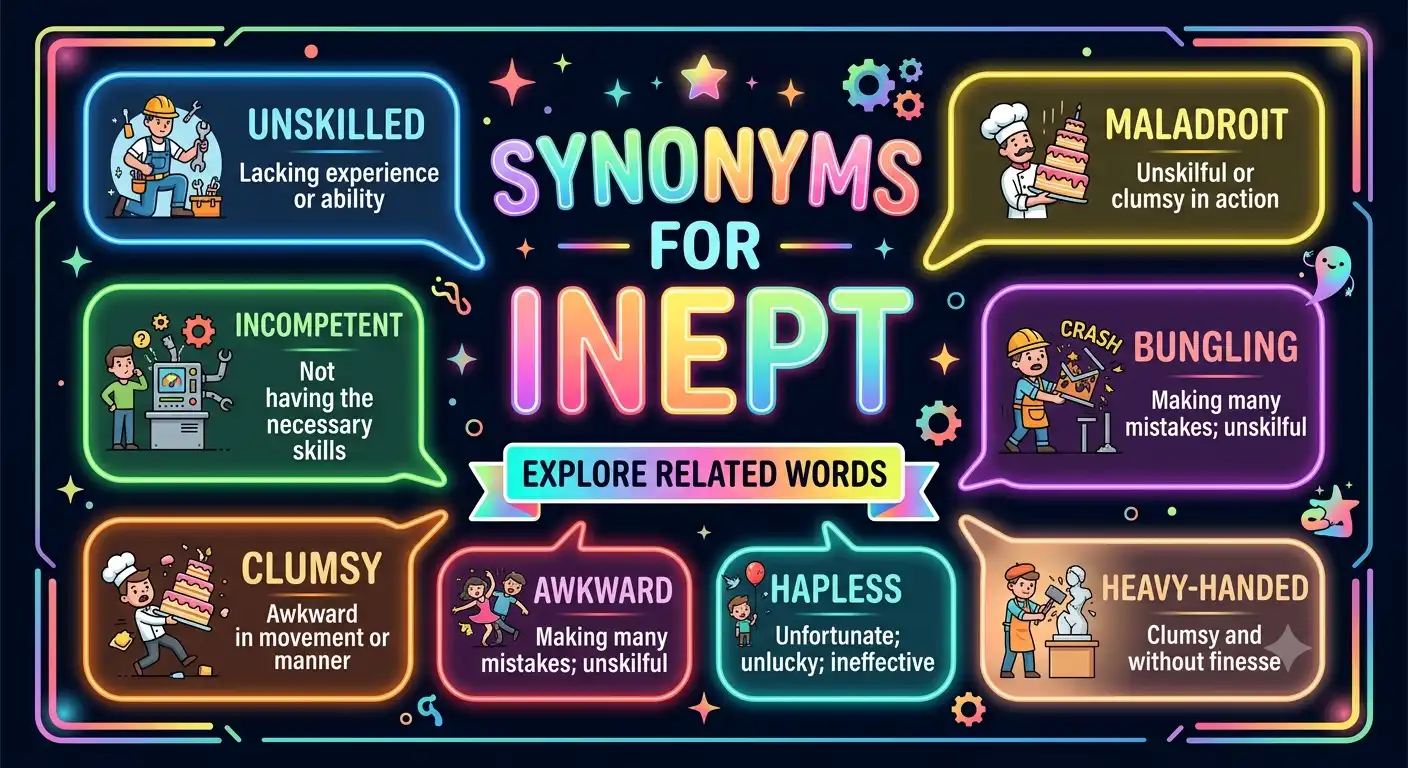
Learning synonyms for inept is an excellent way to describe mistakes or lack of skill without sounding overly harsh. When you explore synonyms for inept, you discover creative ways to paint a picture of clumsy actions or awkward moments. Studying synonyms for inept helps your writing flow naturally when describing uncoordinated movements or poor planning.
Picture a busy waiter balancing a towering stack of six hot soup bowls, only to trip over a flat, smooth rug and splash soup all over a customer. That clumsy moment is a classic example of being inept. In simple English, inept means not having the skill, coordination, or training to do a job well.
This vocabulary guide is a highly useful tool for many different groups of people. Students can use these terms to write better book reports and avoid repeating basic words like “bad” or “clumsy.” Bloggers can use these descriptive terms to paint funny, relatable pictures of human mistakes. Content writers can build deep professional trust by choosing exact terms to critique business strategies or reviews. Daily English users can easily share funny stories or describe poor service with high precision.
“The greatest mistake you can make in life is to continually fear you will make one.” — Elbert Hubbard
“We learn wisdom from failure much more than from success.” — Samuel Smiles
Lexical Profile of “Inept”
- Connotative Meaning: Clumsiness, lack of skill, unsuitability, inefficiency, or awkwardness. In cognitive psychology, we can playfully represent the index of ineptitude ($I$) through a simple ratio of mistakes ($M$) to skill level ($S$) over time ($T$):$$I = \frac{M}{S \cdot T}$$As skills increase, the level of ineptitude naturally drops toward zero.
- Etymology:
- Origins: Derived from the Latin word ineptus, which means “unsuitable,” “unfit,” or “foolish.” It is made from the prefix in- (meaning “not”) and aptus (meaning “fit” or “apt”).
- Evolution: Entered French in the 16th century as inepte and crossed into English shortly after to describe actions or people lacking appropriate skill.
- Pronunciation:
- US IPA: /ɪˈnept/
- UK IPA: /ɪˈnept/
- Syllables: 2 syllables (in-ept).
- Affixation Pattern: Prefix in- (not) joined to the root adjective ept (capable/suitable).
Comparison Table of Key Synonyms
| Keyword | Meaning | Usage Type | Context |
|---|---|---|---|
| Clumsy | Lacking physical coordination or grace | Casual | Sports, kitchen accidents, movement |
| Incompetent | Lacking the necessary skills to do a job | Professional | Workplace, leadership, legal reviews |
| Awkward | Feeling or causing embarrassment or discomfort | Casual / Emotional | Social events, teenage years, speeches |
| Unskilled | Not having special training or experience | Professional | Manual labor, job requirements |
| Bungling | Making silly, visible mistakes continuously | Casual / Professional | Detective work, home repairs, planning |
| Maladroit | Clumsy or insensitive in physical or social ways | Formal | Diplomatic talks, artistic reviews |
| Inefficient | Wasting time, energy, or resources on a task | Professional | Factory systems, schedules, office work |
| Inexpert | Showing a lack of professional knowledge | Formal | Technical tasks, science reports, art |
“To err is human, but to persist in ruinous mistakes is the height of folly.” — Marcus Tullius Cicero
50 Synonyms for Inept
1. Clumsy
- Pronunciation: US: /ˈklʌm.zi/ & UK: /ˈklʌm.zi/
- Meaning: This word means lacking physical grace or coordination in your movements.
- Examples:
- The clumsy puppy tripped over its own long ears.
- I felt clumsy trying to dance in these heavy winter boots.
2. Incompetent
- Pronunciation: US: /ɪnˈkɑːm.pə.t̬ənt/ & UK: /ɪnˈkɒm.pɪ.tənt/
- Meaning: This word means completely lacking the necessary skills or power to do a specific job.
- Examples:
- The company fired the incompetent manager after three months of bad sales.
- She is not incompetent; she just needs more training.
3. Awkward
- Pronunciation: US: /ˈɑː.kwɚd/ & UK: /ˈɔː.kwəd/
- Meaning: This word means causing embarrassment or showing a lack of comfortable physical grace.
- Examples:
- There was an awkward silence after he told the bad joke.
- The teenager felt awkward in his oversized formal suit.
4. Unskilled
- Pronunciation: US: /ʌnˈskɪld/ & UK: /ʌnˈskɪld/
- Meaning: This word means having no special training or technical experience in a field.
- Examples:
- The factory is hiring unskilled workers for the basic packaging line.
- Painting a wall does not require unskilled hands if you want a clean finish.
5. Bungling
- Pronunciation: US: /ˈbʌŋ.ɡlɪŋ/ & UK: /ˈbʌŋ.ɡlɪŋ/
- Meaning: This word means carrying out a task in a clumsy, messy, or highly unsuccessful way.
- Examples:
- The bungling thieves dropped the stolen jewelry on the street.
- Our bungling efforts to fix the plumbing caused a minor flood.
6. Maladroit
- Pronunciation: US: /ˌmæl.əˈdrɔɪt/ & UK: /ˌmæl.əˈdrɔɪt/
- Meaning: This word means clumsy, unskillful, or awkward in physical actions or social habits.
- Examples:
- His maladroit handling of the customer’s complaint made the situation worse.
- She made a maladroit attempt to excuse her late arrival.
7. Inefficient
- Pronunciation: US: /ˌɪn.ɪˈfɪʃ.ənt/ & UK: /ˌɪn.ɪˈfɪʃ.ənt/
- Meaning: This word means wasting time, money, or materials while doing a task.
- Examples:
- The old car engine is highly inefficient and uses too much gas.
- Wasting paper is an inefficient way to run a modern office.
8. Inexpert
- Pronunciation: US: /ɪnˈek.spɝːt/ & UK: /ɪnˈek.spɜːt/
- Meaning: This word means lacking the deep knowledge or polished skills of a trained specialist.
- Examples:
- The house showed signs of inexpert carpentry work on the roof.
- I gave an inexpert opinion on the value of the old painting.
9. Ham-fisted
- Pronunciation: US: /ˌhæmˈfɪs.tɪd/ & UK: /ˌhæmˈfɪs.tɪd/
- Meaning: This word means physical clumsiness or a complete lack of delicate touch.
- Examples:
- His ham-fisted attempts to play the delicate piano keys sounded loud.
- The repair was ham-fisted and left scratches on the wood.
10. Butterfingered
- Pronunciation: US: /ˈbʌt̬.ɚˌfɪŋ.ɡɚd/ & UK: /ˈbʌt.əˌfɪŋ.ɡəd/
- Meaning: This word means constantly dropping objects due to poor grip or clumsiness.
- Examples:
- The butterfingered catcher dropped the ball three times during the game.
- I am too butterfingered to wash these expensive glass cups.
11. Uncoordinated
- Pronunciation: US: /ˌʌn.koʊˈɔːr.dən.eɪ.t̬ɪd/ & UK: /ˌʌn.kəʊˈɔː.dɪ.neɪ.tɪd/
- Meaning: This word means lacking physical control, balance, or smooth movement of the body.
- Examples:
- Toddlers are naturally uncoordinated when they first learn to run.
- He felt uncoordinated on the ice rink and kept falling down.
12. Graceless
- Pronunciation: US: /ˈɡreɪs.ləs/ & UK: /ˈɡreɪs.ləs/
- Meaning: This word means lacking elegance, charm, or polite manners in physical movement or behavior.
- Examples:
- The heavy boat made a graceless landing against the wooden dock.
- He gave a graceless speech that ignored the hard work of his team.
13. Heavy-handed
- Pronunciation: US: /ˌhev.iˈhæn.dɪd/ & UK: /ˌhev.iˈhæn.dɪd/
- Meaning: This word means clumsy, overly forceful, or lacking sensitivity.
- Examples:
- The chef was heavy-handed with the salt, ruining the soup.
- The police used heavy-handed methods to clear the quiet street.
14. Gauche
- Pronunciation: US: /ɡoʊʃ/ & UK: /ɡəʊʃ/
- Meaning: This word means lacking ease, social grace, or tact when dealing with other people.
- Examples:
- It is considered gauche to ask someone how much money they make.
- He felt gauche standing alone at the formal dinner party.
15. Bumbling
- Pronunciation: US: /ˈbʌm.bəl.ɪŋ/ & UK: /ˈbʌm.bəl.ɪŋ/
- Meaning: This word means moving or acting in a confused, clumsy, or incompetent manner.
- Examples:
- A bumbling official lost the keys to the main presentation hall.
- We laughed at the bumbling detective in the comedy movie.
16. Fumbling
- Pronunciation: US: /ˈfʌm.bəl.ɪŋ/ & UK: /ˈfʌm.bəl.ɪŋ/
- Meaning: This word means feeling or grasping about clumsily with your hands.
- Examples:
- She spent minutes fumbling in her purse for her car keys.
- The player’s fumbling fingers cost the team a clear goal.
17. Unfit
- Pronunciation: US: /ʌnˈfɪt/ & UK: /ʌnˈfɪt/
- Meaning: This word means lacking the necessary skills, health, or qualities for a task.
- Examples:
- The board decided he was unfit to lead the school.
- This contaminated water is completely unfit for human use.
18. Incapable
- Pronunciation: US: /ɪnˈkeɪ.pə.bəl/ & UK: /ɪnˈkeɪ.pə.bəl/
- Meaning: This word means not having the ability or strength to do a specific task.
- Examples:
- The broken machine is incapable of processing the heavy plastic.
- He is incapable of keeping a secret for more than an hour.
19. Inadequate
- Pronunciation: US: /ɪnˈæd.ə.kwət/ & UK: /ɪnˈæd.ɪ.kwət/
- Meaning: This word means not good enough, lacking quality, or insufficient for a purpose.
- Examples:
- The small heater was inadequate for the freezing winter cabin.
- I felt inadequate trying to solve the complex physics equation.
20. Unqualified
- Pronunciation: US: /ʌnˈkwɑː.lə.faɪd/ & UK: /ʌnˈkwɒl.ɪ.faɪd/
- Meaning: This word means lacking the official papers, training, or skills required for a job.
- Examples:
- She is unqualified to give professional medical advice to patients.
- The company will not hire unqualified applicants for this role.
21. All-thumbs
- Pronunciation: US: /ˌɑːlˈθʌmz/ & UK: /ˌɔːlˈθʌmz/
- Meaning: This word means extremely clumsy with your hands or fingers.
- Examples:
- I am all-thumbs today and cannot tie my own shoes.
- Do not let him hold the fine china because he is all-thumbs.
22. Clodhopping
- Pronunciation: US: /ˈklɑːd.hɑː.pɪŋ/ & UK: /ˈklɒd.hɒp.ɪŋ/
- Meaning: This word means clumsy, heavy-footed, or boorish in movement.
- Examples:
- He walked with a loud, clodhopping gait across the wooden floor.
- I do not want to dance with him and endure his clodhopping steps.
23. Wooden
- Pronunciation: US: /ˈwʊd.ən/ & UK: /ˈwʊd.ən/
- Meaning: This word means stiff, clumsy, or lacking natural warmth and expression.
- Examples:
- The young actor gave a wooden performance during the play.
- Her wooden movements on stage showed her deep nervousness.
24. Left-handed
- Pronunciation: US: /ˌleftˈhæn.dɪd/ & UK: /ˌleftˈhæn.dɪd/
- Meaning: This word metaphorically means clumsy, awkward, or of doubtful sincerity.
- Examples:
- He gave her a left-handed compliment about how simple her dress looked.
- The builder made a left-handed attempt to fix the crooked door.
25. Oafish
- Pronunciation: US: /ˈoʊ.fɪʃ/ & UK: /ˈəʊ.fɪʃ/
- Meaning: This word means clumsy, stupid, or rough in behavior or appearance.
- Examples:
- His oafish behavior at the quiet library upset the visitors.
- She tried to ignore his oafish remarks during lunch.
26. Unhandy
- Pronunciation: US: /ʌnˈhæn.di/ & UK: /ʌnˈhæn.di/
- Meaning: This word means clumsy with your hands or difficult to handle.
- Examples:
- I am unhandy with tools and cannot even hang a painting.
- The heavy manual lawnmower was very unhandy to use.
27. Careless
- Pronunciation: US: /ˈker.ləs/ & UK: /ˈkeə.ləs/
- Meaning: This word means not giving enough attention or thought to avoiding mistakes.
- Examples:
- Her careless spelling mistakes cost her a perfect grade on the test.
- He made a careless turn and scratched his car against a post.
28. Weak
- Pronunciation: US: /wiːk/ & UK: /wiːk/
- Meaning: This word means lacking skill, power, authority, or effectiveness.
- Examples:
- The team had a very weak defense during the second half.
- His explanation for being late was weak and unconvincing.
29. Floundering
- Pronunciation: US: /ˈflaʊn.dɚ.ɪŋ/ & UK: /ˈflaʊn.dər.ɪŋ/
- Meaning: This word means moving clumsily, struggling, or making mistakes without progress.
- Examples:
- The swimmer was floundering in the deep water before help arrived.
- The new business is floundering due to a lack of money.
30. Slipping
- Pronunciation: US: /ˈslɪp.ɪŋ/ & UK: /ˈslɪp.ɪŋ/
- Meaning: This word means losing your high standards of skill or quality over time.
- Examples:
- The chef’s skills are slipping because the soup is often cold.
- Our sales team is slipping and needs to find new strategies.
31. Ineffectual
- Pronunciation: US: /ˌɪn.əˈfek.tʃu.əl/ & UK: /ˌɪn.ɪˈfek.tʃu.əl/
- Meaning: This word means not producing any of the desired effects or results.
- Examples:
- The teacher’s quiet voice was ineffectual at controlling the noisy room.
- They made an ineffectual attempt to stop the rain from leaking.
32. Inefficacious
- Pronunciation: US: /ˌɪn.ef.əˈkeɪ.ʃəs/ & UK: /ˌɪn.ef.ɪˈkeɪ.ʃəs/
- Meaning: This word means unable to produce the desired result, especially of medical treatments.
- Examples:
- The old cough medicine proved inefficacious against the new virus.
- Using cheap materials is inefficacious for long-term road building.
33. Powerless
- Pronunciation: US: /ˈpaʊ.ɚ.ləs/ & UK: /ˈpaʊ.ə.ləs/
- Meaning: This word means completely lacking the strength or authority to take action.
- Examples:
- The mayor was powerless to stop the state from raising taxes.
- She felt powerless as she watched her phone fall into the lake.
34. Slow
- Pronunciation: US: /sloʊ/ & UK: /sləʊ/
- Meaning: This word means taking a long time to understand, move, or complete a task.
- Examples:
- He is a slow learner but remembers everything once he gets it.
- The old computer is too slow to run this modern game.
35. Unproductive
- Pronunciation: US: /ˌʌn.prəˈdʌk.tɪv/ & UK: /ˌʌn.prəˈdʌk.tɪv/
- Meaning: This word means not producing good results, items, or useful work.
- Examples:
- We had an unproductive meeting that lasted for three hours.
- Watching television all afternoon is highly unproductive.
36. Failed
- Pronunciation: US: /feɪld/ & UK: /feɪld/
- Meaning: This word means not being successful or failing to meet a standard.
- Examples:
- The company abandoned their failed attempt to build a rocket.
- He looked sad after his failed driving test.
37. Botched
- Pronunciation: US: /bɑːtʃt/ & UK: /bɒtʃt/
- Meaning: This word means spoiled through clumsy, careless, or poor work.
- Examples:
- The builder did a botched job on the kitchen cabinets.
- She tried to fix her hair but ended up with a botched haircut.
38. Clunky
- Pronunciation: US: /ˈklʌŋ.ki/ & UK: /ˈklʌŋ.ki/
- Meaning: This word means heavy, awkward, or lacking smooth design and movement.
- Examples:
- This clunky software takes ten minutes to load on my laptop.
- She wore clunky plastic shoes that made a loud noise.
39. Blundering
- Pronunciation: US: /ˈblʌn.dɚ.ɪŋ/ & UK: /ˈblʌn.dər.ɪŋ/
- Meaning: This word means making stupid, clumsy, or careless mistakes.
- Examples:
- The blundering hiker stepped right into a deep patch of mud.
- We lost the game because of a blundering play by our goalie.
40. Inoperative
- Pronunciation: US: /ɪnˈɑː.pɚ.ə.t̬ɪv/ & UK: /ɪnˈɒp.ər.ə.tɪv/
- Meaning: This word means not working, not functioning, or having no effect.
- Examples:
- The elevator has been inoperative since the storm yesterday.
- This old law is completely inoperative in modern times.
41. Slack
- Pronunciation: US: /slæk/ & UK: /slæk/
- Meaning: This word means showing a lack of effort, care, or professional attention.
- Examples:
- The manager warned the team about their slack work habits.
- Business is slack during the cold winter months.
42. Slipshod
- Pronunciation: US: /ˈslɪp.ʃɑːd/ & UK: /ˈslɪp.ʃɒd/
- Meaning: This word means characterized by a lack of care, thought, or organization.
- Examples:
- The essay was written in a slipshod way with many errors.
- We cannot accept slipshod service at a five-star hotel.
43. Tactless
- Pronunciation: US: /ˈtækt.ləs/ & UK: /ˈtækt.ləs/
- Meaning: This word means saying or doing things that upset or offend other people.
- Examples:
- It was tactless of him to complain about the food to the host.
- She made a tactless remark about his weight.
44. Improper
- Pronunciation: US: /ɪnˈprɑː.pɚ/ & UK: /ɪnˈprɒp.ə/
- Meaning: This word means not suited to a situation or violating standards of behavior.
- Examples:
- It is improper to wear casual shorts to a funeral.
- The worker faced suspension for improper use of school computers.
45. Wrong-headed
- Pronunciation: US: /ˌrɑːŋˈhed.ɪd/ & UK: /ˌrɒŋˈhed.ɪd/
- Meaning: This word means stubbornly supporting plans or ideas that are incorrect.
- Examples:
- The city followed a wrong-headed policy that increased traffic.
- He is wrong-headed and refuses to listen to any expert advice.
46. Futile
- Pronunciation: US: /ˈfjuː.t̬əl/ & UK: /ˈfjuː.taɪl/
- Meaning: This word means completely pointless or having no chance of success.
- Examples:
- It is futile to argue with a stubborn mule.
- They made a futile attempt to catch the train by running.
47. Useless
- Pronunciation: US: /ˈjuːs.ləs/ & UK: /ˈjuːs.ləs/
- Meaning: This word means having no practical use, value, or positive effect.
- Examples:
- This broken umbrella is completely useless in a heavy storm.
- A car without fuel is useless if you need to travel far.
48. Worthless
- Pronunciation: US: /ˈwɝːθ.ləs/ & UK: /ˈwɜːθ.ləs/
- Meaning: This word means having no real value, use, or admirable quality.
- Examples:
- The counterfeit coin is worthless at any local bank.
- His promises are worthless because he never keeps them.
49. Clueless
- Pronunciation: US: /ˈkluː.ləs/ & UK: /ˈkluː.ləs/
- Meaning: This word means having no knowledge, understanding, or ability to solve a problem.
- Examples:
- I am completely clueless when it comes to fixing computers.
- The teacher looked at the clueless student who had not studied.
50. Lame
- Pronunciation: US: /leɪm/ & UK: /leɪm/
- Meaning: This word means weak, unconvincing, or clumsy in quality.
- Examples:
- He offered a lame excuse for forgetting my birthday.
- The movie had a lame ending that disappointed the audience.
Antonyms of “Inept”
To completely master this vocabulary concept, you should also learn its opposite terms:
- Competent: Having the necessary ability, knowledge, or skill to do something successfully.
- Adept: Highly skilled or proficient at a particularly difficult task.
- Dexterous: Showing great physical skill and coordination, especially with your hands.
- Capable: Having the practical ability, power, and fitness to achieve goals.
- Efficient: Working in a well-organized and competent way without wasting time or effort.
Prototype Meaning and Categorization of “Inept”
The prototype meaning of “inept” is lacking the essential skills, coordination, suitability, or grace required to perform a task or behave appropriately in a situation. We can group these 50 synonyms into four clear categories:
- Physical Clumsiness and Lack of Grace: Words that emphasize a lack of body coordination, physical balance, or heavy-handed movements (e.g., clumsy, awkward, ham-fisted, butterfingered, uncoordinated, graceless, fumbling, clodhopping, unhandy, clunky).
- Incompetence and Professional Failure: Words describing a lack of training, credentials, or natural skill needed to complete technical or professional tasks successfully (e.g., incompetent, unskilled, inexpert, unfit, incapable, unqualified, wooden, botched, inoperative, slipshod, useless, worthless).
- Inefficiency and Wasted Effort: Words representing actions or systems that waste valuable time, energy, and resources, producing no positive results (e.g., inefficient, inadequate, floundering, slipping, ineffectual, inefficacious, powerless, unproductive, failed, slack, futile).
- Social Awkwardness and Bad Judgment: Words that describe poor choices, foolish thoughts, or offensive behaviors in front of other people (e.g., gauche, bumbling, left-handed, oafish, careless, weak, slow, blundering, tactless, improper, wrong-headed, clueless, lame).
FAQ About Synonyms for Inept
1. What is the main difference between “inept” and “incompetent”?
While both terms describe a lack of ability, inept often carries a connotation of being clumsy, awkward, or socially out of place. Incompetent is a more formal, serious word used in professional and legal settings to state that someone completely lacks the power or qualification to perform a duty.
2. Can “maladroit” be used in casual conversation?
Yes, but it is considered a formal or literary word. Using maladroit in casual conversation might sound overly academic. For daily chats, words like clumsy or awkward are much more natural.
3. What does the idiom “all-thumbs” mean?
This is a common English idiom used when a person is experiencing temporary physical clumsiness with their hands, often causing them to drop small items or struggle with tasks like tying buttons.
4. Is “lame” an appropriate synonym for inept?
Yes, but only when used metaphorically to describe a weak argument, excuse, or performance (e.g., “a lame excuse”). It should not be used to describe people’s physical conditions, as that can be offensive.
5. When should I use “gauche” instead of “clumsy”?
Use gauche when describing a person who lacks social grace, manners, or tact in conversations. Use clumsy when describing physical movements, such as tripping or dropping a cup.
6. How does “futile” relate to being inept?
An inept attempt at solving a problem often results in a futile effort, meaning the action has absolutely no chance of producing a successful or useful outcome.
Conclusion
Expanding your English vocabulary by studying synonyms for inept is an excellent way to elevate your communication. When you learn to use these diverse, descriptive terms, your creative writing becomes more engaging, your blogging becomes more colorful, and your professional presentations sound far more authoritative. Instead of relying on the same simple words, you can paint clear pictures in the minds of your audience by selecting the exact right word for the situation.
Try to practice these fresh terms starting today! Use them when you draft an email to a coworker, write a descriptive essay for class, or talk with your friends about your weekend activities. The more you use them in casual settings, the more natural they will feel in your active vocabulary. Keep practicing, keep learning, and watch your communication skills flourish!
“The difference between the right word and the almost right word is the difference between lightning and a lightning bug.” — Mark Twain
“Words form the thread with which we weave our experiences into the minds of others.” — Unknown

Andrew Collins is an academic English educator with over 12 years of experience helping university students, IELTS candidates, and ESL learners improve their writing vocabulary.