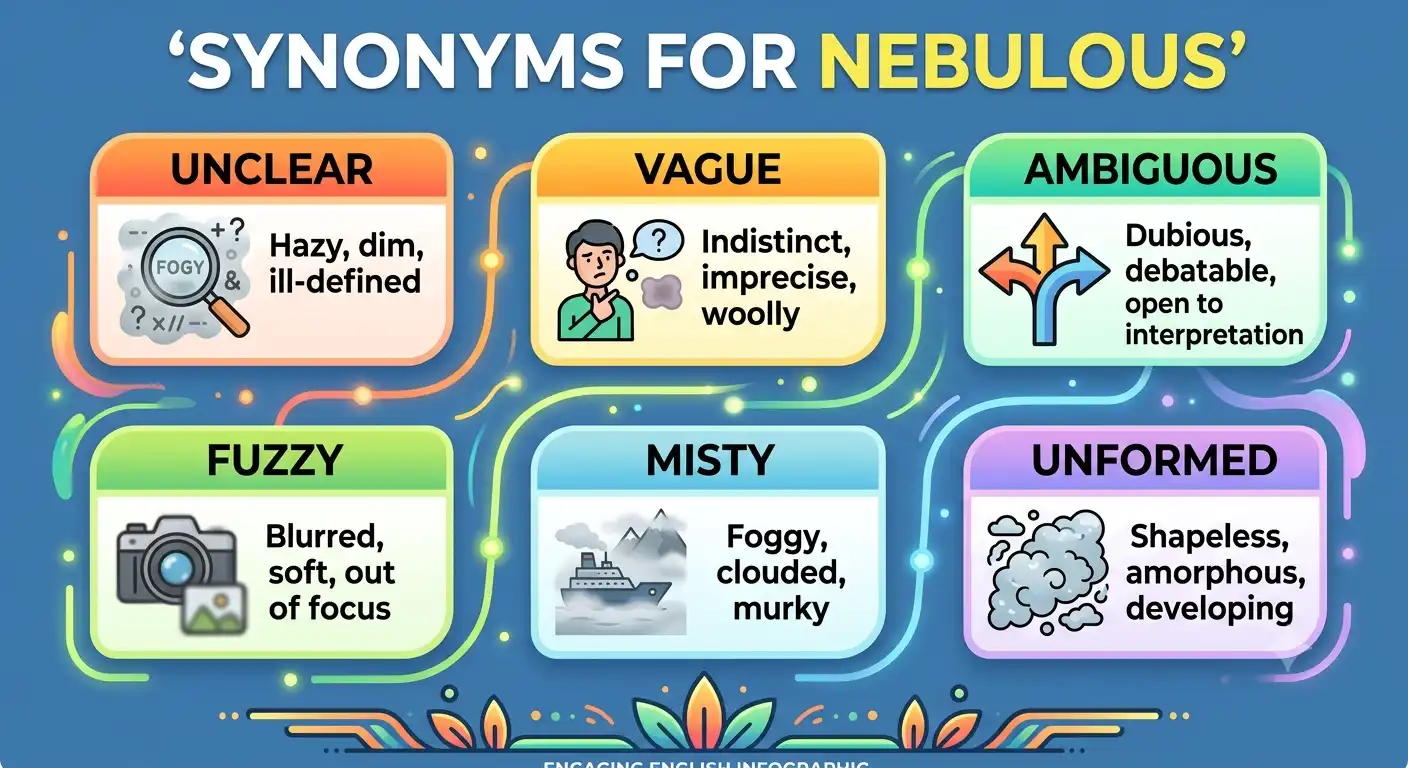
Exploring rich synonyms for nebulous allows you to describe unclear ideas with extreme precision. When you learn diverse synonyms for nebulous, your spoken and written English becomes far more captivating. Mastering various synonyms for nebulous ensures you never struggle to find the exact word when a plan, concept, or memory feels cloudy or incomplete.
Picture sitting in an early morning team meeting where your director presents a new project strategy. The goals sound lofty, but the actual action steps feel floating and undefined, leaving everyone wondering what to do next. In simple terms, something that is nebulous is hazy, unclear, or lacks a firm shape. For instance, the painter had a nebulous idea for his artwork before touching the canvas, or the student gave a nebulous answer because she forgot the history lesson.
“Precision in language is the foundation upon which clear thinking is built.” — Linguistics Principle
Expanding your range of synonyms for nebulous offers practical advantages for every type of communicator:
- Students can craft sharper argumentative essays, literature analysis papers, and research summaries.
- Bloggers can hook readers by describing complex thoughts without relying on repetitive words.
- Content writers can draft crisp business copy, persuasive landing pages, and clear brand messages.
- Daily English users can describe ambiguous situations, fuzzy memories, or uncertain feelings with confidence.
“Choosing the right word turns a cloudy message into a brilliant picture.” — Communication Proverb
Linguistic Breakdown of “Nebulous”
Connotative Meaning
The adjective nebulous carries an ethereal, vague, and often unformed tone. It highlights something that lacks sharp edges, clear boundaries, or concrete details, creating a sense of confusion, mystery, or soft uncertainty.
Etymology
- Root Word: Latin nebula (meaning mist, fog, cloud, or vapor).
- Suffix: -ous (adjectival suffix meaning full of or possessing the qualities of).
- History: Adapted into Middle English during the late 14th century via French nébuleux, originally describing actual sky clouds before shifting to figurative uncertainty.
Pronunciation
- US IPA: /ˈneb.jə.ləs/
- UK IPA: /ˈneb.jʊ.ləs/
Syllables & Affixation Pattern
- Syllables: 3 (neb-u-lous)
- Root Word: Nebula
- Affixation: Root nebula + adjectival suffix -ous.
Comparison Table of Key Synonyms
| Keyword | Meaning | Usage Type | Context |
|---|---|---|---|
| Vague | Not clear or specific in outline or detail | Universal / General | Daily conversations, workplace directions, notes |
| Hazy | Unclear due to mist, fog, or lack of detail | Visual / Descriptive | Weather reports, distant memories, visual art |
| Ambiguous | Open to more than one possible meaning | Formal / Analytical | Legal contracts, logic problems, academic essays |
| Obscure | Hard to understand or not well known | Formal / Academic | Historical facts, complex books, philosophy |
| Indefinite | Not fixed or limited in amount or time | Professional / Neutral | Schedules, project timelines, financial plans |
| Shapeless | Lacking a definite, clear, or organized form | Visual / Expressive | Physical objects, early art sketches, outfits |
| Murky | Dark, dirty, or hard to see through clearly | Dramatic / Figurative | Water quality, ethical decisions, mysterious motives |
| Cryptic | Having a hidden or puzzling meaning | Expressive / Casual | Riddles, text messages, mysterious comments |
Main Content – 50 Synonyms for Nebulous
1. Vague
- Pronunciation: US: /veɪɡ/ | UK: /veɪɡ/
- Meaning: Not clear or detailed in shape or explanation.
- Examples:
- His directions to the store were too vague to follow.
- She gave a vague response when asked about her holiday plans.
2. Hazy
- Pronunciation: US: /ˈheɪ.zi/ | UK: /ˈheɪ.zi/
- Meaning: Unclear and warm like air filled with thin smoke or mist.
- Examples:
- The distant mountains looked hazy in the summer heat.
- I have a hazy memory of my first day at school.
3. Cloudy
- Pronunciation: US: /ˈklaʊ.di/ | UK: /ˈklaʊ.di/
- Meaning: Hard to see through or difficult to understand clearly.
- Examples:
- The pond water was cloudy after the heavy storm.
- His future plans remained cloudy after leaving his job.
4. Indistinct
- Pronunciation: US: /ˌɪn.dɪˈstɪŋkt/ | UK: /ˌɪn.dɪˈstɪŋkt/
- Meaning: Not clear to the eyes, ears, or mind.
- Examples:
- We heard an indistinct sound coming from the dark forest.
- The old photo showed an indistinct figure near the house.
5. Ambiguous
- Pronunciation: US: /æmˈbɪɡ.ju.əs/ | UK: /æmˈbɪɡ.ju.əs/
- Meaning: Having more than one possible meaning.
- Examples:
- The contract had an ambiguous clause that caused a disagreement.
- Her ambiguous smile made it hard to guess her thoughts.
6. Obscure
- Pronunciation: US: /əbˈskjʊr/ | UK: /əbˈskjʊə/
- Meaning: Difficult to understand or not famous.
- Examples:
- The poet used obscure words that few readers understood.
- They visited an obscure town hidden deep in the hills.
7. Indefinite
- Pronunciation: US: /ɪnˈdef.ə.nət/ | UK: /ɪnˈdef.ɪ.nət/
- Meaning: Not set with fixed limits or exact details.
- Examples:
- The road construction was delayed for an indefinite period.
- She made an indefinite offer to help us move next week.
8. Shapeless
- Pronunciation: US: /ˈʃeɪp.ləs/ | UK: /ˈʃeɪp.ləs/
- Meaning: Lacking an exact form or organized structure.
- Examples:
- The baker rolled out a shapeless piece of bread dough.
- He wore a large, shapeless coat during the winter trip.
9. Formless
- Pronunciation: US: /ˈfɔːrm.ləs/ | UK: /ˈfɔːm.ləs/
- Meaning: Having no clear outline, boundary, or shape.
- Examples:
- A formless mass of clay sat on the table.
- Shadows appeared as formless shapes on the bedroom wall.
10. Murky
- Pronunciation: US: /ˈmɝː.ki/ | UK: /ˈmɜː.ki/
- Meaning: Dark, dirty, or hard to see through properly.
- Examples:
- Fish swam slowly through the murky river water.
- The company had a murky history regarding its finances.
11. Dim
- Pronunciation: US: /dɪm/ | UK: /dɪm/
- Meaning: Giving little light or not seen clearly.
- Examples:
- We could only see the dim light of a lantern outside.
- She kept a dim hope that her lost cat would return.
12. Shadowy
- Pronunciation: US: /ˈʃæd.oʊ.i/ | UK: /ˈʃæd.əʊ.i/
- Meaning: Full of shadows or hard to know well.
- Examples:
- A shadowy figure walked quickly down the quiet alley.
- The book tells a story about a shadowy spy group.
13. Foggy
- Pronunciation: US: /ˈfɑː.ɡi/ | UK: /ˈfɒɡ.i/
- Meaning: Filled with thick fog or confused in thought.
- Examples:
- Drivers moved slowly through the foggy morning street.
- My mind feels foggy when I do not get enough sleep.
14. Misty
- Pronunciation: US: /ˈmɪs.ti/ | UK: /ˈmɪs.ti/
- Meaning: Covered with fine droplets of water or unclear.
- Examples:
- The valley looked misty as the morning sun rose.
- She got misty eyes while watching the sad movie.
15. Fuzzy
- Pronunciation: US: /ˈfʌz.i/ | UK: /ˈfʌz.i/
- Meaning: Unfocused or lacking sharp and clear lines.
- Examples:
- The television picture turned fuzzy during the thunderstorm.
- He gave a fuzzy explanation of how the machine works.
“True command of vocabulary gives shape to the most abstract human thoughts.” — Master Wordsmith Guide
16. Amorphous
- Pronunciation: US: /əˈmɔːr.fəs/ | UK: /əˈmɔː.fəs/
- Meaning: Without a fixed chemical structure or clear shape.
- Examples:
- The artist painted an amorphous blob of bright yellow paint.
- The project was still an amorphous idea with no set goal.
17. Imprecise
- Pronunciation: US: /ˌɪm.prəˈsaɪs/ | UK: /ˌɪm.prɪˈsaɪs/
- Meaning: Not exact or careful in measurement or detail.
- Examples:
- Using imprecise measurements can ruin a baking recipe.
- The map was imprecise and led us down the wrong path.
18. Ill-defined
- Pronunciation: US: /ˌɪl.dɪˈfaɪnd/ | UK: /ˌɪl.dɪˈfaɪnd/
- Meaning: Lacking clear borders, rules, or boundaries.
- Examples:
- The job position had ill-defined duties that confused workers.
- An ill-defined outline appeared on the dark radar screen.
19. Blurred
- Pronunciation: US: /blɝːd/ | UK: /blɜːd/
- Meaning: Unable to be seen or heard distinctly.
- Examples:
- The fast car looked like a blurred line in the photograph.
- Tears made the printed words look blurred on the page.
20. Blurry
- Pronunciation: US: /ˈblɝː.i/ | UK: /ˈblɜː.ri/
- Meaning: Not sharp or clear to look at.
- Examples:
- Without his glasses, everything in the room appeared blurry.
- She took a blurry photo of the running dog.
21. Bleary
- Pronunciation: US: /ˈblɪr.i/ | UK: /ˈblɪə.ri/
- Meaning: Unclear or tired, especially regarding eyesight.
- Examples:
- He looked at the morning clock with bleary eyes.
- The tired student had a bleary view of the blackboard.
22. Undecided
- Pronunciation: US: /ˌʌn.dɪˈsaɪ.dɪd/ | UK: /ˌʌn.dɪˈsaɪ.dɪd/
- Meaning: Not yet settled or agreed upon.
- Examples:
- The date for the family picnic remains undecided.
- Voters were still undecided about which candidate to pick.
23. Uncertain
- Pronunciation: US: /ʌnˈsɝː.tən/ | UK: /ʌnˈsɜː.tən/
- Meaning: Not known for sure or feeling unsure.
- Examples:
- We are uncertain about what time the bus will arrive.
- She gave an uncertain answer during her interview.
24. Wishy-washy
- Pronunciation: US: /ˈwɪʃ.iˌwɑː.ʃi/ | UK: /ˈwɪʃ.iˌwɒʃ.i/
- Meaning: Lacking strength, firm purpose, or clear character.
- Examples:
- The manager gave a wishy-washy response to our request.
- Do not be wishy-washy when making big life choices.
25. Faint
- Pronunciation: US: /feɪnt/ | UK: /feɪnt/
- Meaning: Barely visible, audible, or clear.
- Examples:
- We caught a faint smell of baking cookies in the hallway.
- There was a faint star shining in the dark night sky.
26. Enigmatic
- Pronunciation: US: /ˌen.ɪɡˈmæt̬.ɪk/ | UK: /ˌen.ɪɡˈmæt.ɪk/
- Meaning: Mysterious and difficult to understand completely.
- Examples:
- The Mona Lisa painting is famous for her enigmatic smile.
- He left an enigmatic message on the kitchen notepad.
27. Cryptic
- Pronunciation: US: /ˈkrɪp.tɪk/ | UK: /ˈkrɪp.tɪk/
- Meaning: Mysterious and containing a hidden meaning.
- Examples:
- The treasure hunter solved the cryptic clue on the map.
- She sent a cryptic text message that puzzled her friend.
28. Opaque
- Pronunciation: US: /oʊˈpeɪk/ | UK: /əʊˈpeɪk/
- Meaning: Not able to be seen through or hard to understand.
- Examples:
- The bathroom door was made of thick, opaque glass.
- The government report was written in opaque language.
29. Dubious
- Pronunciation: US: /ˈduː.bi.əs/ | UK: /ˈdʒuː.bi.əs/
- Meaning: Thought to be doubtful, uncertain, or dishonest.
- Examples:
- He made a dubious claim about winning the lottery.
- The weather report gave a dubious forecast for sunshine.
30. Sketchy
- Pronunciation: US: /ˈsketʃ.i/ | UK: /ˈsketʃ.i/
- Meaning: Giving only main points without complete details.
- Examples:
- The news article gave a sketchy account of the event.
- We had a sketchy plan for our weekend road trip.
31. Woolly
- Pronunciation: US: /ˈwʊl.i/ | UK: /ˈwʊl.i/
- Meaning: Confused, unclear, or lacking clear logical thought.
- Examples:
- The politician presented a woolly argument during the debate.
- His thinking on the subject was woolly and unstructured.
32. Unsubstantial
- Pronunciation: US: /ˌʌn.səbˈstæn.ʃəl/ | UK: /ˌʌn.səbˈstæn.ʃəl/
- Meaning: Lacking solid truth, strength, or reality.
- Examples:
- The police found unsubstantial evidence against the suspect.
- Shadows created an unsubstantial image on the curtain.
33. Ethereal
- Pronunciation: US: /iˈθɪr.i.əl/ | UK: /iˈθɪə.ri.əl/
- Meaning: Extremely delicate, light, and heavenly in appearance.
- Examples:
- The singer had an ethereal voice that captivated the audience.
- Morning mist gave the garden an ethereal beauty.
34. Dreamlike
- Pronunciation: US: /ˈdriːm.laɪk/ | UK: /ˈdriːm.laɪk/
- Meaning: Having a strange or floating quality like a dream.
- Examples:
- Walking through the quiet castle felt completely dreamlike.
- The film had a dreamlike atmosphere with soft lighting.
35. Phantom
- Pronunciation: US: /ˈfæn.təm/ | UK: /ˈfæn.təm/
- Meaning: Unreal, ghostly, or existing only in imagination.
- Examples:
- He felt a phantom touch on his shoulder in the dark.
- The ship vanished into the fog like a phantom vessel.
36. Indeterminate
- Pronunciation: US: /ˌɪn.dɪˈtɝː.mɪ.nət/ | UK: /ˌɪn.dɪˈtɜː.mɪ.nət/
- Meaning: Not exactly known, measured, or decided.
- Examples:
- The antique clock was of indeterminate age and origin.
- She suffered from an illness of indeterminate cause.
37. Equivocal
- Pronunciation: US: /ɪˈkwɪv.ə.kəl/ | UK: /ɪˈkwɪv.ə.kəl/
- Meaning: Intentionally ambiguous or open to doubt.
- Examples:
- The doctor gave an equivocal answer about the recovery time.
- The test results were equivocal and required another check.
38. Noncommittal
- Pronunciation: US: /ˌnɑːn.kəˈmɪt̬.əl/ | UK: /ˌnɒn.kəˈmɪt.əl/
- Meaning: Not expressing a clear opinion or decision.
- Examples:
- He gave a noncommittal nod when asked about his vote.
- Her noncommittal tone made us feel uncertain about the plan.
39. Unsettled
- Pronunciation: US: /ʌnˈset̬.əld/ | UK: /ʌnˈset.əld/
- Meaning: Changing frequently or not yet decided.
- Examples:
- The weather remained unsettled with rain and wind.
- Their travel plans were still unsettled due to flight delays.
40. Puzzling
- Pronunciation: US: /ˈpʌz.l̩.ɪŋ/ | UK: /ˈpʌz.l̩.ɪŋ/
- Meaning: Difficult to understand or solve easily.
- Examples:
- The detective found a puzzling clue inside the safe.
- Why the car stopped working suddenly was puzzling to us.
41. Mysterious
- Pronunciation: US: /mɪˈstɪr.i.əs/ | UK: /mɪˈstɪə.ri.əs/
- Meaning: Strange, unknown, or hard to explain.
- Examples:
- A mysterious package arrived in the morning mail.
- Strange sounds came from the mysterious old house.
42. Unclear
- Pronunciation: US: /ʌnˈklɪr/ | UK: /ʌnˈklɪə/
- Meaning: Easy to misunderstand or not sharp to see.
- Examples:
- The teacher explained why the homework assignment was unclear.
- It is unclear who will win the final basketball game.
43. Shadowed
- Pronunciation: US: /ˈʃæd.oʊd/ | UK: /ˈʃæd.əʊd/
- Meaning: Covered in shade or obscured from light.
- Examples:
- The shadowed pathway looked scary late at night.
- Her eyes were shadowed under the wide sun hat.
44. Imperceptible
- Pronunciation: US: /ˌɪm.pɚˈsep.tə.bəl/ | UK: /ˌɪm.pəˈsep.tə.bəl/
- Meaning: Almost impossible to see, hear, or notice.
- Examples:
- There was an imperceptible nod from the quiet boy.
- The temperature shift was imperceptible at first glance.
45. Subtle
- Pronunciation: US: /ˈsʌt̬.əl/ | UK: /ˈsʌt.əl/
- Meaning: Small, delicate, and not obvious.
- Examples:
- The soup had a subtle taste of fresh lemon juice.
- She made a subtle change to her painting design.
46. Hidden
- Pronunciation: US: /ˈhɪd.ən/ | UK: /ˈhɪd.ən/
- Meaning: Placed out of sight or secret.
- Examples:
- They found a hidden room behind the bookcase.
- The trail led to a beautiful hidden waterfall.
47. Unspecified
- Pronunciation: US: /ˌʌnˈspes.ə.faɪd/ | UK: /ˌʌnˈspes.ɪ.faɪd/
- Meaning: Not clearly mentioned or named.
- Examples:
- The donor gave an unspecified amount of money.
- He left the meeting for an unspecified reason.
48. Unfixed
- Pronunciation: US: /ˌʌnˈfɪkst/ | UK: /ˌʌnˈfɪkst/
- Meaning: Not firmly set in place, rate, or time.
- Examples:
- The cost of repairs remained unfixed until inspection.
- An unfixed schedule made planning difficult for workers.
49. Doubtful
- Pronunciation: US: /ˈdaʊt.fəl/ | UK: /ˈdaʊt.fəl/
- Meaning: Causing uncertainty or unlikely to happen.
- Examples:
- It is doubtful that it will snow in July.
- She felt doubtful about passing the difficult exam.
50. Unformulated
- Pronunciation: US: /ˌʌnˈfɔːr.mjə.leɪ.t̬ɪd/ | UK: /ˌʌnˈfɔː.mjə.leɪ.tɪd/
- Meaning: Not yet worked out or organized systematically.
- Examples:
- He had unformulated thoughts on how to fix the issue.
- Their business strategy was still unformulated and raw.
Antonyms of “Nebulous”
While nebulous highlights lack of clarity and undefined edges, its antonyms describe clear, sharp, and solid concepts:
- Clear: US: /klɪr/ | UK: /klɪə/ – Easy to see, hear, or understand.
- Definite: US: /ˈdef.ə.nət/ | UK: /ˈdef.ɪ.nət/ – Fixed, certain, and clear.
- Precise: US: /prəˈsaɪs/ | UK: /prɪˈsaɪs/ – Exact and accurate in detail.
- Distinct: US: /dɪˈstɪŋkt/ | UK: /dɪˈstɪŋkt/ – Easily recognized as separate and clear.
Prototype Meaning and Categorization of “Nebulous”
- Grammatical Category: Adjective (modifying nouns to indicate state of clarity, form, or certainty).
- Prototype Meaning: Lacking definite form or clear limits; cloudy, vague, or unformed in appearance or thought.
- Semantic Field: Clarity, visibility, certainty, spatial boundaries, and cognitive comprehension.
Frequently Asked Questions (FAQ)
1. What is the main difference between “nebulous” and “vague”?
Vague is a general word meaning not detailed or clear. Nebulous goes a step further by implying that something is cloudy, shapeless, or still in its early, unformed stage.
2. Can “nebulous” be used in formal business writing?
Yes! Nebulous is an ideal word for formal, corporate, or academic writing when describing undefined strategies, vague business proposals, or unclear concepts.
3. Does “nebulous” always refer to physical clouds?
No. While its Latin origin refers to real mist or clouds, in modern English nebulous is most frequently used figuratively to describe thoughts, goals, ideas, memories, or plans.
4. Which synonym for “nebulous” is best for everyday conversations?
For casual daily speech, words like fuzzy, vague, hazy, or unclear sound most natural and conversational.
5. Is “ambiguous” a direct synonym for “nebulous”?
They are closely related, but ambiguous means something can be interpreted in two or more ways, whereas nebulous means something lacks sharp shape or clear detail altogether.
6. How does learning synonyms for “nebulous” improve my writing?
Using varied vocabulary prevents word repetition, improves descriptive depth, and allows you to communicate exact shades of meaning in essays, blogs, and reports.
Conclusion
Expanding your command of synonyms for nebulous elevates your ability to communicate with accuracy, elegance, and persuasive strength. Replacing generic words with precise choices like indefinite, ill-defined, amorphous, or obscure brings depth and sophistication to every sentence you create.
“The limit of your language marks the boundary of your world.” — Vocabulary Insight
We encourage you to actively test these 50 synonyms in your daily writing routines. Try integrating them into your work emails, university essays, blog entries, and casual conversations. Regular application builds lasting vocabulary confidence, enabling you to share ideas with vivid impact and professional polish.
“Clear words unlock deep understanding, bridging the gap between thought and expression.” — Linguistics Heritage

Andrew Collins is an academic English educator with over 12 years of experience helping university students, IELTS candidates, and ESL learners improve their writing vocabulary.