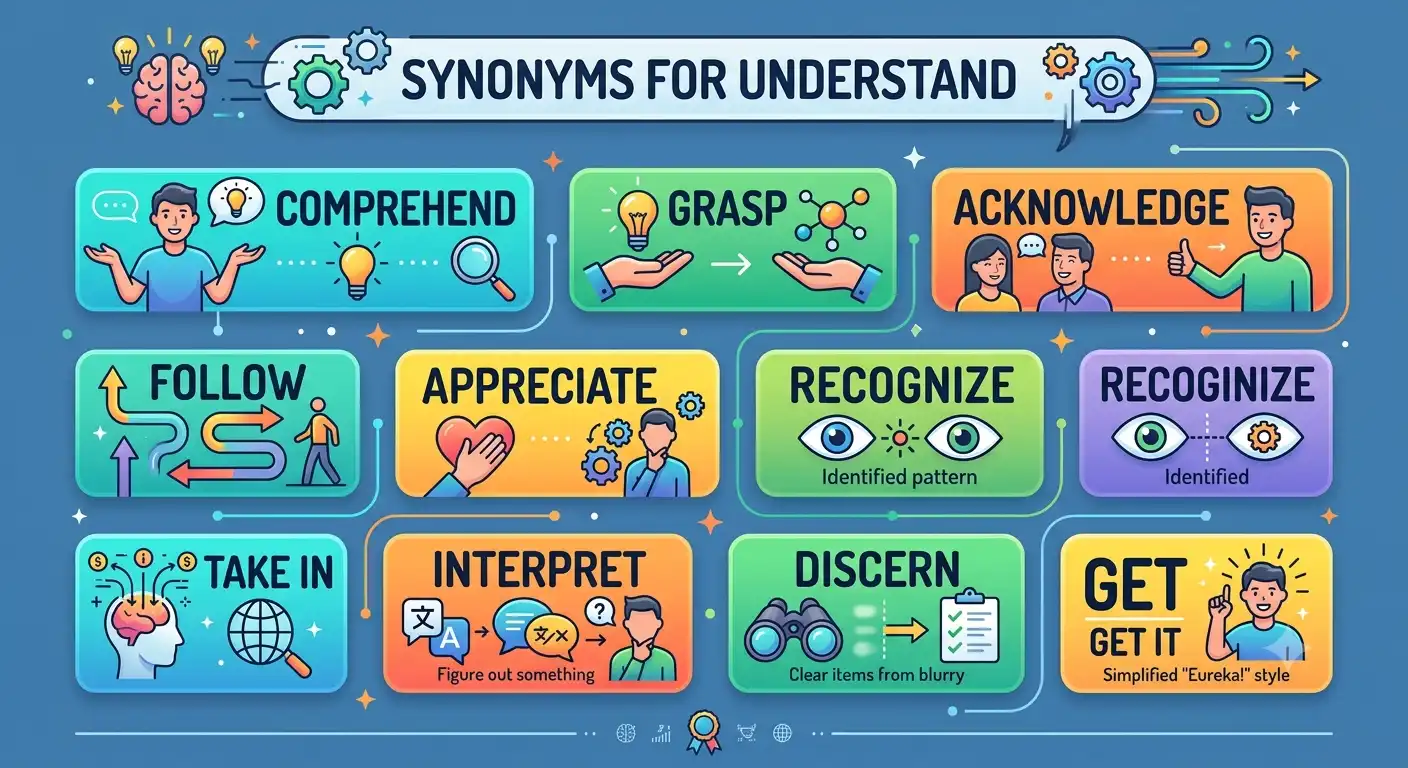
Exploring rich synonyms for understand allows you to express clarity, mental connection, and perception with high precision. When you learn diverse synonyms for understand, your spoken and written English becomes far more engaging and natural. Mastering practical synonyms for understand ensures you never struggle to express how you grasp a new idea, decipher a message, or connect with someone’s feelings.
Imagine sitting in a fast-paced lecture or a busy project meeting. The team lead explains a complex new software strategy, and instead of nodding silently or repeating “I understand,” you comfortably say, “I grasp the core strategy completely.” In simple terms, to understand something means to know its meaning, figure out how it works, or see a point clearly. For instance, the child began to understand how to ride a bike after a few tries, or the manager made sure everyone understood the new schedule.
“Clear expression begins when we move beyond basic words and embrace precise language.” — Linguistics Principle
Expanding your range of synonyms for understand offers practical advantages for every type of communicator:
- Students can write sharper essays, literature analysis papers, and research summaries.
- Bloggers can hook readers by describing complex thoughts without using repetitive phrasing.
- Content writers can draft clear business copy, compelling guides, and sharp brand messages.
- Daily English users can explain feelings, shared thoughts, and everyday ideas with ease.
“Finding the right word transforms a simple thought into an impactful message.” — Communication Proverb
Linguistic Breakdown of “Understand”
Connotative Meaning
The verb understand carries a warm, intelligent, and flexible tone. It highlights cognitive perception, logical reasoning, and empathetic connection, conveying that a person has processed information accurately or feels a meaningful bond with another’s perspective.
Etymology
- Root Words: Old English understandan (meaning to comprehend, realize, or observe).
- Prefix: under- (meaning among, between, or close to).
- Base Verb: standan (meaning to stand firm or hold a position).
- History: Formed in early Germanic languages as a figurative concept of standing in the middle of something to know it thoroughly.
Pronunciation
- US IPA: /ˌʌn.dɚˈstænd/
- UK IPA: /ˌʌn.dəˈstænd/
Syllables & Affixation Pattern
- Syllables: 3 (un-der-stand)
- Root Word: Stand
- Affixation: Prefix under- + root verb stand.
Comparison Table of Key Synonyms
| Keyword | Meaning | Usage Type | Context |
|---|---|---|---|
| Grasp | To hold or understand an idea firmly | Professional / Universal | Workplace strategies, math concepts, complex plans |
| Comprehend | To understand something fully and completely | Formal / Academic | Reading tests, scientific studies, formal essays |
| Perceive | To notice or understand through the senses | Analytical / Reflective | Art appreciation, tone of voice, social settings |
| Fathom | To understand something deep or mysterious | Expressive / Figurative | Complex motives, deep emotions, hidden truths |
| Discern | To see or recognize subtle differences clearly | Formal / Critical | Quality testing, legal facts, detailed editing |
| Get | To quickly understand a point or joke | Casual / Conversational | Everyday chats, quick text messages, banter |
| Decipher | To work out the meaning of something hard | Technical / Descriptive | Messy handwriting, codes, tricky documents |
| Empathize | To understand another person’s feelings | Emotional / Interpersonal | Friendly advice, counseling, close relationships |
Main Content – 50 Synonyms for Understand
1. Grasp
- Pronunciation: US: /ɡræsp/ | UK: /ɡrɑːsp/
- Meaning: To hold an idea firmly in your mind.
- Examples:
- She quicky learned to grasp the main rules of the game.
- The student was able to grasp the hard math problem easily.
2. Comprehend
- Pronunciation: US: /ˌkɑːm.prəˈhend/ | UK: /ˌkɒm.prɪˈhend/
- Meaning: To fully understand the complete meaning of something.
- Examples:
- I could not comprehend why the train was so late today.
- He read the long book twice to comprehend its main idea.
3. Perceive
- Pronunciation: US: /pɚˈsiːv/ | UK: /pəˈsiːv/
- Meaning: To notice or understand something using your senses or mind.
- Examples:
- She could perceive a change in his voice right away.
- We perceive the world differently as we grow older.
4. Fathom
- Pronunciation: US: /ˈfæð.əm/ | UK: /ˈfæð.əm/
- Meaning: To understand a deep, difficult, or mysterious concept.
- Examples:
- Scientists try to fathom the vast size of the ocean.
- I cannot fathom why he left his keys on the table.
5. Discern
- Pronunciation: US: /dɪˈsɝːn/ | UK: /dɪˈsɜːn/
- Meaning: To see or recognize something clearly through careful thought.
- Examples:
- The judge could discern the truth from the statements.
- We could faintly discern two shapes standing in the fog.
6. Gather
- Pronunciation: US: /ˈɡæð.ɚ/ | UK: /ˈɡæð.ər/
- Meaning: To conclude or understand something based on what you see or hear.
- Examples:
- I gather that you are ready for the long trip tomorrow.
- From her smile, we could gather that the news was good.
7. Decipher
- Pronunciation: US: /dɪˈsaɪ.fɚ/ | UK: /dɪˈsaɪ.fər/
- Meaning: To work out the meaning of something difficult or hidden.
- Examples:
- The detective tried to decipher the secret note.
- It took time to decipher the doctor’s messy handwriting.
8. Follow
- Pronunciation: US: /ˈfɑː.loʊ/ | UK: /ˈfɒl.əʊ/
- Meaning: To pay close attention and understand an explanation step by step.
- Examples:
- The lesson was clear, so everyone could follow along easily.
- I am sorry, but I do not follow your main argument.
9. Get
- Pronunciation: US: /ɡet/ | UK: /ɡet/
- Meaning: To quickly catch the meaning of an idea or joke.
- Examples:
- Ah, now I get what you mean!
- Did you get the joke that he told at lunch?
10. Catch
- Pronunciation: US: /kætʃ/ | UK: /kætʃ/
- Meaning: To hear and understand words clearly as someone speaks.
- Examples:
- I did not catch your name when we first met.
- Speak slowly so the class can catch every word.
11. Dig
- Pronunciation: US: /dɪɡ/ | UK: /dɪɡ/
- Meaning: To informal understand or appreciate a concept or style.
- Examples:
- I really dig what you are trying to do with this artwork.
- Do you dig the meaning of this old song lyric?
12. See
- Pronunciation: US: /siː/ | UK: /siː/
- Meaning: To realize or recognize a fact clearly.
- Examples:
- I see why you decided to stay home today.
- Now we see the real reason behind her choice.
13. Realize
- Pronunciation: US: /ˈriː.ə.laɪz/ | UK: /ˈrɪə.laɪz/
- Meaning: To suddenly understand or become aware of a fact.
- Examples:
- She did not realize how late it had gotten.
- He came to realize that hard work brings strong results.
14. Master
- Pronunciation: US: /ˈmæs.tɚ/ | UK: /ˈmɑː.stər/
- Meaning: To understand a skill or topic completely through practice.
- Examples:
- It takes years to master a new spoken language.
- She worked hard to master the piano lesson.
15. Absorb
- Pronunciation: US: /əbˈzɔːrb/ | UK: /əbˈzɔːb/
- Meaning: To take in and fully understand information into your mind.
- Examples:
- Young students absorb new facts very quickly in class.
- He sat quietly to absorb all the news from the letter.
16. Process
- Pronunciation: US: /ˈprɑː.ses/ | UK: /ˈprəʊ.ses/
- Meaning: To think about new facts so you can understand them.
- Examples:
- Give me a moment to process what you just said.
- Her brain needed time to process the huge amount of data.
“The human mind thrives when it moves from simply hearing to truly understanding.” — Modern Learning Thought
17. Interpret
- Pronunciation: US: /ɪnˈtɝː.prət/ | UK: /ɪnˈtɜː.prɪt/
- Meaning: To explain or understand the meaning of something in your own way.
- Examples:
- How do you interpret the ending of this story?
- She helped interpret the chart for the team members.
18. Intuit
- Pronunciation: US: /ɪnˈtuː.ɪt/ | UK: /ɪnˈtʃuː.ɪt/
- Meaning: To understand something instantly using your inner feeling.
- Examples:
- She could intuit that her friend needed help.
- An experienced coach can intuit when an athlete is tired.
19. Register
- Pronunciation: US: /ˈredʒ.ə.stɚ/ | UK: /ˈredʒ.ɪ.stər/
- Meaning: To become clear or noticed in your mind.
- Examples:
- The warning sign took a second to register in his mind.
- Her words did not register until she repeated them slowly.
20. Recognize
- Pronunciation: US: /ˈrek.əɡ.naɪz/ | UK: /ˈrek.əɡ.naɪz/
- Meaning: To see and know something because you have learned it before.
- Examples:
- I recognize the pattern on this old wall.
- She began to recognize the value of daily exercise.
21. Penetrate
- Pronunciation: US: /ˈpen.ə.treɪt/ | UK: /ˈpen.ɪ.treɪt/
- Meaning: To break through confusion and understand a difficult matter.
- Examples:
- His mind was able to penetrate the hard mystery.
- The study helps penetrate how brain cells communicate.
22. Unravel
- Pronunciation: US: /ʌnˈræv.əl/ | UK: /ʌnˈræv.əl/
- Meaning: To solve or understand something tangled or complicated.
- Examples:
- The scientist worked to unravel the secret of the gene.
- Together we can unravel this tricky puzzle.
23. Deduce
- Pronunciation: US: /dɪˈduːs/ | UK: /dɪˈdʒuːs/
- Meaning: To reach an understanding by using logic and facts.
- Examples:
- From the wet shoes, I could deduce that it rained outside.
- We can deduce the answer by looking at the evidence.
24. Infer
- Pronunciation: US: /ɪnˈfɝː/ | UK: /ɪnˈfɜː/
- Meaning: To form an understanding based on clues rather than direct words.
- Examples:
- Readers can infer the character’s mood from her actions.
- What can we infer from the survey results?
25. Make out
- Pronunciation: US: /meɪk aʊt/ | UK: /meɪk aʊt/
- Meaning: To barely see, hear, or understand something with effort.
- Examples:
- I could just make out what he was whispering across the room.
- We could not make out the sign in the dim light.
26. Figure out
- Pronunciation: US: /ˈfɪɡ.jɚ aʊt/ | UK: /ˈfɪɡ.ər aʊt/
- Meaning: To think carefully until you understand how something works.
- Examples:
- Can you figure out how to start this machine?
- She tried to figure out the best route to the park.
27. Take in
- Pronunciation: US: /teɪk ɪn/ | UK: /teɪk ɪn/
- Meaning: To listen to and completely hold facts in your memory.
- Examples:
- There was so much news that I could barely take it all in.
- He paused to take in everything the guide said.
28. Catch on
- Pronunciation: US: /kætʃ ɑːn/ | UK: /kætʃ ɒn/
- Meaning: To learn or understand how to do something after practice.
- Examples:
- Do not worry; you will catch on to the software fast.
- She quickly caught on to the steps of the dance.
29. Latch on to
- Pronunciation: US: /lætʃ ɑːn tuː/ | UK: /lætʃ ɒn tuː/
- Meaning: To quickly understand and focus on an idea.
- Examples:
- He latched on to the main point of the speech right away.
- The students latched on to the fun new learning method.
30. Settle on
- Pronunciation: US: /ˈset̬.əl ɑːn/ | UK: /ˈset.əl ɒn/
- Meaning: To come to a clear understanding and agreement after thought.
- Examples:
- We finally settled on a plan for the summer trip.
- The group settled on a clear answer to the problem.
31. Assimilate
- Pronunciation: US: /əˈsɪm.ə.leɪt/ | UK: /əˈsɪm.ɪ.leɪt/
- Meaning: To absorb ideas completely into your knowledge base.
- Examples:
- It takes time to assimilate new ideas in science.
- The team needed a week to assimilate the new guidelines.
32. Clue in
- Pronunciation: US: /kluː ɪn/ | UK: /kluː ɪn/
- Meaning: To gain or provide essential understanding about a situation.
- Examples:
- Please clue me in on what happened while I was away.
- She quickly clued in on why everyone was celebrating.
33. Sense
- Pronunciation: US: /sens/ | UK: /sens/
- Meaning: To feel or understand something without explicit words.
- Examples:
- I could sense that he was feeling nervous about the speech.
- Dogs can sense when someone is approaching the front door.
34. Know
- Pronunciation: US: /noʊ/ | UK: /nəʊ/
- Meaning: To have complete understanding and information about a fact.
- Examples:
- She knows how to fix broken bicycles quickly.
- I know the answer to the third question on the quiz.
35. Conceive
- Pronunciation: US: /kənˈsiːv/ | UK: /kənˈsiːv/
- Meaning: To form an understanding or picture of an idea in your mind.
- Examples:
- It is hard to conceive how big the universe really is.
- She conceived a clever plan to solve the office issue.
36. Envision
- Pronunciation: US: /ɪnˈvɪʒ.ən/ | UK: /ɪnˈvɪʒ.ən/
- Meaning: To picture and understand a future possibility in your mind.
- Examples:
- He could envision how the new building would look when finished.
- We envision a smooth path toward completing our goals.
37. Cognize
- Pronunciation: US: /ˈkɑːɡ.naɪz/ | UK: /ˈkɒɡ.naɪz/
- Meaning: To formally become aware of or understand a truth.
- Examples:
- The brain must cognize signals sent from the eyes.
- Researchers study how humans cognize abstract thoughts.
38. Unpack
- Pronunciation: US: /ʌnˈpæk/ | UK: /ʌnˈpæk/
- Meaning: To analyze and understand a complex concept piece by piece.
- Examples:
- Let us unpack this idea so everyone understands it well.
- The speaker helped unpack the main points of the report.
39. Deconstruct
- Pronunciation: US: /ˌdiː.kənˈstrʌkt/ | UK: /ˌdiː.kənˈstrʌkt/
- Meaning: To break down a topic to understand its inner parts.
- Examples:
- The teacher helped deconstruct the poem for the students.
- We need to deconstruct the plan to see where the error is.
40. Clear up
- Pronunciation: US: /klɪr ʌp/ | UK: /klɪə r ʌp/
- Meaning: To make an issue clear so it is easy to understand.
- Examples:
- The manager met with us to clear up any lingering doubts.
- A quick explanation will clear up the mistake.
41. Internalize
- Pronunciation: US: /ɪnˈtɝː.nə.laɪz/ | UK: /ɪnˈtɜː.nəl.aɪz/
- Meaning: To understand an idea so deeply that it becomes part of your thinking.
- Examples:
- Good drivers internalize safety rules over time.
- She internalized the advice her teacher gave her.
42. Make sense of
- Pronunciation: US: /meɪk sens ɑːv/ | UK: /meɪk sens ɒv/
- Meaning: To find meaning or order in something confusing.
- Examples:
- I am trying to make sense of these complex directions.
- He could not make sense of the strange map markings.
43. Piece together
- Pronunciation: US: /piːs təˈɡeð.ɚ/ | UK: /piːs təˈɡeð.ər/
- Meaning: To join small facts together until you understand the whole picture.
- Examples:
- The police were able to piece together what happened that night.
- We pieced together the clues to solve the mystery game.
44. Read
- Pronunciation: US: /riːd/ | UK: /riːd/
- Meaning: To understand the meaning of someone’s mood or body language.
- Examples:
- She can read her friend’s face like an open book.
- I could read the concern in his quiet expression.
45. Translate
- Pronunciation: US: /trænˈsleɪt/ | UK: /trænˈsleɪt/
- Meaning: To change information into a form that is easy to understand.
- Examples:
- He helped translate complex technical terms into simple words.
- She translated her feelings into a beautiful piece of poetry.
46. Track
- Pronunciation: US: /træk/ | UK: /træk/
- Meaning: To follow and understand a train of thought or process.
- Examples:
- Are you able to track what the instructor is explaining?
- The software helps us track changes in student scores.
47. Connect
- Pronunciation: US: /kəˈnekt/ | UK: /kəˈnekt/
- Meaning: To bring facts together mentally to form a clear picture.
- Examples:
- The investigator connected the two events to see the pattern.
- It is easy to connect the cause with the final effect.
48. Sympathize
- Pronunciation: US: /ˈsɪm.pə.θaɪz/ | UK: /ˈsɪm.pə.θaɪz/
- Meaning: To understand and share feelings of sorrow or difficulty with someone.
- Examples:
- I sympathize with your situation during this tough week.
- She offered kind words to show she could sympathize.
49. Empathize
- Pronunciation: US: /ˈem.pə.θaɪz/ | UK: /ˈem.pə.θaɪz/
- Meaning: To deeply understand and share another person’s emotions.
- Examples:
- Good leaders empathize with the challenges their teams face.
- It is easy to empathize with a friend going through a hard time.
50. Apprehend
- Pronunciation: US: /ˌæp.rəˈhend/ | UK: /ˌæp.rɪˈhend/
- Meaning: To perceive or understand the basic nature of a concept.
- Examples:
- The student began to apprehend the importance of daily practice.
- It took time for him to apprehend the full meaning of the law.
Antonyms of “Understand”
While understand highlights mental clarity and shared connection, its antonyms describe confusion, oversight, or lack of comprehension:
- Misunderstand: US: /ˌmɪs.ʌn.dɚˈstænd/ | UK: /ˌmɪs.ʌn.dəˈstænd/ – To interpret something incorrectly or get the wrong meaning.
- Misinterpret: US: /ˌmɪs.ɪnˈtɝː.prət/ | UK: /ˌmɪs.ɪnˈtɜː.prɪt/ – To explain or take meaning in an inaccurate way.
- Overlook: US: /ˌoʊ.vɚˈlʊk/ | UK: /ˌəʊ.vəˈlʊk/ – To fail to notice or consider a fact.
- Confuse: US: /kənˈfjuːz/ | UK: /kənˈfjuːz/ – To make something hard to understand or mix up facts.
Prototype Meaning and Categorization of “Understand”
- Grammatical Category: Verb (transitive and intransitive, acting as a mental process verb).
- Prototype Meaning: To perceive the intended meaning, logic, or emotional truth of information or people.
- Semantic Field: Cognitive comprehension, learning, perception, mental processing, and emotional connection.
Frequently Asked Questions (FAQ)
1. What is the most common synonym for “understand” in daily speech?
The most common everyday synonyms for understand are get, see, grasp, and figure out. These words sound natural in friendly conversation and informal emails.
2. What is the main difference between “comprehend” and “understand”?
Understand is a versatile word used in all contexts. Comprehend is more formal and usually refers to deep, complete mental understanding of complex or academic ideas.
3. Can “empathize” be used as a synonym for “understand”?
Yes! When understand refers to feelings or personal experiences, empathize or sympathize serves as an ideal synonym that highlights emotional connection.
4. Is “figure out” better than “understand” in professional writing?
In formal reports, grasp, discern, or determine are usually preferred over phrasal verbs like figure out. However, figure out works great in conversational blogs and casual business emails.
5. How does learning synonyms for “understand” boost my English skills?
Learning varied synonyms for understand keeps your writing fresh, avoids word repetition, and lets you match your word choices to the exact tone of your audience.
6. Are all 50 synonyms interchangeable in every sentence?
No. Words vary by context. For example, decipher fits messy text, empathize fits feelings, and master fits physical or mental skills. Always choose the word that matches your specific sentence context.
Conclusion
Expanding your command of synonyms for understand elevates your communication, giving you the tools to share thoughts with precision and grace. Replacing basic expressions with targeted choices like grasp, comprehend, discern, or fathom adds depth and polish to every piece of writing you produce.
“Precision in word choice is the bridge between a vague thought and lasting impact.” — Writing Insight
We encourage you to actively test these 50 synonyms across your daily writing routines. Try inserting them into your work emails, college essays, blog posts, and personal conversations. Regular practice builds natural confidence, allowing you to share ideas with vivid impact and clear expression.
“To master words is to master the art of bringing people closer together.” — Vocabulary Heritage

Andrew Collins is an academic English educator with over 12 years of experience helping university students, IELTS candidates, and ESL learners improve their writing vocabulary.