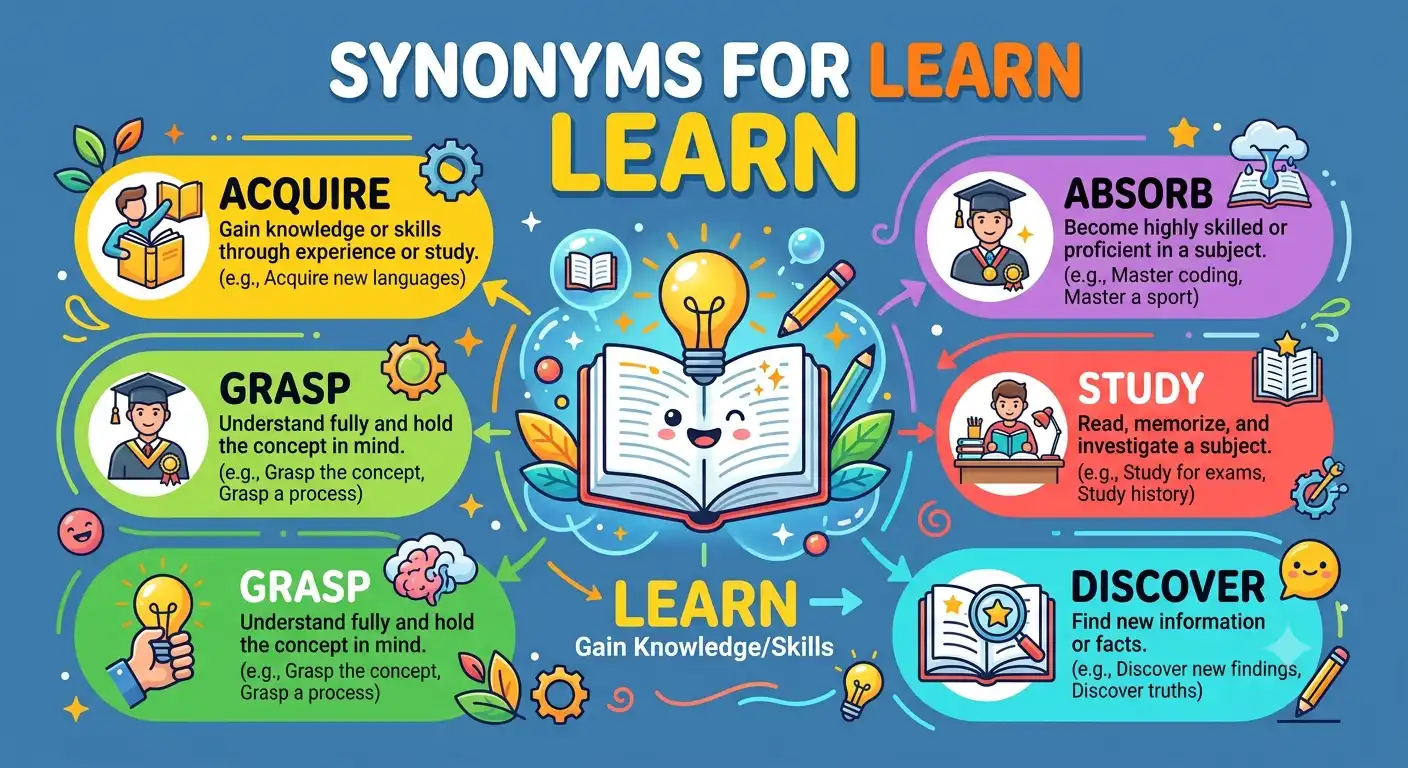
Exploring rich synonyms for learn helps you express how you gain knowledge, master new skills, and share fresh insights without repeating the same basic words. When you master diverse synonyms for learn, your writing and daily speech instantly become more precise, persuasive, and engaging. Discovering these synonyms for learn gives you exact terms for every situation, whether you are picking up a new language or studying complex ideas.
Imagine sitting at your desk late at night trying to understand a new software tool for work. Instead of telling your manager, “I need to learn this program,” you say, “I am going to master this software by Friday.” To learn simply means to get new information, understand an idea, or gain a skill through practice. For example, the student spent hours at the library to learn how plants make their food.
“Learning is a lifelong journey that brightens the mind and opens new paths.” — Educational Wisdom
Expanding your personal collection of synonyms for learn provides clear advantages for every communicator:
- Students can write stronger essays, research summaries, and academic papers.
- Bloggers can keep readers hooked by describing educational guides with fresh phrasing.
- Content writers can draft compelling tutorials, career advice, and marketing articles.
- Daily English users can speak about their experiences and hobbies with confidence.
“The right word at the right moment transforms everyday study into true understanding.” — Language Insight
Linguistic Breakdown of “Learn”
Connotative Meaning
The verb learn carries a positive, curious, and growth-oriented tone. It implies personal development, active mental discovery, and the absorption of new facts or skills over time.
Etymology
- Root Words: Old English leornian (meaning to get knowledge or study).
- Proto-Germanic: liznojanan (meaning to follow a track or footprint).
- History: Linked to the ancient root leis- (track), suggesting that getting knowledge is like following a clear path of discovery.
Pronunciation
- US IPA: /lɝːn/
- UK IPA: /lɜːn/
Syllables & Affixation Pattern
- Syllables: 1 (learn)
- Root Word: Learn
- Affixation: Base root with zero affixes; forms past tense as learned (US/UK) or learnt (UK).
Comparison Table of Key Synonyms
| Keyword | Meaning | Usage Type | Context |
|---|---|---|---|
| Acquire | To gain a new skill or knowledge over time | Professional / Formal | Career growth, language learning, skill development |
| Master | To learn something so well that you become an expert | Professional / Enthusiastic | Technical skills, arts, sports, complex subjects |
| Grasp | To understand a tricky idea fully | Casual / Practical | Problem-solving, class lessons, work instructions |
| Absorb | To take in a lot of information easily | Creative / Reflective | Reading books, watching lectures, listening to news |
| Pick up | To learn a skill naturally without formal lessons | Casual / Everyday | Hobbies, accents, daily habits, slang |
| Study | To spend time reading and practicing to gain knowledge | Academic / Universal | Schoolwork, test prep, scientific research |
| Glean | To collect small pieces of facts from different sources | Formal / Analytical | Researching, gathering news, investigating |
| Assimilation | To make new ideas a natural part of your thinking | Educational / Analytical | Deep study, cultural learning, complex training |
Main Content – 50 Synonyms for Learn
1. Acquire
- Pronunciation: US: /əˈkwaɪɚ/ | UK: /əˈkwaɪə/
- Meaning: To get a new skill or knowledge by trying hard over time.
- Examples:
- She wants to acquire new computer skills for her job.
- Children acquire language naturally by listening to their parents.
2. Master
- Pronunciation: US: /ˈmæs.tɚ/ | UK: /ˈmɑː.stə/
- Meaning: To learn a subject so well that you become an expert at it.
- Examples:
- It takes years of practice to master the guitar.
- He worked hard to master the new game rules.
3. Grasp
- Pronunciation: US: /ɡræsp/ | UK: /ɡrɑːsp/
- Meaning: To fully understand a hard idea or lesson.
- Examples:
- The student was quick to grasp the math problem.
- I need time to grasp all the facts in this report.
4. Absorb
- Pronunciation: US: /əbˈsɔːrb/ | UK: /əbˈzɔːb/
- Meaning: To take in knowledge easily, like a sponge taking in water.
- Examples:
- Young kids absorb facts fast while reading fun stories.
- She loves to absorb new ideas from science books.
5. Discover
- Pronunciation: US: /dɪˈskʌv.ɚ/ | UK: /dɪˈskʌv.ə/
- Meaning: To find out a new fact for the very first time.
- Examples:
- Scientists discover new things about space every year.
- I was happy to discover a great coffee shop near my home.
6. Study
- Pronunciation: US: /ˈstʌd.i/ | UK: /ˈstʌd.i/
- Meaning: To spend focused time reading and practicing to know a topic.
- Examples:
- We need to study hard for the test tomorrow.
- She decided to study history at the university.
7. Gather
- Pronunciation: US: /ˈɡæð.ɚ/ | UK: /ˈɡæð.ə/
- Meaning: To collect facts and news from different places.
- Examples:
- The reporter went out to gather news for the story.
- We must gather details before making a big choice.
8. Pick up
- Pronunciation: US: /pɪk ʌp/ | UK: /pɪk ʌp/
- Meaning: To learn a skill naturally without taking formal classes.
- Examples:
- He was able to pick up Spanish while living in Madrid.
- She can pick up new dance moves very quickly.
9. Comprehend
- Pronunciation: US: /ˌkɑːm.prəˈhend/ | UK: /ˌkɒm.prɪˈhend/
- Meaning: To completely understand the meaning of something.
- Examples:
- It was hard to comprehend why the machine broke down.
- Good readers can comprehend deep book chapters easily.
10. Memorize
- Pronunciation: US: /ˈmem.ə.raɪz/ | UK: /ˈmem.ə.raɪz/
- Meaning: To learn facts by heart so you remember them later.
- Examples:
- The actor had to memorize all his lines for the play.
- She tried to memorize the phone number without writing it down.
11. Internalize
- Pronunciation: US: /ɪnˈtɝː.nə.laɪz/ | UK: /ɪnˈtɜː.nəl.aɪz/
- Meaning: To make an idea a real part of your own thinking.
- Examples:
- Good drivers internalize safety rules until they become habits.
- It takes time to internalize new rules at work.
12. Glean
- Pronunciation: US: /ɡliːn/ | UK: /ɡliːn/
- Meaning: To gather small pieces of useful information slowly.
- Examples:
- We can glean useful tips from reading old books.
- She managed to glean a few facts from the meeting.
13. Assimilate
- Pronunciation: US: /əˈsɪm.ə.leɪt/ | UK: /əˈsɪm.ɪ.leɪt/
- Meaning: To absorb new ideas fully into your mind.
- Examples:
- Students need time to assimilate difficult lessons.
- The team worked to assimilate the new business guidelines.
“Knowledge gained each day opens up a world of endless growth.” — Mindset Note
14. Digest
- Pronunciation: US: /daɪˈdʒest/ | UK: /daɪˈdʒest/
- Meaning: To think carefully about new facts until you fully understand them.
- Examples:
- Give me a moment to digest what you just told me.
- He sat quietly to digest the news from the letter.
15. Gain
- Pronunciation: US: /ɡeɪn/ | UK: /ɡeɪn/
- Meaning: To get more knowledge, experience, or understanding over time.
- Examples:
- You will gain great experience by working on real projects.
- She hopes to gain more confidence in public speaking.
16. Adopt
- Pronunciation: US: /əˈdɑːpt/ | UK: /əˈdɒpt/
- Meaning: To take up a new idea or method and start using it.
- Examples:
- Our company decided to adopt a simpler workflow.
- Teachers often adopt new tools to help students read.
17. Retain
- Pronunciation: US: /rɪˈteɪn/ | UK: /rɪˈteɪn/
- Meaning: To keep facts and knowledge safe inside your memory.
- Examples:
- Reviewing your notes helps you retain key information.
- She can retain dates and names with great ease.
18. Catch on
- Pronunciation: US: /kætʃ ɑːn/ | UK: /kætʃ ɒn/
- Meaning: To understand how to do something after a little time.
- Examples:
- Don’t worry, you will catch on to the rules very soon.
- He caught on quickly after watching the demonstration.
19. Figure out
- Pronunciation: US: /ˈfɪɡ.jɚ aʊt/ | UK: /ˈfɪɡ.ər aʊt/
- Meaning: To solve a problem or understand a topic by thinking about it.
- Examples:
- I need to figure out how to fix this broken toy.
- She helped me figure out the answer to the puzzle.
20. Uncover
- Pronunciation: US: /ʌnˈkʌv.ɚ/ | UK: /ʌnˈkʌv.ə/
- Meaning: To find hidden facts through work or research.
- Examples:
- The study helped uncover important health facts.
- Researchers hope to uncover new details about history.
21. Realize
- Pronunciation: US: /ˈriː.ə.laɪz/ | UK: /ˈrɪə.laɪz/
- Meaning: To suddenly understand a fact clearly.
- Examples:
- I came to realize that practice is the key to success.
- She did not realize how late it had become.
22. Familiarize
- Pronunciation: US: /fəˈmɪl.i.ə.raɪz/ | UK: /fəˈmɪl.i.ə.raɪz/
- Meaning: To get to know a subject well through experience.
- Examples:
- Take time to familiarize yourself with the office tools.
- I need to familiarize myself with the city map.
23. Ascertain
- Pronunciation: US: /ˌæs.ɚˈteɪn/ | UK: /ˌæs.əˈteɪn/
- Meaning: To find out the true facts about a situation.
- Examples:
- The police tried to ascertain the cause of the accident.
- We must ascertain whether the details are correct.
24. Perceive
- Pronunciation: US: /pɚˈsiːv/ | UK: /pəˈsiːv/
- Meaning: To notice and understand something through your senses.
- Examples:
- He was able to perceive the change in her tone.
- Good listeners perceive small details that others miss.
25. Educate oneself
- Pronunciation: US: /ˈedʒ.ə.keɪt wʌnˈself/ | UK: /ˈed.jʊ.keɪt wʌnˈself/
- Meaning: To teach yourself about a topic by reading and researching.
- Examples:
- She decided to educate herself on simple budgeting rules.
- You can educate yourself by reading good books online.
26. Fathom
- Pronunciation: US: /ˈfæð.əm/ | UK: /ˈfæð.əm/
- Meaning: To understand a deep or complicated topic completely.
- Examples:
- It is hard to fathom how vast the ocean really is.
- I cannot fathom why he chose to leave early.
27. Soak up
- Pronunciation: US: /soʊk ʌp/ | UK: /səʊk ʌp/
- Meaning: To enjoy taking in a lot of new information or experiences.
- Examples:
- Students love to soak up new ideas during field trips.
- She sat in the library to soak up knowledge all day.
28. Imbibe
- Pronunciation: US: /ɪmˈbaɪb/ | UK: /ɪmˈbaɪb/
- Meaning: To receive ideas or values into your mind.
- Examples:
- Young people imbibe wisdom from good mentors.
- He went abroad to imbibe the local culture.
29. Take in
- Pronunciation: US: /teɪk ɪn/ | UK: /teɪk ɪn/
- Meaning: To listen to or look at information and understand it.
- Examples:
- There was so much news that I could hardly take it all in.
- She listened carefully to take in every word of the talk.
30. Determine
- Pronunciation: US: /dɪˈtɝː.mɪn/ | UK: /dɪˈtɜː.mɪn/
- Meaning: To discover the exact truth or facts about something.
- Examples:
- Tests help determine the exact cause of an illness.
- We must determine the best route for our trip.
31. Deduce
- Pronunciation: US: /dɪˈduːs/ | UK: /dɪˈdjuːs/
- Meaning: To reach an answer by using logic and known facts.
- Examples:
- From the wet ground, we can deduce that it rained last night.
- She was able to deduce the correct answer from the clues.
32. Observe
- Pronunciation: US: /əbˈzɝːv/ | UK: /əbˈzɜːv/
- Meaning: To watch things carefully in order to gain knowledge.
- Examples:
- Children observe how adults talk and act.
- Scientists observe animals to study their behaviors.
33. Understand
- Pronunciation: US: /ˌʌn.dɚˈstænd/ | UK: /ˌʌn.dəˈstænd/
- Meaning: To know the meaning of an idea or why something happens.
- Examples:
- Do you understand the instructions for the test?
- She helps others understand hard science lessons.
34. Research
- Pronunciation: US: /ˈriː.sɝːtʃ/ | UK: /rɪˈsɜːtʃ/
- Meaning: To study facts carefully to discover new knowledge.
- Examples:
- He will research the topic before writing his paper.
- Doctors research new ways to keep people healthy.
35. Explore
- Pronunciation: US: /ɪkˈsplɔːr/ | UK: /ɪkˈsplɔː/
- Meaning: To investigate a new subject to see what you can find.
- Examples:
- We should explore new topics in our study group.
- The course lets students explore different forms of art.
36. School oneself
- Pronunciation: US: /skuːl wʌnˈself/ | UK: /skuːl wʌnˈself/
- Meaning: To train yourself to master a specific skill or discipline.
- Examples:
- He had to school himself to remain calm under stress.
- She schooled herself in financial planning over the summer.
37. Trace
- Pronunciation: US: /treɪs/ | UK: /treɪs/
- Meaning: To follow the history or development of an idea step by step.
- Examples:
- The lesson helped us trace the origin of modern words.
- Historians try to trace how ancient towns were built.
38. Discern
- Pronunciation: US: /dɪˈsɝːn/ | UK: /dɪˈsɜːn/
- Meaning: To see and recognize differences between things clearly.
- Examples:
- It takes practice to discern real news from false stories.
- She could discern a subtle change in his expression.
39. Know
- Pronunciation: US: /noʊ/ | UK: /nəʊ/
- Meaning: To have clear facts and understanding stored in your mind.
- Examples:
- I know how to solve this basic math equation.
- She wants everyone to know the safety rules.
40. Decipher
- Pronunciation: US: /dɪˈsaɪ.fɚ/ | UK: /dɪˈsaɪ.fə/
- Meaning: To figure out the meaning of something hard or secret.
- Examples:
- The student tried to decipher the teacher’s neat handwriting.
- We need to decipher the code to open the digital file.
41. Practice
- Pronunciation: US: /ˈpræk.tɪs/ | UK: /ˈpræk.tɪs/
- Meaning: To do an activity repeatedly so you learn to do it well.
- Examples:
- If you practice every day, your typing will speed up.
- She likes to practice speaking French with her friends.
42. Read up on
- Pronunciation: US: /riːd ʌp ɑːn/ | UK: /riːd ʌp ɒn/
- Meaning: To get information about a topic by reading books or articles.
- Examples:
- Before buying a car, read up on the best safety ratings.
- I plan to read up on world history this weekend.
43. Train
- Pronunciation: US: /treɪn/ | UK: /treɪn/
- Meaning: To practice and learn skills for a specific job or activity.
- Examples:
- The company will train new workers next Monday.
- Athletes train every morning to stay in good shape.
44. Receive
- Pronunciation: US: /rɪˈsiːv/ | UK: /rɪˈsiːv/
- Meaning: To get knowledge or instruction given by someone else.
- Examples:
- Students receive great advice from their school counselors.
- She was eager to receive guidance on her project.
45. Catch
- Pronunciation: US: /kætʃ/ | UK: /kætʃ/
- Meaning: To hear and understand a point quickly as it is shared.
- Examples:
- Did you catch what the speaker said about the deadline?
- I did not catch his main point because the room was noisy.
46. Note
- Pronunciation: US: /noʊt/ | UK: /nəʊt/
- Meaning: To pay close attention to a fact so you remember it.
- Examples:
- Please note the changes made to our meeting schedule.
- She took time to note down the main ideas from the video.
47. Register
- Pronunciation: US: /ˈredʒ.ə.stɚ/ | UK: /ˈredʒ.ɪ.stə/
- Meaning: To record a new piece of facts inside your brain clearly.
- Examples:
- It took a second for his warning to register in my mind.
- The details did not register with me until I read them twice.
48. Unlock
- Pronunciation: US: /ʌnˈlɑːk/ | UK: /ʌnˈlɒk/
- Meaning: To open up new knowledge or skills through study.
- Examples:
- Reading books helps unlock whole new worlds of knowledge.
- This course will unlock your hidden creative talents.
49. Experience
- Pronunciation: US: /ɪkˈspɪr.i.əns/ | UK: /ɪkˈspɪə.ri.əns/
- Meaning: To gain practical knowledge by living through events.
- Examples:
- You experience real growth when you travel to new places.
- She learned how to lead by gaining hands-on experience.
50. Cultivate
- Pronunciation: US: /ˈkʌl.tə.veɪt/ | UK: /ˈkʌl.tɪ.veɪt/
- Meaning: To develop and grow a skill or habit over time.
- Examples:
- Good habits are easy to cultivate when you practice daily.
- He worked to cultivate a love for reading in his children.
Antonyms of “Learn”
While learn centers on gaining skills and discovering fresh facts, its antonyms involve forgetting, ignoring, or dropping knowledge:
- Forget: US: /fɚˈɡet/ | UK: /fəˈɡet/ – To fail to remember facts or skills you used to know.
- Ignore: US: /ɪɡˈnɔːr/ | UK: /ɪɡˈnɔː/ – To pay no attention to information or advice on purpose.
- Unlearn: US: /ʌnˈlɝːn/ | UK: /ʌnˈlɜːn/ – To make a conscious effort to discard an old habit or false belief.
- Overlook: US: /ˌoʊ.vɚˈlʊk/ | UK: /ˌəʊ.vəˈlʊk/ – To miss seeing or taking in vital details during study.
Prototype Meaning and Categorization of “Learn”
- Grammatical Category: Verb (transitive and intransitive; cognitive process and skill acquisition verb).
- Prototype Meaning: To gain new knowledge, understanding, or physical skill through study, instruction, or personal experience.
- Semantic Field: Education, cognition, mental growth, skill development, intellectual discovery, and memory retention.
Frequently Asked Questions (FAQ)
1. What is the most common synonym for “learn” in daily conversation?
The most popular everyday synonyms for learn are pick up, figure out, grasp, and understand. These phrases sound natural in casual chats, personal messages, and daily emails.
2. What is the subtle difference between “learn” and “acquire”?
To learn is a broad term for gaining any information or skill. To acquire usually suggests a gradual, deliberate process of building a complex skill or acquiring deep knowledge over a long period.
3. When should I use “master” instead of “learn”?
Use master when you want to emphasize that someone has reached a high level of skill or complete expertise, rather than just getting started or knowing basic facts.
4. Is “pick up” formal enough for business communications?
Yes! Phrasal verbs like pick up work great in workplace updates, casual emails, and team meetings. However, for official business reports, words like acquire or assimilate offer a higher level of formality.
5. How does using varied synonyms for “learn” help SEO content writers?
Using rich synonyms for learn prevents search engines from flagging your page for keyword stuffing. It also allows your article to rank naturally for a wider variety of search queries used by readers.
6. Are all 50 synonyms completely interchangeable in every sentence?
No. Word choice depends heavily on tone and context. For example, memorize specifically means committing facts to memory, while explore means investigating a broad topic to see what you find.
Conclusion
Expanding your vocabulary with diverse synonyms for learn brings fresh energy, clarity, and authority to everything you express. Replacing repetitive words with precise terms like acquire, master, grasp, or absorb makes your ideas far more captivating for your readers and listeners.
“To master words is to unlock clearer paths for connecting with others.” — Communication Rule
We encourage you to put these 50 synonyms into active practice starting today. Try incorporating them into your daily emails, academic essays, blog posts, and conversations. Consistent practice builds lasting vocabulary strength, ensuring that your message always reaches your audience with precision and impact.
“Continuous learning keeps the mind curious, sharp, and forever growing.” — Learning Philosophy

Andrew Collins is an academic English educator with over 12 years of experience helping university students, IELTS candidates, and ESL learners improve their writing vocabulary.