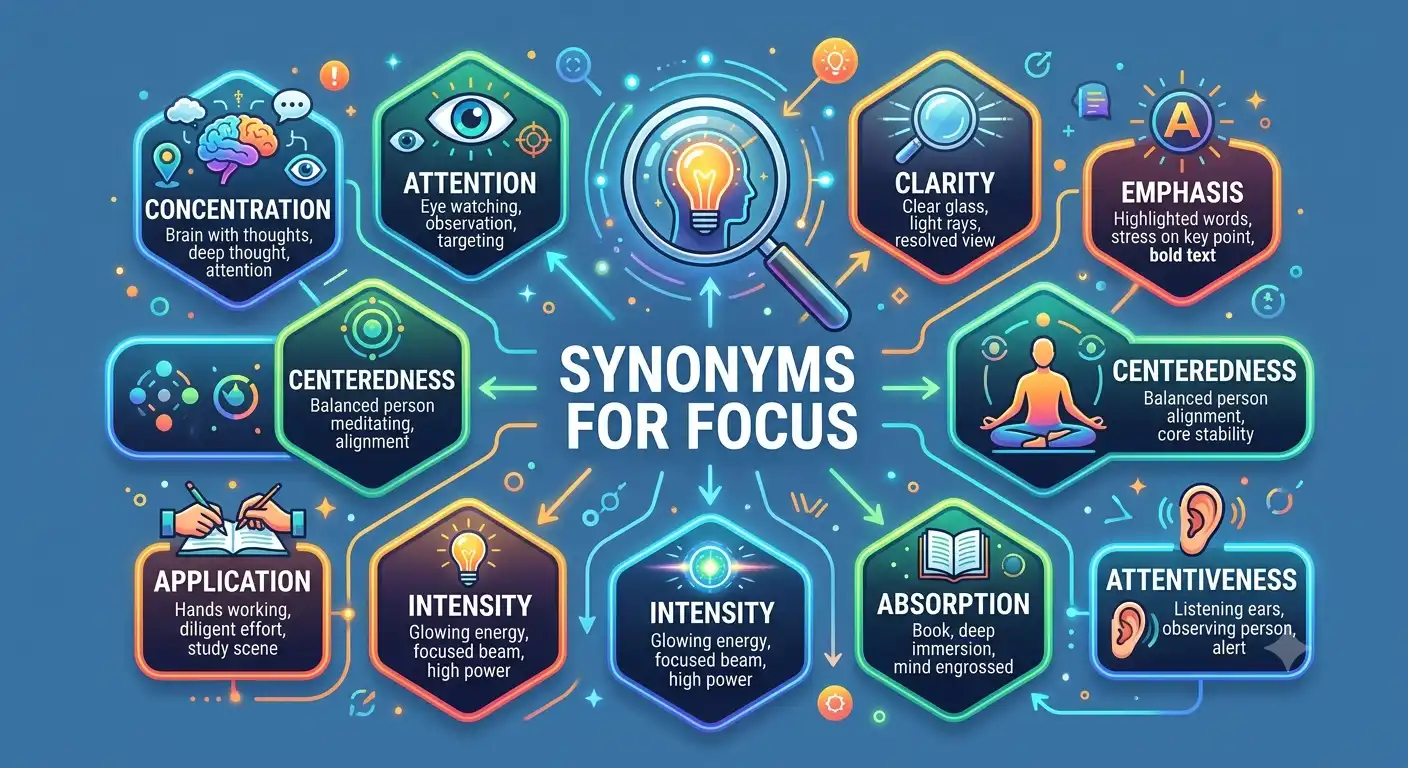
Mastering diverse synonyms for focus helps you describe mental clarity, main targets, and sharp attention without using the same word repeatedly. When you use creative synonyms for focus, your speeches, essays, and business emails instantly become clearer and more captivating. Learning these synonyms for focus gives you the precise terms you need whether you are locking onto a goal or highlighting a main idea.
Imagine sitting at your computer with ten browser tabs open while your phone keeps buzzing. Instead of telling your teammate, “I need to focus on this report,” you say, “I am going to zero in on this report until it is done.” To focus means to give your full attention to one thing or to make a picture clear. For example, the student turned off his television so he could focus on his homework.
“Clear attention is the quiet key that turns big goals into real achievements.” — Mindset Guide
Using a rich variety of synonyms for focus offers distinct benefits for every communicator:
- Students can write stronger research papers, thesis statements, and essays.
- Bloggers can keep readers engaged by describing personal productivity with fresh language.
- Content writers can craft sharper headlines, business updates, and call-to-action guides.
- Daily English users can explain their goals and thoughts with complete confidence.
“Choosing the precise word sharpens your message like a beam of light.” — Language Insight
Linguistic Breakdown of “Focus”
Connotative Meaning
The word focus carries a positive, disciplined, and purposeful tone. It implies sharp mental concentration, clear direction, and the elimination of distractions to achieve a specific outcome.
Etymology
- Root Word: Latin focus (meaning hearth or fireplace, the center of home activity).
- 17th Century Use: Introduced into optics by Johannes Kepler to mean the point where light rays converge.
- Modern Shift: Expanded from light optics to describe mental concentration and primary targets.
Pronunciation
- US IPA: /ˈfoʊ.kəs/
- UK IPA: /ˈfəʊ.kəs/
Syllables & Affixation Pattern
- Syllables: 2 (fo-cus)
- Root Word: Focus
- Affixation: Base root; inflects as focused or focussed, focusing or focussing, and forms derivatives like refocus or autofocus.
Comparison Table of Key Synonyms
| Keyword | Meaning | Usage Type | Context |
|---|---|---|---|
| Concentration | Deep mental effort on a single task | Professional / Formal | Studying, working, solving hard problems |
| Attention | Directing your mind or senses toward something | Casual / Universal | Listening to speakers, watching events, reading |
| Target | A specific goal or result you aim to hit | Business / Practical | Setting goals, sales plans, athletic training |
| Aim | The direction or purpose behind an action | Everyday / Academic | Career plans, writing goals, archery |
| Spotlight | Intense public or mental interest on one topic | Creative / Energetic | News media, stage shows, team reviews |
| Centerpiece | The most important part of a collection or event | Formal / Decorative | Design, main arguments, event planning |
| Zero in on | To direct all your effort onto one specific point | Casual / Energetic | Troubleshooting, shooting, project work |
| Focal point | The center of attention or interest | Technical / Formal | Photography, art, strategic planning |
Main Content – 50 Synonyms for Focus
1. Concentration
- Pronunciation: US: /ˌkɑːn.sənˈtreɪ.ʃən/ | UK: /ˌkɒn.sənˈtreɪ.ʃən/
- Meaning: Giving all your mental power to one activity.
- Examples:
- Chess requires total concentration during every move.
- Her concentration stayed strong despite the loud noise.
2. Attention
- Pronunciation: US: /əˈten.ʃən/ | UK: /əˈten.ʃən/
- Meaning: Listening or watching something very closely.
- Examples:
- Please give your full attention to the safety instructions.
- The bright lights caught his attention right away.
3. Center
- Pronunciation: US: /ˈsen.t̬ɚ/ | UK: /ˈsen.tə/
- Meaning: The middle or main part of an activity or idea.
- Examples:
- The family is the center of her life.
- He placed the lamp in the center of the desk.
4. Target
- Pronunciation: US: /ˈtɑːr.ɡɪt/ | UK: /ˈtɑː.ɡɪt/
- Meaning: A clear goal you try to reach.
- Examples:
- Our sales team hit its monthly target early.
- She set a high target for her running distance.
5. Aim
- Pronunciation: US: /eɪm/ | UK: /eɪm/
- Meaning: The main result you intend to achieve.
- Examples:
- My main aim is to learn ten new words every day.
- He took careful aim before throwing the ball.
6. Clarity
- Pronunciation: US: /ˈklær.ə.t̬i/ | UK: /ˈklær.ə.ti/
- Meaning: Being clear and easy to see or understand.
- Examples:
- The fresh morning air brought clarity to his thoughts.
- She spoke with great clarity during the meeting.
7. Emphasize
- Pronunciation: US: /ˈem.fə.saɪz/ | UK: /ˈem.fə.saɪz/
- Meaning: To show that something is very important.
- Examples:
- Teachers emphasize daily practice for learning math.
- The speaker used bold slides to emphasize her points.
8. Priority
- Pronunciation: US: /praɪˈɔːr.ə.t̬i/ | UK: /praɪˈɒr.ə.ti/
- Meaning: Something that is more important than other things.
- Examples:
- Finishing this task is my top priority today.
- Good health should always be a high priority.
9. Focal point
- Pronunciation: US: /ˈfoʊ.kəl poɪnt/ | UK: /ˈfəʊ.kəl poɪnt/
- Meaning: The main thing that people look at or talk about.
- Examples:
- The fireplace is the focal point of the living room.
- Customer service is the focal point of our new plan.
10. Spotlight
- Pronunciation: US: /ˈspɑːt.laɪt/ | UK: /ˈspɒt.laɪt/
- Meaning: Strong focus or public interest placed on someone or something.
- Examples:
- The reporter put a bright spotlight on local news.
- She enjoyed being in the spotlight during the play.
11. Direct
- Pronunciation: US: /dəˈrekt/ | UK: /daɪˈrekt/
- Meaning: To aim your thoughts or actions toward a specific point.
- Examples:
- Please direct your questions to the team leader.
- He directed his effort toward fixing the engine.
12. Hub
- Pronunciation: US: /hʌb/ | UK: /hʌb/
- Meaning: The busy central place where main activities happen.
- Examples:
- The library is the central hub for campus study.
- The city serves as a major hub for international business.
13. Core
- Pronunciation: US: /kɔːr/ | UK: /kɔː/
- Meaning: The central and most vital part of anything.
- Examples:
- Honesty is the core value of our company.
- We must get to the core of this technical issue.
14. Highlight
- Pronunciation: US: /ˈhaɪ.laɪt/ | UK: /ˈhaɪ.laɪt/
- Meaning: To draw special attention to a key detail.
- Examples:
- Use a yellow pen to highlight important facts.
- The video will highlight the best moments of the game.
15. Zero in on
- Pronunciation: US: /ˈzɪr.oʊ ɪn ɑːn/ | UK: /ˈzɪə.rəʊ ɪn ɒn/
- Meaning: To direct all your attention straight to one detail.
- Examples:
- Let us zero in on the main problem in this design.
- Scientists zero in on finding a fast solution.
16. Home in on
- Pronunciation: US: /hoʊm ɪn ɑːn/ | UK: /həʊm ɪn ɒn/
- Meaning: To move steadily toward a single target or answer.
- Examples:
- The search team began to home in on the right location.
- We need to home in on the cause of the delay.
17. Pinpoint
- Pronunciation: US: /ˈpɪn.poɪnt/ | UK: /ˈpɪn.poɪnt/
- Meaning: To find or describe the exact spot or detail.
- Examples:
- It was hard to pinpoint the exact source of the sound.
- The doctor helped pinpoint the cause of her pain.
18. Fixate
- Pronunciation: US: /ˈfɪk.seɪt/ | UK: /ˈfɪk.seɪt/
- Meaning: To think about or look at one thing completely.
- Examples:
- Try not to fixate on minor mistakes during your test.
- He tends to fixate on details when drawing maps.
19. Center on
- Pronunciation: US: /ˈsen.t̬ɚ ɑːn/ | UK: /ˈsen.tə ɒn/
- Meaning: To have a main topic or base around one subject.
- Examples:
- Today’s lesson will center on world geography.
- Her talk will center on healthy eating habits.
20. Single-mindedness
- Pronunciation: US: /ˌsɪŋ.ɡəlˈmaɪn.dɪd.nəs/ | UK: /ˌsɪŋ.ɡəlˈmaɪn.dɪd.nəs/
- Meaning: Working toward one goal without getting distracted.
- Examples:
- Her single-mindedness helped her win the race.
- He worked with absolute single-mindedness to finish his book.
“True success is born when single-mindedness meets daily effort.” — Productivity Axiom
21. Objective
- Pronunciation: US: /əbˈdʒek.tɪv/ | UK: /əbˈdʒek.tɪv/
- Meaning: Something you plan to do or achieve.
- Examples:
- Our primary objective is to build a safe playground.
- She reached her main objective ahead of time.
22. Intensity
- Pronunciation: US: /ɪnˈten.sə.t̬i/ | UK: /ɪnˈten.sə.ti/
- Meaning: Deep strength and focus applied to an activity.
- Examples:
- He trained with high intensity before the championship.
- The intensity of her study session brought fast results.
23. Absorption
- Pronunciation: US: /əbˈsɔːrp.ʃən/ | UK: /əbˈzɔːp.ʃən/
- Meaning: Being so interested in something that you forget other things.
- Examples:
- His absorption in the book made him miss his bus stop.
- She worked with complete absorption all afternoon.
24. Application
- Pronunciation: US: /ˌæp.ləˈkeɪ.ʃən/ | UK: /ˌæp.lɪˈkeɪ.ʃən/
- Meaning: Hard and steady mental work spent on a task.
- Examples:
- With steady application, you can master any trade.
- Her application to study led to top exam marks.
25. Convergence
- Pronunciation: US: /kənˈvɝː.dʒəns/ | UK: /kənˈvɜː.dʒəns/
- Meaning: Coming together at one central point.
- Examples:
- The convergence of light rays creates a clear picture.
- There was a convergence of opinions during the debate.
26. Dedication
- Pronunciation: US: /ˌded.əˈkeɪ.ʃən/ | UK: /ˌded.ɪˈkeɪ.ʃən/
- Meaning: Giving your time and energy fully to a goal.
- Examples:
- Her dedication to music inspired her classmates.
- It takes dedication to learn a new language well.
27. Devotion
- Pronunciation: US: /dɪˈvoʊ.ʃən/ | UK: /dɪˈvəʊ.ʃən/
- Meaning: Deep love and focus given to a person or work.
- Examples:
- His devotion to art showed in every painting.
- She cared for her garden with great devotion.
28. Deliberateness
- Pronunciation: US: /dɪˈlɪb.ɚ.ət.nəs/ | UK: /dɪˈlɪb.ər.ət.nəs/
- Meaning: Doing things carefully and on purpose.
- Examples:
- He chose his words with great deliberateness.
- Her deliberateness helped avoid silly mistakes.
29. Sharpness
- Pronunciation: US: /ˈʃɑːrp.nəs/ | UK: /ˈʃɑːp.nəs/
- Meaning: Being clear, distinct, and highly focused.
- Examples:
- The image had great sharpness on the new screen.
- Mental sharpness comes from good sleep and rest.
30. Key aspect
- Pronunciation: US: /kiː ˈæs.pekt/ | UK: /kiː ˈæs.pekt/
- Meaning: A main feature or part of a subject.
- Examples:
- Communication is a key aspect of teamwork.
- Safety is the most vital key aspect of driving.
31. Main topic
- Pronunciation: US: /meɪn ˈtɑː.pɪk/ | UK: /meɪn ˈtɒp.ɪk/
- Meaning: The central subject being discussed or written about.
- Examples:
- Solar energy was the main topic of the lecture.
- The news report covered the main topic in detail.
32. Heart
- Pronunciation: US: /hɑːrt/ | UK: /hɑːt/
- Meaning: The center or most vital part of a problem or plan.
- Examples:
- Trust is at the heart of every true friendship.
- Let us get to the heart of the matter quickly.
33. Essence
- Pronunciation: US: /ˈes.əns/ | UK: /ˈes.əns/
- Meaning: The basic and most important quality of a thing.
- Examples:
- Kindness is the essence of good leadership.
- The story captures the essence of summer fun.
34. Centerpiece
- Pronunciation: US: /ˈsen.t̬ɚ.piːs/ | UK: /ˈsen.tə.piːs/
- Meaning: The central or most featured item in a display or plan.
- Examples:
- The tall cake was the centerpiece of the party.
- Environmental protection is the centerpiece of their policy.
35. Magnet
- Pronunciation: US: /ˈmæɡ.nət/ | UK: /ˈmæɡ.nət/
- Meaning: A person, place, or thing that pulls all attention toward it.
- Examples:
- The new park acts as a magnet for happy families.
- Her energetic speech was a magnet for young listeners.
36. Anchor
- Pronunciation: US: /ˈæŋ.kɚ/ | UK: /ˈæŋ.kə/
- Meaning: The central support that holds everything steady.
- Examples:
- She served as the emotional anchor for her team.
- The main store acts as the anchor for the shopping mall.
37. Foundation
- Pronunciation: US: /faʊnˈdeɪ.ʃən/ | UK: /faʊnˈdeɪ.ʃən/
- Meaning: The base idea or structure on which everything is built.
- Examples:
- Reading daily is the foundation of good writing.
- Hard work forms the foundation of great achievement.
38. Pivot
- Pronunciation: US: /ˈpɪv.ət/ | UK: /ˈpɪv.ət/
- Meaning: The central point around which actions turn or depend.
- Examples:
- Customer feedback became the pivot for our new strategy.
- The central character acts as the pivot of the story.
39. Target area
- Pronunciation: US: /ˈtɑːr.ɡɪt ˈer.i.ə/ | UK: /ˈtɑː.ɡɪt ˈeə.ri.ə/
- Meaning: The specific region or subject you concentrate on.
- Examples:
- Lower body strength was his main target area today.
- Math skills remain our primary target area this term.
40. Bullseye
- Pronunciation: US: /ˈbʊlz.aɪ/ | UK: /ˈbʊlz.aɪ/
- Meaning: The exact center of a target or main goal.
- Examples:
- Her smart answer hit the bullseye during the quiz.
- He aimed right at the bullseye and scored full points.
41. Accentuate
- Pronunciation: US: /ækˈsen.tʃu.eɪt/ | UK: /əkˈsen.tʃu.eɪt/
- Meaning: To make a specific detail more noticeable or obvious.
- Examples:
- Bright colors accentuate the key parts of the map.
- He used simple words to accentuate his main point.
42. Stress
- Pronunciation: US: /stres/ | UK: /stres/
- Meaning: To give extra weight or attention to a special word or idea.
- Examples:
- The coach likes to stress the value of daily practice.
- She placed stress on the importance of punctuality.
43. Zoom in on
- Pronunciation: US: /zuːm ɪn ɑːn/ | UK: /zuːm ɪn ɒn/
- Meaning: To make a camera or your mind look closely at one detail.
- Examples:
- The camera began to zoom in on the actor’s face.
- Let us zoom in on the second line of the chart.
44. Channel
- Pronunciation: US: /ˈtʃæn.əl/ | UK: /ˈtʃæn.əl/
- Meaning: To direct your energy or thoughts toward one activity.
- Examples:
- She chose to channel her energy into painting.
- He tried to channel his excitement into hard work.
45. Align
- Pronunciation: US: /əˈlaɪn/ | UK: /əˈlaɪn/
- Meaning: To bring your ideas or efforts into clear agreement with a goal.
- Examples:
- Make sure your daily actions align with your long-term goals.
- We must align our project timeline with the budget.
46. Narrow down
- Pronunciation: US: /ˈnær.oʊ daʊn/ | UK: /ˈnær.əʊ daʊn/
- Meaning: To reduce choices until you focus on the best one.
- Examples:
- We need to narrow down our choices to two options.
- She narrowed down her research topic to local plants.
47. Tune in
- Pronunciation: US: /tuːn ɪn/ | UK: /tjuːn ɪn/
- Meaning: To pay total mental attention to what is happening.
- Examples:
- Students should tune in when the teacher gives directions.
- It takes a moment to tune in to a difficult conversation.
48. Engrossment
- Pronunciation: US: /ɪnˈɡroʊs.mənt/ | UK: /ɪnˈɡrəʊs.mənt/
- Meaning: Being fully occupied with an interesting task or book.
- Examples:
- Her engrossment in the novel kept her up late.
- The child’s engrossment with the puzzle was sweet to watch.
49. Immersed
- Pronunciation: US: /ɪˈmɝːst/ | UK: /ɪˈmɜːst/
- Meaning: Deeply involved in an activity so that nothing else distracts you.
- Examples:
- He remained immersed in his work all afternoon.
- She was fully immersed in learning her new software.
50. Mindful
- Pronunciation: US: /ˈmaɪnd.fəl/ | UK: /ˈmaɪnd.fəl/
- Meaning: Aware of and giving conscious attention to the present moment.
- Examples:
- Be mindful of your time during the written test.
- She stayed mindful of her words while speaking to the group.
Antonyms of “Focus”
While focus concentrates attention onto a central target, its antonyms describe scattering energy, drifting away, or being distracted:
- Distraction: US: /dɪˈstræk.ʃən/ | UK: /dɪˈstræk.ʃən/ – Something that prevents you from giving full attention to a task.
- Inattention: US: /ˌɪn.əˈten.ʃən/ | UK: /ˌɪn.əˈten.ʃən/ – Lack of focus or failure to pay proper attention.
- Dispersal: US: /dɪˈspɝː.səl/ | UK: /dɪˈspɜː.səl/ – Spreading energy or things out in many directions.
- Neglect: US: /nɪˈɡlekt/ | UK: /nɪˈɡlekt/ – Failing to care for or pay attention to something important.
Prototype Meaning and Categorization of “Focus”
- Grammatical Category: Noun and Verb (transitive and intransitive; cognitive state, optical process, and goal setting).
- Prototype Meaning: The state or act of concentrating mental or physical attention onto a single, clear point or goal.
- Semantic Field: Cognition, mental discipline, optics, goal achievement, priority setting, and visual clarity.
Frequently Asked Questions (FAQ)
1. What is the most common synonym for “focus” in everyday conversation?
The most popular everyday synonyms for focus are attention, concentration, aim, and zero in on. These terms sound natural in daily conversations, schoolwork, and work communications.
2. How do “focus” and “concentration” differ in formal writing?
While focus often describes the specific point or goal you are looking at, concentration describes the continuous mental energy and effort you apply to keep working on that point.
3. When should I use “spotlight” instead of “focus”?
Use spotlight when you want to highlight a topic publicly or draw special public interest to an important issue, rather than just describing personal study habits.
4. Is “zero in on” formal enough for business emails?
Yes! Zero in on is an active, modern phrasal verb that works well in business emails, team updates, and project planning. However, for formal academic journals, words like pinpoint or accentuate are preferred.
5. How does using diverse synonyms for “focus” boost SEO content writing?
Using varied synonyms for focus keeps your prose engaging for human readers while helping search engines connect your page to related terms like mental clarity, goal setting, and key priorities.
6. Are all 50 synonyms completely interchangeable in every sentence?
No. Words depend heavily on context. For example, bullseye refers to an exact target center, while mindful describes an open state of mental awareness.
Conclusion
Expanding your active vocabulary with rich synonyms for focus brings clarity, punch, and professionalism to everything you communicate. Swapping out repetitive phrases for sharp terms like concentration, target, pinpoint, or zero in on makes your ideas stand out with maximum force.
“Clear words create clear thoughts, and clear thoughts drive steady progress.” — Vocabulary Standard
We invite you to put these 50 synonyms into daily practice right away. Experiment with incorporating them into your professional emails, academic essays, blog entries, and casual conversations. Building strong vocabulary habits ensures that your words always convey your exact meaning with effortless precision and impact.
“Mastering language is an ongoing habit that continually opens fresh doors.” — Educational Principle

Andrew Collins is an academic English educator with over 12 years of experience helping university students, IELTS candidates, and ESL learners improve their writing vocabulary.