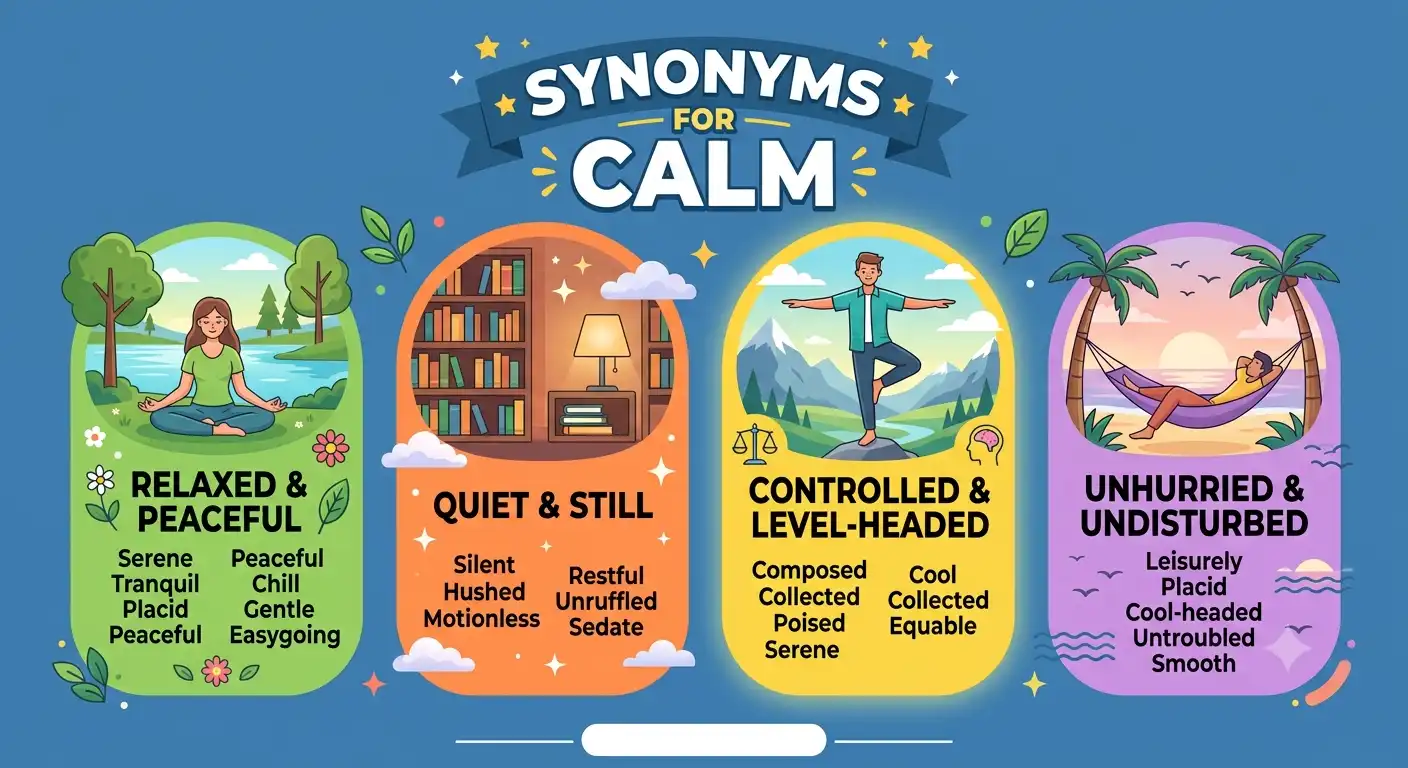
Learning useful synonyms for calm allows you to express peacefulness, emotional balance, and quiet moments without repeating the same word. Using diverse synonyms for calm makes your essays, blog posts, and daily conversations far more vivid and engaging. When you master these synonyms for calm, you can easily choose the perfect word for any peaceful scenario.
Picture walking through a quiet park on a warm Sunday morning while soft sunlight shines through the green leaves. Instead of saying, “The morning feels calm,” you might describe the park as serene, peaceful, or tranquil. To be calm means to feel peaceful inside and not feel worried, angry, or upset. For example, the sleepy cat lay calm on the soft rug while the children read their books quietly.
“A quiet mind brings inner strength and clear thinking to every situation.” — Mindful Living Guide
Building a strong collection of synonyms for calm helps every type of communicator:
- Students can write descriptive essays, literary analyses, and stories with richer imagery.
- Bloggers can share mindfulness tips and personal experiences using fresh, relaxing vocabulary.
- Content writers can craft compelling headlines, wellness articles, and product reviews.
- Daily English users can describe their feelings and peaceful moments with complete confidence.
“Choosing the right word softens your tone and brings true peace to your message.” — Language Insights
Linguistic Breakdown of “Calm”
Connotative Meaning
The word calm carries a gentle, positive, and soothing tone. It implies the absence of noise, agitation, or stress, reflecting inner peace, emotional control, and steady composure.
Etymology
- Root Word: Old French calme (meaning stillness or quiet weather).
- Historical Origin: Derived from Late Latin cauma (heat of the midday sun, a time when people rest).
- Modern Shift: Evolved from describing windless, calm sea weather to describing peaceful human emotions and quiet environments.
Pronunciation
- US IPA: /kɑːm/
- UK IPA: /kɑːm/
Syllables & Affixation Pattern
- Syllables: 1 (calm)
- Root Word: Calm
- Affixation: Base root; inflects as calmed, calming, calmer, calmest, and forms derivatives like calmness or becalm.
Comparison Table of Key Synonyms
| Keyword | Meaning | Usage Type | Context |
|---|---|---|---|
| Peaceful | Free from disturbing noise or violence | Universal / General | Quiet places, calm feelings, nature |
| Tranquil | Deeply quiet and completely free from disturbance | Formal / Descriptive | Lakes, countrysides, meditation |
| Serene | Untroubled, shiny, and pure in mind or setting | Poetic / Refined | Bright skies, quiet faces, inner spirit |
| Placid | Not easily excited, upset, or moved | Character / Formal | Calm lakes, quiet babies, gentle animals |
| Quiet | Making very little noise or disturbance | Everyday / Casual | Libraries, late evenings, soft voices |
| Composed | Having control over your feelings in tough times | Professional / Emotional | Job interviews, speeches, emergency work |
| Unruffled | Remaining peaceful when problems happen | Descriptive / Formal | Leaders under pressure, skilled pilots |
| Restful | Giving a feeling of peaceful relaxation | Lifestyle / Casual | Bedrooms, vacations, slow music |
Main Content – 50 Synonyms for Calm
1. Peaceful
- Pronunciation: US: /ˈpiːs.fəl/ | UK: /ˈpiːs.fəl/
- Meaning: Free from noise, war, or strong bad feelings.
- Examples:
- The quiet mountain village felt very peaceful at sunset.
- She enjoyed a peaceful afternoon reading by the window.
2. Tranquil
- Pronunciation: US: /ˈtræŋ.kwəl/ | UK: /ˈtræŋ.kwɪl/
- Meaning: Extremely calm and free from any disturbance.
- Examples:
- The lake was so tranquil that it looked like a clean mirror.
- Listening to soft music helps me stay tranquil.
3. Serene
- Pronunciation: US: /səˈriːn/ | UK: /səˈriːn/
- Meaning: Completely peaceful, clear, and untroubled.
- Examples:
- The monk held a serene smile on his face.
- We watched the serene morning sky turn soft pink.
4. Placid
- Pronunciation: US: /ˈplæs.ɪd/ | UK: /ˈplæs.ɪd/
- Meaning: Not easily upset, angry, or excited.
- Examples:
- The placid water stayed smooth all afternoon.
- He has a placid nature and rarely gets angry.
5. Quiet
- Pronunciation: US: /ˈkwaɪ.ət/ | UK: /ˈkwaɪ.ət/
- Meaning: Making very little or no sound.
- Examples:
- Please keep quiet while the baby is resting.
- They spent a quiet evening resting at home.
6. Restful
- Pronunciation: US: /ˈrest.fəl/ | UK: /ˈrest.fəl/
- Meaning: Helping you to feel calm and refreshed.
- Examples:
- Green plants make the room look very restful.
- A good night of restful sleep boosts your energy.
7. Unruffled
- Pronunciation: US: /ʌnˈrʌf.əld/ | UK: /ʌnˈrʌf.əld/
- Meaning: Remaining calm when unexpected things happen.
- Examples:
- The captain stayed unruffled during the heavy wind.
- Her unruffled tone made everyone feel safe.
8. Untroubled
- Pronunciation: US: /ʌnˈtrʌb.əld/ | UK: /ʌnˈtrʌb.əld/
- Meaning: Free from worry, care, or pain.
- Examples:
- The child fell into an untroubled sleep.
- She walked with an untroubled mind down the path.
9. Still
- Pronunciation: US: /stɪL/ | UK: /stɪL/
- Meaning: Not moving and very quiet.
- Examples:
- The air was completely still before the gentle rain.
- Sit still while I tie your shoes.
10. Composed
- Pronunciation: US: /kəmˈpoʊzd/ | UK: /kəmˈpəʊzd/
- Meaning: In full control of your feelings and actions.
- Examples:
- She looked calm and composed during her speech.
- He stayed composed even under heavy pressure.
11. Collected
- Pronunciation: US: /kəˈlek.tɪd/ | UK: /kəˈlek.tɪd/
- Meaning: In control of your thoughts and not confused.
- Examples:
- Take a deep breath to stay cool and collected.
- She gave a very clear and collected answer.
12. Cool
- Pronunciation: US: /kuːl/ | UK: /kuːl/
- Meaning: Not getting excited, angry, or nervous easily.
- Examples:
- Keep a cool head when solving a problem.
- He remained cool despite the silly argument.
13. Relaxed
- Pronunciation: US: /rɪˈlækst/ | UK: /rɪˈlækst/
- Meaning: Feeling comfortable and free from worry or stress.
- Examples:
- I felt relaxed after taking a warm bath.
- They had a relaxed conversation over tea.
14. Mild
- Pronunciation: US: /maɪld/ | UK: /maɪld/
- Meaning: Gentle, pleasant, and not harsh or strong.
- Examples:
- The spring weather was warm and mild.
- He answered her question with a mild tone.
15. Smooth
- Pronunciation: US: /smuːð/ | UK: /smuːð/
- Meaning: Without rough moves, bad trouble, or sudden changes.
- Examples:
- The boat enjoyed a smooth ride across the bay.
- Everything went according to a smooth plan today.
16. Undisturbed
- Pronunciation: US: /ˌʌn.dɪˈstɝːbd/ | UK: /ˌʌn.dɪˈstɜːbd/
- Meaning: Not touched, moved, or bothered by anything.
- Examples:
- The forest remained undisturbed for many years.
- He worked undisturbed in his private room.
17. Halcyon
- Pronunciation: US: /ˈhæl.si.ən/ | UK: /ˈhæl.si.ən/
- Meaning: Very peaceful, happy, and prosperous.
- Examples:
- She often remembered the halcyon days of youth.
- The coastal town enjoyed a halcyon summer.
18. Soothing
- Pronunciation: US: /ˈsuː.ðɪŋ/ | UK: /ˈsuː.ðɪŋ/
- Meaning: Making you feel less painful, angry, or worried.
- Examples:
- Soft raindrops make a soothing sound on the roof.
- Her soothing words calmed the nervous boy.
19. Easygoing
- Pronunciation: US: /ˌiː.ziˈɡoʊ.ɪŋ/ | UK: /ˌiː.ziˈɡəʊ.ɪŋ/
- Meaning: Relaxed and happy to accept things without worry.
- Examples:
- My brother has a very easygoing personality.
- They enjoy an easygoing lifestyle near the beach.
20. Sedate
- Pronunciation: US: /sɪˈdeɪt/ | UK: /sɪˈdeɪt/
- Meaning: Slow, quiet, and serious in movement or style.
- Examples:
- They walked at a sedate pace through the garden.
- The hotel offers a sedate atmosphere for older guests.
“True inner peace allows you to meet life’s noise with steady grace.” — Mindfulness Journal
21. Unflappable
- Pronunciation: US: /ʌnˈflæp.ə.bəl/ | UK: /ʌnˈflæp.ə.bəl/
- Meaning: Never getting nervous or excited in hard times.
- Examples:
- Our teacher is unflappable even when the class is noisy.
- She showed an unflappable attitude during the test.
22. Pacific
- Pronunciation: US: /pəˈsɪf.ɪk/ | UK: /pəˈsɪf.ɪk/
- Meaning: Peaceful and loving to keep order without fighting.
- Examples:
- The two leaders reached a pacific agreement.
- They live in a pacific community built on trust.
23. Mellow
- Pronunciation: US: /ˈmel.oʊ/ | UK: /ˈmel.əʊ/
- Meaning: Soft, sweet, and pleasingly relaxed.
- Examples:
- The room was lit by a mellow yellow light.
- He grew more mellow as he got older.
24. Equable
- Pronunciation: US: /ˈek.wə.bəl/ | UK: /ˈek.wə.bəl/
- Meaning: Staying steady and not changing easily.
- Examples:
- The island has an equable climate all year round.
- She maintains an equable temper under stress.
25. Balanced
- Pronunciation: US: /ˈbæl.ənst/ | UK: /ˈbæl.ənst/
- Meaning: Keeping equal focus and feeling steady inside.
- Examples:
- Eating good food keeps your body feeling balanced.
- He gave a balanced view on the main subject.
26. Unbothered
- Pronunciation: US: /ʌnˈbɑː.ðɚd/ | UK: /ʌnˈbɒð.əd/
- Meaning: Not feeling worried or troubled by bad things.
- Examples:
- The duck sat unbothered by the passing dogs.
- She remained unbothered by silly rumors.
27. Gentle
- Pronunciation: US: /ˈdʒen.t̬əl/ | UK: /ˈdʒen.təl/
- Meaning: Soft, kind, and careful not to hurt anyone.
- Examples:
- A gentle breeze blew through the open window.
- He picked up the tiny bird with gentle hands.
28. Level-headed
- Pronunciation: US: /ˌlev.əlˈhed.ɪd/ | UK: /ˌlev.əlˈhed.ɪd/
- Meaning: Making smart decisions and keeping calm easily.
- Examples:
- A level-headed driver stays calm in traffic.
- She is very level-headed when trouble starts.
29. Soft
- Pronunciation: US: /sɑːft/ | UK: /sɒft/
- Meaning: Quiet, smooth, and pleasant to the ears or eyes.
- Examples:
- The room was filled with soft music.
- She spoke in a soft voice so as not to wake him.
30. Patient
- Pronunciation: US: /ˈpeɪ.ʃənt/ | UK: /ˈpeɪ.ʃənt/
- Meaning: Able to wait calmly without getting annoyed.
- Examples:
- Good teachers are always patient with young learners.
- He waited in a patient way for his turn.
31. Imperturbable
- Pronunciation: US: /ˌɪm.pɚˈtɝː.bə.bəl/ | UK: /ˌɪm.pəˈtɜː.bə.bəl/
- Meaning: Impossible to make worried, angry, or excited.
- Examples:
- Her imperturbable nature helped her stay safe.
- The wise old judge kept an imperturbable look.
32. Nonchalant
- Pronunciation: US: /ˌnɑːn.ʃəˈlɑːnt/ | UK: /ˌnɒn.ʃəˈlɑːnt/
- Meaning: Feeling or showing a calm lack of worry.
- Examples:
- He gave a nonchalant wave as he walked past us.
- She looked nonchalant despite the big exam.
33. Unagitated
- Pronunciation: US: /ˌʌnˈædʒ.ə.teɪ.t̬ɪd/ | UK: /ˌʌnˈædʒ.ɪ.teɪ.tɪd/
- Meaning: Free from shaking, movement, or emotional trouble.
- Examples:
- The sea remained unagitated throughout the day.
- He spoke with an unagitated voice to help them.
34. Quieted
- Pronunciation: US: /ˈkwaɪ.ə.t̬ɪd/ | UK: /ˈkwaɪ.ə.tɪd/
- Meaning: Made peaceful, still, or less noisy.
- Examples:
- The teacher quieted the noisy room quickly.
- Her warm hug quieted his fears.
35. Peaceful-minded
- Pronunciation: US: /ˈpiːs.fəl ˈmaɪn.dɪd/ | UK: /ˈpiːs.fəl ˈmaɪn.dɪd/
- Meaning: Having thoughts that are free from anger or worry.
- Examples:
- Peaceful-minded people resolve problems without fights.
- Daily walks help keep you peaceful-minded.
36. Rested
- Pronunciation: US: /ˈres.tɪd/ | UK: /ˈres.tɪd/
- Meaning: Feeling fresh and relaxed after a good break.
- Examples:
- I woke up feeling happy and fully rested.
- The rested team played a great match today.
37. Self-possessed
- Pronunciation: US: /ˌself.pəˈzest/ | UK: /ˌself.pəˈzest/
- Meaning: Confident and calm in controlling your feelings.
- Examples:
- She looked self-possessed as she took the stage.
- A self-possessed person handles criticism well.
38. Unexcited
- Pronunciation: US: /ˌʌn.ɪkˈsaɪ.t̬ɪd/ | UK: /ˌʌn.ɪkˈsaɪ.tɪd/
- Meaning: Not easily thrilled, wild, or agitated.
- Examples:
- He gave an unexcited answer to the big news.
- The dog stayed unexcited when visitors arrived.
39. Unperturbed
- Pronunciation: US: /ˌʌn.pɚˈtɝːbd/ | UK: /ˌʌn.pəˈtɜːbd/
- Meaning: Not worried or bothered by bad weather or news.
- Examples:
- She seemed unperturbed by the rain outside.
- He remained unperturbed by the sudden change.
40. Peaceful-hearted
- Pronunciation: US: /ˈpiːs.fəl ˈhɑːr.t̬ɪd/ | UK: /ˈpiːs.fəl ˈhɑː.tɪd/
- Meaning: Filled with kindness, love, and quiet peace.
- Examples:
- She is a peaceful-hearted friend who always helps.
- Living a peaceful-hearted life brings true joy.
41. Quiet-spirited
- Pronunciation: US: /ˈkwaɪ.ət ˈspɪr.ɪ.t̬ɪd/ | UK: /ˈkwaɪ.ət ˈspɪr.ɪ.tɪd/
- Meaning: Having a naturally gentle and quiet soul.
- Examples:
- The quiet-spirited boy liked painting flowers.
- Her quiet-spirited nature brings harmony to the house.
42. Settled
- Pronunciation: US: /ˈset.əld/ | UK: /ˈset.əld/
- Meaning: Comfortable, stable, and free from sudden changes.
- Examples:
- The weather looks settled for the weekend.
- She felt settled in her new cozy bedroom.
43. Peaceful-looking
- Pronunciation: US: /ˈpiːs.fəl ˈlʊk.ɪŋ/ | UK: /ˈpiːs.fəl ˈlʊk.ɪŋ/
- Meaning: Appearing quiet, gentle, and happy on the outside.
- Examples:
- The garden looked very peaceful-looking in the morning.
- The sleeping baby was sweet and peaceful-looking.
44. Tranquilised
- Pronunciation: US: /ˈtræŋ.kwə.laɪzd/ | UK: /ˈtræŋ.kwɪ.laɪzd/
- Meaning: Calmed down completely from noise or excitement.
- Examples:
- The soft rainfall tranquilised the busy city sounds.
- Her gentle music tranquilised the restless children.
45. Reposeful
- Pronunciation: US: /rɪˈpoʊz.fəl/ | UK: /rɪˈpəʊz.fəl/
- Meaning: Giving or keeping a state of quiet rest.
- Examples:
- The room had a warm and reposeful feel.
- Painting is a reposeful hobby for many people.
46. Unstirred
- Pronunciation: US: /ʌnˈstɝːd/ | UK: /ʌnˈstɜːd/
- Meaning: Not moved, shaken, or upset by strong forces.
- Examples:
- The deep pond water stayed completely unstirred.
- He stood unstirred by the loud angry shouting.
47. Unshaken
- Pronunciation: US: /ʌnˈʃeɪ.kən/ | UK: /ʌnˈʃeɪ.kən/
- Meaning: Firm and steady in mind or belief during danger.
- Examples:
- Her faith in her team remained unshaken.
- He stayed unshaken during the difficult test.
48. Peaceable
- Pronunciation: US: /ˈpiː.sə.bəl/ | UK: /ˈpiː.sə.bəl/
- Meaning: Liking peace and avoiding arguments or fights.
- Examples:
- They are peaceable neighbors who love helping others.
- We hope to find a peaceable solution to this issue.
49. Soothed
- Pronunciation: US: /suːðd/ | UK: /suːðd/
- Meaning: Made to feel less worried, hurt, or upset.
- Examples:
- The warm tea soothed her dry throat.
- His kind words soothed her sad feelings.
50. At ease
- Pronunciation: US: /æt iːz/ | UK: /æt iːz/
- Meaning: Feeling comfortable, relaxed, and not nervous.
- Examples:
- The friendly host made everyone feel at ease.
- She felt completely at ease in her new school.
Antonyms of “Calm”
While calm describes a quiet, peaceful, and steady state, its antonyms focus on noise, anger, or strong agitation:
- Agitated: US: /ˈædʒ.ə.teɪ.t̬ɪd/ | UK: /ˈædʒ.ɪ.teɪ.tɪd/ – Feeling worried, disturbed, or angry.
- Stormy: US: /ˈstɔːr.mi/ | UK: /ˈstɔː.mi/ – Violent, noisy, or filled with bad weather and arguments.
- Excited: US: /ɪkˈsaɪ.t̬ɪd/ | UK: /ɪkˈsaɪ.tɪd/ – Feeling very happy, eager, or energetic.
- Anxious: US: /ˈæŋk.ʃəs/ | UK: /ˈæŋk.ʃəs/ – Worried and nervous about something bad that may happen.
Prototype Meaning and Categorization of “Calm”
- Grammatical Category: Adjective, Noun, and Verb (transitive and intransitive; emotional state, weather condition, and self-regulation action).
- Prototype Meaning: The physical or emotional state of being quiet, peaceful, and undisturbed by fear, anger, wind, or noise.
- Semantic Field: Emotion regulation, peace, environmental stillness, character traits, and mental wellness.
Frequently Asked Questions (FAQ)
1. What is the most common synonym for “calm” in daily English?
The most common everyday synonyms for calm are peaceful, quiet, relaxed, and cool. These terms sound completely natural in everyday conversations, emails, and school activities.
2. How do “calm” and “tranquil” differ in descriptive writing?
While calm can describe both human moods and general settings, tranquil usually describes deeply quiet nature scenes, like still lakes or quiet forests, suggesting complete freedom from disturbance.
3. Can I use “unflappable” in formal business writing?
Yes! Unflappable is a strong word that highlights a person’s ability to stay cool and effective under intense work pressure or during unexpected company challenges.
4. Which synonym works best when describing a person during a crisis?
Words like composed, collected, and level-headed are perfect for describing individuals who maintain smart thinking and emotional control in stressful situations.
5. How does using diverse synonyms for “calm” improve SEO content?
Using varied synonyms for calm prevents repetitive language while helping search engines connect your article to related topics like mindfulness, stress relief, and emotional wellness.
6. Are all 50 synonyms completely interchangeable?
No. Words depend on context. For example, placid often describes a gentle character or water surface, whereas at ease describes a comfortable social feeling.
Conclusion
Expanding your vocabulary with descriptive synonyms for calm adds warmth, clarity, and precision to your daily speech and written work. Replacing repetitive words with evocative terms like serene, tranquil, composed, or level-headed helps your thoughts land smoothly with every reader.
“Clear and peaceful language creates harmonious connections in every conversation.” — Communication Standard
We encourage you to put these 50 words into daily practice starting today. Try using them in your business emails, creative essays, personal journals, and friendly chats. Developing a strong vocabulary habit ensures that your message always carries grace, confidence, and lasting impact.
“Mastering gentle words is a silent power that opens minds and warms hearts.” — Educational Axiom

Andrew Collins is an academic English educator with over 12 years of experience helping university students, IELTS candidates, and ESL learners improve their writing vocabulary.