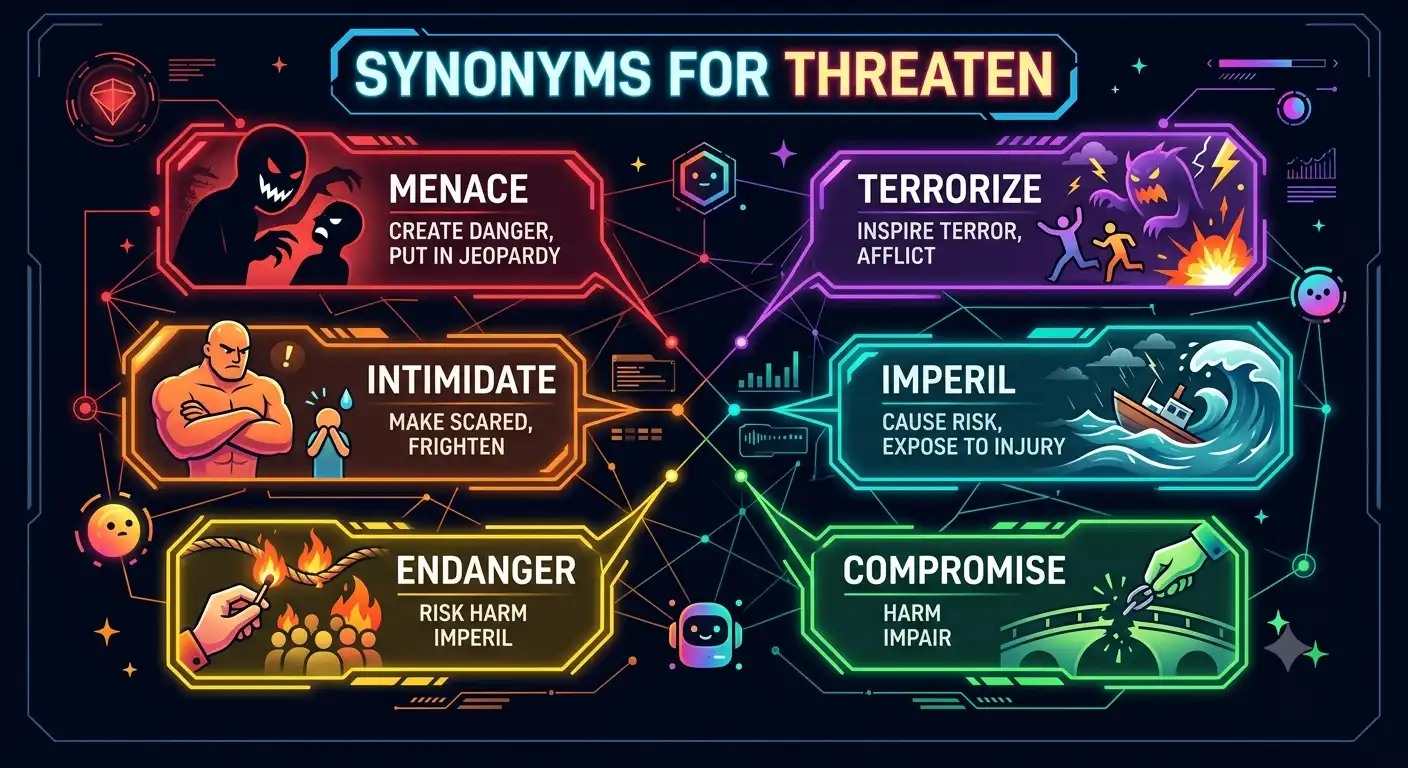
Learning synonyms for threaten is a powerful way to make your writing sound strong and clear. When you explore synonyms for threaten, you can easily describe bad weather, scary warnings, or dangerous situations without using the same basic word. Finding diverse synonyms for threaten helps you choose the perfect tone for stories, school essays, and professional reports.
Imagine walking through a quiet forest when the sky suddenly turns dark grey. The wind picks up, and a loud crack of thunder rolls across the hills. You know a storm is on the way. In simple English, to threaten means to say or show that something bad is about to happen. It is when someone warns of harm, or when nature shows a sign of danger.
This vocabulary guide is a highly useful tool for many different groups of people. Students can use these terms to make their history papers and English stories sound much more dramatic. Bloggers can use these action-packed words to write catchy suspense stories or review action movies. Content writers can build deep professional trust by using exact terms for environmental risks or business competition. Daily English users can easily express caution and share their concerns with precision. Let us dive in and learn these fresh words!
“A threat is only as strong as the fear it creates in your mind.” — Unknown
“When we find words to express danger, we find the power to overcome it.” — Unknown
Lexical Profile of “Threaten”
- Connotative Meaning: Danger, warning, fear, risk, or looming storm. In basic safety modeling, the severity of a threat ($T_s$) can be represented as a function of the intent ($I$) of the source and its physical capability ($C$):$$T_s = I \times C$$As either intent or physical capability grows, the threat becomes more dangerous and real over time.
- Etymology:
- Origins: Derived from the Middle English word thretenen, which came from the Old English word þrēatnian (meaning to urge, press, or afflict).
- Evolution: It grew out of the Germanic root þreut- (meaning to squeeze or pinch) and took on the meaning of warning someone of harm by the 14th century.
- Pronunciation:
- US IPA: /ˈθret.ən/
- UK IPA: /ˈθret.ən/
- Syllables: 2 syllables (threat-en).
- Affixation Pattern: Root verb threat combined with the suffix “-en” (used to make verbs from nouns or adjectives). It forms the adjective threatening or the adverb threateningly.
Comparison Table of Key Synonyms
| Keyword | Meaning | Usage Type | Context |
|---|---|---|---|
| Menace | To act as a scary danger to others | Casual / Professional | Nature, wild animals, city streets |
| Intimidate | To make someone feel small and scared | Emotional / Professional | Workplace, school, sports games |
| Warn | To tell someone about a future danger | Casual / Professional | Weather alerts, parenting, road signs |
| Endanger | To put someone in an unsafe situation | Professional | Law, science reports, environment |
| Loom | To hang over someone like a dark cloud | Creative / Casual | Stormy weather, upcoming exams, debts |
| Forebode | To feel like something bad is coming | Creative / Formal | Literature, classic books, scary stories |
| Coerce | To force someone to do a task | Formal / Professional | Police work, legal trials, history |
| Compromise | To weaken or harm a safe structure | Professional | Computer security, health, secret plans |
“The storm threatens the shore, but the deep rocks remain unbroken.” — Unknown
50 Synonyms for Threaten
1. Menace
- Pronunciation: US: /ˈmen.əs/ & UK: /ˈmen.əs/
- Meaning: This word means to be a dangerous threat to someone or something.
- Examples:
- Dark storm clouds began to menace the small mountain village.
- Stray dogs would menace the children walking home from school.
2. Intimidate
- Pronunciation: US: /ɪnˈtɪm.ə.deɪt/ & UK: /ɪnˈtɪm.ɪ.deɪt/
- Meaning: This word means to make someone feel scared so they do what you want.
- Examples:
- The big defender tried to intimidate the young soccer player.
- Do not let loud voices intimidate you during the debate.
3. Frighten
- Pronunciation: US: /ˈfraɪ.tən/ & UK: /ˈfraɪ.tən/
- Meaning: This word means to make someone feel sudden fear.
- Examples:
- Loud thunderclaps always frighten our family cat.
- The scary movie was designed to frighten the audience.
4. Scare
- Pronunciation: US: /skeər/ & UK: /skeə/
- Meaning: This word means to make a person or animal afraid.
- Examples:
- Sudden movements will scare the colorful birds away.
- He tried to scare his sister by hiding behind the door.
5. Terrorize
- Pronunciation: US: /ˈter.ə.raɪz/ & UK: /ˈter.ə.raɪz/
- Meaning: This word means to keep someone in a state of deep fear for a long time.
- Examples:
- A wild wolf began to terrorize the local sheep farms.
- The cruel leader tried to terrorize the citizens of the city.
6. Bully
- Pronunciation: US: /ˈbʊl.i/ & UK: /ˈbʊl.i/
- Meaning: This word means to hurt or frighten a weaker person.
- Examples:
- Older kids should never bully others on the school playground.
- He tried to bully his coworkers into doing his chores.
7. Browbeat
- Pronunciation: US: /ˈbraʊ.biːt/ & UK: /ˈbraʊ.biːt/
- Meaning: This word means to use angry words to force someone to obey.
- Examples:
- The angry boss would browbeat his team during meetings.
- Do not let anyone browbeat you into signing that paper.
8. Cow
- Pronunciation: US: /kaʊ/ & UK: /kaʊ/
- Meaning: This word means to make someone too afraid to try something.
- Examples:
- The harsh critics could not cow the brave young artist.
- He was easily cowed by the stern look on his father’s face.
9. Coerce
- Pronunciation: US: /koʊˈɝːs/ & UK: /kəʊˈɜːs/
- Meaning: This word means to force someone to do a task by using threats.
- Examples:
- The thief tried to coerce the guard into opening the bank vault.
- You cannot coerce me to make a choice I do not like.
10. Overawe
- Pronunciation: US: /ˌoʊ.vɚˈɑː/ & UK: /ˌəʊ.vəˈrɔː/
- Meaning: This word means to make someone feel so much respect or fear that they stay silent.
- Examples:
- The grand palace was built to overawe visiting diplomats.
- She was overawed by the presence of the famous scientist.
11. Daunt
- Pronunciation: US: /dɑːnt/ & UK: /dɔːnt/
- Meaning: This word means to make someone feel less confident about a hard job.
- Examples:
- The steep mountain path did not daunt the experienced hikers.
- Writing a long essay can daunt many young students.
12. Oppress
- Pronunciation: US: /əˈpres/ & UK: /əˈpres/
- Meaning: This word means to treat a group of people in a cruel and unfair way.
- Examples:
- The greedy rulers continued to oppress the poor farmers.
- Throughout history, strong nations have tried to oppress their neighbors.
13. Domineer
- Pronunciation: US: /ˌdɑː.məˈnɪr/ & UK: /ˌdɒm.ɪˈnɪə/
- Meaning: This word means to control other people in an arrogant way.
- Examples:
- She did not want a partner who would domineer over her.
- He liked to domineer the conversations during family dinners.
14. Harass
- Pronunciation: US: /həˈræs/ & UK: /ˈhær.əs/
- Meaning: This word means to annoy or trouble someone repeatedly.
- Examples:
- The salesman would harass clients with constant phone calls.
- Bugs will harass you if you sit near the lake at night.
15. Torment
- Pronunciation: US: /ˈtɔːr.ment/ & UK: /ˈtɔː.ment/
- Meaning: This word means to cause severe mental or physical suffering.
- Examples:
- Guilty thoughts began to torment the dishonest young boy.
- The heat would torment the soldiers in the dry desert.
16. Pressure
- Pronunciation: US: /ˈpreʃ.ɚ/ & UK: /ˈpreʃ.ə/
- Meaning: This word means to make someone do something by arguing or pleading.
- Examples:
- Peers may pressure you to make bad choices at school.
- The company tried to pressure him to work on the weekend.
17. Force
- Pronunciation: US: /fɔːrs/ & UK: /fɔːs/
- Meaning: This word means to make someone do something they do not want to do.
- Examples:
- You cannot force me to eat those green vegetables.
- The heavy rain will force us to cancel our outdoor picnic.
18. Corner
- Pronunciation: US: /ˈkɔːr.nɚ/ & UK: /ˈkɔː.nə/
- Meaning: This word means to trap someone so they cannot escape or make a choice.
- Examples:
- The police managed to corner the suspect in a dark alley.
- The reporter tried to corner the mayor with a hard question.
19. Warn
- Pronunciation: US: /wɔːrn/ & UK: /wɔːn/
- Meaning: This word means to tell someone about a danger before it happens.
- Examples:
- The red signs warn drivers about the slippery road ahead.
- I must warn you that the dog bites when he is scared.
20. Forewarn
- Pronunciation: US: /fɔːrˈwɔːrn/ & UK: /fɔːˈwɔːn/
- Meaning: This word means to warn someone early about a future problem.
- Examples:
- The weather report will forewarn us about the winter storm.
- She wanted to forewarn her friend about the difficult test.
21. Caution
- Pronunciation: US: /ˈbæŋk/ & UK: /bæŋk/
- Meaning: This word means to advise someone to be very careful.
- Examples:
- Lifeguards caution swimmers to stay close to the shore.
- My parents always caution me about talking to strangers.
22. Loom
- Pronunciation: US: /luːm/ & UK: /luːm/
- Meaning: This word means to appear as a large, scary shape that is about to happen.
- Examples:
- The tall dark mountains began to loom in the distance.
- Final exams loom closer as the school year ends.
23. Impend
- Pronunciation: US: /ɪmˈpend/ & UK: /ɪmˈpend/
- Meaning: This word means to be about to happen very soon.
- Examples:
- Dark clouds showed that a heavy downpour was about to impend.
- We prepared our winter supplies for the impending cold snap.
24. Portend
- Pronunciation: US: /pɔːrˈtend/ & UK: /pɔːˈtend/
- Meaning: This word means to be a sign that something bad is coming.
- Examples:
- These dry soil conditions portend a very bad harvest.
- Sudden silence in the woods can portend a nearby predator.
25. Presage
- Pronunciation: US: /ˈpres.ɪdʒ/ & UK: /ˈpres.ɪdʒ/
- Meaning: This word means to show or warn that an event will happen in the future.
- Examples:
- Low flying birds often presage a change in the weather.
- The loud rumbling did presage the volcanic blast.
26. Forebode
- Pronunciation: US: /fɔːrˈboʊd/ & UK: /fɔːˈbəʊd/
- Meaning: This word means to have a strong feeling that evil is on the way.
- Examples:
- Those strange bird cries forebode a rough storm.
- The ancient myths forebode a time of great darkness.
27. Augur
- Pronunciation: US: /ˈɑː.ɡɚ/ & UK: /ˈɔː.ɡə/
- Meaning: This word means to be a sign of a good or bad result.
- Examples:
- The early success did augur well for the new company.
- A cold wet spring could augur a poor crop this year.
28. Bode
- Pronunciation: US: /boʊd/ & UK: /bəʊd/
- Meaning: This word means to be an omen of a particular outcome.
- Examples:
- The dark smoke does not bode well for the burning house.
- A warm handshake did bode a friendly business agreement.
29. Shadow
- Pronunciation: US: /ˈʃæd.oʊ/ & UK: /ˈʃæd.əʊ/
- Meaning: This word means to follow someone closely or cast a dark mood over them.
- Examples:
- Fears of failure began to shadow her exciting new journey.
- Detectives continued to shadow the suspect through the city.
30. Hint
- Pronunciation: US: /hɪnt/ & UK: /hɪnt/
- Meaning: This word means to suggest something in an indirect way.
- Examples:
- The grey skies hint that we might get some snow today.
- She tried to hint that she wanted to leave the party.
31. Signal
- Pronunciation: US: /ˈsɪɡ.nəl/ & UK: /ˈsɪɡ.nəl/
- Meaning: This word means to show a sign that an action is starting.
- Examples:
- A flare was used to signal for help from the island.
- Falling leaves signal the arrival of the cold autumn season.
32. Endanger
- Pronunciation: US: /ɪnˈdeɪn.dʒɚ/ & UK: /ɪnˈdeɪn.dʒə/
- Meaning: This word means to put someone or something in a harmful situation.
- Examples:
- Leaving campfires burning can endanger the entire forest.
- Reckless driving will endanger everyone on the busy road.
33. Imperil
- Pronunciation: US: /ɪmˈper.əl/ & UK: /ɪmˈper.əl/
- Meaning: This word means to place a person or thing in great danger.
- Examples:
- Building homes near cliffs can imperil family safety.
- The giant oil spill will imperil thousands of sea birds.
34. Jeopardize
- Pronunciation: US: /ˈdʒep.ɚ.daɪz/ & UK: /ˈdʒep.ə.daɪz/
- Meaning: This word means to do something that could ruin a good plan.
- Examples:
- Being late to class might jeopardize your final school grade.
- Making silly jokes can jeopardize a serious business deal.
35. Risk
- Pronunciation: US: /rɪsk/ & UK: /rɪsk/
- Meaning: This word means to take a chance on losing something valuable.
- Examples:
- Do not risk your health by skipping meals during work.
- He decided to risk his savings on the new restaurant.
36. Compromise
- Pronunciation: US: /ˈkɑːm.prə.maɪz/ & UK: /ˈkɒm.prə.maɪz/
- Meaning: This word means to weaken or damage a safe position.
- Examples:
- A weak password can compromise your computer’s safety.
- Sharing secrets will compromise our trust in the project.
37. Expose
- Pronunciation: US: /ɪkˈspoʊz/ & UK: /ɪkˈspəʊz/
- Meaning: This word means to leave someone without protection from harm.
- Examples:
- Going outside without a coat will expose you to the cold.
- She did not want to expose her young children to scary news.
38. Undermine
- Pronunciation: US: /ˌʌn.dɚˈmaɪn/ & UK: /ˌʌn.dəˈmaɪn/
- Meaning: This word means to weaken someone’s power or confidence slowly.
- Examples:
- Constant negative comments can undermine your self-esteem.
- Heavy floods began to undermine the bridge’s concrete base.
39. Sabotage
- Pronunciation: US: /ˈsæb.ə.tɑːʒ/ & UK: /ˈsæb.ə.tɑːʒ/
- Meaning: This word means to destroy something on purpose so it does not work.
- Examples:
- He tried to sabotage his sister’s science project out of anger.
- Spies wanted to sabotage the enemy trains during the war.
40. Subvert
- Pronunciation: US: /səbˈvɝːt/ & UK: /səbˈvɜːt/
- Meaning: This word means to ruin the power of an established system.
- Examples:
- They tried to subvert the democratic laws of the country.
- Lies were used to subvert the captain’s authority on the ship.
41. Destabilize
- Pronunciation: US: /ˌdiːˈsteɪ.bə.laɪz/ & UK: /ˌdiːˈsteɪ.bɪ.laɪz/
- Meaning: This word means to make a nation or system weak and unsteady.
- Examples:
- High inflation rates can destabilize the country’s economy.
- Bad rumors were spread to destabilize the political party.
42. Shake
- Pronunciation: US: /ʃeɪk/ & UK: /ʃeɪk/
- Meaning: This word means to make someone feel less sure or less safe.
- Examples:
- The bad news did shake his confidence before the speech.
- Sudden moves will shake the loose ladder beneath your feet.
43. Alarm
- Pronunciation: US: /əˈlɑːrm/ & UK: /əˈlɑːm/
- Meaning: This word means to make someone feel sudden worry or fear.
- Examples:
- Loud smoke detectors will alarm the sleeping family.
- The rapid rise in water levels began to alarm the city.
44. Terrify
- Pronunciation: US: /ˈter.ə.faɪ/ & UK: /ˈter.ə.faɪ/
- Meaning: This word means to fill someone with extreme fear.
- Examples:
- Giant spiders on the wall terrify my little brother.
- The sudden earthquake did terrify the people in the building.
45. Dismay
- Pronunciation: US: /dɪˈsmeɪ/ & UK: /dɪˈsmeɪ/
- Meaning: This word means to make someone feel sad, worried, or disappointed.
- Examples:
- The terrible grade on his paper did dismay the young student.
- Seeing trash in the beautiful park did dismay the visitors.
46. Appall
- Pronunciation: US: /əˈpɑːl/ & UK: /əˈpɔːl/
- Meaning: This word means to shock someone deeply because of something bad.
- Examples:
- The cruel treatment of the animals will appall anyone.
- Her messy kitchen did appall her grandmother when she visited.
47. Confront
- Pronunciation: US: /kənˈfrʌnt/ & UK: /kənˈfrʌnt/
- Meaning: This word means to face a scary person or problem directly.
- Examples:
- You must confront your fears if you want to grow strong.
- She decided to confront her classmate about the stolen pencil.
48. Challenge
- Pronunciation: US: /ˈtʃæl.ɪndʒ/ & UK: /ˈtʃæl.ɪndʒ/
- Meaning: This word means to invite someone to fight or prove their power.
- Examples:
- The young knight decided to challenge the champion to a duel.
- The hard puzzle will challenge your brain power today.
49. Hound
- Pronunciation: US: /haʊnd/ & UK: /haʊnd/
- Meaning: This word means to follow or chase someone without stopping.
- Examples:
- Reporters continued to hound the movie star for an interview.
- Bill collectors will hound you if you do not pay the money.
50. Plague
- Pronunciation: US: /pleɪɡ/ & UK: /pleɪɡ/
- Meaning: This word means to cause continuous trouble or worry to someone.
- Examples:
- Constant knee pain continued to plague the old runner.
- Mechanical errors plague the new engine design.
Antonyms of “Threaten”
To completely master this vocabulary concept, you should also learn its opposite terms:
- Protect: To keep someone or something safe from harm or injury.
- Defend: To fight or speak in favor of someone to keep them safe.
- Reassure: To say comforting words so someone stops feeling scared.
- Guard: To watch over a person or place to prevent danger.
- Shield: To cover or block someone from being hit by harm.
Prototype Meaning and Categorization of “Threaten”
The prototype meaning of “threaten” is to show an intention of causing harm, or to be a sign of incoming danger or trouble. We can group these 50 synonyms into four clear categories:
- Personal Fear and Bullying: Words that describe people using their size, power, or words to scare or control others (e.g., intimidate, bully, browbeat, cow, coerce, overawe, domineer, harass, hound, torment).
- Looming or Future Warnings: Words that show signs that danger, weather, or bad events are about to happen (e.g., warn, forewarn, caution, loom, impend, portend, presage, forebode, augur, bode, shadow, hint, signal).
- Physical Danger and Risk: Words describing situations where safety is put in real danger of being broken or ruined (e.g., menace, endanger, imperil, jeopardize, risk, compromise, expose, undermine, sabotage, subvert, destabilize).
- Emotional and Shocking Impact: Words that highlight how threat and fear make a person feel inside (e.g., frighten, scare, terrorize, shake, alarm, terrify, dismay, appall, confront, challenge, plague, daunt, oppress, corner, force).
FAQ About Synonyms for Threaten
1. What is the difference between “threaten” and “intimidate”?
While both terms involve making someone afraid, threaten means to state or show that harm will follow if demands are not met. Intimidate is focused on the emotional outcome, meaning to make someone feel small, nervous, or scared through your presence or actions.
2. Can “loom” be used to describe positive events?
No. Loom is almost always used for negative, scary, or stressful events that are approaching, such as storms, exams, deadlines, or debts.
3. Is “cow” a verb or a noun?
While “cow” is commonly known as a farm animal noun, it is also a powerful verb. As a verb, it means to make someone feel too afraid to speak up or try something.
4. When should I use “imperil” instead of “endanger”?
Both are excellent words, but imperil is more formal and poetic. It is ideal for creative stories or serious scientific warnings, while endanger is used in daily news and legal contexts.
5. What does the term “bode well” mean?
This is a common English idiom that means to be a good sign for the future. Its opposite, “bode ill,” means that bad times are likely on the way.
6. Can “sabotage” be used for thoughts?
No. Sabotage is used for physical actions or plans. You can sabotage a machine or a project, but for personal thoughts or confidence, it is better to use words like undermine or shake.
Conclusion
Expanding your English vocabulary by studying synonyms for threaten is an excellent way to elevate your communication. When you learn to use these diverse, descriptive terms, your creative writing becomes more engaging, your blogging becomes more colorful, and your professional presentations sound far more authoritative. Instead of relying on the same simple words, you can paint clear pictures in the minds of your audience by selecting the exact right word for the situation.
Try to practice these fresh terms starting today! Use them when you draft an email to a coworker, write a descriptive essay for class, or talk with your friends about your weekend activities. The more you use them in casual settings, the more natural they will feel in your active vocabulary. Keep practicing, keep learning, and watch your communication skills flourish!
“To speak with precision is to turn a vague fear into a clear path forward.” — Unknown
“Words can build shelters of peace or cast shadows of warning; choose them wisely.” — Unknown

Andrew Collins is an academic English educator with over 12 years of experience helping university students, IELTS candidates, and ESL learners improve their writing vocabulary.