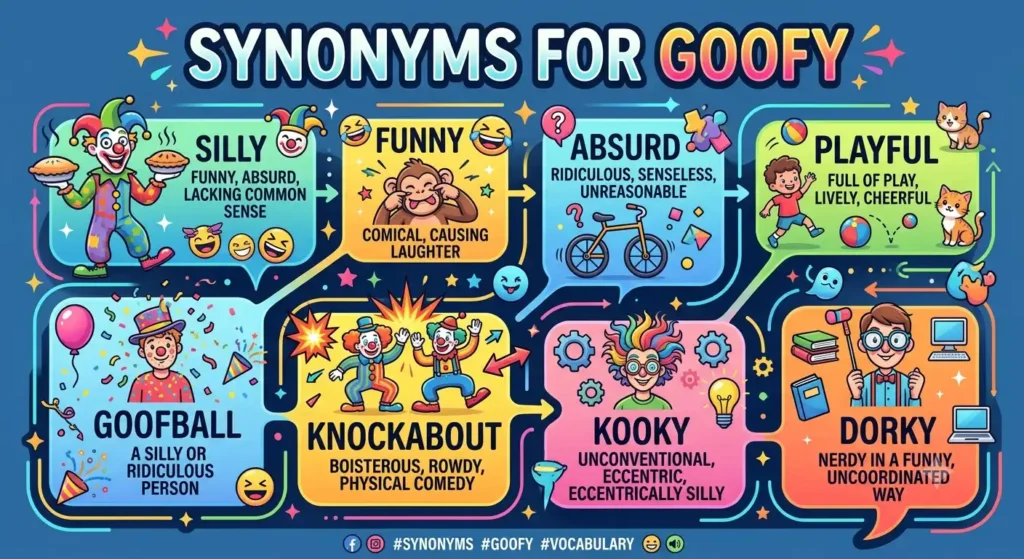
Picture a beloved uncle wearing a bright neon hat while doing a ridiculous dance at a family dinner. Everyone bursts into warm laughter because his goofy behavior brings pure joy to the room. While calling someone goofy works well in casual talk, using specific words helps you share the exact mood of the moment. The word goofy simply describes someone who acts silly or makes fun mistakes that make people laugh.
Exploring vivid synonyms for goofy helps you describe funny, playful, or foolish behavior with charm and precision. The word goofy means acting playfully silly, eccentric, or delightfully clumsy in a lighthearted way. When writers search for synonyms for goofy, they want flexible words to capture everything from awkward smiles to hilarious comedy.
“A day without laughter is a day wasted.” — Charlie Chaplin
Mastering a rich set of synonyms for goofy offers great benefits for different communication needs:
- Students can write funnier creative essays and narrative stories without repeating basic vocabulary.
- Bloggers can write entertaining lifestyle posts that keep readers engaged and smiling.
- Content writers can choose exact playful terms for social media campaigns, scripts, and humorous copy.
- Daily English users can express lighthearted moments naturally when chatting with friends, family, or coworkers.
“Angels fly because they take themselves lightly.” — G.K. Chesterton
Linguistic Breakdown of “Goofy”
Connotative Meaning
The word goofy carries positive, affectionate, and lighthearted connotations. It suggests innocence, harmless humor, and fun silliness rather than malicious or foolish behavior. In modern culture, it often describes someone endearing who does not take themselves too seriously.
Etymology
- Prefix: None.
- Root Word: Goff (Middle English/Early Modern English for “fool” or “simpleton”, likely from French goffe meaning “awkward” or “clumsy”).
- Historical Path: Emerged in American slang during the early 20th century (around the 1910s–1920s) and was popularized globally by Walt Disney’s famous cartoon character, Goofy, in the 1930s.
Pronunciation
- US IPA: /ˈɡuː.fi/
- UK IPA: /ˈɡuː.fi/
Syllables & Affixation Pattern
- Syllables: 2 (goo-fy)
- Root Word: Goof
- Affixation: Root word goof + suffix -y (forming an adjective).
Comparison Table of Key Synonyms
| Keyword | Meaning | Usage Type | Context |
|---|---|---|---|
| Silly | Showing a lack of serious thought | Casual / Friendly | Everyday chats, child play, light jokes |
| Zany | Amusingly unconventional and eccentric | Playful / Energetic | Comedy shows, wild parties, creative arts |
| Wacky | Funny or amusing in an odd way | Informal / Expressive | Cartoons, quirky ideas, fun stories |
| Kooky | Strange, eccentric, yet endearing | Casual / Descriptive | Unique personalities, odd habits |
| Dorky | Awkward or silly in a cute way | Informal / Affectionate | Friendly teasing, awkward moments |
| Whimsical | Playfully quaint or fanciful | Creative / Gentle | Storybooks, art, imaginative play |
| Foolish | Lacking good sense or judgment | General / Mild | Minor mistakes, careless decisions |
| Clownish | Resembling a clown in fun antics | Descriptive / Physical | Slapstick humor, exaggerated tricks |
Main Content – 50 Synonyms for Goofy
“Laughter is timeless, imagination has no age, and dreams are forever.” — Walt Disney
1. Silly
- Pronunciation: US: /ˈsɪl.i/ | UK: /ˈsɪl.i/
- Meaning: Silly means acting in a funny way that is not serious.
- Examples:
- The kids made silly faces at the camera.
- She wore a silly hat to the birthday party.
2. Zany
- Pronunciation: US: /ˈzeɪ.ni/ | UK: /ˈzeɪ.ni/
- Meaning: Zany means delightfully wild, crazy, and funny.
- Examples:
- The cartoon host performed zany stunts on stage.
- We loved his zany ideas for the school game.
3. Wacky
- Pronunciation: US: /ˈwæk.i/ | UK: /ˈwæk.i/
- Meaning: Wacky means funny and unusual in a crazy way.
- Examples:
- He wore wacky socks with red and green stripes.
- The morning show played a wacky prank on the host.
4. Kooky
- Pronunciation: US: /ˈkuː.ki/ | UK: /ˈkuː.ki/
- Meaning: Kooky means strange and eccentric in an amusing way.
- Examples:
- My aunt has a kooky habit of talking to her plants.
- They painted the house in a bright, kooky pattern.
5. Dorky
- Pronunciation: US: /ˈdɔːr.ki/ | UK: /ˈdɔː.ki/
- Meaning: Dorky means silly or socially awkward in a sweet way.
- Examples:
- He gave a dorky smile after missing the high five.
- She wore dorky oversized glasses for the costume contest.
6. Daffy
- Pronunciation: US: /ˈdæf.i/ | UK: /ˈdæf.i/
- Meaning: Daffy means slightly crazy or foolish in a fun way.
- Examples:
- The daffy duck tumbled across the farmyard.
- Her daffy jokes made everyone in the room laugh.
7. Nutty
- Pronunciation: US: /ˈnʌt.i/ | UK: /ˈnʌt.i/
- Meaning: Nutty means behaving in an odd, foolish, or silly manner.
- Examples:
- He came up with a nutty plan to build a cardboard castle.
- That comedian always tells nutty stories about his dog.
8. Whimsical
- Pronunciation: US: /ˈwɪm.zɪ.kəl/ | UK: /ˈwɪm.zɪ.kəl/
- Meaning: Whimsical means playfully cute, fancy, or full of fun ideas.
- Examples:
- The garden was decorated with whimsical fairy lights.
- She wrote a whimsical poem about flying pigs.
9. Eccentric
- Pronunciation: US: /ɪkˈsen.trɪk/ | UK: /ɪkˈsen.trɪk/
- Meaning: Eccentric means behaving in an unusual but interesting way.
- Examples:
- The eccentric painter always wore two different shoes.
- People liked his eccentric way of decorating his office.
10. Foolish
- Pronunciation: US: /ˈfuː.lɪʃ/ | UK: /ˈfuː.lɪʃ/
- Meaning: Foolish means lacking good judgment or wise thought.
- Examples:
- It was foolish to run on the wet grass.
- He felt foolish after dropping his ice cream cone.
11. Playful
- Pronunciation: US: /ˈpleɪ.fəl/ | UK: /ˈpleɪ.fəl/
- Meaning: Playful means lighthearted and full of fun energy.
- Examples:
- The playful puppy chased its own tail across the rug.
- She gave him a playful nudge on the shoulder.
12. Ridiculous
- Pronunciation: US: /rɪˈdɪk.jə.ləs/ | UK: /rɪˈdɪk.jə.ləs/
- Meaning: Ridiculous means very foolish or absurd in a funny way.
- Examples:
- Wearing sunglasses inside the dark room looked ridiculous.
- That comedy movie had a completely ridiculous plot.
13. Offbeat
- Pronunciation: US: /ˌɑːfˈbiːt/ | UK: /ˌɒfˈbiːt/
- Meaning: Offbeat means unconventional, unusual, and original.
- Examples:
- The store sells offbeat gifts and quirky decorations.
- He has an offbeat sense of humor that makes us smile.
14. Lighthearted
- Pronunciation: US: /ˌlaɪtˈhɑːr.t̬ɪd/ | UK: /ˌlaɪtˈhɑː.tɪd/
- Meaning: Lighthearted means cheerful, free from care, and easygoing.
- Examples:
- They enjoyed a lighthearted chat over warm coffee.
- The movie offered a lighthearted break from studying.
15. Bizarre
- Pronunciation: US: /bɪˈzɑːr/ | UK: /bɪˈzɑː/
- Meaning: Bizarre means very strange, unusual, or odd.
- Examples:
- He told a bizarre story about seeing a pink squirrel.
- The art exhibit displayed several bizarre modern sculptures.
16. Outlandish
- Pronunciation: US: /aʊtˈslæn.dɪʃ/ | UK: /aʊtˈslæn.dɪʃ/
- Meaning: Outlandish means looking or sounding remarkably strange or bizarre.
- Examples:
- She wore an outlandish hat shaped like a teapot.
- The actor made outlandish claims during the interview.
17. Screwy
- Pronunciation: US: /ˈskruː.i/ | UK: /ˈskruː.i/
- Meaning: Screwy means eccentric, silly, or not working normally.
- Examples:
- My computer started making a screwy sound this morning.
- That was a screwy idea, but it actually worked.
18. Clowning
- Pronunciation: US: /ˈklaʊ.nɪŋ/ | UK: /ˈklaʊ.nɪŋ/
- Meaning: Clowning means acting silly to make people laugh.
- Examples:
- Stop clowning around and finish your homework.
- The boys were clowning in the hallway before class.
19. Farcical
- Pronunciation: US: /ˈfɑːr.sɪ.kəl/ | UK: /ˈfɑː.sɪ.kəl/
- Meaning: Farcical means absurd, ridiculous, and highly funny.
- Examples:
- The mix-up at the airport led to a farcical series of events.
- The play was a farcical comedy about mistaken identities.
20. Loony
- Pronunciation: US: /ˈluː.ni/ | UK: /ˈluː.ni/
- Meaning: Loony means silly, crazy, or foolish in an entertaining way.
- Examples:
- He came up with another loony scheme to win the race.
- The loony cartoon characters chased each other around.
21. Quirky
- Pronunciation: US: /ˈkwɝː.ki/ | UK: /ˈkwɜː.ki/
- Meaning: Quirky means having unusual habits or features that are charming.
- Examples:
- She loves wearing quirky mismatched socks every day.
- The cafe has a quirky atmosphere with vintage furniture.
22. Slapstick
- Pronunciation: US: /ˈslæp.stɪk/ | UK: /ˈslæp.stɪk/
- Meaning: Slapstick means physical comedy involving silly slips and falls.
- Examples:
- Children love watching slapstick cartoon humor.
- The old silent film was packed with slapstick comedy.
23. Freaky
- Pronunciation: US: /ˈfriː.ki/ | UK: /ˈfriː.ki/
- Meaning: Freaky means odd, unusual, or strangely foolish.
- Examples:
- That storm created some freaky cloud patterns.
- He performed a freaky magic trick with playing cards.
24. Oddball
- Pronunciation: US: /ˈɑːd.bɑːl/ | UK: /ˈɒd.bɔːl/
- Meaning: Oddball means behaving in an eccentric or unusual way.
- Examples:
- My brother is an oddball who likes eating popcorn with syrup.
- The team enjoyed working with their oddball leader.
25. Giddy
- Pronunciation: US: /ˈɡɪd.i/ | UK: /ˈɡɪd.i/
- Meaning: Giddy means feeling silly, excited, and dizzy with happiness.
- Examples:
- The girls felt giddy before opening their birthday presents.
- She gave a giddy laugh when she won the prize.
26. Droll
- Pronunciation: US: /droʊl/ | UK: /drəʊl/
- Meaning: Droll means amusing in an odd or dry way.
- Examples:
- He told a droll story that made us quiet smile.
- Her droll comments always brighten up boring meetings.
27. Absurd
- Pronunciation: US: /əbˈsɝːd/ | UK: /əbˈsɜːd/
- Meaning: Absurd means completely unreasonable or ridiculously silly.
- Examples:
- It is absurd to wear a heavy winter coat to the beach.
- The cartoon had an absurd storyline about talking donuts.
28. Laughable
- Pronunciation: US: /ˈlæf.ə.bəl/ | UK: /ˈlɑː.fə.bəl/
- Meaning: Laughable means so silly or bad that it makes you laugh.
- Examples:
- His attempt to bake a cake without flour was laughable.
- The team gave a laughable excuse for losing the match.
29. Preposterous
- Pronunciation: US: /prɪˈpɑːs.tɚ.əs/ | UK: /prɪˈpɒs.tər.əs/
- Meaning: Preposterous means contrary to reason or common sense.
- Examples:
- Paying fifty dollars for a single donut is preposterous.
- He made a preposterous claim that he could jump over a bus.
30. Nonsensical
- Pronunciation: US: /ˌnɑːnˈsen.sɪ.kəl/ | UK: /ˌnɒnˈsen.sɪ.kəl/
- Meaning: Nonsensical means making no sense and feeling silly.
- Examples:
- The sleepy toddler spoke in nonsensical words.
- That riddle was completely nonsensical to everyone.
31. Ludicrous
- Pronunciation: US: /ˈluː.də.krəs/ | UK: /ˈluː.dɪ.krəs/
- Meaning: Ludicrous means foolish or unreasonable enough to cause laughter.
- Examples:
- It looked ludicrous when the dog wore boots on all four paws.
- Her price offer for the old bike was ludicrous.
32. Flaky
- Pronunciation: US: /ˈfleɪ.ki/ | UK: /ˈfleɪ.ki/
- Meaning: Flaky means acting eccentric, crazy, or unreliable in a silly way.
- Examples:
- He can be a bit flaky and forget where he parked his car.
- She had a flaky habit of misplacing her keys daily.
33. Ha-ha
- Pronunciation: US: /ˌhɑːˈhɑː/ | UK: /ˌhɑːˈhɑː/
- Meaning: Ha-ha means intended to cause laughter or amusement.
- Examples:
- He told a ha-ha joke that cheered up the entire class.
- They shared a ha-ha moment during the photo shoot.
34. Batty
- Pronunciation: US: /ˈbæt.i/ | UK: /ˈbæt.i/
- Meaning: Batty means slightly crazy, silly, or eccentric.
- Examples:
- The old professor had a batty idea about building time machines.
- She went a little batty after staying indoors all week.
35. Spacey
- Pronunciation: US: /ˈspeɪ.si/ | UK: /ˈspeɪ.si/
- Meaning: Spacey means out of touch with reality or absent-minded in a silly way.
- Examples:
- He felt spacey because he did not drink enough water.
- She gave a spacey look when the teacher called her name.
36. Dizzy
- Pronunciation: US: /ˈdɪz.i/ | UK: /ˈdɪz.i/
- Meaning: Dizzy means acting silly, foolish, or lacking deep concentration.
- Examples:
- She gave a dizzy laugh and forgot what she was saying.
- The movie starred a dizzy character who kept getting lost.
37. Chucklesome
- Pronunciation: US: /ˈtʃʌk.əl.səm/ | UK: /ˈtʃʌk.əl.səm/
- Meaning: Chucklesome means causing mild laughter or quiet amusement.
- Examples:
- The book contained several chucklesome stories about pets.
- He shared a chucklesome memory from his childhood.
38. Amusing
- Pronunciation: US: /əˈmjuː.zɪŋ/ | UK: /əˈmjuː.zɪŋ/
- Meaning: Amusing means entertaining and causing joyful laughter.
- Examples:
- The clown performed amusing tricks with colorful balls.
- She found his silly dance moves very amusing.
39. Comical
- Pronunciation: US: /ˈkɑː.mɪ.kəl/ | UK: /ˈkɒm.ɪ.kəl/
- Meaning: Comical means funny and inviting laughter like a comedy.
- Examples:
- The puppy made a comical expression when it heard the horn.
- His attempt to ice skate was quite comical to watch.
40. Entertaining
- Pronunciation: US: /ˌen.t̬ɚˈteɪ.nɪŋ/ | UK: /ˌen.təˈteɪ.nɪŋ/
- Meaning: Entertaining means holding interest and providing fun enjoyment.
- Examples:
- The street performer put on an entertaining show for the crowd.
- He is an entertaining storyteller who keeps everyone laughing.
41. Clownish
- Pronunciation: US: /ˈklaʊ.nɪʃ/ | UK: /ˈklaʊ.nɪʃ/
- Meaning: Clownish means acting like a clown in an exaggerated way.
- Examples:
- He made clownish gestures to make his little sister smile.
- Her clownish suit drew attention at the party.
42. Dotty
- Pronunciation: US: /ˈdɑː.ti/ | UK: /ˈdɒt.i/
- Meaning: Dotty means slightly mad, eccentric, or silly.
- Examples:
- My dotty grandmother decorates her yard with pink plastic flamingos.
- He gave a dotty answer to a simple question.
43. Crackpot
- Pronunciation: US: /ˈkræk.pɑːt/ | UK: /ˈkræk.pɒt/
- Meaning: Crackpot means foolish, crazy, or eccentric.
- Examples:
- Nobody believed his crackpot theory about hidden treasure.
- They laughed at the crackpot invention made of spoons.
44. Waggish
- Pronunciation: US: /ˈwæɡ.ɪʃ/ | UK: /ˈwæɡ.ɪʃ/
- Meaning: Waggish means playfully mischievous and humorous.
- Examples:
- He gave a waggish grin before telling his joke.
- The waggish student hid the teacher’s dry-erase marker.
45. Buffoonish
- Pronunciation: US: /bəˈfuː.nɪʃ/ | UK: /bəˈfuː.nɪʃ/
- Meaning: Buffoonish means acting like a ridiculous fool to get attention.
- Examples:
- His buffoonish behavior at the dinner table annoyed his parents.
- The movie featured a buffoonish villain who kept falling over.
46. Madcap
- Pronunciation: US: /ˈmæd.kæp/ | UK: /ˈmæd.kæp/
- Meaning: Madcap means wildly impulsive, crazy, and foolishly energetic.
- Examples:
- They went on a madcap adventure through the amusement park.
- Her madcap ideas always led to hilarious memories.
47. Sappy
- Pronunciation: US: /ˈsæp.i/ | UK: /ˈsæp.i/
- Meaning: Sappy means silly and foolishly sentimental.
- Examples:
- He wrote a sappy love letter that made her giggle.
- The film had a sappy ending where everyone broke into song.
48. Far Out
- Pronunciation: US: /fɑːr aʊt/ | UK: /fɑːr aʊt/
- Meaning: Far out means extremely strange, unusual, or unconventional.
- Examples:
- That retro costume party had some far out outfits.
- His far out ideas about outer space fascinated the audience.
49. Goofy-looking
- Pronunciation: US: /ˈɡuː.fi ˈlʊk.ɪŋ/ | UK: /ˈɡuː.fi ˈlʊk.ɪŋ/
- Meaning: Goofy-looking means appearing delightfully awkward or silly in appearance.
- Examples:
- The dog wore a goofy-looking sweater knit by his owner.
- He made a goofy-looking face in the group photo.
50. Farce-like
- Pronunciation: US: /fɑːrs laɪk/ | UK: /fɑːs laɪk/
- Meaning: Farce-like means absurdly comical and full of ridiculous events.
- Examples:
- The confusion at the desk created a farce-like situation.
- Their cooking mistake turned into a farce-like mess.
Antonyms of “Goofy”
While goofy describes playful, foolish, or clumsy silliness, these antonyms represent seriousness, dignity, and calm composure:
- Serious: US: /ˈsɪr.i.əs/ | UK: /ˈsɪə.ri.əs/ – Thinking or acting with heavy care, earnestness, and no humor.
- Solemn: US: /ˈsɑː.ləm/ | UK: /ˈsɒl.əm/ – Deeply serious, formal, and free from light behavior.
- Dignified: US: /ˈdɪɡ.nə.faɪd/ | UK: /ˈdɪɡ.nɪ.faɪd/ – Showing serious, respectful, and controlled self-behavior.
- Sensible: US: /ˈsen.sə.bəl/ | UK: /ˈsen.sə.bəl/ – Having or showing good judgment, logic, and wisdom.
Prototype Meaning and Categorization of “Goofy”
- Grammatical Category: Adjective (comparative: goofier; superlative: goofiest).
- Prototype Meaning: Acting in a playfully silly, lighthearted, clumsy, or harmlessly foolish manner.
- Semantic Field: Humor, personality traits, behavior, comedy, social interaction, and entertainment.
Frequently Asked Questions (FAQ)
1. What is the most common synonym for goofy?
The most common everyday synonym for goofy is silly. Both words describe harmless, fun, and lighthearted behavior that makes people smile.
2. Is “goofy” an offensive word in English?
No. Goofy is an affectionate, friendly term. It implies sweet, endearing silliness rather than actual foolishness or mean behavior.
3. Can I use “goofy” in professional or academic writing?
Goofy is informal. In formal essays or professional reports, replace it with polished terms like playful, eccentric, unconventional, or whimsical.
4. What is the difference between “goofy” and “foolish”?
While goofy focuses on fun, playful, and funny actions, foolish often implies bad judgment or thoughtless mistakes that might cause problems.
5. What are good synonyms for goofy when describing comedy or art?
When describing funny performances, films, or art, words like zany, slapstick, farcical, whimsical, or comical fit best.
6. Where did the word “goofy” come from?
The word developed from older English slang (goff, meaning fool) and gained worldwide popularity thanks to Walt Disney’s iconic cartoon character, Goofy.
Conclusion
Expanding your collection of synonyms for goofy transforms how you express humor, describe playful personalities, and share fun stories in English. Replacing generic vocabulary with precise words like zany, whimsical, dorky, or farcical adds warmth, vivid images, and humor to every sentence you compose.
Whether you write creative school essays, compose engaging blog posts, send professional marketing emails, or chat casually with friends, picking the exact right synonym makes your communication clear and memorable. Make it a daily habit to try these fresh words in your conversation and writing exercises to see your vocabulary flourish.
“Wit is the appearance, the flashtime of mind; humour is its warm glow.” — E.V. Lucas
“There is nothing in the world so irresistibly contagious as laughter and good humor.” — Charles Dickens

Andrew Collins is an academic English educator with over 12 years of experience helping university students, IELTS candidates, and ESL learners improve their writing vocabulary.