When you write a story, finding synonyms for original is very helpful. Using different synonyms for original keeps your sentences fresh and clean. If you do not look up synonyms for original, you might repeat the same word many times. This makes your readers lose interest quickly.
Imagine a young boy making a clay cup in art class. He does not copy the other kids. He molds a cup with small clay wings on the sides. His teacher smiles and calls it an original cup. This means it is the very first one of its kind and comes from his own mind.
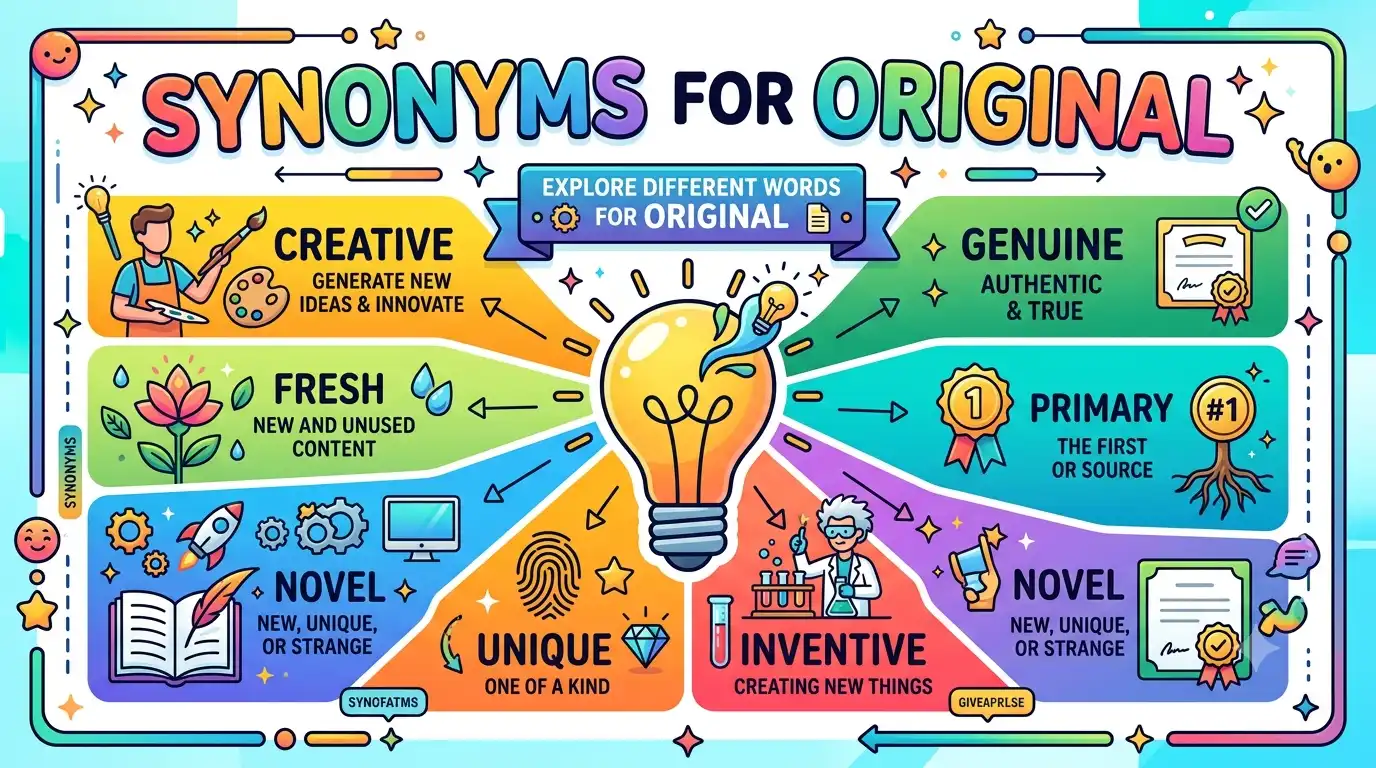
The term synonyms for original means other words that describe things that are new, creative, or authentic.
“To be yourself in a world that is constantly trying to make you something else is the greatest accomplishment.” — Ralph Waldo Emerson
“Originality is nothing but imitation with a fresh look.” — Voltaire
These words are useful for many people:
- Students can write high-quality papers about new science discoveries.
- Bloggers can describe their fresh daily routines with exciting language.
- Content writers can make ads for unique products stand out on the web.
- Daily English users can share their fresh thoughts with friends more clearly.
Using short, clear words keeps our writing simple and fast.
Linguistic Analysis of “Original”
This section shows how the word “original” works in the English language.
Connotative Meaning
The word “original” brings feelings of freshness, truth, and deep talent. It makes us think of things that are the very first of their kind, untouched by others, or highly creative.
Etymology
- Origin: From the Latin word originalis (meaning beginning or source).
- History: It comes from oriri, which means to rise up like the morning sun.
Pronunciation
- US IPA: /əˈrɪdʒ.ən.əl/
- UK IPA: /əˈrɪdʒ.ən.əl/
Syllables
The word has four syllables: o-rig-i-nal.
Affixation Pattern
- Originally: Base adjective original with the adverb suffix -ly.
- Originality: Base adjective original with the noun suffix -ity.
- Unoriginal: Base adjective original with the negative prefix un- (meaning not).
Synonym Comparison Table
This table helps you choose the exact word you need. It compares some of the most common words that mean original.
| Keyword | Meaning | Usage Type | Context |
|---|---|---|---|
| Novel | New and not like anything else before | Casual | Ideas, designs, books |
| Authentic | Real and true to its source | Professional | Art, foods, signatures |
| Initial | Happening at the very start | Professional | Plans, steps, reactions |
| Groundbreaking | Making a very big and new change | Professional | Science, technology, research |
| Fresh | Bright, clean, and newly made | Casual | Cooking, thoughts, paint |
| Indigenous | Naturally belonging to a specific place | Academic | Plants, animals, cultures |
Master Your Vocabulary Today (Search Intent Hub)
- Informational: Read our complete list of $N = 50$ synonyms below to find the exact word you need for your next project.
- Commercial: To check your writing style and see if your sentences are easy to read, we highly recommend using tools like the Hemingway Editor or Grammarly.
- Navigational: To find deep academic definitions and origin stories, you can visit the official Merriam-Webster Thesaurus or the Oxford English Dictionary.
- Transactional: Ready to boost your communication skills instantly?$$Download our Free Original Synonyms Cheat Sheet PDF$$or subscribe to our free weekly vocabulary email newsletter below!
50 Synonyms for “Original”
Here is your complete list of 50 synonyms to use in your writing and speech.
1. First
Pronunciation: of first (US: /fɝːst/ & UK: /fɜːst/ – IPA).
Meaning: This describes the thing that comes before all others in time or order.
Examples:
- She was the first person to arrive at the party.
- He wrote down his very first thoughts in his notebook.
2. Initial
Pronunciation: of initial (US: /ɪˈnɪʃ.əl/ & UK: /ɪˈnɪʃ.əl/ – IPA).
Meaning: This describes something that happens at the very beginning of a process.
Examples:
- My initial plan was to stay home and read.
- The company made an initial test of the new toy.
3. Primary
Pronunciation: of primary (US: /ˈpraɪ.mer.i/ & UK: /ˈpraɪ.mər.i/ – IPA).
Meaning: This describes the most important or earliest source of something.
Examples:
- Rain is the primary source of water for the small farm.
- Her primary goal is to finish school this year.
4. Primeval
Pronunciation: of primeval (US: /praɪˈmiː.vəl/ & UK: /praɪˈmiː.vəl/ – IPA).
Meaning: This describes things from the earliest times in the history of the world.
Examples:
- The hikers walked through a dark, primeval forest.
- Scientists found primeval rocks deep under the ground.
5. Primordial
Pronunciation: of primordial (US: /praɪˈmɔːr.di.əl/ & UK: /praɪˈmɔː.di.əl/ – IPA).
Meaning: This describes something that has existed since the very start of time.
Examples:
- The earth was covered in a primordial sea long ago.
- We listened to the primordial sounds of the wild jungle.
6. Earliest
Pronunciation: of earliest (US: /ˈɝː.li.ɪst/ & UK: /ˈɜː.li.ɪst/ – IPA).
Meaning: This describes the first point in a line of time.
Examples:
- Some of the earliest drawings were made on cave walls.
- He woke up at the earliest hour to watch the sun rise.
7. Native
Pronunciation: of native (US: /ˈneɪ.t̬ɪv/ & UK: /ˈneɪ.tɪv/ – IPA).
Meaning: This describes someone or something born in or belonging to a specific place.
Examples:
- This beautiful blue flower is native to our state.
- She is a native speaker of the Spanish language.
8. Indigenous
Pronunciation: of indigenous (US: /ɪnˈdɪdʒ.ə.nəs/ & UK: /ɪnˈdɪdʒ.ɪ.nəs/ – IPA).
Meaning: This describes plants, animals, or people that have always lived in a place.
Examples:
- The guide taught us about the indigenous trees of the valley.
- They want to protect the culture of the indigenous people.
9. Aboriginal
Pronunciation: of aboriginal (US: /ˌæb.əˈrɪdʒ.ən.əl/ & UK: /ˌæb.əˈrɪdʒ.ən.əl/ – IPA).
Meaning: This describes things that have been in a region since the very beginning.
Examples:
- The museum shows aboriginal art from many centuries ago.
- He studied the aboriginal plants that grow near the river.
10. Archetypal
Pronunciation: of archetypal (US: /ˌɑːr.kəˈtaɪ.pəl/ & UK: /ˌɑː.kɪˈtaɪ.pəl/ – IPA).
Meaning: This describes a perfect example that others copy.
Examples:
- He wrote a book about the archetypal hero who saves the day.
- This cozy red brick house is the archetypal family home.
11. Prototype
Pronunciation: of prototype (US: /ˈproʊ.t̬ə.taɪp/ & UK: /ˈprəʊ.tə.taɪp/ – IPA).
Meaning: This describes the first model of something made to test an idea.
Examples:
- The team built a prototype car that runs on electricity.
- They tested the prototype app before they sold it online.
12. Standard
Pronunciation: of standard (US: /ˈstæn.dɚd/ & UK: /ˈstæn.dəd/ – IPA).
Meaning: This describes the model that is used to judge all other things.
Examples:
- This book is the standard guide for training young dogs.
- We must follow the standard rules during the card game.
13. Master
Pronunciation: of master (US: /ˈmæs.tɚ/ & UK: /ˈmɑː.stər/ – IPA).
Meaning: This describes the main copy of a recording or document from which others are made.
Examples:
- The band kept the master tape of their new song.
- The chef wrote his recipes in a master book.
14. Source
Pronunciation: of source (US: /sɔːrs/ & UK: /sɔːs/ – IPA).
Meaning: This describes the place, person, or thing where something starts.
Examples:
- The high mountain is the source of the clean river.
- She used an old letter as a source for her history paper.
15. Root
Pronunciation: of root (US: /ruːt/ & UK: /ruːt/ – IPA).
Meaning: This describes the cause or origin of something.
Examples:
- Fear is often the root of many silly mistakes.
- They wanted to find the root cause of the loud noise.
16. Basic
Pronunciation: of basic (US: /ˈbeɪ.sɪk/ & UK: /ˈbeɪ.sɪk/ – IPA).
Meaning: This describes the main starting part of something from which it grows.
Examples:
- He taught us the basic steps of the dance.
- We bought the basic tools needed to fix the broken door.
17. Fundamental
Pronunciation: of fundamental (US: /ˌfʌn.dəˈmen.t̬əl/ & UK: /ˌfʌn.dəˈmen.təl/ – IPA).
Meaning: This describes a primary rule or part that holds everything else up.
Examples:
- Reading is a fundamental skill for every young student.
- The science class learned the fundamental laws of gravity.
18. Elemental
Pronunciation: of elemental (US: /ˌel.əˈmen.t̬əl/ & UK: /ˌel.ɪˈmen.təl/ – IPA).
Meaning: This describes the simplest and most natural parts of something.
Examples:
- The storm showed the elemental power of wind and water.
- He enjoyed the elemental joy of walking in the woods.
19. Seed
Pronunciation: of seed (US: /siːd/ & UK: /siːd/ – IPA).
Meaning: This describes the tiny starting point of an idea or project.
Examples:
- His brief trip to Italy planted the seed of a new book.
- That small talk was the seed of their great business.
20. Infant
Pronunciation: of infant (US: /ˈɪn.fənt/ & UK: /ˈɪn.fənt/ – IPA).
Meaning: This describes something that is in its very earliest stage of growth.
Examples:
- Space travel is still in its infant stage.
- The infant company had only three workers in the office.
21. Creative
Pronunciation: of creative (US: /kriˈeɪ.t̬ɪv/ & UK: /kriˈeɪ.tɪv/ – IPA).
Meaning: This describes having the power to make new and interesting things.
Examples:
- The creative girl drew a picture of a purple cat.
- He thought of a creative way to solve the puzzle.
22. Unique
Pronunciation: of unique (US: /juːˈniːk/ & UK: /juːˈniːk/ – IPA).
Meaning: This describes being the only one of its kind in the world.
Examples:
- Every snowflake has a unique shape that melts fast.
- She has a unique voice that sounds like a sweet bell.
23. Novel
Pronunciation: of novel (US: /ˈnɑː.vəl/ & UK: /ˈnɒv.əl/ – IPA).
Meaning: This describes an idea or way of doing things that is new and interesting.
Examples:
- He came up with a novel way to clean his room.
- The teacher used a novel method to teach math.
“An original writer is not one who imitates nobody, but one whom nobody can imitate.” — François-René de Chateaubriand
24. Fresh
Pronunciation: of fresh (US: /freʃ/ & UK: /freʃ/ – IPA).
Meaning: This describes something newly made or full of clean energy.
Examples:
- She painted the walls a fresh shade of light green.
- He woke up with a fresh mind ready to write his blog.
25. New
Pronunciation: of new (US: /nuː/ & UK: /njuː/ – IPA).
Meaning: This describes something made or bought for the first time.
Examples:
- I bought a new pair of shoes for school today.
- The chef added a new dish to the dinner menu.
26. Innovative
Pronunciation: of innovative (US: /ˈɪn.ə.veɪ.t̬ɪv/ & UK: /ˈɪn.ə.və.tɪv/ – IPA).
Meaning: This describes using new ideas and methods to make things better.
Examples:
- The smart young man created an innovative phone app.
- They found an innovative way to recycle old plastic bags.
27. Inventive
Pronunciation: of inventive (US: /ɪnˈven.t̬ɪv/ & UK: /ɪnˈven.tɪv/ – IPA).
Meaning: This describes someone who is very good at making up new things.
Examples:
- The inventive boy built a small robot out of tin cans.
- She has an inventive mind that loves science projects.
28. Imaginative
Pronunciation: of imaginative (US: /ɪˈmædʒ.ə.nə.t̬ɪv/ & UK: /ɪˈmædʒ.ɪ.nə.tɪv/ – IPA).
Meaning: This describes showing a lot of creative thought and deep imagination.
Examples:
- The author wrote an imaginative story about a flying fish.
- He drew an imaginative map of a magical green island.
29. Uncommon
Pronunciation: of uncommon (US: /ʌnˈkɑː.mən/ & UK: /ʌnˈkɒm.ən/ – IPA).
Meaning: This describes something that is rare, special, and not seen every day.
Examples:
- It is uncommon to see snow in this warm town.
- She has an uncommon talent for playing the piano.
30. Rare
Pronunciation: of rare (US: /rer/ & UK: /reər/ – IPA).
Meaning: This describes something that is not common and is often valuable.
Examples:
- The collector found a rare gold coin in the old dirt.
- It is rare to find a wild bear in these low hills.
31. Singular
Pronunciation: of singular (US: /ˈsɪŋ.ɡjə.lɚ/ & UK: /ˈsɪŋ.ɡjə.lər/ – IPA).
Meaning: This describes something that is highly unusual, special, or outstanding.
Examples:
- The young boy showed a singular focus during his test.
- We enjoyed the singular beauty of the desert night.
32. Unusual
Pronunciation: of unusual (US: /ʌnˈjuː.ʒu.əl/ & UK: /ʌnˈjuː.ʒu.əl/ – IPA).
Meaning: This describes something different from what is normal or expected.
Examples:
- The bird had a very unusual song that woke us up.
- He wore an unusual hat with long green feathers.
33. Offbeat
Pronunciation: of offbeat (US: /ˌɑːfˈbiːt/ & UK: /ˌɒfˈbiːt/ – IPA).
Meaning: This describes something that is casual, strange, and highly creative.
Examples:
- The movie had an offbeat humor that made us laugh.
- She loves to buy offbeat art pieces for her room.
34. Out-of-the-box
Pronunciation: of out-of-the-box (US: /ˌaʊt.əv.ðəˈbɑːks/ & UK: /ˌaʊt.əv.ðəˈbɒks/ – IPA).
Meaning: This describes creative thinking that does not follow normal limits.
Examples:
- The team used some out-of-the-box ideas to solve the bug.
- He is famous for his out-of-the-box business plans.
35. Unconventional
Pronunciation: of unconventional (US: /ˌʌn.kənˈven.ʃən.əl/ & UK: /ˌʌn.kənˈven.ʃən.əl/ – IPA).
Meaning: This describes doing things in a different way than most people do.
Examples:
- The artist used an unconventional style to paint the sky.
- They built a house out of unconventional mud bricks.
36. Groundbreaking
Pronunciation: of groundbreaking (US: /ˈɡraʊndˌbreɪ.kɪŋ/ & UK: /ˈɡraʊndˌbreɪ.kɪŋ/ – IPA).
Meaning: This describes a major new discovery that changes how people think.
Examples:
- The doctor did groundbreaking research on how the brain works.
- The tech company built a groundbreaking solar power tool.
37. Avant-garde
Pronunciation: of avant-garde (US: /ˌæv.ɑ̃ːtˈɡɑːrd/ & UK: /ˌæv.ɒ̃ːˈɡɑːd/ – IPA).
Meaning: This describes art or music that is very modern, wild, and experimental.
Examples:
- We went to an avant-garde show with weird paper clothes.
- He plays avant-garde music on his electric guitar.
38. Bold
Pronunciation: of bold (US: /boʊld/ & UK: /bəʊld/ – IPA).
Meaning: This describes a design or idea that is strong, bright, and brave.
Examples:
- The designer chose bold colors for the new website.
- She made a bold choice by moving to a big city alone.
39. Inspired
Pronunciation: of inspired (US: /ɪnˈspaɪərd/ & UK: /ɪnˈspaɪəd/ – IPA).
Meaning: This describes something that shows outstanding skill or sudden creative thoughts.
Examples:
- The chef cooked an inspired meal using sweet fresh figs.
- He gave an inspired speech that made everyone smile.
40. Clever
Pronunciation: of clever (US: /ˈklev.ɚ/ & UK: /ˈklev.ər/ – IPA).
Meaning: This describes showing quick learning and smart, creative thinking.
Examples:
- The clever monkey figured out how to open the box.
- She came up with a clever trick to remember her keys.
41. Genuine
Pronunciation: of genuine (US: /ˈdʒen.ju.ɪn/ & UK: /ˈdʒen.ju.ɪn/ – IPA).
Meaning: This describes something that is real, true, and not a fake copy.
Examples:
- The ring was made of genuine silver from the mine.
- He showed a genuine smile when his friend walked in.
42. Real
Pronunciation: of real (US: /rɪəl/ & UK: /rɪəl/ – IPA).
Meaning: This describes something that actually exists and is not made up.
Examples:
- The kids saw a real bear during their mountain hike.
- She wanted to know the real reason why he left early.
43. Authentic
Pronunciation: of authentic (US: /ɑːˈθen.t̬ɪk/ & UK: /ɔːˈθen.tɪk/ – IPA).
Meaning: This describes being true to its origin, history, or character.
Examples:
- We ate authentic Italian pizza at the new restaurant.
- The museum has an authentic sword from the old war.
44. True
Pronunciation: of true (US: /truː/ & UK: /truː/ – IPA).
Meaning: This describes something that is correct, real, or faithful.
Examples:
- It is a true story that happened in our town long ago.
- He has proved to be a true friend to me over the years.
45. Actual
Pronunciation: of actual (US: /ˈæk.tʃu.əl/ & UK: /ˈæk.tʃu.əl/ – IPA).
Meaning: This describes the real facts of a situation, not just ideas.
Examples:
- The actual cost of the trip was very low.
- We want to see the actual results of the school vote.
46. Pure
Pronunciation: of pure (US: /pjʊr/ & UK: /pjʊə/ – IPA).
Meaning: This describes something clean that is not mixed with other things.
Examples:
- The ring was made of pure gold from the riverbed.
- He felt pure joy when he saw his new puppy run.
47. Honest
Pronunciation: of honest (US: /ˈɑː.nɪst/ & UK: /ˈɒn.ɪst/ – IPA).
Meaning: This describes something sincere, simple, and without any lies.
Examples:
- She gave an honest answer to the teacher’s question.
- He wrote an honest review of the new movie.
48. Unaltered
Pronunciation: of unaltered (US: /ʌnˈɑːl.tɚd/ & UK: /ʌnˈɔːl.təd/ – IPA).
Meaning: This describes something that has not been changed or edited at all.
Examples:
- The photographer kept the unaltered photo on his drive.
- This old house remains completely unaltered since 1920.
49. Raw
Pronunciation: of raw (US: /rɑː/ & UK: /rɔː/ – IPA).
Meaning: This describes something in its natural state before it is cooked or polished.
Examples:
- The artist used raw clay to build the large vase.
- He showed raw emotion when he read the sad letter.
50. Untouched
Pronunciation: of untouched (US: /ʌnˈtʌtʃt/ & UK: /ʌnˈtʌtʃt/ – IPA).
Meaning: This describes a natural place or thing that has not been changed by humans.
Examples:
- We found an untouched beach with no footprints in the sand.
- The ancient forest remains untouched by the logging teams.
Antonyms of “Original”
When we talk about things that are copied or not new, we use these antonyms:
- Copied: Made to look exactly like something else that already exists.
- Fake: Not real or genuine; made to trick people.
- Banal: Boring, common, and not interesting at all.
- Imitative: Tending to copy the style of other people or things.
- Stale: Old, dry, and no longer fresh or exciting to see.
Prototype Meaning and Categorization of “Original”
In cognitive linguistics, words group together in our minds. The main class for “original” is “Source and Creative Value.”
Source and Creative Value (Main Class)
   |
   +-- Origin & First Source (e.g., First, Initial, Primary, Earliest, Root, Source, Prototype)
   |
   +-- Creative & New (e.g., Creative, Unique, Novel, Fresh, Innovative, Inventive, Out-of-the-box)
   |
   +-- Real & Authentic (e.g., Authentic, Genuine, Real, True, Pure, Honest, Unaltered, Untouched)
   |
   +-- Ancient & Native (e.g., Native, Indigenous, Aboriginal, Primeval, Primordial)
By sorting these words into groups, you can easily choose the right word for your sentence.
Frequently Asked Questions
Is “novel” always a synonym for “original”?
Yes. Novel is a great synonym when you want to describe an idea, plan, or design that is fresh and has not been seen before.
Can “standard” mean the same as “original”?
Yes. In some settings, a standard copy is the main model that we use as the source to check all other copies.
What is the difference between original and authentic?
Being original means being the first one made or being very creative. Being authentic means that a thing is real, true, and not a cheap copy.
How do you use “original” to describe an artist’s style?
You can describe a great artist as inventive, imaginative, or avant-garde to show they create fresh art that does not copy others.
What is the most formal synonym for original plans?
The most formal terms are initial, primary, or fundamental, which sound highly professional in business reports and project papers.
Can original mean being raw?
Yes. In some settings, raw materials that have not been changed, polished, or cooked are described as being in their original or unaltered state.
Conclusion
Learning synonyms for original is a great way to grow your English writing skills today. When you know more words, your school essays and reading blogs become beautiful. Your online posts will keep your readers excited and moving. Your spoken stories about life, choices, and daily wins will sound clear, warm, and highly powerful to everyone who listens.
“Be yourself; everyone else is already taken.” — Oscar Wilde
“Create your own visual style… let it be unique for yourself and yet identifiable for others.” — Orson Welles
“The difference between the right word and the almost right word is the difference between lightning and a lightning bug.” — Mark Twain
We encourage you to practice these terms as much as you can. Try to use them when you write daily emails to colleagues about your group goals. Use them in your school essays to get better grades on history projects. Use them in your everyday conversations to share your thoughts about your daily tasks. Choosing the right word shows that you are a smart communicator. Start using these new words today, and watch your business English skills soar!

Andrew Collins is an academic English educator with over 12 years of experience helping university students, IELTS candidates, and ESL learners improve their writing vocabulary.