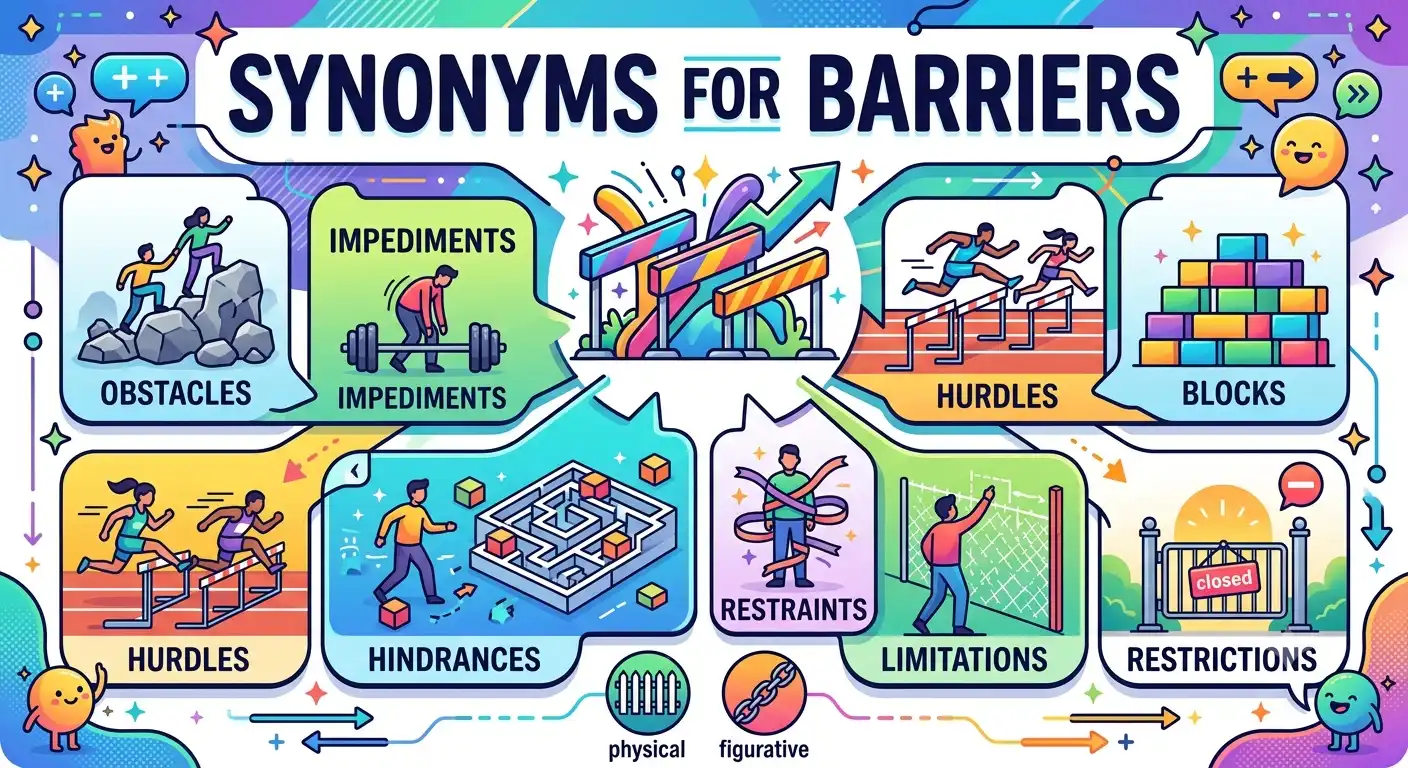
When you search for synonyms for barriers, you want to find words that describe things that block your way. Learning these synonyms for barriers helps you talk about physical walls or mental blocks that stop progress. Using different synonyms for barriers makes your sentences much more exciting and clear to read.
Picture yourself standing at the starting line of a race. You are excited to run, but suddenly you notice a series of high wooden fences blocking your track. This is exactly what a barrier is in real life. In simple English, a barrier is something that stops you from going where you want to go. It can be a real wall, or it can be an abstract problem like not understanding a language.
This concept is very useful for many people. Students can use these words to write better school essays. Bloggers can use them to write exciting blog posts that catch attention. Content writers can make their articles more professional and polished. Daily English users can sound more natural when chatting with friends. Using different words helps everyone avoid repeating themselves.
“The biggest barrier to success is the fear of failure.” – Sven-Göran Eriksson
“To conquer fear is the beginning of wisdom.” – Bertrand Russell
Lexical Profile of “Barriers”
- Connotative Meaning: Obstruction, protection, division, difficulty, limitation, and challenge. It can also imply safety or security (such as a protective guardrail).
- Etymology:
- Old French: barriere (from barre meaning “bar, gate”).
- Vulgar Latin: barra (meaning “rod, barrier”).
- Pronunciation:
- US IPA: /ˈbær.i.ɚz/
- UK IPA: /ˈbær.i.əz/
- Syllables: 3 syllables (bar-ri-ers).
- Affixation Pattern: Base word barrier + plural suffix -s.
Comparison Table of Key Synonyms
| Keyword | Meaning | Usage Type | Context |
|---|---|---|---|
| Obstacle | Something that blocks your path | Casual / Professional | Daily life, goals, sports |
| Hurdle | A problem you must jump over | Professional / Casual | Business, track races, life |
| Block | A solid object that stops movement | Casual | Traffic, construction, building |
| Barricade | A fast wall built to keep people out | Formal / Professional | Police, events, emergencies |
| Impediment | Something that slows down progress | Formal | Medicine, law, speech |
| Restriction | A rule that limits what you can do | Formal | Law, schools, libraries |
| Wall | A tall structure that divides spaces | Casual / Emotional | Construction, relationships |
| Snag | A small, unexpected problem | Casual | Planning, shopping, sewing |
| Hindrance | A person or thing that makes life hard | Formal | Workplace, homework, projects |
| Boundary | A line that shows where an area ends | Formal / Professional | Property, relationships, maps |
“An obstacle is often a stepping stone.” – William Prescott
50 Synonyms for Barriers
1. Obstacle
- Pronunciation: US: /ˈɑːb.stə.kəl/ & UK: /ˈɒb.stə.kəl/
- Meaning: This word means something that blocks your way and makes it hard to move forward.
- Examples:
- The big rock in the road was a dangerous obstacle.
- We must work hard to overcome every obstacle.
2. Hurdle
- Pronunciation: US: /ˈhɝː.dəl/ & UK: /ˈhɜː.dəl/
- Meaning: This word means a frame that athletes jump over or any problem you must solve.
- Examples:
- She jumped over the last hurdle and won the race.
- Saving enough money is our biggest hurdle right now.
3. Block
- Pronunciation: US: /blɑːk/ & UK: /blɒk/
- Meaning: This word means a solid object that stops anything from passing through.
- Examples:
- There is a huge block of ice in the freezer.
- A heavy truck created a block on the narrow street.
4. Barricade
- Pronunciation: US: /ˈbær.ə.keɪd/ & UK: /ˈbær.ɪ.keɪd/
- Meaning: This word means a temporary wall built quickly to stop people from passing.
- Examples:
- The police put up a barricade to keep the crowd safe.
- We built a small barricade of dirt to stop the water.
5. Impediment
- Pronunciation: US: /ɪmˈped.ə.mənt/ & UK: /ɪmˈped.ɪ.mənt/
- Meaning: This word means something that makes it very difficult for you to do a task.
- Examples:
- His lack of a computer was a major impediment to his studies.
- The loud noise was an impediment to our deep sleep.
6. Restriction
- Pronunciation: US: /rɪˈstrɪk.ʃən/ & UK: /rɪˈstrɪk.ʃən/
- Meaning: This word means a rule or law that limits what people are allowed to do.
- Examples:
- The park has a strict restriction against bringing dogs inside.
- I have a food restriction because of my health.
7. Wall
- Pronunciation: US: /wɑːl/ & UK: /wɔːl/
- Meaning: This word means a tall, solid structure made of stone or brick that divides areas.
- Examples:
- He painted the bedroom wall a bright shade of blue.
- The old castle wall has stood for hundreds of years.
8. Snag
- Pronunciation: US: /snæɡ/ & UK: /snæɡ/
- Meaning: This word means an unexpected difficulty or a sharp point that tears your clothes.
- Examples:
- We hit a small snag when our car ran out of gas.
- My favorite sweater caught on a sharp metal snag.
9. Hindrance
- Pronunciation: US: /ˈhɪn.drəns/ & UK: /ˈhɪn.drəns/
- Meaning: This word means a person or thing that makes a situation more difficult for you.
- Examples:
- Heavy rain is always a hindrance to outdoor work.
- Try to help your mother instead of being a hindrance.
10. Boundary
- Pronunciation: US: /ˈbaʊn.də.ri/ & UK: /ˈbaʊn.dər.i/
- Meaning: This word means a real or imagined line that marks the edge of something.
- Examples:
- The wooden fence marks the boundary of our backyard.
- It is important to set a healthy boundary with friends.
11. Limit
- Pronunciation: US: /ˈlɪm.ɪt/ & UK: /ˈlɪm.ɪt/
- Meaning: This word means the greatest amount or level of something that is allowed or possible.
- Examples:
- You must drive slowly because the speed limit is very low.
- My patience has reached its absolute limit today.
12. Dam
- Pronunciation: US: /dæm/ & UK: /dæm/
- Meaning: This word means a wall built across a river to stop the flow of water.
- Examples:
- The beavers built a clever dam out of branches and mud.
- This large dam provides electricity for the entire town.
13. Fence
- Pronunciation: US: /fens/ & UK: /fens/
- Meaning: This word means a structure made of wood or metal that surrounds a yard.
- Examples:
- Our dog loves to run along the white wooden fence.
- We need to build a taller fence around the garden.
14. Jam
- Pronunciation: US: /dʒæm/ & UK: /dʒæm/
- Meaning: This word means a situation where a lot of people or things are crowded together.
- Examples:
- We were stuck in a massive traffic jam for two hours.
- Paper caused a bad jam inside the office printer.
15. Blockage
- Pronunciation: US: /ˈblɑː.kɪdʒ/ & UK: /ˈblɒk.ɪdʒ/
- Meaning: This word means something that stops a liquid or gas from moving through a pipe.
- Examples:
- The plumber found a dirty blockage inside the kitchen sink.
- Leaves caused a serious blockage in the water pipe.
16. Stop
- Pronunciation: US: /stɑːp/ & UK: /stɒp/
- Meaning: This word means a place where a vehicle pauses or the act of halting progress.
- Examples:
- Let us wait for the school bus at the next stop.
- The sudden stop made the passengers slide forward.
17. Clutter
- Pronunciation: US: /ˈklʌt.tɚ/ & UK: /ˈklʌt.ər/
- Meaning: This word means a large mess of untidy things that fill a space.
- Examples:
- Please clean up the clutter of toys on your floor.
- I cannot work when my desk is full of clutter.
18. Shackle
- Pronunciation: US: /ˈʃæk.əl/ & UK: /ˈʃæk.əl/
- Meaning: This word means a metal ring used to lock a prisoner’s hands or feet.
- Examples:
- The guards removed the heavy iron shackle from his ankle.
- Old rules can feel like a shackle on your creative ideas.
19. Chain
- Pronunciation: US: /tʃeɪn/ & UK: /tʃeɪn/
- Meaning: This word means a row of metal rings joined together to hold or pull things.
- Examples:
- He used a strong steel chain to lock his bicycle.
- The heavy chain clanked against the old wooden door.
20. Bar
- Pronunciation: US: /bɑːr/ & UK: /bɑː/
- Meaning: This word means a long, straight piece of metal or wood used as a barrier.
- Examples:
- He placed a wooden bar across the door to lock it.
- There was a thick iron bar on the window for safety.
21. Check
- Pronunciation: US: /tʃek/ & UK: /tʃek/
- Meaning: This word means a sudden pause in progress or a mark showing something is correct.
- Examples:
- The bad news put a check on our exciting plans.
- Put a green check next to the words you know.
22. Clog
- Pronunciation: US: /klɑːɡ/ & UK: /klɒɡ/
- Meaning: This word means an object or a sticky mess that stops a tube or pipe.
- Examples:
- Hair caused a terrible clog in the bathroom shower.
- Mud will clog the wheels of your bicycle very fast.
23. Curb
- Pronunciation: US: /kɝːb/ & UK: /kɜːb/
- Meaning: This word means a stone edge along a street or something that limits your actions.
- Examples:
- The little girl stepped off the curb and onto the road.
- We need to put a curb on our spending this month.
24. Delay
- Pronunciation: US: /dɪˈleɪ/ & UK: /dɪˈleɪ/
- Meaning: This word means a period of time when you must wait for something to happen.
- Examples:
- The heavy snowstorm caused a long delay for our flight.
- I apologize for the delay in sending your package.
25. Detour
- Pronunciation: US: /ˈdiː.tʊr/ & UK: /ˈdiː.tʊə/
- Meaning: This word means a different route you must take because a road is closed.
- Examples:
- Road construction forced us to take a muddy detour.
- The detour added twenty minutes to our drive home.
26. Difficulty
- Pronunciation: US: /ˈdɪf.ə.kəl.ti/ & UK: /ˈdɪf.ɪ.kəl.ti/
- Meaning: This word means a problem or something that is not easy to complete.
- Examples:
- She had great difficulty solving the hard math problem.
- We ran into some difficulty during our long hike.
27. Drag
- Pronunciation: US: /dræɡ/ & UK: /dræɡ/
- Meaning: This word means a force that slows down movement or a very boring event.
- Examples:
- The weight of the wet clothes acts as a heavy drag.
- Sitting in a silent room all day is a real drag.
28. Drawback
- Pronunciation: US: /ˈdrɑː.bæk/ & UK: /ˈdrɔː.bæk/
- Meaning: This word means a disadvantage or a bad point about an otherwise good thing.
- Examples:
- The house is beautiful, but the small kitchen is a drawback.
- The only drawback of the job is the early start time.
29. Interruption
- Pronunciation: US: /ˌɪn.t̬əˈrʌp.ʃən/ & UK: /ˌɪn.təˈrʌp.ʃən/
- Meaning: This word means an event that stops an activity from continuing smoothly.
- Examples:
- I need to work on my homework without any interruption.
- A brief power interruption turned off our computers.
30. Hitch
- Pronunciation: US: /hɪtʃ/ & UK: /hɪtʃ/
- Meaning: This word means a minor problem that delays a plan for a short time.
- Examples:
- The party went off without a single hitch last night.
- A small technical hitch delayed the start of the movie.
31. Interference
- Pronunciation: US: /ˌɪn.t̬ɚˈfɪr.əns/ & UK: /ˌɪn.təˈfɪə.rəns/
- Meaning: This word means the unwanted noise or activity that ruins a clear signal.
- Examples:
- There was a lot of static interference on the old radio.
- I cannot study with constant interference from my brother.
32. Holdback
- Pronunciation: US: /ˈhoʊld.bæk/ & UK: /ˈhəʊld.bæk/
- Meaning: This word means something that restrains you or prevents you from growing.
- Examples:
- Fear can be a major holdback when trying new things.
- The lack of funding is a serious holdback for the school.
33. Bottleneck
- Pronunciation: US: /ˈbɑː.t̬əl.nek/ & UK: /ˈbɒt.əl.nek/
- Meaning: This word means a narrow road or point where progress slows down to a crawl.
- Examples:
- The narrow bridge creates a daily bottleneck for cars.
- This step in the project is a major bottleneck for us.
34. Checkpoint
- Pronunciation: US: /ˈtʃek.pɔɪnt/ & UK: /ˈtʃek.pɔɪnt/
- Meaning: This word means a place where travelers must stop for an inspection.
- Examples:
- The guards checked our passports at the border checkpoint.
- Drivers must slow down when they approach the checkpoint.
35. Shield
- Pronunciation: US: /ʃiːld/ & UK: /ʃiːld/
- Meaning: This word means a wide object held to protect the body from danger.
- Examples:
- The brave knight held his silver shield to block the sword.
- Wearing sunglasses is a good shield against bright light.
36. Partition
- Pronunciation: US: /pɑːrˈtɪʃ.ən/ & UK: /pɑːˈtɪʃ.ən/
- Meaning: This word means a thin wall or screen that divides a large room.
- Examples:
- We put up a wooden partition to make two offices.
- The glass partition allows light but keeps out noise.
37. Screen
- Pronunciation: US: /skriːn/ & UK: /skriːn/
- Meaning: This word means a flat surface that protects or hides a private area.
- Examples:
- We placed a folding screen in the corner to change clothes.
- The mesh screen keeps pesky flies out of the house.
38. Divide
- Pronunciation: US: /dɪˈvaɪd/ & UK: /dɪˈvaɪd/
- Meaning: This word means a wide line or space that separates two groups of people.
- Examples:
- There is a deep cultural divide between the two countries.
- The river creates a natural divide through the valley.
39. Border
- Pronunciation: US: /ˈbɔːr.dɚ/ & UK: /ˈbɔː.dər/
- Meaning: This word means the official line that separates two states or countries.
- Examples:
- We had to show our papers to cross the state border.
- Colorful flowers grew along the border of the garden path.
40. Buffer
- Pronunciation: US: /ˈbʌf.ɚ/ & UK: /ˈbʌf.ər/
- Meaning: This word means an extra space or object that protects you from a collision.
- Examples:
- The trees act as a helpful buffer against strong winds.
- Leave a buffer of extra time before your next flight.
41. Trench
- Pronunciation: US: /trentʃ/ & UK: /trentʃ/
- Meaning: This word means a long, narrow ditch dug deep into the ground.
- Examples:
- The workers dug a trench to lay down new pipes.
- Rainwater filled the muddy trench along the road.
42. Moat
- Pronunciation: US: /moʊt/ & UK: /məʊt/
- Meaning: This word means a deep, wide ditch filled with water around a castle.
- Examples:
- The castle has a deep moat to keep enemies away.
- We saw a lazy alligator swimming in the castle moat.
43. Gate
- Pronunciation: US: /ɡeɪt/ & UK: /ɡeɪt/
- Meaning: This word means a hinged door in a fence or wall outside.
- Examples:
- Please close the garden gate so the dog cannot run away.
- We painted the rusty iron gate a bright white color.
44. Grate
- Pronunciation: US: /ɡreɪt/ & UK: /ɡreɪt/
- Meaning: This word means a metal frame with bars that covers an opening.
- Examples:
- Water drains quickly through the iron grate on the street.
- He placed a heavy grate in front of the warm fireplace.
45. Gridlock
- Pronunciation: US: /ˈɡrɪd.lɑːk/ & UK: /ˈɡrɪd.lɒk/
- Meaning: This word means a traffic jam where no cars can move in any direction.
- Examples:
- A minor car accident caused total gridlock in the city center.
- We sat in gridlock for hours during the heavy rain.
46. Lock
- Pronunciation: US: /lɑːk/ & UK: /lɒk/
- Meaning: This word means a device that keeps a door closed until a key opens it.
- Examples:
- She checked the lock on the front door three times.
- Put a strong lock on your locker at school.
47. Trap
- Pronunciation: US: /træp/ & UK: /træp/
- Meaning: This word means a clever device or trick used to catch animals or people.
- Examples:
- The mice avoided the wooden trap in the kitchen corner.
- He felt like he was caught in a painful trap at work.
48. Enclosure
- Pronunciation: US: /ɪnˈkloʊ.ʒɚ/ & UK: /ɪnˈkləʊ.ʒər/
- Meaning: This word means an area of land that is surrounded by a wall or fence.
- Examples:
- The zebras ran happily around their spacious grassy enclosure.
- We built a safe wire enclosure for our pet rabbits.
49. Friction
- Pronunciation: US: /ˈfrɪk.ʃən/ & UK: /ˈfrɪk.ʃən/
- Meaning: This word means the force that slows down sliding objects or a small disagreement.
- Examples:
- Rough roads create friction that slows down your bicycle.
- There is some friction between the two rival teams.
50. Constraint
- Pronunciation: US: /kənˈstreɪnt/ & UK: /kənˈstreɪnt/
- Meaning: This word means a rule or limit that controls what you can do.
- Examples:
- Budget constraint means we cannot buy a brand new car.
- Time constraint forced us to finish the test very fast.
Antonyms of “Barriers”
To understand “barriers” completely, it helps to know its opposite words. Here are some of the most common antonyms:
- Opening: A gap or space that allows you to pass through.
- Aid: Help or support that makes a task easier for you.
- Pathway: A clear track or road that leads directly to a goal.
- Clearance: Official permission to pass or a space free of blocks.
- Access: The right or ability to enter a place easily.
- Assistance: The act of helping someone achieve their goals.
Prototype Meaning and Categorization of “Barriers”
The prototype meaning of “barriers” is a physical object or abstract challenge that blocks, separates, or prevents movement or progress. We can categorize this concept into four main areas:
- Physical Obstructions: Objects that physically block your body or vehicles (e.g., wall, fence, barricade, dam).
- Abstract Limits and Rules: Non-physical laws or boundaries that control behavior (e.g., restriction, constraint, boundary, limit).
- Delays and Interruptions: Challenges that slow down your speed or time progress (e.g., bottleneck, hitch, delay, snag).
- Protective Dividers: Shields or partitions used to separate areas for safety (e.g., buffer, screen, partition, shield).
FAQ About Synonyms for Barriers
1. What is the most common synonym for barriers?
The most common synonym is obstacle when you talk about everyday physical things or general life goals that block your path.
2. Is “restriction” always a synonym for barriers?
Not always. A restriction is a rule or a law that tells you what you cannot do, whereas a barrier can be a physical object like a wall or a natural obstacle.
3. How do you use “hurdle” in a professional business email?
You can use it to describe a business challenge. For example: “Our team must jump over this financial hurdle before we can launch the new product.”
4. What is the difference between a barricade and a barrier?
A barrier is a general term for anything that blocks, while a barricade is specifically a wall built quickly by humans to stop traffic or crowds during events.
5. Why does learning synonyms for barriers help my writing?
It keeps your essays and articles from sounding repetitive. Instead of using the word “barrier” ten times, you can use impediment, snag, or hurdle to keep your readers interested.
6. Can a barrier be a good thing?
Yes, a barrier can be very good when it protects you. For example, a safety rail on a highway is a protective barrier that keeps cars on the road.
Conclusion
Expanding your vocabulary by learning synonyms for barriers is one of the best ways to improve your daily English skills. When you study different words, your writing becomes much more colorful and precise. Bloggers can use these varied words to keep their readers glued to the screen. Content writers can write more professional articles that sound natural and smart. Students can get better grades on essays by avoiding repetitive phrasing.
Even in your daily life, using these words will help you communicate clearly. Try practicing these new words today. Use them when you write an email to your boss, when you draft an essay for class, or even when you text your friends. The more you use them, the more natural they will feel to you. Your vocabulary is a powerful tool, so keep building it every single day!
“What stands in the way becomes the way.” – Marcus Aurelius
“There are no barriers to the human spirit.” – Unknown

Andrew Collins is an academic English educator with over 12 years of experience helping university students, IELTS candidates, and ESL learners improve their writing vocabulary.