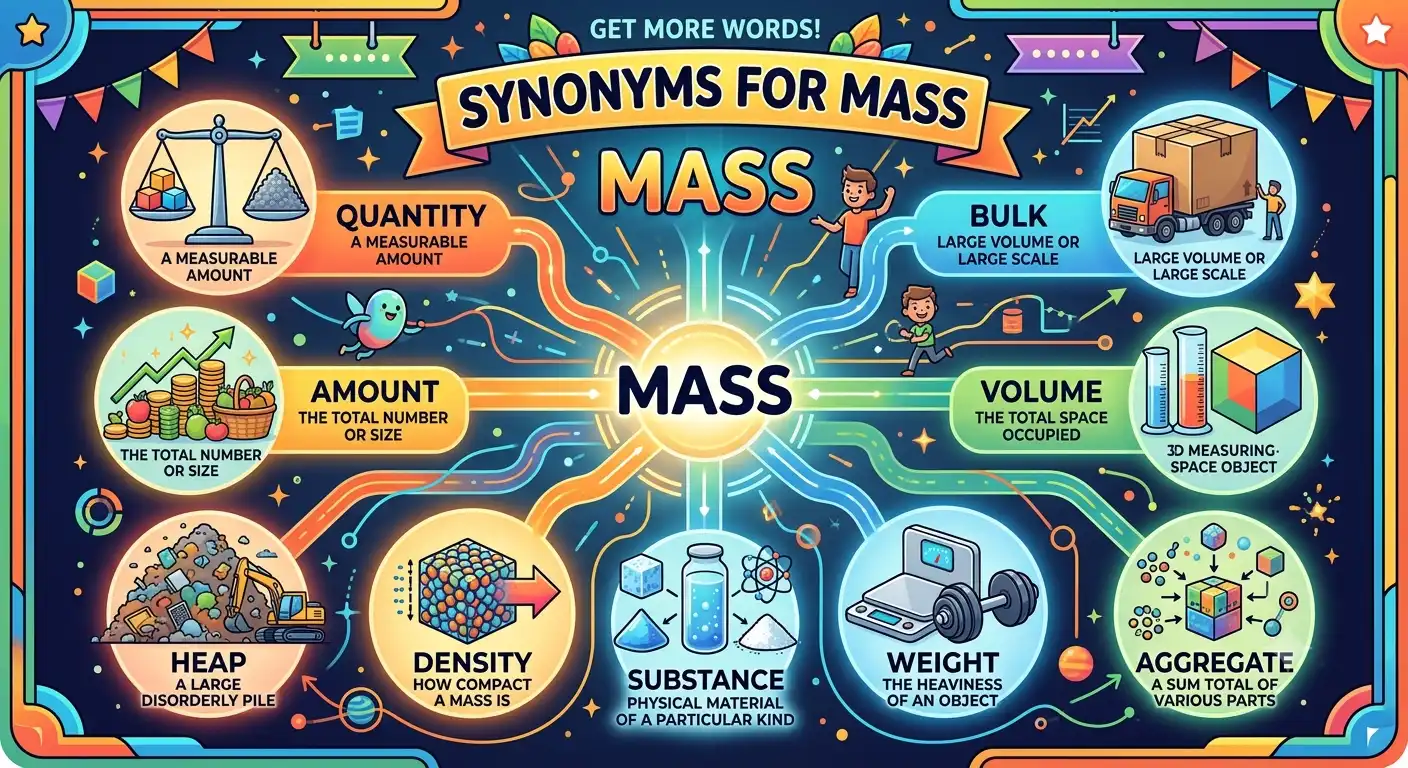
When you search for synonyms for mass, you want to find words that describe a large amount of matter or a big group of things. Learning these synonyms for mass helps you describe huge crowds, heavy objects, or the main part of something. Using different synonyms for mass makes your English sentences sound more precise and professional.
Picture yourself standing on a tall hill on a sunny morning. You look down and see a giant forest of trees stretching all the way to the blue horizon. That huge collection of trees is a real-life example of a mass. In very simple English, a mass is a large body of matter with no definite shape, or a very large number of people or things. It is like a big lump of clay, a crowd of screaming sports fans, or the main bulk of an object.
This vocabulary concept is very useful for many different people. Students can use these words to write better science reports and history essays. Bloggers can use them to write exciting blog posts that paint vivid pictures for their readers. Content writers can make their marketing copy sound punchy and polished. Daily English users can express the size and scale of things naturally when chatting with friends. Using different words helps everyone avoid repeating themselves.
“The mass of men lead lives of quiet desperation.” – Henry David Thoreau
“In the mass of human actions, more are good than bad.” – Thomas Jefferson
Lexical Profile of “Mass”
- Connotative Meaning: Heaviness, abundance, weight, unity, crowd, bulk, or a large scale. In physics, mass ($m$) is a measure of an object’s resistance to acceleration when a force ($F$) is applied, represented by the formula $F = ma$. It can also imply a sense of overwhelming size or a collective group of people.
- Etymology:
- Old French: masse (meaning “lump, heap, crowd”).
- Latin: massa (meaning “kneaded dough, lump”).
- Greek: maza (meaning “barley cake”).
- Pronunciation:
- US IPA: /mæs/
- UK IPA: /mæs/
- Syllables: 1 syllable (mass).
- Affixation Pattern: Base word mass (can take plural suffix -es to form masses).
Comparison Table of Key Synonyms
| Keyword | Meaning | Usage Type | Context |
|---|---|---|---|
| Bulk | The greater part or large size of something | Professional / Casual | Business, shipping, objects |
| Crowd | A large number of people gathered together | Casual | Public places, events, cities |
| Heap | A messy pile of many things | Casual | Cleaning, construction, trash |
| Substance | Real physical matter that you can touch | Formal / Professional | Science, philosophy, materials |
| Quantity | An amount or number of something | Professional | Math, business, shopping |
| Myriad | A countless or extremely great number | Formal | Writing, nature, ideas |
| Majority | More than half of a total group | Formal / Professional | Voting, opinions, groups |
| Lump | A small piece of solid matter with no shape | Casual | Cooking, science, medicine |
| Multitude | A very large number of people or things | Formal | Literature, speeches, crowds |
| Volume | The total amount or space something fills | Professional / Casual | Liquids, business sales, noise |
“The great force of history is the collective mass of ordinary people.” – Unknown
50 Synonyms for Mass
1. Bulk
- Pronunciation: US: /bʌlk/ & UK: /bʌlk/
- Meaning: This word means the largest part or the giant size of an object.
- Examples:
- The bulk of the heavy boxes arrived at the warehouse yesterday.
- He used his physical bulk to push open the stuck door.
2. Crowd
- Pronunciation: US: /kraʊd/ & UK: /kraʊd/
- Meaning: This word means a very large group of people gathered in one place.
- Examples:
- A loud crowd waited outside the theater to see the actor.
- It is easy to get lost in a busy city crowd.
3. Heap
- Pronunciation: US: /hiːp/ & UK: /hiːp/
- Meaning: This word means an untidy pile of clothes, toys, or other objects.
- Examples:
- She left a messy heap of warm blankets on the floor.
- We saw a giant heap of dry autumn leaves in the yard.
4. Substance
- Pronunciation: US: /ˈsʌb.stəns/ & UK: /ˈsʌb.stəns/
- Meaning: This word means physical material that you can touch, see, or measure.
- Examples:
- The sticky substance on the kitchen counter was hard to clean.
- Water is a natural substance that is necessary for all life.
5. Quantity
- Pronunciation: US: /ˈkwɑːn.t̬ə.t̬i/ & UK: /ˈkwɒn.tə.ti/
- Meaning: This word means a specific amount or number of something you can count.
- Examples:
- The factory produced a vast quantity of toys for the holidays.
- We need a small quantity of salt to finish this recipe.
6. Myriad
- Pronunciation: US: /ˈmɪr.i.əd/ & UK: /ˈmɪr.i.əd/
- Meaning: This word means a countless or extremely large number of things.
- Examples:
- We looked up and saw a myriad of bright stars in the sky.
- The young artist has a myriad of creative ideas in her mind.
7. Majority
- Pronunciation: US: /məˈdʒɑːr.ə.t̬i/ & UK: /məˈdʒɒr.ə.ti/
- Meaning: This word means the largest group or more than half of the total.
- Examples:
- The majority of the students voted to have the party outside.
- I spent the majority of my weekend reading a new book.
8. Lump
- Pronunciation: US: /lʌmp/ & UK: /lʌmp/
- Meaning: This word means a small piece of something solid that has no regular shape.
- Examples:
- He dropped a sweet lump of sugar into his hot tea.
- The child molded a wet lump of clay into a little bowl.
9. Multitude
- Pronunciation: US: /ˈmʌl.tə.tuːd/ & UK: /ˈmʌl.tɪ.tʃuːd/
- Meaning: This word means a very large number of people or things grouped together.
- Examples:
- A multitude of eager fans arrived early for the rock concert.
- This simple guide answers a multitude of common questions.
10. Volume
- Pronunciation: US: /ˈvɑːl.juːm/ & UK: /ˈvɒl.juːm/
- Meaning: This word means the total amount of space that an object or liquid fills.
- Examples:
- The high volume of water in the pool surprised the kids.
- Our store handled a large volume of business sales this week.
11. Pile
- Pronunciation: US: /paɪl/ & UK: /paɪl/
- Meaning: This word means a collection of things laid one on top of another.
- Examples:
- He made a neat pile of wood near the warm fireplace.
- There is a tall pile of laundry waiting to be folded.
12. Stack
- Pronunciation: US: /stæk/ & UK: /stæk/
- Meaning: This word means an orderly pile of objects, especially books, papers, or boxes.
- Examples:
- She carefully carried a heavy stack of textbooks to her desk.
- A clean stack of white plates sat on the kitchen table.
13. Load
- Pronunciation: US: /loʊd/ & UK: /ləʊd/
- Meaning: This word means a large amount of weight that is carried by a vehicle or person.
- Examples:
- The big yellow truck carried a heavy load of gray stones.
- Washing a full load of dirty clothes takes about an hour.
14. Bunch
- Pronunciation: US: /bʌntʃ/ & UK: /bʌntʃ/
- Meaning: This word means a number of things of the same kind growing or joined together.
- Examples:
- She bought a sweet bunch of yellow bananas at the store.
- A friendly bunch of children played together in the park.
15. Horde
- Pronunciation: US: /hɔːrd/ & UK: /hɔːd/
- Meaning: This word means a massive, excited crowd of people that is moving quickly.
- Examples:
- A horde of eager shoppers rushed through the mall doors.
- We saw a horde of tourists taking photos near the castle.
16. Throng
- Pronunciation: US: /θrɑːŋ/ & UK: /θrɒŋ/
- Meaning: This word means a densely packed crowd of people standing very close together.
- Examples:
- A great throng of citizens gathered to hear the mayor speak.
- He pushed his way slowly through the busy throng of commuters.
17. Swarm
- Pronunciation: US: /swɔːrm/ & UK: /swɔːm/
- Meaning: This word means a large group of insects or busy people moving around together.
- Examples:
- A dark swarm of honeybees flew around the wooden hive.
- A swarm of children ran out to the playground for recess.
18. Pack
- Pronunciation: US: /pæk/ & UK: /pæk/
- Meaning: This word means a collection of related items or a tight group of wild animals.
- Examples:
- The hungry pack of wolves ran quickly through the deep snow.
- He carried a heavy pack of camping supplies on his back.
19. Block
- Pronunciation: US: /blɑːk/ & UK: /blɒk/
- Meaning: This word means a solid piece of hard material with flat sides.
- Examples:
- The builder used a heavy block of concrete to make the wall.
- The toddler stacked a colorful block of wood on top of another.
20. Chunk
- Pronunciation: US: /tʃʌŋk/ & UK: /tʃʌŋk/
- Meaning: This word means a thick, solid piece of something larger.
- Examples:
- She cut a delicious chunk of cheese to eat with her bread.
- A large chunk of ice broke off the glacier and fell.
21. Cluster
- Pronunciation: US: /ˈklʌs.tɚ/ & UK: /ˈklʌs.tər/
- Meaning: This word means a small group of similar things growing or standing close together.
- Examples:
- We noticed a pretty cluster of purple flowers near the tall tree.
- A tiny cluster of houses sat at the bottom of the hill.
22. Collection
- Pronunciation: US: /kəˈlek.ʃən/ & UK: /kəˈlek.ʃən/
- Meaning: This word means a group of similar objects that have been gathered over time.
- Examples:
- He is proud of his rare collection of silver coins.
- The school library has a wonderful collection of science books.
23. Assembly
- Pronunciation: US: /əˈsem.bli/ & UK: /əˈsem.bli/
- Meaning: This word means a group of people gathered together for a common purpose.
- Examples:
- The principal spoke to the whole school during the morning assembly.
- Putting together the metal assembly for the toy was easy.
24. Gathering
- Pronunciation: US: /ˈɡæð.ɚ.ɪŋ/ & UK: /ˈɡæð.ər.ɪŋ/
- Meaning: This word means a friendly meeting of people who want to spend time together.
- Examples:
- We had a cozy family gathering at our house on Thanksgiving.
- The community center hosts a weekly gathering for local artists.
25. Body
- Pronunciation: US: /ˈbɑː.di/ & UK: /ˈbɒd.i/
- Meaning: This word means a large physical structure or an organized group of people.
- Examples:
- The ocean is a massive body of saltwater that covers Earth.
- A formal body of experts met to discuss the school rules.
26. Aggregate
- Pronunciation: US: /ˈæɡ.rə.ɡət/ & UK: /ˈæɡ.rɪ.ɡət/
- Meaning: This word means a whole formed by combining several different elements.
- Examples:
- The team’s score was an aggregate of three separate games.
- The builder mixed stone and sand to create an aggregate concrete.
27. Mountain
- Pronunciation: US: /ˈmaʊn.tən/ & UK: /ˈmaʊn.tɪn/
- Meaning: This word means a giant pile of something that looks like a high hill.
- Examples:
- There is a mountain of paperwork sitting on my office desk.
- The children built a mountain of sand near the cool water.
28. Sea
- Pronunciation: US: /siː/ & UK: /siː/
- Meaning: This word means a massive area of saltwater or an endless crowd of things.
- Examples:
- The singer looked out at a sea of smiling faces tonight.
- Ships sail across the wide blue sea to deliver important goods.
29. Flood
- Pronunciation: US: /flʌd/ & UK: /flʌd/
- Meaning: This word means a very large amount of water or things that arrive all at once.
- Examples:
- The heavy rain created a sudden flood of water on the road.
- We received a friendly flood of emails on our first day.
30. Host
- Pronunciation: US: /hoʊst/ & UK: /həʊst/
- Meaning: This word means a very large number of people, animals, or objects.
- Examples:
- A whole host of colorful birds nested in the backyard trees.
- The store offers a host of fun activities for young children.
31. Mob
- Pronunciation: US: /mɑːb/ & UK: /mɒb/
- Meaning: This word means a very large and rowdy crowd of people who are angry.
- Examples:
- An angry mob shouted loudly outside the city hall building.
- The police asked the noisy mob to leave the quiet street.
32. Flock
- Pronunciation: US: /flɑːk/ & UK: /flɒk/
- Meaning: This word means a large group of birds, sheep, or people moving together.
- Examples:
- We watched a beautiful flock of wild geese fly south today.
- A flock of excited kids ran toward the ice cream truck.
33. Herd
- Pronunciation: US: /hɝːd/ & UK: /hɜːd/
- Meaning: This word means a large group of animals or a big crowd of people.
- Examples:
- A large herd of wild cows walked slowly across the green field.
- He joined the herd of daily travelers boarding the morning train.
34. Plenitude
- Pronunciation: US: /ˈplen.ə.tuːd/ & UK: /ˈplen.ɪ.tʃuːd/
- Meaning: This word means a wonderful and completely full amount of something.
- Examples:
- The farm offers a rich plenitude of fresh fruits and vegetables.
- She enjoyed a peaceful plenitude of free time during her vacation.
35. Abundance
- Pronunciation: US: /əˈbʌn.dəns/ & UK: /əˈbʌn.dəns/
- Meaning: This word means a very large quantity that is more than enough for your needs.
- Examples:
- The warm rain brought an abundance of green grass this spring.
- There was a sweet abundance of delicious food at the party.
36. Batch
- Pronunciation: US: /bætʃ/ & UK: /bætʃ/
- Meaning: This word means a group of things made or processed at the same time.
- Examples:
- My mother baked a fresh batch of chocolate chip cookies.
- We mailed the first batch of graduation invitations this morning.
37. Bundle
- Pronunciation: US: /ˈbʌn.dəl/ & UK: /ˈbʌn.dəl/
- Meaning: This word means a collection of things tied or wrapped tightly together.
- Examples:
- He carried a neat bundle of dry firewood into the cabin.
- She received a lovely bundle of red roses from her husband.
38. Clump
- Pronunciation: US: /klʌmp/ & UK: /klʌmp/
- Meaning: This word means a small, thick group of trees, dirt, or other items.
- Examples:
- We walked past a small clump of birch trees in the park.
- A heavy clump of wet mud stuck to his running shoes.
39. Slab
- Pronunciation: US: /slæb/ & UK: /slæb/
- Meaning: This word means a broad, flat, and thick piece of stone, wood, or food.
- Examples:
- The mason placed a heavy slab of gray marble on the floor.
- He served a thick slab of sweet apple pie for dessert.
40. Accumulation
- Pronunciation: US: /əˌkjuː.mjəˈleɪ.ʃən/ & UK: /əˌkjuː.mjəˈleɪ.ʃən/
- Meaning: This word means a gathered amount of things that builds up over time.
- Examples:
- The cold winter storm caused a deep accumulation of white snow.
- Cleaning up the massive accumulation of old dust took all afternoon.
41. Amalgamation
- Pronunciation: US: /əˌmæl.ɡəˈmeɪ.ʃən/ & UK: /əˌmæl.ɡəˈmeɪ.ʃən/
- Meaning: This word means the action or result of combining multiple things into one.
- Examples:
- The school show was an amalgamation of dance, music, and art.
- This tasty dish is a perfect amalgamation of sweet and spicy flavors.
42. Magnitude
- Pronunciation: US: /ˈmæɡ.nə.tuːd/ & UK: /ˈmæɡ.nɪ.tʃuːd/
- Meaning: This word means the great size, importance, or physical scale of something.
- Examples:
- The young students did not understand the immense magnitude of the solar system.
- We were shocked by the physical magnitude of the ancient stone castle.
43. Conglomeration
- Pronunciation: US: /kənˌɡlɑː.məˈreɪ.ʃən/ & UK: /kənˌɡlɒm.əˈreɪ.ʃən/
- Meaning: This word means a large mixture of different things grouped together.
- Examples:
- The messy bedroom was a conglomeration of books, clothes, and games.
- The modern city is a huge conglomeration of different cultures and styles.
44. Core
- Pronunciation: US: /kɔːr/ & UK: /kɔː/
- Meaning: This word means the central, most important, or deepest part of something.
- Examples:
- Scientists study the hot core of our planet to learn more about it.
- Honesty is the true core of a happy and healthy friendship.
45. Whole
- Pronunciation: US: /hoʊl/ & UK: /həʊl/
- Meaning: This word means the entire amount or all the parts of an object.
- Examples:
- The hungry boy ate the whole pizza by himself last night.
- We want to travel across the whole world during our summer break.
46. Gross
- Pronunciation: US: /ɡroʊs/ & UK: /ɡrəʊs/
- Meaning: This word means the complete amount of something before any deductions.
- Examples:
- The gross weight of the packed shipping box was ten pounds.
- Our small company’s gross income increased greatly this year.
47. Totality
- Pronunciation: US: /toʊˈtæl.ə.t̬i/ & UK: /təʊˈtæl.ə.ti/
- Meaning: This word means the complete and whole amount of a specific thing.
- Examples:
- We watched the moon cover the sun during the totality of the solar eclipse.
- He read the totality of the book series in just one week.
48. Store
- Pronunciation: US: /stɔːr/ & UK: /stɔː/
- Meaning: This word means a large supply of useful items kept for future use.
- Examples:
- The clever squirrels kept a large store of brown acorns for the winter.
- The village has a backup store of fresh drinking water.
49. Array
- Pronunciation: US: /əˈreɪ/ & UK: /əˈreɪ/
- Meaning: This word means an impressive and orderly display or group of things.
- Examples:
- The sweet bakery has an amazing array of delicious cakes on display.
- He has a useful array of metal tools in his garage.
50. Shoal
- Pronunciation: US: /ʃoʊl/ & UK: /ʃəʊl/
- Meaning: This word means a large number of fish swimming close together in the water.
- Examples:
- We saw a bright shoal of tropical fish swimming near the coral reef.
- A massive shoal of silver fish darted quickly away from the shark.
Antonyms of “Mass”
To understand “mass” completely, it helps to know its opposite words. Here are some of the most common antonyms:
- Speck: A tiny spot or extremely small piece of something.
- Particle: A minute portion of matter, like dust or sand.
- Fragment: A small part broken off from a larger whole.
- Bit: A very small piece or amount of something.
- Individual: A single human being or object, rather than a group.
- Minority: A small part of a group that is less than half of the total.
- Void: A completely empty space containing nothing.
Prototype Meaning and Categorization of “Mass”
The prototype meaning of “mass” is a large, cohesive collection of matter or a high quantity of individuals grouped together without a distinct shape. We can categorize this concept into four main areas:
- Physical Objects & Solid Pieces: Large solid materials or shapeless heaps of objects (e.g., lump, block, chunk, slab, pile).
- Massive Quantities & Crowds: Large groups of people or animals moving or standing together (e.g., crowd, multitude, horde, throng, herd).
- Scientific/Technical Concepts: Words used to define volume, matter, or physical limits (e.g., substance, volume, magnitude, aggregate).
- Totality and Core Bulk: The central bulk or entire amount of an item (e.g., bulk, majority, totality, whole, core).
FAQ About Synonyms for Mass
1. What is the most common synonym for mass?
The most common synonym is bulk when you are talking about the size of an object, or crowd when you are talking about a large group of people.
2. Can “mass” refer to people as well as objects?
Yes. “Mass” can refer to physical objects like a mass of clay, or to groups of people, such as “the masses” meaning the general public.
3. Is “weight” the same thing as “mass”?
No. In science, mass is the actual amount of matter in an object, while weight is the force of gravity pulling on that mass.
4. How do you use “myriad” in a professional setting?
You can use it to highlight a great number of items. For example: “Our company offers a myriad of technical solutions for your business problems.”
5. What is the difference between a “crowd” and a “mob”?
A crowd is simply a large group of people gathered together, while a mob is a chaotic, rowdy, or angry group of people who may cause trouble.
6. Why does knowing synonyms for mass help in writing?
It prevents your writing from sounding repetitive. Instead of using “mass” over and over, you can use precise words like abundance, throng, or magnitude to make your text engaging.
Conclusion
Expanding your vocabulary by learning synonyms for mass is one of the best ways to improve your daily English skills. When you study different words, your writing becomes much more colorful and precise. Bloggers can use these varied words to keep their readers glued to the screen. Content writers can write more professional articles that sound natural and smart. Students can get better grades on science and history essays by avoiding repetitive phrasing.
Even in your daily life, using these words will help you communicate clearly. Try practicing these new words today. Use them when you write an email to your boss, when you draft an essay for class, or even when you text your friends. The more you use them, the more natural they will feel to you. Your vocabulary is a powerful tool, so keep building it every single day!
“The difference between the right word and the almost right word is the difference between lightning and a lightning bug.” – Mark Twain
“Words are, of course, the most powerful drug used by mankind.” – Rudyard Kipling

Andrew Collins is an academic English educator with over 12 years of experience helping university students, IELTS candidates, and ESL learners improve their writing vocabulary.