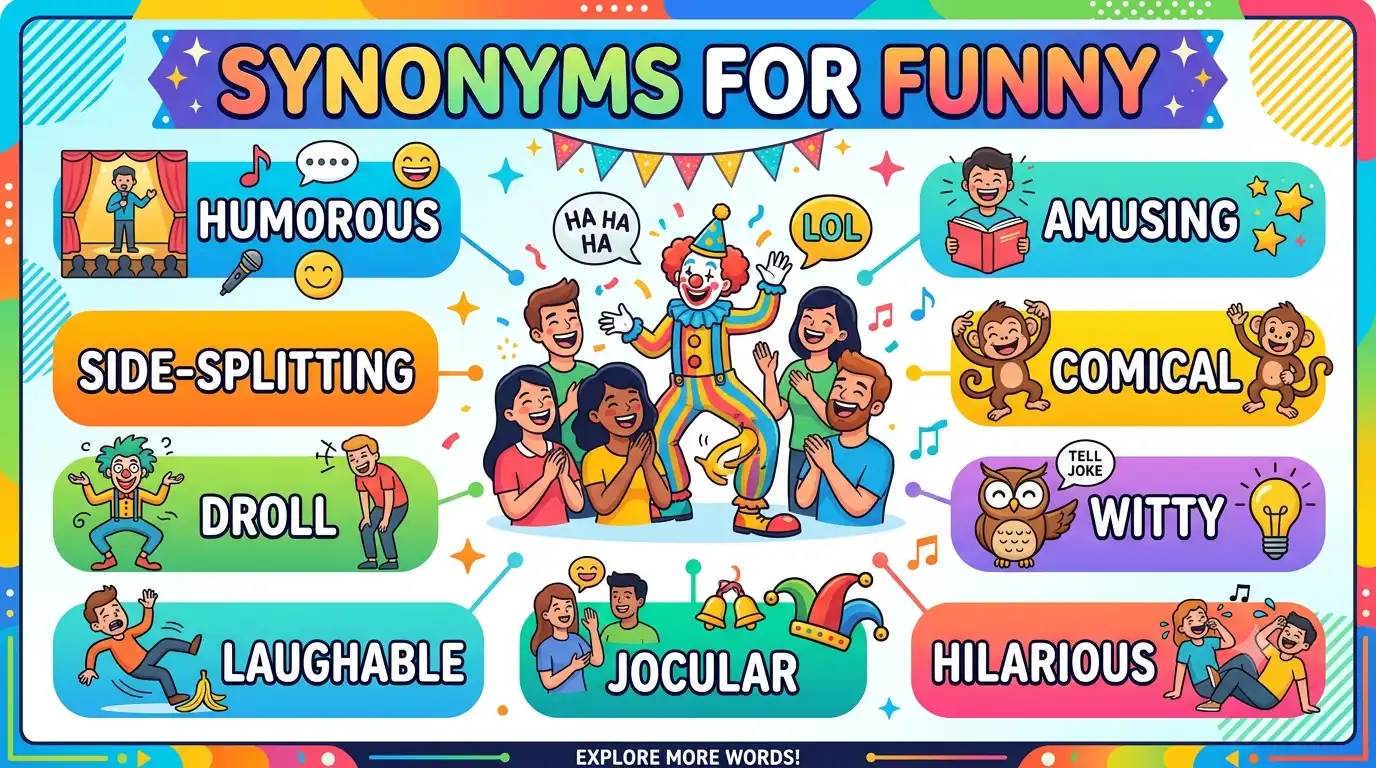
When you want to describe something that makes you laugh, finding the right synonyms for funny is extremely helpful. Using different synonyms for funny prevents your writing from sounding boring and repetitive. By expanding your vocabulary with excellent synonyms for funny, you can share your stories in a way that matches exactly how much you laughed.
Picture this: You are sitting around a campfire on a chilly autumn night. Your friend leans in and tells a story about the time they tried to teach their cat to fetch, ending with the cat landing headfirst in a bowl of warm soup. Everyone bursts into wild, roaring laughter. If you write about this moment later, simply calling the story “funny” does not capture the pure joy of that messy soup disaster. Using more specific words brings your story to life.
“Laughter is the sun that drives winter from the human face.” — Victor Hugo
Let us explain what the word funny means in very simple terms. Funny describes things that make us smile, giggle, or laugh out loud. It is a feeling of happiness and playfulness that we share with others.
“A day without laughter is a day wasted.” — Charlie Chaplin
Learning these alternative words is incredibly useful for different people:
- Students: Learning these words helps you write better school essays and creative stories so your teachers can enjoy your descriptive language.
- Bloggers: You can keep your readers hooked by using fresh words instead of repeating the same simple terms over and over.
- Content Writers: You need to keep your articles exciting and easy to scan, making new terms perfect for catchy headlines.
- Daily English Users: You will find that using a variety of words makes everyday talks with friends and family much more fun.
Linguistic Breakdown of Funny
- Connotative Meaning: Lightheartedness, joy, amusement, absurdity, or sometimes oddity.
- Etymology:
- Originates from the noun fun (which meant trickery or a hoax in the late 17th century).
- Shifted to mean amusement or sport by the 18th century.
- The suffix -y was added to describe things that cause amusement.
- Pronunciation (US & UK): US:
/ˈfʌni/| UK:/ˈfʌni/ - Syllables: 2 (fun-ny)
- Affixation Pattern: Root word (fun) + Suffix (-y)
Prototype Meaning and Categorization
The word funny primarily categorizes experiences that trigger amusement or laughter. Linguistically, it splits into two distinct prototype meanings:
- The Amusing Prototype: Things that cause laughter, joy, or smiles (e.g., a good joke).
- The Eccentric Prototype: Things that are strange, peculiar, or suspicious (e.g., “a funny smell”).
Quick Comparison Table
| Keyword | Meaning | Usage Type | Context |
|---|---|---|---|
| Funny | Causing amusement or laughter | Casual | Daily life, casual conversations |
| Hilarious | Extremely amusing or loud | Emotional | Movies, wild parties, great jokes |
| Witty | Showing quick, clever humor | Professional | Work meetings, speeches, books |
| Humorous | Having a playful or funny quality | Formal | Academic essays, written reviews |
| Comical | Amusing in an absurd or silly way | Casual | Slapstick comedy, clumsy mistakes |
| Amusing | Providing entertainment or enjoyment | Neutral | Casual reading, light hobbies |
| Droll | Having an odd or dry sense of humor | Formal | Dry wit, intellectual comedy |
| Facetious | Joking at an inappropriate time | Casual | Sarcastic comments, light arguments |
“Humor is the great thing, the saving thing after all.” — Mark Twain
50 Synonyms for Funny
1. Hilarious
- Pronunciation: of Hilarious (US:
/hɪˈlɛriəs/& UK:/hɪˈlɛəriəs/) - Meaning: This word describes something that is extremely funny and makes you laugh out loud.
- Examples:
- That comedy show last night was absolutely hilarious.
- He told a hilarious story about his dog chasing a laser pointer.
2. Humorous
- Pronunciation: of Humorous (US:
/ˈhjuːmərəs/& UK:/ˈhjuːmərəs/) - Meaning: This word describes something that has a playful sense of humor and makes people smile.
- Examples:
- The author wrote a humorous book about growing up in a big family.
- She gave a humorous speech that everyone in the room enjoyed.
3. Witty
- Pronunciation: of Witty (US:
/ˈwɪti/& UK:/ˈwɪti/) - Meaning: This word describes someone who is very clever and quick with funny remarks.
- Examples:
- My coworker always makes witty comments during our lunch break.
- The dialogue in that movie was incredibly sharp and witty.
4. Comical
- Pronunciation: of Comical (US:
/ˈkɑːmɪkl/& UK:/ˈkɒmɪkl/) - Meaning: This word describes something that is amusing in a silly, strange, or unexpected way.
- Examples:
- The puppy looked comical trying to walk in little winter boots.
- It was a comical mistake that made us all giggle.
5. Amusing
- Pronunciation: of Amusing (US:
/əˈmjuːzɪŋ/& UK:/əˈmjuːzɪŋ/) - Meaning: This word describes something that is entertaining and causes gentle laughter or smiles.
- Examples:
- I found the video game to be very amusing to play.
- He told an amusing story while we waited for our food.
6. Droll
- Pronunciation: of Droll (US:
/droʊl/& UK:/drəʊl/) - Meaning: This word describes an odd, dry, or quiet style of humor.
- Examples:
- She has a droll expression whenever she tells a joke.
- The actor is famous for his droll delivery of lines on stage.
7. Facetious
- Pronunciation: of Facetious (US:
/fəˈsiːʃəs/& UK:/fəˈsiːʃəs/) - Meaning: This word describes saying funny things at a time when you should be serious.
- Examples:
- Please stop making facetious remarks during this important meeting.
- He was just being facetious when he said he wanted to quit.
8. Hysterical
- Pronunciation: of Hysterical (US:
/hɪˈstɛrɪkl/& UK:/hɪˈstɛrɪkl/) - Meaning: This word describes something so funny that you lose control of your laughter.
- Examples:
- The blooper reel for the movie was completely hysterical.
- We all burst into hysterical laughter at his silly dance.
9. Jocular
- Pronunciation: of Jocular (US:
/ˈdʒɑːkjələr/& UK:/ˈdʒɒkjʊlə/) - Meaning: This word describes someone who is cheerful, playful, and likes to tell jokes.
- Examples:
- Our teacher was in a jocular mood on Friday afternoon.
- He made a jocular comment to break the ice with the team.
10. Side-splitting
- Pronunciation: of Side-splitting (US:
/ˈsaɪdˌsplɪtɪŋ/& UK:/ˈsaɪdˌsplɪtɪŋ/) - Meaning: This word describes something extremely funny that makes your sides hurt from laughing.
- Examples:
- The comedian told a side-splitting joke about traveling on airplanes.
- We had a side-splitting laugh over our old school photos.
11. Rib-tickling
- Pronunciation: of Rib-tickling (US:
/ˈrɪbˌtɪklɪŋ/& UK:/ˈrɪbˌtɪklɪŋ/) - Meaning: This word describes something that is highly entertaining and full of fun.
- Examples:
- The children watched a rib-tickling cartoon about animal friends.
- It was a rib-tickling comedy show that the family loved.
12. Entertaining
- Pronunciation: of Entertaining (US:
/ˌɛntərˈteɪnɪŋ/& UK:/ˌɛntəˈteɪnɪŋ/) - Meaning: This word describes something that holds your attention and makes you feel happy.
- Examples:
- The street performer gave a very entertaining show today.
- Your travel stories are always highly entertaining to hear.
13. Lighthearted
- Pronunciation: of Lighthearted (US:
/ˌlaɪtˈhɑːrtəd/& UK:/ˌlaɪtˈhɑːtɪd/) - Meaning: This word describes something that is cheerful, simple, and not serious.
- Examples:
- We had a lighthearted chat about our weekend plans.
- The film is a lighthearted look at life in college.
14. Slapstick
- Pronunciation: of Slapstick (US:
/ˈslæpstɪk/& UK:/ˈslæpstɪk/) - Meaning: This word describes comedy based on clumsy actions and harmless falls.
- Examples:
- Old silent movies relied heavily on slapstick comedy routines.
- The clown performed a classic slapstick act at the party.
15. Zany
- Pronunciation: of Zany (US:
/ˈzeɪni/& UK:/ˈzeɪni/) - Meaning: This word describes something strangely funny, crazy, and unconventional.
- Examples:
- He came up with a zany idea for a costume party.
- The cartoon features a cast of zany forest creatures.
16. Whimsical
- Pronunciation: of Whimsical (US:
/ˈwɪmzɪkl/& UK:/ˈwɪmzɪkl/) - Meaning: This word describes something playfully quaint, fanciful, and amusing.
- Examples:
- The park was decorated with whimsical fairy houses.
- She tells stories with a whimsical twist at the end.
17. Ludicrous
- Pronunciation: of Ludicrous (US:
/ˈluːdɪkrəs/& UK:/ˈluːdɪkrəs/) - Meaning: This word describes something foolish or unreasonable in an amusing way.
- Examples:
- It is ludicrous to think that cats can fly planes.
- The plot of the movie was completely ludicrous but fun.
18. Farcical
- Pronunciation: of Farcical (US:
/ˈfɑːrsɪkl/& UK:/ˈfɑːsɪkl/) - Meaning: This word describes an absurd, disorganized, and ridiculously funny situation.
- Examples:
- The mixed-up schedule turned the event into a farcical mess.
- It was a farcical situation with people running everywhere.
19. Absurd
- Pronunciation: of Absurd (US:
/əbˈsɜːrd/& UK:/əbˈsɜːd/) - Meaning: This word describes something extremely silly or ridiculous in an amusing way.
- Examples:
- Wearing a winter coat to the beach is totally absurd.
- The comedian made an absurd claim about living on Mars.
20. Risible
- Pronunciation: of Risible (US:
/ˈrɪzəbl/& UK:/ˈrɪzəbl/) - Meaning: This word describes something that naturally provokes laughter or ridicule.
- Examples:
- His attempt to skate on ice for the first time was risible.
- The suggestions they made to fix the car were honestly risible.
21. Priceless
- Pronunciation: of Priceless (US:
/ˈpraɪsləs/& UK:/ˈpraɪsləs/) - Meaning: This word describes something so funny that its value cannot be measured.
- Examples:
- The look of surprise on his face was absolutely priceless.
- She caught a priceless moment on camera during the party.
22. Waggish
- Pronunciation: of Waggish (US:
/ˈwæɡɪʃ/& UK:/ˈwæɡɪʃ/) - Meaning: This word describes being humorous in a playful and mischievous way.
- Examples:
- The boy gave a waggish grin before hiding the keys.
- She made a waggish suggestion during the card game.
23. Playful
- Pronunciation: of Playful (US:
/ˈpleɪfl/& UK:/ˈpleɪfl/) - Meaning: This word describes being full of fun, high spirits, and good humor.
- Examples:
- The kittens were in a playful mood all afternoon.
- He gave her a playful nudge to cheer her up.
24. Merry
- Pronunciation: of Merry (US:
/ˈmɛri/& UK:/ˈmɛri/) - Meaning: This word describes being cheerful, lively, and full of festive laughter.
- Examples:
- The children made a merry sound as they played outside.
- We had a merry time celebrating his birthday last night.
25. Gleeful
- Pronunciation: of Gleeful (US:
/ˈɡliːfl/& UK:/ˈɡliːfl/) - Meaning: This word describes being full of triumph, joy, and bright amusement.
- Examples:
- She let out a gleeful laugh when she won the game.
- The kids gave a gleeful shout at the amusement park.
26. Joyous
- Pronunciation: of Joyous (US:
/ˈdʒɔɪəs/& UK:/ˈdʒɔɪəs/) - Meaning: This word describes being full of deep happiness and joyful fun.
- Examples:
- It was a joyous occasion filled with smiles and music.
- The holiday gathering was loud and joyous.
27. Jolly
- Pronunciation: of Jolly (US:
/ˈdʒɑːli/& UK:/ˈdʒɒli/) - Meaning: This word describes being happy, cheerful, and full of high spirits.
- Examples:
- The old man gave a jolly laugh when he saw the kids.
- We joined in the jolly singing around the campfire.
28. Jovial
- Pronunciation: of Jovial (US:
/ˈdʒoʊviəl/& UK:/ˈdʒəʊviəl/) - Meaning: This word describes being friendly, cheerful, and full of good humor.
- Examples:
- Our host was a jovial person who made everyone welcome.
- He shared a jovial conversation with his new neighbors.
29. Mirthful
- Pronunciation: of Mirthful (US:
/ˈmɜːrθfl/& UK:/ˈmɜːθfl/) - Meaning: This word describes being full of laughter, gladness, and high spirits.
- Examples:
- The party ended with a mirthful song around the room.
- We shared a mirthful moment when the cake arrived.
30. Chucklesome
- Pronunciation: of Chucklesome (US:
/ˈtʃʌklsəm/& UK:/ˈtʃʌklsəm/) - Meaning: This word describes something that mildly causes you to chuckle or smile.
- Examples:
- It was a chucklesome thought that kept me smiling.
- The comic strip provided a chucklesome moment this morning.
31. Satirical
- Pronunciation: of Satirical (US:
/səˈtɪrɪkl/& UK:/səˈtɪrɪkl/) - Meaning: This word describes using humor or irony to criticize foolishness.
- Examples:
- The show offers a satirical look at modern shopping habits.
- He wrote a satirical essay about social media trends.
32. Sardonic
- Pronunciation: of Sardonic (US:
/sɑːrˈdɑːnɪk/& UK:/sɑːˈdɒnɪk/) - Meaning: This word describes a grimly mocking, cynical, or darkly funny tone.
- Examples:
- He let out a sardonic little laugh at his bad luck.
- Her sharp, sardonic wit keeps everyone on their toes.
33. Ironical
- Pronunciation: of Ironical (US:
/aɪˈrɑːnɪkl/& UK:/aɪˈrɒnɪkl/) - Meaning: This word describes using words that mean the opposite of what you think.
- Examples:
- It was ironical that the computer broke during IT class.
- She made an ironical remark about the lovely rainy weather.
34. Bantering
- Pronunciation: of Bantering (US:
/ˈbæntərɪŋ/& UK:/ˈbæntərɪŋ/) - Meaning: This word describes talking in a witty, teasing, and friendly way.
- Examples:
- The two siblings shared a bantering relationship for years.
- I love the bantering tone between the story characters.
35. Teasing
- Pronunciation: of Teasing (US:
/ˈtiːzɪŋ/& UK:/ˈtiːzɪŋ/) - Meaning: This word describes making light, playful jokes about someone.
- Examples:
- She gave him a teasing smile when he missed the ball.
- His teasing comments were always meant in good fun.
36. Joshing
- Pronunciation: of Joshing (US:
/ˈdʒɑːʃɪŋ/& UK:/ˈdʒɒʃɪŋ/) - Meaning: This word describes teasing or joking with someone in a gentle manner.
- Examples:
- Don’t get upset; I was just joshing with you.
- They spent the evening joshing each other about old times.
37. Kidding
- Pronunciation: of Kidding (US:
/ˈkɪdɪŋ/& UK:/ˈkɪdɪŋ/) - Meaning: This word describes making a joke or pretending something is true.
- Examples:
- You must be kidding if you think I believe that.
- He is always kidding around when he should work.
38. Comic
- Pronunciation: of Comic (US:
/ˈkɑːmɪk/& UK:/ˈkɒmɪk/) - Meaning: This word describes anything relating to comedy or causing laughter.
- Examples:
- The actor has excellent comic timing on the stage.
- I enjoy reading comic strips in the morning paper.
39. Campy
- Pronunciation: of Campy (US:
/ˈkæmpi/& UK:/ˈkæmpi/) - Meaning: This word describes being absurdly or exaggeratedly funny in an artistic way.
- Examples:
- The old sci-fi movie was full of campy special effects.
- I love the campy humor of retro holiday shows.
40. Diverting
- Pronunciation: of Diverting (US:
/daɪˈvɜːrtɪŋ/& UK:/daɪˈvɜːtɪŋ/) - Meaning: This word describes something entertaining that distracts you in a pleasant way.
- Examples:
- We found the board game to be highly diverting.
- He told a diverting story while we waited in line.
41. Blithe
- Pronunciation: of Blithe (US:
/blaɪð/& UK:/blaɪð/) - Meaning: This word describes being happy, carefree, and lightheartedly cheerful.
- Examples:
- She showed a blithe disregard for the rainy weather.
- His blithe spirit always brings joy to the room.
42. Roaring
- Pronunciation: of Roaring (US:
/ˈrɔːrɪŋ/& UK:/ˈrɔːrɪŋ/) - Meaning: This word describes something extremely loud, successful, and hilarious.
- Examples:
- His funny speech was a roaring success tonight.
- The audience set off into roaring laughter at the joke.
43. Screaming
- Pronunciation: of Screaming (US:
/ˈskriːmɪŋ/& UK:/ˈskriːmɪŋ/) - Meaning: This informal word describes something that is incredibly or loudly funny.
- Examples:
- That viral video online is a screaming comedy show.
- The comedian was a screaming hit with the crowd.
44. Rich
- Pronunciation: of Rich (US:
/rɪtʃ/& UK:/rɪtʃ/) - Meaning: This word describes something highly amusing, especially in an ironic way.
- Examples:
- That is rich coming from someone who is always late.
- The irony of the whole situation was incredibly rich.
45. Sportive
- Pronunciation: of Sportive (US:
/ˈspɔːrtɪv/& UK:/ˈspɔːtɪv/) - Meaning: This word describes being playful, light, and fond of games or fun.
- Examples:
- The young dogs engaged in a sportive chase across the lawn.
- She made a sportive comment to lighten the heavy mood.
46. Festive
- Pronunciation: of Festive (US:
/ˈfɛstɪv/& UK:/ˈfɛstɪv/) - Meaning: This word describes being joyful, celebratory, and amused in a bright way.
- Examples:
- The room was filled with festive cheer and light laughter.
- They enjoyed a festive dinner with plenty of funny stories.
47. Giggling
- Pronunciation: of Giggling (US:
/ˈɡɪɡlɪŋ/& UK:/ˈɡɪɡlɪŋ/) - Meaning: This word describes laughing in a light, silly, or nervous way.
- Examples:
- The girls were giggling in the back row of class.
- A giggling fit caught us during the quiet movie.
48. Quizzical
- Pronunciation: of Quizzical (US:
/ˈkwɪzɪkl/& UK:/ˈkwɪzɪkl/) - Meaning: This word describes showing mild, amused confusion or disbelief.
- Examples:
- He raised a quizzical eyebrow at my weird outfit.
- She gave him a quizzical smile when he told the tale.
49. Chaffing
- Pronunciation: of Chaffing (US:
/ˈtʃæfɪŋ/& UK:/ˈtʃæfɪŋ/) - Meaning: This word describes good-natured teasing or joking around with someone.
- Examples:
- He was only chaffing you when he said the test was canceled.
- Their friendly chaffing made the long car ride fly by.
50. Sparky
- Pronunciation: of Sparky (US:
/ˈspɑːrki/& UK:/ˈspɑːki/) - Meaning: This word describes being lively, high-spirited, and quick with sharp humor.
- Examples:
- She is a sparky speaker who keeps the crowd laughing.
- His sparky personality makes him great at parties.
Antonyms of Funny
If something does not fit into our list, it usually falls into these serious categories:
- Serious: Not joking; solemn or grave.
- Solemn: Formal, dignified, and deeply serious.
- Grave: Causing serious worry or deep concern.
- Sad: Causing sorrow, unhappiness, or grief.
- Tragic: Extremely distressing, sad, or full of failure.
Frequently Asked Questions
What is the closest synonym for funny?
The closest option depends on how much you are laughing. If you mean something that makes you laugh out loud, hilarious is the most common substitute. If you mean someone who is clever with words, witty is the best match.
Can funny mean strange or odd?
Yes. The word has two main uses. It can mean something that makes you laugh, or it can mean something unusual, peculiar, or weird. For instance, “a funny noise” means a strange noise.
When should I use “humorous” instead of “funny”?
You should use humorous in formal settings, like school essays, business emails, or book reviews. It sounds more professional than its casual counterpart.
Is “hysterical” a positive word for funny?
Yes, in casual English, calling a joke or movie hysterical means it is incredibly amusing. It implies you are laughing so hard you can barely breathe.
What does a “droll” sense of humor mean?
A droll sense of humor is dry, quiet, and slightly strange. People with this style often tell jokes with a straight face without smiling.
How do synonyms for funny help with search engine optimization (SEO)?
Using varied keywords like “hilarious” or “comical” keeps your content from keyword stuffing. Search engines reward content that uses natural vocabulary variety because it reads better for humans.
Conclusion
Mastering various synonyms for funny is an excellent way to elevate your writing, blogging, speaking, and everyday communication. Using vibrant, precise vocabulary allows you to capture your audience’s attention much better than repeating basic words. When you swap out repetitive phrasing for colorful terms like “witty,” “amusing,” or “hilarious,” your stories instantly become more engaging.
We encourage you to practice these terms in your daily routines. Try dropping a new word into your work emails, school essays, or casual evening conversations with friends. The more you play with language, the more natural and confident your communication will sound.
“With the mirth and laughter let old wrinkles come.” — William Shakespeare
“The human race has one really effective weapon, and that is laughter.” — Mark Twain

Andrew Collins is an academic English educator with over 12 years of experience helping university students, IELTS candidates, and ESL learners improve their writing vocabulary.