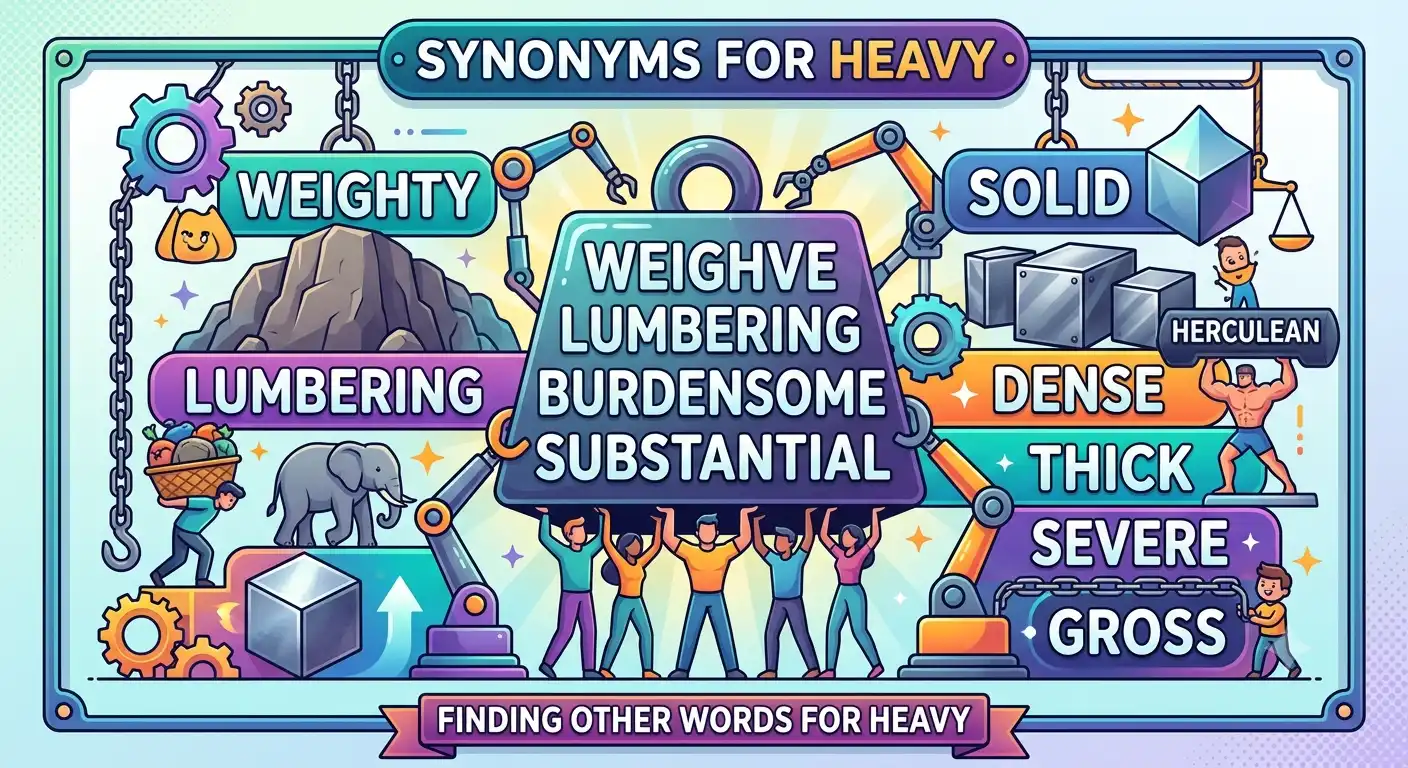
When you need to describe something with a lot of weight, finding synonyms for heavy is highly useful. Knowing many synonyms for heavy helps you pick the best word to show weight or force. If you use different synonyms for heavy, your writing and daily speech will sound much more interesting.
A little girl tries to lift her family’s old oak toy box. She pulls with all her might, but the wood does not budge. Her face turns red and she laughs. We say the box is heavy because it is hard to lift. This simple word describes many things in our daily lives, from wet bags of soil to thick grey clouds in the sky.
The phrase synonyms for heavy refers to other words that mean hard to lift, large in size, or deep in feeling.
“Words have weight, and some have more than others.” — Unknown
“The limits of my language mean the limits of my world.” — Ludwig Wittgenstein
These words are highly useful for many people:
- Students can write better essays about big animals or strong storms.
- Bloggers can make their descriptions of weather or tough days feel more exciting.
- Content writers can write reviews that describe products with great detail.
- Daily English users can explain their chores and feelings to friends with ease.
Linguistic Analysis of “Heavy”
This section shows how the word “heavy” works in the English language.
Connotative Meaning
The word “heavy” brings feelings of physical effort, tiredness, deep sadness, or serious importance. It makes us think of things that are solid, hard to move, or hard to bear.
Etymology
- Origin: From the Old English word hefig (meaning of much weight, important, or grave).
- History: It is closely related to the word heave, which means to lift up with great effort.
Pronunciation
- US IPA: /ˈhev.i/
- UK IPA: /ˈhev.i/
Syllables
The word has two syllables: hea-vy.
Affixation Pattern
- Heavily: Base adjective heavy with the adverb suffix -ly.
- Heaviness: Base adjective heavy with the noun suffix -ness.
- Overheavy: Base adjective heavy with the prefix over- (meaning too much).
Synonym Comparison Table
This table helps you choose the exact word you need. It compares some of the most common words that mean heavy.
| Keyword | Meaning | Usage Type | Context |
|---|---|---|---|
| Hefty | Large, heavy, and very strong | Casual | Objects, people, amounts of money |
| Massive | Very large and heavy in structure | Professional | Buildings, rocks, crowd sizes |
| Burdensome | Hard to bear or causing a lot of worry | Emotional | Tasks, duties, feelings |
| Dense | Packed tightly together with a lot of mass | Academic | Forests, wood, thick fog |
| Intense | Very strong, heavy, or extreme | Professional | Weather, feelings, study |
| Grave | Highly serious and heavy in tone | Professional | News, mistakes, health problems |
Master Your Vocabulary Today (Search Intent Hub)
- Informational: Read our complete list of $N = 50$ synonyms below to find the exact word you need for your next project.
- Commercial: To check your writing style and see if your sentences are easy to read, we highly recommend using tools like the Hemingway Editor or Grammarly.
- Navigational: To find deep academic definitions and origin stories, you can visit the official Merriam-Webster Thesaurus or the Oxford English Dictionary.
- Transactional: Ready to boost your communication skills instantly?$$Download our Free Heavy Synonyms Cheat Sheet PDF$$or subscribe to our free weekly vocabulary email newsletter below!
50 Synonyms for “Heavy”
Here is your complete list of 50 synonyms to use in your writing and speech.
1. Hefty
Pronunciation: of hefty (US: /ˈhef.ti/ & UK: /ˈhef.ti/ – IPA).
Meaning: This describes something that is large, heavy, and very strong.
Examples:
- The delivery worker carried a hefty box to our porch.
- She had to pay a hefty price for the new car.
2. Massive
Pronunciation: of massive (US: /ˈmæs.ɪv/ & UK: /ˈmæs.ɪv/ – IPA).
Meaning: This describes something very large, solid, and heavy.
Examples:
- We stood next to a massive stone wall in the old castle.
- The ship hit a massive wave during the storm.
3. Weighty
Pronunciation: of weighty (US: /ˈweɪ.t̬i/ & UK: /ˈweɪ.ti/ – IPA).
Meaning: This describes something that has a lot of physical weight or is very important.
Examples:
- The gold crown was too weighty for the young king’s head.
- The judge had to make a weighty choice about the case.
4. Burdensome
Pronunciation: of burdensome (US: /ˈbɝː.dən.səm/ & UK: /ˈbɜː.dən.səm/ – IPA).
Meaning: This describes a task or duty that is hard to carry or do.
Examples:
- Carrying the water buckets up the hill was very burdensome.
- He found the extra homework to be burdensome after school.
5. Ponderous
Pronunciation: of ponderous (US: /ˈpɑːn.dɚ.əs/ & UK: /ˈpɒn.dər.əs/ – IPA).
Meaning: This describes something that is slow and clumsy because of its great weight.
Examples:
- The huge elephant moved with slow, ponderous steps.
- He wrote a ponderous book that was hard to read.
6. Leaden
Pronunciation: of leaden (US: /ˈled.ən/ & UK: /ˈled.ən/ – IPA).
Meaning: This describes something that feels heavy like lead or is dark grey.
Examples:
- His legs felt leaden and tired after the long run.
- The leaden clouds told us that rain was coming soon.
7. Dense
Pronunciation: of dense (US: /dens/ & UK: /dens/ – IPA).
Meaning: This describes something that has parts packed very closely together.
Examples:
- We got lost in the dense woods near the river.
- The warm soup was dense with fresh vegetables.
8. Substantial
Pronunciation: of substantial (US: /səbˈstæn.ʃəl/ & UK: /səbˈstæn.ʃəl/ – IPA).
Meaning: This describes something large, solid, and of great value or size.
Examples:
- They ate a substantial meal before they started their hike.
- The builder used substantial wood beams to hold up the roof.
9. Hulking
Pronunciation: of hulking (US: /ˈhʌl.kɪŋ/ & UK: /ˈhʌl.kɪŋ/ – IPA).
Meaning: This describes a person or object that is very large, heavy, and often clumsy.
Examples:
- A hulking truck blocked the narrow street yesterday.
- The hulking football player smiled and signed my book.
10. Bulky
Pronunciation: of bulky (US: /ˈbʌl.ki/ & UK: /ˈbʌl.ki/ – IPA).
Meaning: This describes something that takes up a lot of space and is hard to carry.
Examples:
- I found it hard to pack the bulky winter coat into my bag.
- This bulky box will not fit through the small door.
11. Cumbersome
Pronunciation: of cumbersome (US: /ˈkʌm.bɚ.səm/ & UK: /ˈkʌm.bə.səm/ – IPA).
Meaning: This describes something large and heavy that is hard to manage or use.
Examples:
- The old camera was cumbersome to carry on our trip.
- This is a cumbersome process that takes too much time.
12. Unwieldy
Pronunciation: of unwieldy (US: /ʌnˈwiːl.di/ & UK: /ʌnˈwiːl.di/ – IPA).
Meaning: This describes an object that is hard to move or carry because of its shape or size.
Examples:
- The long ladder was very unwieldy in the windy garden.
- It is hard to steer such an unwieldy cart through the store.
13. Solid
Pronunciation: of solid (US: /ˈsɑː.lɪd/ & UK: /ˈsɒl.ɪd/ – IPA).
Meaning: This describes something hard and heavy with no empty space inside.
Examples:
- The table was made of solid wood that did not shake.
- He built a solid wall of clay to stop the rushing water.
14. Severe
Pronunciation: of severe (US: /səˈvɪr/ & UK: /səˈvɪə/ – IPA).
Meaning: This describes something that is very harsh, extreme, or hard to bear.
Examples:
- The town suffered from a severe winter storm last week.
- He had a severe headache and went to sleep early.
15. Intense
Pronunciation: of intense (US: /ɪnˈtens/ & UK: /ɪnˈtens/ – IPA).
Meaning: This describes something that is very strong, heavy, or felt deeply.
Examples:
- The sun gave off intense heat in the dry desert.
- She felt intense joy when she won the science contest.
16. Grave
Pronunciation: of grave (US: /ɡreɪv/ & UK: /ɡreɪv/ – IPA).
Meaning: This describes a situation or tone that is highly serious or worrying.
Examples:
- The doctor had a grave look on his face.
- They made a grave mistake by leaving the campfire burning.
17. Serious
Pronunciation: of serious (US: /ˈsɪr.i.əs/ & UK: /ˈsɪə.ri.əs/ – IPA).
Meaning: This describes something that is important and needs careful thought.
Examples:
- We had a serious talk about our future school plans.
- The car accident caused serious damage to the bumper.
18. Profound
Pronunciation: of profound (US: /prəˈfaʊnd/ & UK: /prəˈfaʊnd/ – IPA).
Meaning: This describes showing or feeling great knowledge or deep emotion.
Examples:
- The teacher shared a profound thought about peace.
- He felt a profound sadness when his old pet died.
19. Deep
Pronunciation: of deep (US: /diːp/ & UK: /diːp/ – IPA).
Meaning: This describes something that goes far down or is strongly felt.
Examples:
- The hikers had to cross a deep river in the valley.
- She fell into a deep sleep after the long workday.
20. Oppressive
Pronunciation: of oppressive (US: /əˈpres.ɪv/ & UK: /əˈpres.ɪv/ – IPA).
Meaning: This describes weather or rules that make you feel hot, tired, or ruled over.
Examples:
- The wet heat of the jungle was very oppressive to the tourists.
- The people wanted to escape the oppressive laws of the ruler.
21. Hard
Pronunciation: of hard (US: /hɑːrd/ & UK: /hɑːd/ – IPA).
Meaning: This describes something solid, strong, or difficult to do.
Examples:
- The ice on the small pond was hard enough to walk on.
- He had to do a lot of hard work in the garden.
22. Tough
Pronunciation: of tough (US: /tʌf/ & UK: /tʌf/ – IPA).
Meaning: This describes something strong that does not break easily or a task that is difficult.
Examples:
- The boots were made of tough leather for hiking.
- It was a tough question, but she answered it well.
23. Difficult
Pronunciation: of difficult (US: /ˈdɪf.ə.kəlt/ & UK: /ˈdɪf.ɪ.kəlt/ – IPA).
Meaning: This describes a job or puzzle that is not easy to do or solve.
Examples:
- Reading the old map was a difficult task for us.
- It is difficult to climb the mountain when it snows.
24. Strenuous
Pronunciation: of strenuous (US: /ˈstren.ju.əs/ & UK: /ˈstren.ju.əs/ – IPA).
Meaning: This describes an action that needs a lot of physical force and effort.
Examples:
- Lifting heavy boxes all day is very strenuous work.
- We took a break after our strenuous climb up the hill.
“A word fitly spoken is like apples of gold in pictures of silver.” — Proverbs 25:11
25. Arduous
Pronunciation: of arduous (US: /ˈɑːr.dʒu.əs/ & UK: /ˈɑː.dʒu.əs/ – IPA).
Meaning: This describes a journey or task that is difficult and takes a long time.
Examples:
- The pioneers made an arduous trip across the wild land.
- Cleaning the entire school was an arduous job for the team.
26. Demanding
Pronunciation: of demanding (US: /dɪˈmæn.dɪŋ/ & UK: /dɪˈmɑːn.dɪŋ/ – IPA).
Meaning: This describes a task or person that needs a lot of time, attention, or effort.
Examples:
- Nursing is a demanding job that requires a kind heart.
- The coach was demanding, but he helped us win the game.
27. Stout
Pronunciation: of stout (US: /staʊt/ & UK: /staʊt/ – IPA).
Meaning: This describes someone or something that is thick, strong, and heavy.
Examples:
- He used a stout wooden stick to help him walk.
- The stout little dog was very good at digging holes.
28. Beefy
Pronunciation: of beefy (US: /ˈbiː.fi/ & UK: /ˈbiː.fi/ – IPA).
Meaning: This describes a person who has a large, heavy, and muscular body.
Examples:
- Two beefy men helped push the stuck car out of the mud.
- He has beefy arms because he lifts weights at the gym.
29. Brawny
Pronunciation: of brawny (US: /ˈbrɑː.ni/ & UK: /ˈbrɔː.ni/ – IPA).
Meaning: This describes someone who is very strong with big, heavy muscles.
Examples:
- The brawny blacksmith beat the hot iron with a hammer.
- She hired some brawny workers to carry the heavy piano.
30. Portly
Pronunciation: of portly (US: /ˈpɔːrt.li/ & UK: /ˈpɔːt.li/ – IPA).
Meaning: This describes a person, often older, who is round, heavy, and polite.
Examples:
- A portly gentleman in a nice suit welcomed us to the hotel.
- The portly baker always gave extra cookies to the children.
31. Thick
Pronunciation: of thick (US: /θɪk/ & UK: /θɪk/ – IPA).
Meaning: This describes something that has a large distance between its sides or is dense.
Examples:
- She spread a thick layer of sweet butter on the warm bread.
- We could not see through the thick smoke from the fire.
32. Heavyweight
Pronunciation: of heavyweight (US: /ˈhev.i.weɪt/ & UK: /ˈhev.i.weɪt/ – IPA).
Meaning: This describes a person or thing that is in the heaviest weight class.
Examples:
- The heavyweight boxer won the gold medal with one punch.
- He is a heavyweight thinker in the field of science.
33. Overweight
Pronunciation: of overweight (US: /ˌoʊ.vɚˈweɪt/ & UK: /ˌəʊ.vəˈweɪt/ – IPA).
Meaning: This describes a person or animal that weighs more than what is healthy.
Examples:
- The doctor said my overweight cat needs to run more.
- He started eating salads because he was slightly overweight.
34. Loaded
Pronunciation: of loaded (US: /ˈloʊ.dɪd/ & UK: /ˈləʊ.dɪd/ – IPA).
Meaning: This describes a vehicle or container that is completely filled with things.
Examples:
- The loaded truck moved slowly up the steep dirt road.
- She bought a baked potato loaded with cheese and sour cream.
35. Burdened
Pronunciation: of burdened (US: /ˈbɝː.dənd/ & UK: /ˈbɜː.dənd/ – IPA).
Meaning: This describes carrying a heavy physical weight or a lot of mental worry.
Examples:
- The donkey was burdened with heavy sacks of dry corn.
- He walked home feeling burdened by his bad test score.
36. Laden
Pronunciation: of laden (US: /ˈleɪ.dən/ & UK: /ˈleɪ.dən/ – IPA).
Meaning: This describes something that is heavily loaded with a specific thing.
Examples:
- The apple tree branches were laden with sweet red fruit.
- She spoke in a voice laden with deep love and care.
37. Weighted
Pronunciation: of weighted (US: /ˈweɪ.t̬ɪd/ & UK: /ˈweɪ.tɪd/ – IPA).
Meaning: This describes something that has extra weight added to it to make it heavy.
Examples:
- He wore a weighted vest to make his run harder.
- The weighted blanket helped the child fall asleep fast.
38. Slow
Pronunciation: of slow (US: /sloʊ/ & UK: /sləʊ/ – IPA).
Meaning: This describes moving at a low speed because of weight or tiredness.
Examples:
- The giant turtle made slow progress across the warm sand.
- He gave a slow nod because he was very tired.
39. Sluggish
Pronunciation: of sluggish (US: /ˈslʌɡ.ɪʃ/ & UK: /ˈslʌɡ.ɪʃ/ – IPA).
Meaning: This describes moving or working much slower than usual.
Examples:
- The cold weather made the green frogs feel very sluggish.
- The computer was sluggish because many programs were open.
40. Somber
Pronunciation: of somber (US: /ˈsɑːm.bɚ/ & UK: /ˈsɒm.bər/ – IPA).
Meaning: This describes a dark, sad, and serious mood or color.
Examples:
- The sky turned a somber grey before the storm began.
- The family was in a somber mood after they said goodbye.
41. Gloomy
Pronunciation: of gloomy (US: /ˈɡluː.mi/ & UK: /ˈɡluː.mi/ – IPA).
Meaning: This describes a place or feeling that is dark, sad, and without hope.
Examples:
- It was a gloomy day with constant cold rain outside.
- He sat in a gloomy corner of the room and read his book.
42. Sad
Pronunciation: of sad (US: /sæd/ & UK: /sæd/ – IPA).
Meaning: This describes feeling unhappy, sorrowful, or down.
Examples:
- She felt sad when her best friend moved to another city.
- The movie had a very sad ending that made us cry.
43. Depressing
Pronunciation: of depressing (US: /dɪˈpres.ɪŋ/ & UK: /dɪˈpres.ɪŋ/ – IPA).
Meaning: This describes something that makes you feel very sad and hopeless.
Examples:
- The rainy weather was depressing for the outdoor market.
- He stopped reading the depressing news on his phone.
44. Hard-hitting
Pronunciation: of hard-hitting (US: /ˌhɑːrdˈhɪt̬.ɪŋ/ & UK: /ˌhɑːdˈhɪt.ɪŋ/ – IPA).
Meaning: This describes speech or writing that is strong, direct, and honest.
Examples:
- The newspaper published a hard-hitting story about the crime.
- The coach gave a hard-hitting speech to the team at halftime.
45. Mighty
Pronunciation: of mighty (US: /ˈmaɪ.t̬i/ & UK: /ˈmaɪ.ti/ – IPA).
Meaning: This describes having great physical power, size, or strength.
Examples:
- The mighty oak tree stood strong against the wild wind.
- He hit the ball with a mighty swing and scored a point.
46. Powerful
Pronunciation: of powerful (US: /ˈpaʊ.ɚ.fəl/ & UK: /ˈpaʊ.ə.fəl/ – IPA).
Meaning: This describes having a lot of strength, power, or control over things.
Examples:
- The king was a powerful leader who ruled many green lands.
- A powerful engine helped the train climb up the high hill.
47. Abundant
Pronunciation: of abundant (US: /əˈbʌn.dənt/ & UK: /əˈbʌn.dənt/ – IPA).
Meaning: This describes having a very large amount of something.
Examples:
- The farmers had an abundant harvest of sweet yellow corn.
- The river is home to an abundant supply of fresh fish.
48. Plentiful
Pronunciation: of plentiful (US: /ˈplen.t̬ɪ.fəl/ & UK: /ˈplen.tɪ.fəl/ – IPA).
Meaning: This describes something that exists in large numbers or amounts.
Examples:
- Clean water is plentiful in this beautiful mountain town.
- There was plentiful food for everyone at the party.
49. Copious
Pronunciation: of copious (US: /ˈkoʊ.pi.əs/ & UK: /ˈkəʊ.pi.əs/ – IPA).
Meaning: This describes a very large amount of something that is written or produced.
Examples:
- The student took copious notes during the science class.
- The chef used copious amounts of fresh oil in the pan.
50. Ample
Pronunciation: of ample (US: /ˈæm.pəl/ & UK: /ˈæm.pəl/ – IPA).
Meaning: This describes having more than enough space, time, or things.
Examples:
- We had ample time to pack our bags before the bus came.
- The large yard provided ample space for the dogs to play.
Antonyms of “Heavy”
When we talk about things that are not heavy or hard to carry, we use these antonyms:
- Light: Having little weight; very easy to lift and carry around.
- Featherweight: Extremely light in weight, just like a tiny bird’s feather.
- Easy: Needing very little physical effort or mental work to complete.
- Gentle: Soft and mild in force; not harsh, loud, or heavy.
- Soft: Easy to press or shape; not hard or solid to the touch.
Prototype Meaning and Categorization of “Heavy”
In cognitive linguistics, words group together in our minds. The main class for “heavy” is “Physical Weight and Intensity.”
Physical Weight and Intensity (Main Class)
   |
   +-- Physical Weight (e.g., Hefty, Massive, Bulky, Cumbersome, Weighty, Solid, Stout, Stout)
   |
   +-- Severe & Intense (e.g., Severe, Intense, Grave, Hard-hitting, Mighty, Powerful)
   |
   +-- Difficult & Tough (e.g., Hard, Tough, Difficult, Strenuous, Arduous, Demanding)
   |
   +-- Sad & Somber (e.g., Somber, Gloomy, Sad, Depressing, Leaden)
By sorting these words into groups, you can easily choose the right word for your sentence.
Frequently Asked Questions
Is “hefty” always a synonym for “heavy”?
Yes. Hefty is a great synonym when you want to describe something that is large, strong, and has a lot of physical weight or a large cost.
Can “serious” mean the same as “heavy”?
Yes. You can use serious as a synonym when you are talking about “heavy” news, choices, or moods that need careful thought.
What is the difference between heavy and burdensome?
Being heavy means having a lot of physical weight. Being burdensome means that the weight or task is causing you a lot of worry and tiredness.
How do you use “heavy” to describe a person’s body?
You can describe a strong, heavy person as brawny, beefy, or stout to show they have a lot of big muscles.
What is the most formal synonym for heavy weather?
The most formal terms are severe, intense, or oppressive, which sound highly professional in news reports and weather forecasts.
Can heavy mean being slow?
Yes. In some settings, moving slowly because of physical weight or extreme tiredness is described as being ponderous or sluggish.
Conclusion
Learning synonyms for heavy is a great way to grow your English writing skills today. When you know more words, your school essays and reading blogs become beautiful. Your online posts will keep your readers excited and moving. Your spoken stories about life, choices, and daily wins will sound clear, warm, and highly powerful to everyone who listens.
“Manners are a sensitive awareness of the feelings of others.” — Emily Post
“A beautiful word is like a beautiful tree, whose roots are firm and whose branches reach the sky.” — Unknown
“The difference between the right word and the almost right word is the difference between lightning and a lightning bug.” — Mark Twain
We encourage you to practice these terms as much as you can. Try to use them when you write daily emails to colleagues about your group goals. Use them in your school essays to get better grades on history projects. Use them in your everyday conversations to share your thoughts about your daily tasks. Choosing the right word shows that you are a smart communicator. Start using these new words today, and watch your business English skills soar!

Andrew Collins is an academic English educator with over 12 years of experience helping university students, IELTS candidates, and ESL learners improve their writing vocabulary.