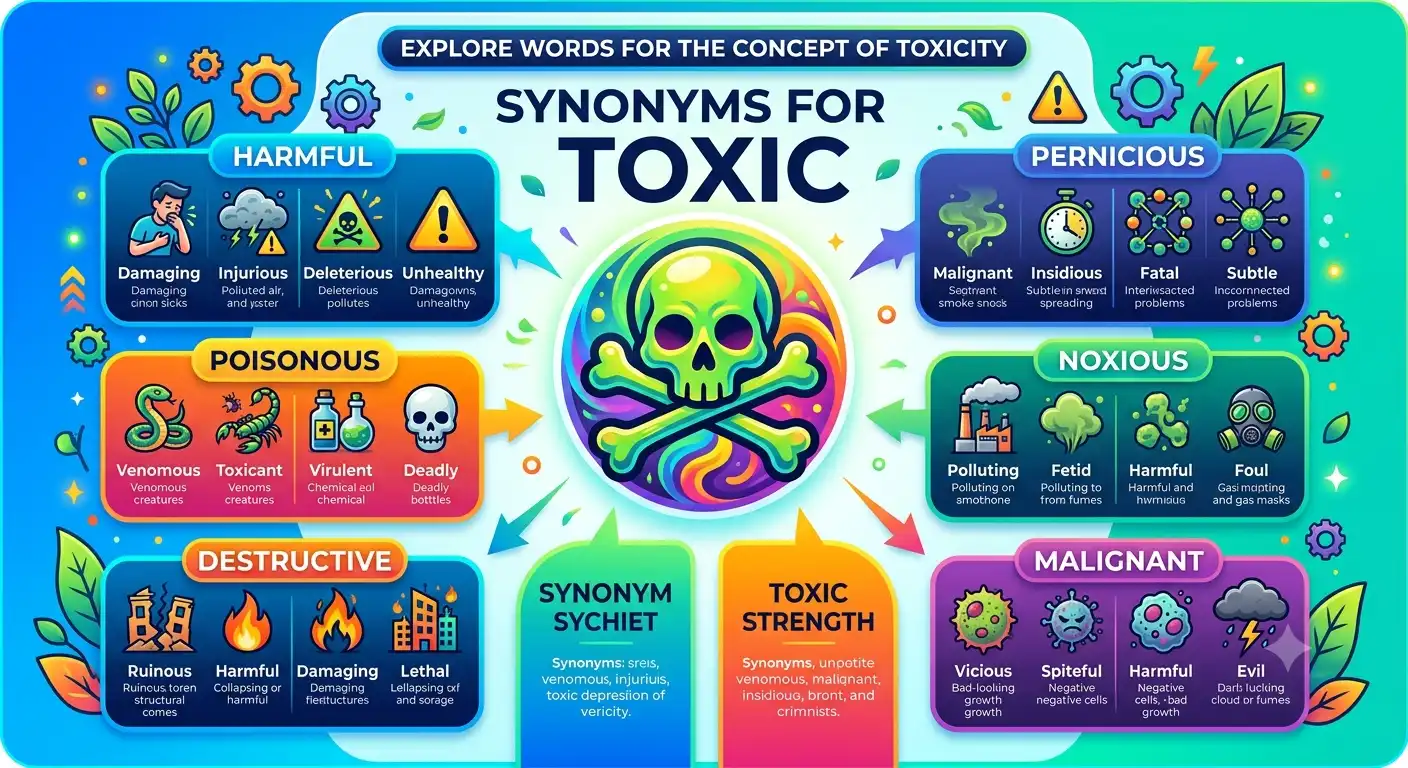
Learning different synonyms for toxic is a great way to grow your English writing skills. When you study synonyms for toxic, you find better words to describe bad things. Using synonyms for toxic helps you show readers when a person, place, or thing is unsafe.
Imagine walking into a beautiful office on your first day of work. The desk is clean. The windows are big and bright. But soon, you hear a worker yell at a helper. The boss walks past and does not smile. No one talks during lunch. The air feels heavy and sad. This office has a toxic workplace because the bad mood hurts everyone there. This bad energy is what we mean when we use this word.
The term synonyms for toxic means other words that describe things or people that are harmful, hurtful, or full of poison.
“Mean words can act like silent poison to our minds.” — Unknown
“Choosing the right word can help heal a painful story.” — Smart Writer
These words are useful for many people:
- Students can write high-quality school papers about clean nature or bad rulers.
- Bloggers can describe hard relationships with a clear and helpful style.
- Content writers can make their health ads feel urgent and clear to buyers.
- Daily English users can explain how they feel about bad situations with simple words.
Using short, clear words keeps our writing simple and fast.
Linguistic Analysis of “Toxic”
This section shows how the word “toxic” works in the English language.
Connotative Meaning
The word “toxic” brings up feelings of danger, sickness, bad moods, and hidden harm. It makes us think of dirty green mud, a skull sign on a bottle, or a person who makes us feel bad about ourselves.
Etymology
- Origin: From the Late Latin word toxicus (meaning poisoned).
- History: It goes back to the Greek word toxikon pharmakon (which means poison for arrows).
Pronunciation
- US IPA: /ˈtɑːk.sɪk/
- UK IPA: /ˈtɒk.sɪk/
Syllables
The word has two syllables: tox-ic.
Affixation Pattern
- Toxically: Base adjective toxic with the adverb suffix -ly.
- Toxicity: Base adjective toxic with the noun suffix -ity.
- Nontoxic: Base adjective toxic with the negative prefix non- (meaning safe).
Synonym Comparison Table
This table helps you choose the exact word you need. It compares some of the most common words that mean toxic.
| Keyword | Meaning | Usage Type | Context |
|---|---|---|---|
| Poisonous | Causing death or sickness if eaten | Formal | Snakes, berries, frogs |
| Harmful | Causing damage or hurt | Casual | Habits, diets, choices |
| Abusive | Saying mean things to hurt someone | Emotional | Relationships, speech |
| Hostile | Unfriendly and ready to fight | Professional | Workplaces, arguments |
| Lethal | Enough to cause death | Formal | Weapons, doses, gases |
| Noxious | Having a bad smell or dirty gas | Creative | Smoke, swamps, air |
Master Your Vocabulary Today (Search Intent Hub)
- Informational: Read our complete list of $N = 50$ synonyms below to find the exact word you need for your next project.
- Commercial: To check your writing style and see if your sentences are easy to read, we highly recommend using tools like the Hemingway Editor or Grammarly.
- Navigational: To find deep academic definitions and origin stories, you can visit the official Merriam-Webster Thesaurus or the Oxford English Dictionary.
- Transactional: Ready to boost your communication skills instantly?$$Download our Free Toxic Synonyms Cheat Sheet PDF$$or subscribe to our free weekly vocabulary email newsletter below!
50 Synonyms for “Toxic”
Here is your complete list of 50 synonyms to use in your writing and speech.
1. Poisonous
Pronunciation: of poisonous (US: /ˈpɔɪ.zən.əs/ & UK: /ˈpɔɪ.zən.əs/ – IPA).
Meaning: This means something can make you very sick or die if you eat it.
Examples:
- Do not eat those bright red berries because they are poisonous.
- The snake has a poisonous bite that hurts.
2. Harmful
Pronunciation: of harmful (US: /ˈhɑːrm.fəl/ & UK: /ˈhɑːm.fʊl/ – IPA).
Meaning: This means something can hurt your body or mind.
Examples:
- Too much sugar is harmful to your teeth.
- Reading in the dark can be harmful to your eyes.
3. Deadly
Pronunciation: of deadly (US: /ˈded.li/ & UK: /ˈded.li/ – IPA).
Meaning: This describes something that is able to cause death.
Examples:
- The spider has a deadly bite.
- He made a deadly mistake on the road.
4. Abusive
Pronunciation: of abusive (US: /əˈbjuː.sɪv/ & UK: /əˈbjuː.sɪv/ – IPA).
Meaning: This describes saying or doing very mean things to hurt someone.
Examples:
- No one should stay in an abusive home.
- The angry fan used abusive words at the game.
5. Hostile
Pronunciation: of hostile (US: /ˈhɑː.stəl/ & UK: /ˈhɒs.taɪl/ – IPA).
Meaning: This describes being very unfriendly and ready to fight.
Examples:
- The two nations have a hostile relationship.
- She gave me a cold, hostile look.
6. Damaging
Pronunciation: of damaging (US: /ˈdæm.ɪ.dʒɪŋ/ & UK: /ˈdæm.ɪ.dʒɪŋ/ – IPA).
Meaning: This describes causing harm, loss, or bad changes.
Examples:
- Strong winds can be very damaging to homes.
- His lies were damaging to his good name.
7. Destructive
Pronunciation: of destructive (US: /dɪˈstrʌk.tɪv/ & UK: /dɪˈstrʌk.tɪv/ – IPA).
Meaning: This describes causing a lot of damage or ruin.
Examples:
- The fire was very destructive to the forest.
- Angry thoughts can lead to destructive acts.
8. Lethal
Pronunciation: of lethal (US: /ˈliː.θəl/ & UK: /ˈliː.θəl/ – IPA).
Meaning: This means enough to kill someone.
Examples:
- The soldier carried a lethal weapon.
- A lethal dose of the drug was found.
9. Venomous
Pronunciation: of venomous (US: /ˈven.ə.məs/ & UK: /ˈven.ə.məs/ – IPA).
Meaning: This describes a beast that uses poison to hurt or kill.
Examples:
- We saw a venomous snake in the green grass.
- She spoke with a venomous tone of voice.
10. Noxious
Pronunciation: of noxious (US: /ˈnɑːk.ʃəs/ & UK: /ˈnɒk.ʃəs/ – IPA).
Meaning: This describes gas, smoke, or smell that is highly unsafe.
Examples:
- The old car sent noxious fumes into the street.
- Keep away from those noxious chemicals.
11. Malicious
Pronunciation: of malicious (US: /məˈlɪʃ.əs/ & UK: /məˈlɪʃ.əs/ – IPA).
Meaning: This describes wanting to hurt other people on purpose.
Examples:
- He spread malicious rumors about his friend.
- A malicious program broke my home computer.
12. Negative
Pronunciation: of negative (US: /ˈneɡ.ə.t̬ɪv/ & UK: /ˈneɡ.ə.tɪv/ – IPA).
Meaning: This describes thinking or showing only the bad side of things.
Examples:
- Try to keep away from negative people.
- Her negative attitude made us all sad.
13. Cruel
Pronunciation: of cruel (US: /ˈkruː.əl/ & UK: /ˈkruː.əl/ – IPA).
Meaning: This describes causing pain or suffering to others without caring.
Examples:
- It is cruel to leave a dog in a hot car.
- He gave a cruel laugh when she fell down.
14. Unhealthy
Pronunciation: of unhealthy (US: /ʌnˈhel.θi/ & UK: /ʌnˈhel.θi/ – IPA).
Meaning: This means bad for your physical or mental health.
Examples:
- Eating fast food every day is unhealthy.
- They have an unhealthy way of talking to each other.
15. Hurtful
Pronunciation: of hurtful (US: /ˈhɝːt.fəl/ & UK: /ˈhɜːt.fʊl/ – IPA).
Meaning: This describes causing pain to your mind or feelings.
Examples:
- She said some very hurtful things to her sister.
- It is hurtful when friends ignore you.
16. Baneful
Pronunciation: of baneful (US: /ˈbeɪn.fəl/ & UK: /ˈbeɪn.fʊl/ – IPA).
Meaning: This describes causing serious ruin or death.
Examples:
- The baneful war destroyed the old town.
- His baneful habit ruined his health.
17. Pernicious
Pronunciation: of pernicious (US: /pɚˈnɪʃ.əs/ & UK: /pəˈnɪʃ.əs/ – IPA).
Meaning: This describes causing great harm in a slow, quiet way.
Examples:
- Lies can have a pernicious effect on a family.
- The cold weather had a pernicious impact on the plants.
18. Bitter
Pronunciation: of bitter (US: /ˈbɪt̬.ɚ/ & UK: /ˈbɪt.ə/ – IPA).
Meaning: This describes being full of anger and deep hate.
Examples:
- The two old enemies had a bitter fight.
- He felt bitter about losing his job.
19. Spiteful
Pronunciation: of spiteful (US: /ˈspaɪt.fəl/ & UK: /ˈspaɪt.fʊl/ – IPA).
Meaning: This describes wanting to annoy or hurt someone because of anger.
Examples:
- She sent a spiteful text to her classmate.
- His spiteful acts made him very unpopular.
20. Evil
Pronunciation: of evil (US: /ˈiː.vəl/ & UK: /ˈiː.vəl/ – IPA).
Meaning: This describes being very bad and morally wrong.
Examples:
- The evil king put nice people in jail.
- She had an evil plan to steal the gold.
21. Mean
Pronunciation: of mean (US: /miːn/ & UK: /miːn/ – IPA).
Meaning: This describes being unkind, angry, or rude.
Examples:
- Do not be mean to your little brother.
- He made a mean face when I asked for help.
22. Bad
Pronunciation: of bad (US: /bæd/ & UK: /bæd/ – IPA).
Meaning: This describes something that is not good and causes trouble.
Examples:
- Smoking is a very bad habit.
- We had bad weather during our trip.
23. Ruinous
Pronunciation: of ruinous (US: /ˈruː.ə.nəs/ & UK: /ˈruː.ɪ.nəs/ – IPA).
Meaning: This describes causing huge cost, damage, or total loss.
Examples:
- The fire led to ruinous costs for the store.
- He made a ruinous choice with his money.
24. Fatal
Pronunciation: of fatal (US: /ˈfeɪ.t̬əl/ & UK: /ˈfeɪ.təl/ – IPA).
Meaning: This describes causing disaster or actual death.
Examples:
- The car crash was fatal for the driver.
- He made a fatal error in the test.
25. Dangerous
Pronunciation: of dangerous (US: /ˈdeɪn.dʒɚ.əs/ & UK: /ˈdeɪn.dʒər.əs/ – IPA).
Meaning: This describes something that can easily hurt or kill you.
Examples:
- It is dangerous to walk on thin ice.
- He lives in a dangerous part of town.
“Words have power, and a toxic word can ruin a whole day.” — Old Lesson
26. Violent
Pronunciation: of violent (US: /ˈvaɪə.lənt/ & UK: /ˈvaɪə.lənt/ – IPA).
Meaning: This describes using strong physical force to hurt people.
Examples:
- The violent storm broke many tall trees.
- He has a violent temper when he is mad.
27. Hateful
Pronunciation: of hateful (US: /ˈheɪt.fəl/ & UK: /ˈheɪt.fʊl/ – IPA).
Meaning: This describes being full of hate or causing people to hate.
Examples:
- The group sent hateful letters to the school.
- She gave him a hateful look and walked away.
28. Vicious
Pronunciation: of vicious (US: /ˈvɪʃ.əs/ & UK: /ˈvɪʃ.əs/ – IPA).
Meaning: This describes being very violent, mean, and dangerous.
Examples:
- Keep away from that vicious guard dog.
- He told a vicious lie to get her fired.
29. Foul
Pronunciation: of foul (US: /faʊl/ & UK: /faʊl/ – IPA).
Meaning: This describes having a very bad smell, taste, or look.
Examples:
- The garbage had a foul smell after three days.
- He used foul language during the meeting.
30. Sour
Pronunciation: of sour (US: /ˈsaʊ.ɚ/ & UK: /ˈsaʊ.ə/ – IPA).
Meaning: This describes a bad mood that is cold and unfriendly.
Examples:
- She had a sour look on her face all day.
- He gave a sour answer when I said hello.
31. Cold
Pronunciation: of cold (US: /koʊld/ & UK: /kəʊld/ – IPA).
Meaning: This describes showing no warm feelings, love, or care.
Examples:
- He gave her a cold welcome at the door.
- She has a cold heart and never helps others.
32. Harsh
Pronunciation: of harsh (US: /hɑːrʃ/ & UK: /hɑːʃ/ – IPA).
Meaning: This describes being very strict, unkind, and hard.
Examples:
- The judge gave him a harsh punishment.
- She spoke in a harsh voice to the kids.
33. Angry
Pronunciation: of angry (US: /ˈæŋ.ɡri/ & UK: /ˈæŋ.ɡri/ – IPA).
Meaning: This describes having strong feelings of hate and dislike.
Examples:
- The angry man yelled at the slow driver.
- He wrote an angry email to his boss.
34. Selfish
Pronunciation: of selfish (US: /ˈsel.fɪʃ/ & UK: /ˈsel.fɪʃ/ – IPA).
Meaning: This describes caring only about yourself and not others.
Examples:
- It is selfish to eat all the cake.
- She made a selfish choice that hurt the group.
35. Unkind
Pronunciation: of unkind (US: /ʌnˈkaɪnd/ & UK: /ʌnˈkaɪnd/ – IPA).
Meaning: This describes not being nice or friendly to people.
Examples:
- He made an unkind remark about her coat.
- Do not be unkind to people who help you.
36. Wicked
Pronunciation: of wicked (US: /ˈwɪk.ɪd/ & UK: /ˈwɪk.ɪd/ – IPA).
Meaning: This describes being very bad, mean, or evil.
Examples:
- The wicked witch cast a bad spell on the town.
- He has a wicked grin when he plays tricks.
37. Nasty
Pronunciation: of nasty (US: /ˈnæs.ti/ & UK: /ˈnɑː.sti/ – IPA).
Meaning: This describes being very bad, dirty, or unkind.
Examples:
- The soup has a nasty taste of old fish.
- He has a nasty habit of biting his nails.
38. Rude
Pronunciation: of rude (US: /ruːd/ & UK: /ruːd/ – IPA).
Meaning: This describes not showing good manners or respect.
Examples:
- It is rude to speak when your mouth is full.
- The clerk gave a rude answer to the lady.
39. Sharp
Pronunciation: of sharp (US: /ʃɑːrp/ & UK: /ʃɑːp/ – IPA).
Meaning: This describes words that are quick, cold, and hurtful.
Examples:
- She gave a sharp reply to his question.
- He felt a sharp pain in his back.
40. Heavy
Pronunciation: of heavy (US: /ˈhev.i/ & UK: /ˈhev.i/ – IPA).
Meaning: This describes a mood or place that feels sad and hard.
Examples:
- There was a heavy silence in the room.
- He walked home with a heavy heart today.
41. Corrosive
Pronunciation: of corrosive (US: /kəˈroʊ.sɪv/ & UK: /kəˈrəʊ.sɪv/ – IPA).
Meaning: This describes slowly eating away or destroying something.
Examples:
- Acid has a corrosive effect on most metals.
- Her corrosive words slowly ruined their friendship.
42. Dark
Pronunciation: of dark (US: /dɑːrk/ & UK: /dɑːk/ – IPA).
Meaning: This describes being full of bad thoughts, sadness, or evil.
Examples:
- The book has a dark story about a ghost.
- He was in a dark mood after the game.
43. Unsafe
Pronunciation: of unsafe (US: /ʌnˈseɪf/ & UK: /ʌnˈseɪf/ – IPA).
Meaning: This describes being dangerous and able to hurt you.
Examples:
- The old wood bridge is unsafe to cross.
- It is unsafe to play near the busy road.
44. Low
Pronunciation: of low (US: /loʊ/ & UK: /ləʊ/ – IPA).
Meaning: This describes being mean, dirty, and without honor.
Examples:
- It was a low trick to steal his lunch.
- He has a very low opinion of his boss.
45. Hard
Pronunciation: of hard (US: /hɑːrd/ & UK: /hɑːd/ – IPA).
Meaning: This describes being severe, cold, and without pity.
Examples:
- The boss was a hard man who never smiled.
- He had to make a hard choice today.
46. Rough
Pronunciation: of rough (US: /rʌf/ & UK: /rʌf/ – IPA).
Meaning: This describes being violent, loud, or not gentle.
Examples:
- The boys had some rough play in the yard.
- He spoke in a rough voice to the dog.
47. Dirty
Pronunciation: of dirty (US: /ˈdɝː.t̬i/ & UK: /ˈdɜː.ti/ – IPA).
Meaning: This describes being unfair, mean, or dishonest.
Examples:
- The player made a dirty move during the game.
- He told a dirty lie to win the prize.
48. Poison-like
Pronunciation: of poison-like (US: /ˈpɔɪ.zən.laɪk/ & UK: /ˈpɔɪ.zən.laɪk/ – IPA).
Meaning: This describes something that acts like actual poison.
Examples:
- The chemical had a poison-like effect on the fish.
- He gave her a poison-like stare from his desk.
49. Cold-hearted
Pronunciation: of cold-hearted (US: /ˌkoʊldˈhɑːr.t̬ɪd/ & UK: /ˌkəʊldˈhɑː.tɪd/ – IPA).
Meaning: This describes having zero love, pity, or kind feelings.
Examples:
- The cold-hearted man did not help the poor child.
- She made a cold-hearted plan to win the game.
50. Unfriendly
Pronunciation: of unfriendly (US: /ʌnˈfrend.li/ & UK: /ʌnˈfrend.li/ – IPA).
Meaning: This describes not acting like a nice friend.
Examples:
- The new neighbors gave us an unfriendly look.
- The city can feel cold and unfriendly to guests.
Antonyms of “Toxic”
When we talk about things that are clean, safe, or nice, we use these antonyms:
- Safe: Healthy and not able to hurt you.
- Nontoxic: Free from any bad poison.
- Friendly: Warm, kind, and nice to be around.
- Healthy: Good for your body and mind.
- Kind: Showing love and care to others.
Prototype Meaning and Categorization of “Toxic”
In cognitive linguistics, words group together in our minds. The main class for “toxic” is “Harm and Poison.”
Harm and Poison (Main Class)
   |
   +-- Real Poison & Gas (e.g., Poisonous, Venomous, Noxious, Lethal, Deadly)
   |
   +-- Bad Speech & Moods (e.g., Abusive, Malicious, Hostile, Spiteful, Hurtful)
   |
   +-- Hard & Cold Manners (e.g., Unfriendly, Cold, Cold-hearted, Rude, Harsh)
   |
   +-- Damage & Ruin (e.g., Destructive, Ruinous, Damaging, Fatal, Corrosive)
By sorting these words into groups, you can easily choose the right word for your sentence.
Frequently Asked Questions
Is “toxic” always about poison?
No. Today, we use toxic to describe bad relationships, stressful jobs, and mean people, as well as real poison in nature.
Can “dirty” be a synonym for “toxic”?
Yes. In daily use, dirty works well when you want to describe an unfair action, a mean trick, or a dishonest play.
What is the difference between toxic and venomous?
Something is toxic if it contains harmful poison. Something is venomous if it actively injects poison into you, like a snake or spider.
How do you describe a toxic work office?
You can describe a bad office as hostile, unhealthy, or destructive to show that the bad mood hurts the staff.
What is the most formal synonym for a toxic substance?
The most formal terms are noxious, pernicious, or corrosive, which sound highly professional in science papers and law reports.
Can “bad” mean toxic?
Yes. In very simple speech, bad is a simple word that shows something is unsafe or unkind to you.
Conclusion
Learning synonyms for toxic is a great way to grow your English writing skills today. When you know more words, your school essays and reading blogs become beautiful. Your online posts will keep your readers excited and moving. Your spoken stories about life, choices, and daily wins will sound clear, warm, and highly powerful to everyone who listens.
“Clean writing starts with choosing clean, clear words.” — Wise Writer
“Your language can build a bridge or make a wall.” — Ludwig Wittgenstein
We encourage you to practice these terms as much as you can. Try to use them when you write daily emails to colleagues about your group goals. Use them in your school essays to get better grades on history projects. Use them in your everyday conversations to share your thoughts about your daily tasks. Choosing the right word shows that you are a smart communicator. Start using these new words today, and watch your business English skills soar!

Andrew Collins is an academic English educator with over 12 years of experience helping university students, IELTS candidates, and ESL learners improve their writing vocabulary.