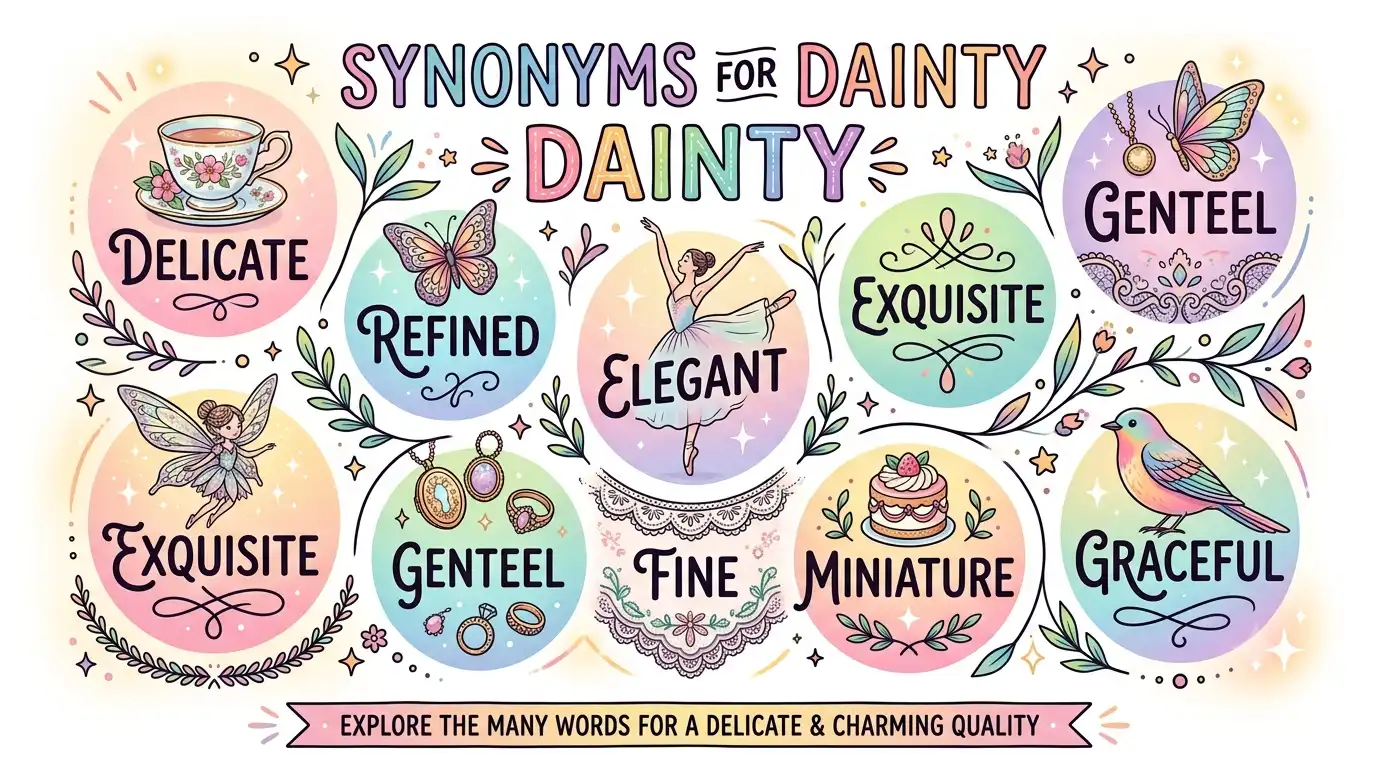
Learning different synonyms for dainty is a great way to improve your English writing today. When you study synonyms for dainty, you find beautiful words to describe small and pretty things. Using synonyms for dainty helps you show your readers when a person, place, or thing is elegant, light, or sweet.
Imagine visiting a quiet tea shop with your grandmother. She hands you a tiny, light cup made of thin white clay. It has small pink roses painted on the side. You hold it with just two fingers because it feels like it might break. This is a dainty teacup. The word dainty describes things that are small, pretty, and easy to break. This sweet, light feel is what we mean when we use this word.
Finding a good dainty synonym helps you express yourself clearly in your daily life. For example, if you want another word for dainty, you can use “delicate” or “petite” depending on your sentence. Learning the many synonyms of dainty will make your sentences sound much more interesting.
“Small things can hold the biggest beauty in the world.” — Unknown
“A beautiful word acts like a tiny spark of light.” — Wise Writer
These words are highly useful for many different people:
- Students can use a synonym for dainty to write great school papers about old art or history.
- Bloggers can describe cute fashion items or small home decorations with a warm style.
- Content writers can make their online product reviews sound sweet, clear, and stylish.
- Daily English users can easily ask which word is a synonym of dainty? to expand their daily speech.
Using short, friendly words keeps our writing simple, clean, and fast.
Linguistic Analysis of “Dainty”
This section shows how the word “dainty” works in the English language.
Connotative Meaning
The word “dainty” brings up feelings of grace, small size, sweet taste, and careful beauty. It makes us think of tiny lace cloths, small glass animals, or a quiet princess.
Etymology
- Origin: From the Old French word deintié (meaning a delicacy or value).
- History: It goes back to the Latin word dignitas (which means worth or dignity).
Pronunciation
- US IPA: /ˈdeɪn.t̬i/
- UK IPA: /ˈdeɪn.ti/
Syllables
The word has two syllables: dain-ty.
Affixation Pattern
- Daintily: Base adjective dainty with the adverb suffix -ly.
- Daintiness: Base adjective dainty with the noun suffix -ness.
- Undainty: Base adjective dainty with the negative prefix un- (meaning rough or clumsy).
Synonym Comparison Table
This table helps you choose the exact word you need. It compares some of the most common words that mean dainty.
| Keyword | Meaning | Usage Type | Context |
|---|---|---|---|
| Delicate | Thin, light, and easy to break | Casual | Flowers, glass, health |
| Petite | Small and thin in a pretty way | Casual | People, clothes, toys |
| Exquisite | Very beautiful and made with great care | Formal | Art, jewelry, food |
| Fine | Made of very thin or high-quality parts | Professional | Sand, lace, threads |
| Fragile | Easily broken or damaged | Casual | Box shipments, feelings |
| Elegant | Graceful and beautiful in a simple way | Formal | Dresses, movements, speech |
Master Your Vocabulary Today (Search Intent Hub)
- Informational: Read our complete list of $N = 50$ synonyms below to find the exact word you need for your next project.
- Commercial: To check your writing style and see if your sentences are easy to read, we highly recommend using tools like the Hemingway Editor or Grammarly.
- Navigational: To find deep academic definitions and origin stories, you can visit the official Merriam-Webster Thesaurus or the Oxford English Dictionary.
- Transactional: Ready to boost your communication skills instantly?$$Download our Free Dainty Synonyms Cheat Sheet PDF$$or subscribe to our free weekly vocabulary email newsletter below!
50 Synonyms for “Dainty”
Here is your complete list of 50 synonyms to use in your writing and speech.
“To write well is to paint with the colors of language.” — Old Scholar
1. Delicate
Pronunciation: of delicate (US: /ˈdel.ɪ.kət/ & UK: /ˈdel.ɪ.kət/ – IPA).
Meaning: This means something is thin, light, and easy to break.
Examples:
- The spider spun a delicate web in the garden.
- She has a delicate touch when she plays the piano.
2. Petite
Pronunciation: of petite (US: /pəˈtiːt/ & UK: /pəˈtiːt/ – IPA).
Meaning: This describes a person or thing that is small and thin.
Examples:
- She bought a petite dress that fits her perfectly.
- The petite puppy slept in the small basket.
3. Exquisite
Pronunciation: of exquisite (US: /ɪkˈskwɪz.ɪt/ & UK: /ɪkˈskwɪz.ɪt/ – IPA).
Meaning: This describes something that is very beautiful and made with care.
Examples:
- The queen wore an exquisite gold ring.
- The chef made an exquisite dessert with sweet fruit.
4. Fine
Pronunciation: of fine (US: /faɪn/ & UK: /faɪn/ – IPA).
Meaning: This describes things made of very thin or small parts.
Examples:
- The beach has very fine white sand.
- She used a fine thread to sew the shirt.
5. Elegant
Pronunciation: of elegant (US: /ˈel.ɪ.ɡənt/ & UK: /ˈel.ɪ.ɡənt/ – IPA).
Meaning: This describes being graceful, simple, and highly beautiful.
Examples:
- She made an elegant bow to the crowd.
- The room had an elegant design with tall windows.
6. Fragile
Pronunciation: of fragile (US: /ˈfrædʒ.əl/ & UK: /ˈfrædʒ.aɪl/ – IPA).
Meaning: This means very easy to break or damage.
Examples:
- Please be careful with those fragile glass cups.
- The fragile leaves fell from the dry tree.
7. Tiny
Pronunciation: of tiny (US: /ˈtaɪ.ni/ & UK: /ˈtaɪ.ni/ – IPA).
Meaning: This describes something that is extremely small in size.
Examples:
- A tiny ladybug landed on my green leaf.
- He wrote his name in tiny letters.
8. Neat
Pronunciation: of neat (US: /niːt/ & UK: /niːt/ – IPA).
Meaning: This describes being clean, tidy, and pleasing to see.
Examples:
- She keeps her desk very neat and clean.
- He made a neat pile of his books.
9. Small
Pronunciation: of small (US: /smɔːl/ & UK: /smɔːl/ – IPA).
Meaning: This describes something that is not big or loud.
Examples:
- We live in a small house near the park.
- The baby has small hands and toes.
10. Graceful
Pronunciation: of graceful (US: /ˈɡreɪs.fəl/ & UK: /ˈɡreɪs.fʊl/ – IPA).
Meaning: This describes moving in a smooth, pretty, and easy way.
Examples:
- The graceful dancer moved across the dry stage.
- We watched the graceful birds fly in the sky.
11. Fair
Pronunciation: of fair (US: /feər/ & UK: /feər/ – IPA).
Meaning: This describes something that is lovely, pale, or soft.
Examples:
- The fair maiden lived in a tall stone tower.
- She has fair skin that burns in the sun.
12. Pretty
Pronunciation: of pretty (US: /ˈprɪt̬.i/ & UK: /ˈprɪt.i/ – IPA).
Meaning: This describes being pleasant to look at.
Examples:
- He gave her a pretty flower from the yard.
- The house has a pretty view of the blue lake.
13. Light
Pronunciation: of light (US: /laɪt/ & UK: /laɪt/ – IPA).
Meaning: This describes having very little weight or force.
Examples:
- A light wind blew through the open window.
- She took a light step on the soft grass.
14. Soft
Pronunciation: of soft (US: /sɑːft/ & UK: /sɒft/ – IPA).
Meaning: This describes being gentle, smooth, and not hard.
Examples:
- The cat has very soft grey fur.
- He spoke in a soft voice to the baby.
15. Subtle
Pronunciation: of subtle (US: /ˈsʌt̬.əl/ & UK: /ˈsʌt.əl/ – IPA).
Meaning: This describes a small difference that is hard to see.
Examples:
- The soup has a subtle taste of fresh lemon.
- She gave a subtle nod to start the play.
16. Sweet
Pronunciation: of sweet (US: /swiːt/ & UK: /swiːt/ – IPA).
Meaning: This describes being nice, kind, or pleasing to the mind.
Examples:
- The little child gave us a sweet smile.
- What a sweet song the bird is singing!
17. Lovely
Pronunciation: of lovely (US: /ˈlʌv.li/ & UK: /ˈlʌv.li/ – IPA).
Meaning: This describes being very beautiful and pleasant.
Examples:
- We had a lovely time at the park today.
- She wore a lovely hat with red ribbons.
18. Precious
Pronunciation: of precious (US: /ˈpreʃ.əs/ & UK: /ˈpreʃ.əs/ – IPA).
Meaning: This describes having great value or being loved a lot.
Examples:
- The museum has many precious gold items.
- Spend your precious time with good friends.
19. Nice
Pronunciation: of nice (US: /naɪs/ & UK: /naɪs/ – IPA).
Meaning: This describes being pleasant, kind, or fine.
Examples:
- He is a very nice boy who helps everyone.
- She wore a nice dress to the party.
20. Mild
Pronunciation: of mild (US: /maɪld/ & UK: /maɪld/ – IPA).
Meaning: This describes being gentle and not strong or harsh.
Examples:
- We enjoyed the mild weather of spring.
- He has a mild temper and never gets angry.
21. Rare
Pronunciation: of rare (US: /reər/ & UK: /reər/ – IPA).
Meaning: This describes something that is not found very often.
Examples:
- The scientist found a rare plant in the forest.
- It is rare to see snow in this hot city.
22. Thin
Pronunciation: of thin (US: /θɪn/ & UK: /θɪn/ – IPA).
Meaning: This describes having a small distance between sides.
Examples:
- He wrote on a thin sheet of white paper.
- She wore a thin coat because it was warm.
23. Gentle
Pronunciation: of gentle (US: /ˈdʒen.təl/ & UK: /ˈdʒen.təl/ – IPA).
Meaning: This describes being kind, soft, and calm.
Examples:
- The doctor had a gentle touch on my arm.
- A gentle rain fell on the dry dirt.
24. Beautiful
Pronunciation: of beautiful (US: /ˈbjuː.t̬ɪ.fəl/ & UK: /ˈbjuː.tɪ.fʊl/ – IPA).
Meaning: This describes being very pretty and pleasing to the eye.
Examples:
- We saw a beautiful sunset at the beach.
- She sang a beautiful song about love.
25. Cute
Pronunciation: of cute (US: /kjuːt/ & UK: /kjuːt/ – IPA).
Meaning: This describes being attractive in a small or young way.
Examples:
- The cute kitten played with a ball of wool.
- He wore a cute bow tie to school.
26. Trim
Pronunciation: of trim (US: /trɪm/ & UK: /trɪm/ – IPA).
Meaning: This describes being neat, fit, and in good shape.
Examples:
- The house has a trim garden with green grass.
- He kept his body trim by walking every day.
27. Charming
Pronunciation: of charming (US: /ˈtʃɑːr.mɪŋ/ & UK: /ˈtʃɑː.mɪŋ/ – IPA).
Meaning: This describes being very pleasant, likeable, and sweet.
Examples:
- The old town has many charming shops.
- She gave us a charming welcome at the door.
28. Classy
Pronunciation: of classy (US: /ˈklæs.i/ & UK: /ˈklɑː.si/ – IPA).
Meaning: This describes showing high style and good taste.
Examples:
- He goes to classy restaurants for dinner.
- She has a classy way of speaking to people.
29. Silky
Pronunciation: of silky (US: /ˈsɪl.ki/ & UK: /ˈsɪl.ki/ – IPA).
Meaning: This describes being soft, smooth, and shiny like silk.
Examples:
- The dog has long, silky ears.
- She rested her head on a silky pillow.
30. Tender
Pronunciation: of tender (US: /ˈten.dɚ/ & UK: /ˈten.dər/ – IPA).
Meaning: This describes being gentle, loving, and soft.
Examples:
- The mother gave her baby a tender hug.
- Cook the meat until it is soft and tender.
31. Polished
Pronunciation: of polished (US: /ˈpɑː.lɪʃt/ & UK: /ˈpɒl.ɪʃt/ – IPA).
Meaning: This describes being shiny, clean, and smooth.
Examples:
- He walked on the highly polished wood floor.
- She gave a polished speech to the club.
32. Pure
Pronunciation: of pure (US: /pjʊr/ & UK: /pjʊər/ – IPA).
Meaning: This describes being clean and not mixed with bad things.
Examples:
- We drank pure water from the mountain stream.
- She showed pure joy when she won the game.
33. Slim
Pronunciation: of slim (US: /slɪm/ & UK: /slɪm/ – IPA).
Meaning: This describes being thin in an attractive way.
Examples:
- The tall girl has a slim build.
- He held a slim book in his left hand.
34. Slight
Pronunciation: of slight (US: /slaɪt/ & UK: /slaɪt/ – IPA).
Meaning: This describes being small, thin, or not very strong.
Examples:
- She felt a slight pain in her left foot.
- He has a slight frame but is very strong.
35. Wee
Pronunciation: of wee (US: /wiː/ & UK: /wiː/ – IPA).
Meaning: This is a simple word for very small or tiny.
Examples:
- The bird built a wee nest in the bush.
- Wait a wee minute for me to get ready.
36. Diminutive
Pronunciation: of diminutive (US: /dɪˈmɪn.jə.t̬ɪv/ & UK: /dɪˈmɪn.jə.tɪv/ – IPA).
Meaning: This describes something that is much smaller than usual.
Examples:
- The doll had diminutive teacups on its table.
- He has a diminutive stature compared to his brothers.
37. Miniature
Pronunciation: of miniature (US: /ˈmɪn.i.ə.tʃɚ/ & UK: /ˈmɪn.i.ə.tʃər/ – IPA).
Meaning: This describes a very small copy of a larger object.
Examples:
- The boy plays with a miniature train set.
- She grows miniature roses in small pots.
38. Pocket-sized
Pronunciation: of pocket-sized (US: /ˈpɑː.kɪt.saɪzd/ & UK: /ˈpɒk.ɪt.saɪzd/ – IPA).
Meaning: This describes something small enough to fit in a pocket.
Examples:
- He bought a pocket-sized book of maps.
- She owns a pocket-sized camera for trips.
39. Doll-like
Pronunciation: of doll-like (US: /ˈdɑːl.laɪk/ & UK: /ˈdɒl.laɪk/ – IPA).
Meaning: This describes having the tiny, pretty features of a toy doll.
Examples:
- The little girl has doll-like eyelashes.
- She sat still with a doll-like pose.
40. Bitty
Pronunciation: of bitty (US: /ˈbɪt̬.i/ & UK: /ˈbɪt.i/ – IPA).
Meaning: This describes being very tiny or made of tiny pieces.
Examples:
- There were bitty bugs on the yellow flower.
- She cut the paper into bitty squares.
41. Feathery
Pronunciation: of feathery (US: /ˈfeð.ɚ.i/ & UK: /ˈfeð.ər.i/ – IPA).
Meaning: This describes being light, soft, or fuzzy like a bird feather.
Examples:
- The fern has feathery green leaves.
- She felt the feathery touch of the snow.
42. Lacy
Pronunciation: of lacy (US: /ˈleɪ.si/ & UK: /ˈleɪ.si/ – IPA).
Meaning: This describes having a pretty pattern with many small holes.
Examples:
- The window had lacy curtains that let light in.
- We saw lacy frost on the cold glass.
43. Minikin
Pronunciation: of minikin (US: /ˈmɪn.ɪ.kɪn/ & UK: /ˈmɪn.ɪ.kɪn/ – IPA).
Meaning: This is an old word for a tiny, delicate person or thing.
Examples:
- She played with a minikin cup made of clay.
- The minikin kitten fit inside my hand.
44. Teeny
Pronunciation: of teeny (US: /ˈtiː.ni/ & UK: /ˈtiː.ni/ – IPA).
Meaning: This is a casual word for very, very small.
Examples:
- He found a teeny piece of gold in the dirt.
- She ate a teeny bite of the sweet cake.
45. Micro
Pronunciation: of micro (US: /ˈmaɪ.kroʊ/ & UK: /ˈmaɪ.krəʊ/ – IPA).
Meaning: This describes something that is extremely small.
Examples:
- The scientist studied micro organisms in the water.
- He works at a micro brewery down the street.
46. Puny
Pronunciation: of puny (US: /ˈpjuː.ni/ & UK: /ˈpjuː.ni/ – IPA).
Meaning: This describes being small, thin, and not very strong.
Examples:
- The puny plant did not grow many leaves.
- He has a puny arm but can throw fast.
47. Svelte
Pronunciation: of svelte (US: /svelt/ & UK: /svelt/ – IPA).
Meaning: This describes being elegantly thin, slim, and attractive.
Examples:
- The model had a svelte shape in the dress.
- He looked very svelte in his new black suit.
48. Dapper
Pronunciation: of dapper (US: /ˈdæp.ɚ/ & UK: /ˈdæp.ər/ – IPA).
Meaning: This describes a man who looks neat, smart, and small.
Examples:
- The dapper gentleman wore a gray hat.
- He looked very dapper on his wedding day.
49. Nifty
Pronunciation: of nifty (US: /ˈnɪf.ti/ & UK: /ˈnɪf.ti/ – IPA).
Meaning: This describes being small, handy, neat, and very good.
Examples:
- She has a nifty tool for opening glass jars.
- He told a nifty joke that made us laugh.
50. Spry
Pronunciation: of spry (US: /spraɪ/ & UK: /spraɪ/ – IPA).
Meaning: This describes being active, light, and quick in movement.
Examples:
- The spry old man walked up the steep hill.
- The spry cat jumped onto the high wall.
Antonyms of “Dainty”
When we talk about things that are heavy, rough, or very large, we use these antonyms:
- Coarse: Rough, thick, or not fine in texture.
- Heavy: Having a lot of weight and hard to lift.
- Clumsy: Moving in an awkward way that breaks things.
- Rough: Not smooth or gentle to the touch.
- Large: Big in size, amount, or strength.
Prototype Meaning and Categorization of “Dainty”
In cognitive linguistics, words group together in our minds. The main class for “dainty” is “Smallness and Grace.”
Smallness and Grace (Main Class)
   |
   +-- Small & Pretty (e.g., Petite, Tiny, Cute, Wee, Miniature, Diminutive)
   |
   +-- Fragile & Light (e.g., Delicate, Fine, Fragile, Soft, Lacy, Feathery)
   |
   +-- Elegant & Clean (e.g., Exquisite, Graceful, Classy, Polished, Dapper)
   |
   +-- Mild & Gentle (e.g., Sweet, Lovely, Gentle, Tender, Pure, Subtle)
By sorting these words into groups, you can easily choose the right word for your sentence.
Frequently Asked Questions
Is “dainty” only used to describe girls or women?
No. While people often use it to describe women’s clothes or jewelry, you can also use it to describe small cups, tiny art, or light movements.
Can “weak” be a synonym for “dainty”?
Yes. In some cases, if something is so dainty that it breaks very easily, you can describe it as fragile or slight.
What is the difference between dainty and delicate?
Something is dainty if it is small, pretty, and elegant. Something is delicate if it is thin, light, and needs careful handling so it does not break.
How do you describe a dainty style of dress?
You can describe a pretty dress style as petite, elegant, lacy, or charming to show its small details.
What is the most formal synonym for a dainty piece of art?
The most formal terms are exquisite, fine, or diminutive, which sound highly professional in museum guides and art reports.
Can “small” mean dainty?
Yes. In very simple speech, small is a simple word that shows something is not big. However, dainty also adds the idea of beauty and grace.
Conclusion
Learning synonyms for dainty is a great way to grow your English writing skills today. When you know more words, your school essays and reading blogs become beautiful. Your online posts will keep your readers excited and moving. Your spoken stories about life, choices, and daily wins will sound clear, warm, and highly powerful to everyone who listens.
“Clean writing starts with choosing clean, clear words.” — Wise Writer
“Your language can build a bridge or make a wall.” — Ludwig Wittgenstein
We encourage you to practice these terms as much as you can. Try to use them when you write daily emails to colleagues about your group goals. Use them in your school essays to get better grades on history projects. Use them in your everyday conversations to share your thoughts about your daily tasks. Choosing the right word shows that you are a smart communicator. Start using these new words today, and watch your business English skills soar!

Andrew Collins is an academic English educator with over 12 years of experience helping university students, IELTS candidates, and ESL learners improve their writing vocabulary.