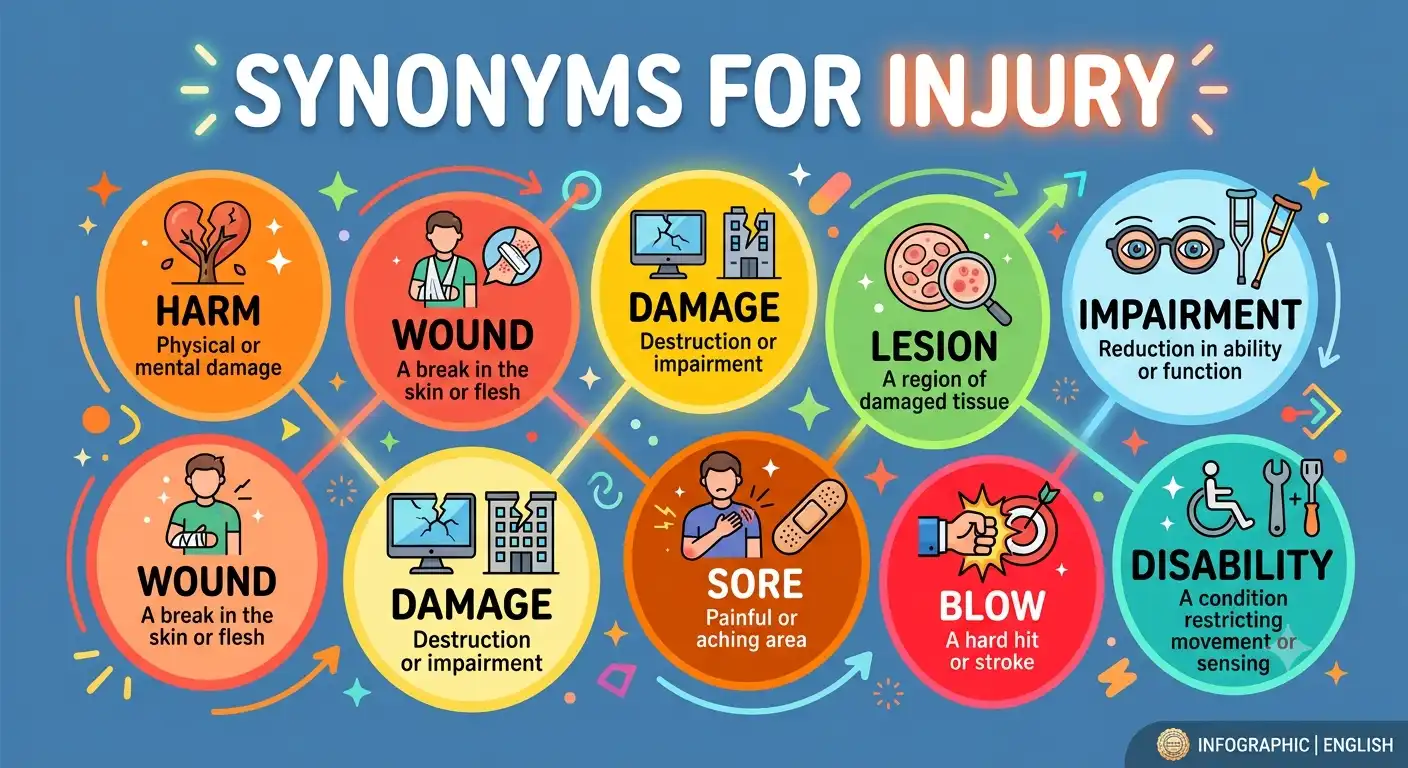
Finding the right synonyms for injury helps you describe physical wounds, emotional pain, and financial harm with total clarity. Learning varied synonyms for injury gives you the precise vocabulary to talk about accidents, medical conditions, and personal setbacks effectively. When you master these synonyms for injury, your writing becomes far more descriptive, engaging, and professional.
Imagine a high school athlete who twists an ankle during the final minutes of a championship basketball game. Calling every physical hurt a basic “injury” gets repetitive very quickly. An injury is simply physical, mental, or legal damage caused to a person, animal, or object.
Using a diverse set of words for physical and emotional damage benefits many types of writers and speakers:
- Students can write vivid essays and medical summaries without repeating basic vocabulary.
- Bloggers can share personal health journeys and news reports that capture immediate reader interest.
- Content writers can craft precise medical, legal, and wellness articles that build trust with readers.
- Daily English users can describe pain, accidents, and minor mishaps clearly to doctors and friends.
“Turn your wounds into wisdom.” — Oprah Winfrey
“Out of suffering have emerged the strongest souls; the most massive characters are seared with scars.” — Kahlil Gibran
Linguistic Breakdown of “Injury”
Connotative Meaning
The word injury carries a strong negative connotation. It implies harm, physical pain, disruption of normal health, or legal damage to someone’s rights or reputation.
Etymology
- Latin Origin: Derived from the Latin word injuria (in- meaning “not” and jus meaning “right” or “law”).
- Anglo-Norman French: Passed into Anglo-Norman as injurie (wrong, hurt, or damage).
- Middle English: Entered Middle English in the 14th century to denote harm done to a person’s body, rights, or dignity.
Pronunciation
- US IPA: /ˈɪn.dʒɚ.i/
- UK IPA: /ˈɪn.dʒər.i/
Syllables & Affixation Pattern
- Syllables: 3 (in-ju-ry)
- Root: injur (harm or wrong)
- Suffix: -y (noun suffix indicating state or quality)
Comparison Table of Key Synonyms
| Keyword | Meaning | Usage Type | Context |
|---|---|---|---|
| Wound | Physical damage to the body caused by a cut or tear | Formal / Medical | Cuts, surgeries, military combat, accidents |
| Harm | Physical or emotional damage done to someone | General / Casual | Safety warnings, emotional hurts, general danger |
| Trauma | Severe physical injury or deep emotional shock | Professional / Medical | Emergency rooms, psychological healing, accidents |
| Laceration | A deep cut or tear in the skin or flesh | Professional / Medical | Hospital reports, sharp object cuts, accidents |
| Impairment | A loss or weakness in bodily or mental function | Professional / Academic | Disability reports, hearing loss, medical exams |
| Contusion | A region of injured tissue or skin where blood capillaries are broken (bruise) | Formal / Medical | Sports reports, medical charts, fall impacts |
| Grievance | A real or imagined cause for complaint or feeling wronged | Professional / Legal | Workplace disputes, legal claims, personal fights |
| Detriment | The state of being harmed or damaged | Formal / Professional | Financial loss, health risks, career impacts |
Main Content – 50 Synonyms for Injury
1. Wound
- Pronunciation: US: /wuːnd/ | UK: /wuːnd/
- Meaning: A wound is a physical break or cut in the skin or body tissue.
- Examples:
- The nurse cleaned the small wound on my knee carefully.
- Soldiers received medals for recovering from a combat wound.
2. Harm
- Pronunciation: US: /hɑːrm/ | UK: /hɑːm/
- Meaning: Harm is physical or emotional damage caused to someone or something.
- Examples:
- Seatbelts keep passengers safe from severe harm in car crashes.
- She meant no harm when she made that silly joke.
3. Hurt
- Pronunciation: US: /hɝːt/ | UK: /hɜːt/
- Meaning: Hurt is physical pain or emotional sadness caused by an action or event.
- Examples:
- Ice helped cool down the hurt on his sore elbow.
- She felt a lot of emotional hurt after losing her beloved pet.
4. Damage
- Pronunciation: US: /ˈdæm.ɪdʒ/ | UK: /ˈdæm.ɪdʒ/
- Meaning: Damage is physical harm that reduces the value, usefulness, or strength of something.
- Examples:
- The storm caused heavy damage to several roofs on our street.
- Drinking plenty of water protects your body from muscle damage.
5. Trauma
- Pronunciation: US: /ˈtrɑː.mə/ | UK: /ˈtrɔː.mə/
- Meaning: Trauma is severe physical injury to the body or deep emotional shock.
- Examples:
- The emergency team treated him for severe head trauma.
- She needed time and therapy to recover from emotional trauma.
6. Impairment
- Pronunciation: US: /ɪmˈper.mənt/ | UK: /ɪmˈpeə.mənt/
- Meaning: Impairment is a loss or weakening of normal body or mental function.
- Examples:
- Special glasses helped correct his visual impairment completely.
- Ear protection prevents hearing impairment near loud machinery.
7. Lesion
- Pronunciation: US: /ˈliː.ʒən/ | UK: /ˈliː.ʒən/
- Meaning: A lesion is a damaged area of skin or tissue caused by disease or injury.
- Examples:
- The dermatologist examined a small skin lesion on her arm.
- Scans showed a minor lesion on the athlete’s thigh muscle.
8. Bruise
- Pronunciation: US: /bruːz/ | UK: /bruːz/
- Meaning: A bruise is a dark mark on the skin caused by a blow or fall.
- Examples:
- He had a purple bruise on his shin after bumping the table.
- A warm compress helps a painful bruise heal faster.
9. Laceration
- Pronunciation: US: /ˌlæs.əˈreɪ.ʃən/ | UK: /ˌlæs.ərˈeɪ.ʃən/
- Meaning: A laceration is a deep cut or tear in the skin.
- Examples:
- The doctor used three stitches to close the deep laceration.
- Broken glass caused a sharp laceration on his left palm.
10. Affliction
- Pronunciation: US: /əˈflɪk.ʃən/ | UK: /əˈflɪk.ʃən/
- Meaning: An affliction is something that causes pain, suffering, or physical discomfort.
- Examples:
- Joint pain was a common affliction among elderly villagers.
- Kindness brings comfort to anyone carrying a heavy physical affliction.
11. Disablement
- Pronunciation: US: /dɪsˈeɪ.bəl.mənt/ | UK: /dɪsˈeɪ.bəl.mənt/
- Meaning: Disablement is a condition that limits a person’s physical or mental capacity.
- Examples:
- The government provides aid for workers suffering from permanent disablement.
- Modern physical therapy helps reduce long-term physical disablement.
12. Disfigurement
- Pronunciation: US: /dɪsˈfɪɡ.jɚ.mənt/ | UK: /dɪsˈfɪɡ.ə.mənt/
- Meaning: Disfigurement is visible damage that spoils the appearance of a person’s body or face.
- Examples:
- Reconstructive surgery erased the facial disfigurement caused by the fire.
- The ointment prevented permanent disfigurement from the deep burn.
13. Scratch
- Pronunciation: US: /skrætʃ/ | UK: /skrætʃ/
- Meaning: A scratch is a slight cut or mark made on a surface or skin.
- Examples:
- The friendly cat gave me a tiny scratch on my thumb.
- Fortunately, he escaped the minor bike accident with just a scratch.
14. Cut
- Pronunciation: US: /kʌt/ | UK: /kʌt/
- Meaning: A cut is an opening in the skin made by something sharp.
- Examples:
- Place a clean bandage over the small cut on your finger.
- She got a minor cut while slicing fresh bread for breakfast.
15. Fracture
- Pronunciation: US: /ˈfræk.tʃɚ/ | UK: /ˈfræk.tʃər/
- Meaning: A fracture is a crack or break in a bone.
- Examples:
- The X-ray revealed a minor fracture in her wrist bone.
- He wore a hard plaster cast to help his bone fracture heal.
16. Sprain
- Pronunciation: US: /spreɪn/ | UK: /spreɪn/
- Meaning: A sprain is a painful twist or stretch of a ligament around a joint.
- Examples:
- Ankle sprains are common among basketball players during games.
- Wrapping the wrist tightly speeds up recovery from a mild sprain.
17. Contusion
- Pronunciation: US: /kənˈtuː.ʒən/ | UK: /kənˈtjuː.ʒən/
- Meaning: A contusion is a medical term for a bruise caused by a direct hit.
- Examples:
- The medical report noted a muscle contusion on his shoulder.
- Applying ice bags quickly reduces swelling from a deep contusion.
18. Abrasion
- Pronunciation: US: /əˈbreɪ.ʒən/ | UK: /əˈbreɪ.ʒən/
- Meaning: An abrasion is a scraped area of skin caused by friction.
- Examples:
- Falling on the gravel road left a painful abrasion on his elbow.
- Wash every skin abrasion with soap and clean warm water.
19. Sore
- Pronunciation: US: /sɔːr/ | UK: /sɔː/
- Meaning: A sore is a painful or tender spot on the skin or body.
- Examples:
- A soothing gargle can relieve a painful sore throat quickly.
- Tight shoes left a tender red sore on her heel.
20. Detriment
- Pronunciation: US: /ˈdet.rə.mənt/ | UK: /ˈdet.rɪ.mənt/
- Meaning: Detriment means harm, loss, or damage to something important.
- Examples:
- Skipping rest days works to the detriment of athletic performance.
- Smoking causes severe detriment to long-term lung health.
“The art of life is the art of avoiding pain.” — Thomas Jefferson
21. Loss
- Pronunciation: US: /lɑːs/ | UK: /lɒs/
- Meaning: Loss is the damage or state of no longer having something valuable.
- Examples:
- The fire resulted in a major financial loss for the shopkeeper.
- Proper earplugs prevent sudden hearing loss at construction sites.
22. Ruin
- Pronunciation: US: /ˈruː.ɪn/ | UK: /ˈruː.ɪn/
- Meaning: Ruin is total physical destruction or severe damage to health or status.
- Examples:
- Bad advice brought financial ruin to the young startup company.
- Neglecting the roof led to the complete ruin of the attic.
23. Blemish
- Pronunciation: US: /ˈblem.ɪʃ/ | UK: /ˈblem.ɪʃ/
- Meaning: A blemish is a small mark or flaw that spoils the perfection of something.
- Examples:
- The car had a minor paint blemish on the back door.
- A single mistake on his record was a small blemish on his career.
24. Disadvantage
- Pronunciation: US: /ˌdɪs.ədˈvæn.t̬ɪdʒ/ | UK: /ˌdɪs.ədˈvɑːn.tɪdʒ/
- Meaning: A disadvantage is a unfavorable condition that causes harm or hardship.
- Examples:
- Playing in the rain put our team at a clear disadvantage.
- Lacking internet access was a big disadvantage for rural students.
25. Wrong
- Pronunciation: US: /rɑːŋ/ | UK: /rɒŋ/
- Meaning: A wrong is an unjust or harmful act done to another person.
- Examples:
- He tried his best to right the wrong he had committed.
- Apologizing helps heal the emotional wrong done to a close friend.
26. Grievance
- Pronunciation: US: /ˈɡriː.vəns/ | UK: /ˈɡriː.vəns/
- Meaning: A grievance is a real or imagined feeling of being treated unfairly.
- Examples:
- Workers filed a formal grievance regarding unsafe factory conditions.
- She listened patiently as her coworker shared a personal grievance.
27. Agony
- Pronunciation: US: /ˈæɡ.ə.ni/ | UK: /ˈæɡ.ə.ni/
- Meaning: Agony is extreme physical pain or severe mental suffering.
- Examples:
- He lay on the grass in agony after breaking his leg.
- Waiting for emergency news caused her deep mental agony.
28. Suffering
- Pronunciation: US: /ˈsʌf.ɚ.ɪŋ/ | UK: /ˈsʌf.ər.ɪŋ/
- Meaning: Suffering is the state of experiencing pain, distress, or hardship.
- Examples:
- Doctors work endlessly to ease human suffering in war zones.
- The new medication helped stop his chronic back suffering.
29. Distress
- Pronunciation: US: /dɪˈstres/ | UK: /dɪˈstres/
- Meaning: Distress is great pain, anxiety, sorrow, or physical discomfort.
- Examples:
- The crying child showed obvious physical distress from the fever.
- Lifeguards spotted a swimmer in distress near the deep rocks.
30. Puncture
- Pronunciation: US: /ˈpʌŋk.tʃɚ/ | UK: /ˈpʌŋk.tʃər/
- Meaning: A puncture is a small hole made by a sharp object.
- Examples:
- A sharp nail caused a puncture in the bicycle tire.
- The doctor cleaned the small puncture wound on his foot.
31. Rupture
- Pronunciation: US: /ˈrʌp.tʃɚ/ | UK: /ˈrʌp.tʃər/
- Meaning: A rupture is a sudden tearing or breaking of bodily tissue or pipe.
- Examples:
- Surgeons repaired a dangerous rupture in the patient’s stomach wall.
- Freezing temperatures caused a main water pipe rupture under the street.
32. Strain
- Pronunciation: US: /streɪn/ | UK: /streɪn/
- Meaning: A strain is an injury to a muscle caused by stretching it too far.
- Examples:
- Lifting heavy boxes caused a painful muscle strain in his back.
- Rest and light stretching help recover from a hamstring strain.
33. Swelling
- Pronunciation: US: /ˈswel.ɪŋ/ | UK: /ˈswel.ɪŋ/
- Meaning: Swelling is an abnormal enlargement of a body part due to injury.
- Examples:
- An ice pack reduced the red swelling around her sprained ankle.
- The doctor checked his arm to ensure the swelling was going down.
34. Bleeding
- Pronunciation: US: /ˈbliː.dɪŋ/ | UK: /ˈbliː.dɪŋ/
- Meaning: Bleeding is the escape of blood from damaged blood vessels.
- Examples:
- Apply firm pressure with a clean cloth to stop the bleeding.
- Direct pressure quickly controlled the minor nose bleeding.
35. Scar
- Pronunciation: US: /skɑːr/ | UK: /skɑː/
- Meaning: A scar is a mark left on the skin after a wound has healed.
- Examples:
- He has a small scar above his eye from a childhood fall.
- Laser treatment helped fade the dark scar on her forehead.
36. Defect
- Pronunciation: US: /ˈdiː.fekt/ | UK: /ˈdiː.fekt/
- Meaning: A defect is a physical fault, mark, or imperfection in something.
- Examples:
- The factory recalled cars due to a minor brake defect.
- Surgery corrected the structural defect in the baby’s heart.
37. Disability
- Pronunciation: US: /ˌdɪs.əˈbɪl.ə.t̬i/ | UK: /ˌdɪs.əˈbɪl.ə.ti/
- Meaning: A disability is a physical or mental condition that limits movement or senses.
- Examples:
- Wheelchair ramps help people with physical disability access buildings.
- He overcame his learning disability through patient study routines.
38. Degradation
- Pronunciation: US: /ˌdeɡ.rəˈdeɪ.ʃən/ | UK: /ˌdeɡ.rəˈdeɪ.ʃən/
- Meaning: Degradation is the process of breaking down, spoiling, or damaging something.
- Examples:
- Pollution causes severe degradation of natural river habitats.
- Regular maintenance prevents the structural degradation of wooden bridges.
39. Injustice
- Pronunciation: US: /ɪnˈdʒʌs.tɪs/ | UK: /ɪnˈdʒʌs.tɪs/
- Meaning: An injustice is an unfair act or violation of someone’s rights.
- Examples:
- Peaceful protests were held to stand against social injustice.
- It was a clear injustice to blame the innocent worker for the mistake.
40. Destruction
- Pronunciation: US: /dɪˈstrʌk.ʃən/ | UK: /dɪˈstrʌk.ʃən/
- Meaning: Destruction is the action of breaking or damaging something beyond repair.
- Examples:
- The hurricane caused total destruction along the coast.
- Termites can cause severe structural destruction to wooden houses.
41. Blight
- Pronunciation: US: /blaɪt/ | UK: /blaɪt/
- Meaning: A blight is something that spoils, damages, or ruins a place or condition.
- Examples:
- Litter on the playground was a sad blight on the neighborhood.
- Crop blight ruined the tomato harvest for local farmers this summer.
42. Misfortune
- Pronunciation: US: /ˌmɪsˈfɔːr.tʃən/ | UK: /ˌmɪsˈfɔː.tʃuːn/
- Meaning: Misfortune is bad luck or an unfortunate event that causes harm.
- Examples:
- He suffered the misfortune of falling down the stairs on vacation.
- Friends rallied around the family during their time of misfortune.
43. Blow
- Pronunciation: US: /bloʊ/ | UK: /bləʊ/
- Meaning: A blow is a sudden hard hit or an unexpected setback.
- Examples:
- Losing his job was a severe emotional blow to his confidence.
- The boxer dodged a heavy blow from his opponent during round two.
44. Calamity
- Pronunciation: US: /kəˈlæm.ə.t̬i/ | UK: /kəˈlæm.ə.ti/
- Meaning: A calamity is an event causing great and sudden damage or distress.
- Examples:
- The severe earthquake was a major calamity for the island town.
- Careful planning prevented a financial calamity for the company.
45. Casualty
- Pronunciation: US: /ˈkæʒ.u.əl.ti/ | UK: /ˈkæʒ.ju.əl.ti/
- Meaning: A casualty is a person injured or killed in a serious accident or war.
- Examples:
- Fortunately, there was not a single casualty in the train derailment.
- Paramedics treated the injured casualty immediately on scene.
46. Disrepair
- Pronunciation: US: /ˌdɪs.rɪˈper/ | UK: /ˌdɪs.rɪˈpeər/
- Meaning: Disrepair is a damaged state resulting from neglect or lack of care.
- Examples:
- The abandoned old school fell into complete disrepair over time.
- Fixing the house before winter prevents further structural disrepair.
47. Pain
- Pronunciation: US: /peɪn/ | UK: /peɪn/
- Meaning: Pain is an unpleasant physical feeling caused by illness or injury.
- Examples:
- The doctor prescribed medicine to relieve his back pain.
- She felt a sharp pain in her ankle when stepping off the curb.
48. Infliction
- Pronunciation: US: /ɪnˈflɪk.ʃən/ | UK: /ɪnˈflɪk.ʃən/
- Meaning: Infliction is the act of causing pain, harm, or damage to someone.
- Examples:
- The court punished the deliberate infliction of harm on animals.
- Kindness stands in direct contrast to the intentional infliction of pain.
49. Maiming
- Pronunciation: US: /ˈmeɪm.ɪŋ/ | UK: /ˈmeɪm.ɪŋ/
- Meaning: Maiming is severe physical injury that permanently damages a body part.
- Examples:
- Strict safety gear prevents the terrible maiming of factory workers.
- The dangerous machinery carried a severe risk of bodily maiming.
50. Prejudicing
- Pronunciation: US: /ˈpredʒ.ə.dɪs.ɪŋ/ | UK: /ˈpredʒ.ə.dɪs.ɪŋ/
- Meaning: Prejudicing means causing harm or damage to someone’s rights or legal claims.
- Examples:
- Leaking evidence risked prejudicing the fairness of the court trial.
- Late filing of papers led to prejudicing his legal appeal.
Antonyms of “Injury”
When you want to express healing, restoration, protection, or safety, use these primary antonyms:
- Healing: US: /ˈhiː.lɪŋ/ | UK: /ˈhiː.lɪŋ/ – The process of making or becoming sound or healthy again.
- Recovery: US: /rɪˈkʌv.ɚ.i/ | UK: /rɪˈkʌv.ər.i/ – Returning to a normal state of health, mind, or strength.
- Cure: US: /kjʊr/ | UK: /kjʊər/ – A substance or treatment that restores health and ends a disease.
- Protection: US: /prəˈtek.ʃən/ | UK: /prəˈtek.ʃən/ – The state of keeping someone safe from harm or damage.
Prototype Meaning and Categorization of “Injury”
- Grammatical Category: Noun.
- Prototype Meaning: Physical damage or harm inflicted upon a living organism’s body, resulting in pain, structural tissue impairment, or functional loss.
- Semantic Field: Health, medicine, safety, law, sports science, human trauma, and risk management.
Frequently Asked Questions (FAQ)
1. What is the most common synonym for injury?
The most common synonyms for injury are wound, hurt, damage, harm, and trauma. These terms are widely recognized across both everyday speech and formal medical or legal contexts.
2. Is “injury” used only for physical bodily harm?
No, injury is not limited to bodily harm. It frequently describes emotional hurt, financial loss, structural damage to property, or legal harm done to a person’s rights or reputation (such as “injury to reputation”).
3. Which synonym for injury is best for medical or academic writing?
Words like laceration, contusion, lesion, trauma, and impairment are standard, precise terms used in medical reports, scientific research, and academic studies.
4. What is the difference between “wound” and “laceration”?
A wound is a broad term for any break or damage in bodily skin or tissue. A laceration specifically describes a jagged, deep cut or tear caused by sharp objects or severe blunt force.
5. How does learning these synonyms improve everyday vocabulary?
Using varied synonyms prevents repetitive word usage, allows you to describe physical pain and accidents with high accuracy, and helps you communicate clearly with medical professionals, insurance agents, and friends.
Conclusion
Expanding your vocabulary with synonyms for injury transforms how effectively you describe physical harm, emotional pain, and practical setbacks in your everyday writing and speaking. Replacing basic terms with precise words like laceration, trauma, impairment, and detriment allows you to communicate physical conditions and technical situations with total accuracy. Whether you are writing a personal blog post, crafting a medical report, or telling a compelling story, choosing the exact word ensures your meaning is clear and impactful.
Make it a habit to practice these words in your daily communications. Use them in essays, professional emails, news updates, and conversational stories to build vocabulary confidence and sharpen your linguistic precision.
“Healing is a matter of time, but it is sometimes also a matter of opportunity.” — Hippocrates
“Character cannot be developed in ease and quiet. Only through experience of trial and suffering can the soul be strengthened.” — Helen Keller

Andrew Collins is an academic English educator with over 12 years of experience helping university students, IELTS candidates, and ESL learners improve their writing vocabulary.