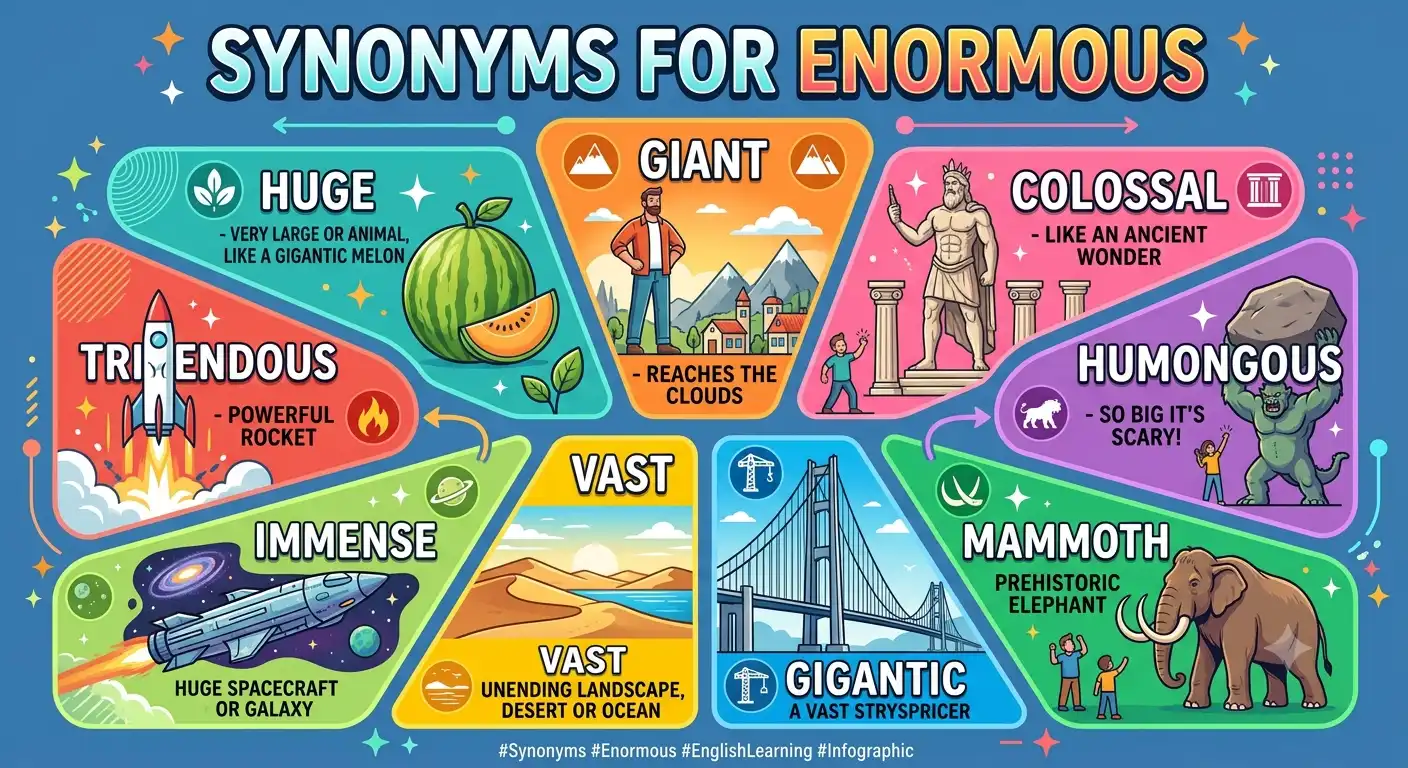
Exploring synonyms for enormous is the fastest way to expand your vocabulary and describe giant objects with precision. When you learn synonyms for enormous, your speech and writing become far more vivid and descriptive. Mastering synonyms for enormous allows you to replace repetitive words with rich, expressive language.
Imagine standing inside a cavernous airplane hangar next to a jumbo cargo jet. Calling that aircraft simply “big” barely conveys its true scale. Enormous means something that is unusually large in size, amount, degree, or volume.
A strong vocabulary benefits every communicator:
- Students can write descriptive essays without using the word “big” over and over again.
- Bloggers can write catchy headlines and stories that hold reader attention.
- Content writers can craft engaging articles that explain complex scale effortlessly.
- Daily English users can describe travel sights, objects, and experiences with clarity.
“Language is the armor of the human mind.” — Samuel Taylor Coleridge
“Words are, in my not-so-humble opinion, our most inexhaustible source of magic.” — J.K. Rowling
Linguistic Breakdown of “Enormous”
Connotative Meaning
The word enormous carries a neutral to dramatic connotation of great scale, impressive size, or overwhelming volume.
Etymology
- Latin Origin: Derived from the Latin word enormis (e- meaning “out of” and norma meaning “rule” or “pattern”).
- Middle French: Passed into Middle French as énorme (huge, abnormal, or extraordinary).
- Middle English: Entered Middle English in the 15th century to describe things exceeding ordinary limits.
Pronunciation
- US IPA: /ɪˈnɔːr.məs/
- UK IPA: /ɪˈnɔː.məs/
Syllables & Affixation Pattern
- Syllables: 3 (e-nor-mous)
- Root: norm (standard or rule)
- Prefix: e- (out of / away from)
- Suffix: -ous (adjective suffix meaning full of)
Comparison Table of Key Synonyms
| Keyword | Meaning | Usage Type | Context |
|---|---|---|---|
| Huge | Very large in size, amount, or degree | Casual / General | Everyday chat, home items, general size |
| Massive | Large, heavy, and solid | Formal / Physical | Architecture, mountains, solid structures |
| Gigantic | Like a giant in size or power | Creative / Descriptive | Animals, buildings, fantasy figures |
| Immense | So great in size or scale that it is hard to measure | Formal / Emotional | Oceans, gratitude, space, deep feelings |
| Colossal | Unbelievably large or grand | Academic / Formal | Monuments, ancient statues, achievements |
| Vast | Covering a huge area or space | Casual / Nature | Deserts, skies, forests, open lands |
| Tremendous | Very great in amount, scale, or intensity | Emotional / Casual | Effort, speed, success, enthusiasm |
| Mammoth | Extremely large like a woolly mammoth | General / Business | Projects, tasks, physical structures |
Main Content – 50 Synonyms for Enormous
1. Huge
- Pronunciation: US: /hjuːdʒ/ | UK: /hjuːdʒ/
- Meaning: Huge means very large in size or amount.
- Examples:
- We saw a huge truck parking outside the grocery store.
- She made a huge mistake on her history homework.
2. Massive
- Pronunciation: US: /ˈmæs.ɪv/ | UK: /ˈmæs.ɪv/
- Meaning: Massive means very heavy, solid, and large.
- Examples:
- The castle was built with massive stone walls.
- A massive wave crashed against the sandy shore.
3. Gigantic
- Pronunciation: US: /dʒaɪˈɡæn.t̬ɪk/ | UK: /dʒaɪˈɡæn.tɪk/
- Meaning: Gigantic means extremely large like a mythical giant.
- Examples:
- The museum has a gigantic dinosaur skeleton near the door.
- A gigantic oak tree grows in our backyard.
4. Immense
- Pronunciation: US: /ɪˈmens/ | UK: /ɪˈmens/
- Meaning: Immense means so big that it is hard to measure.
- Examples:
- The ocean looks immense when you stand on the beach.
- He felt immense relief after passing his final test.
5. Colossal
- Pronunciation: US: /kəˈlɑː.səl/ | UK: /kəˈlɒs.əl/
- Meaning: Colossal means unbelievably large or impressive in size.
- Examples:
- Workers built a colossal statue in the city park.
- The project was a colossal success for the team.
6. Vast
- Pronunciation: US: /væst/ | UK: /vɑːst/
- Meaning: Vast means covering a huge area or open space.
- Examples:
- Stars shone bright across the vast night sky.
- The farmer owns a vast field of green corn.
7. Tremendous
- Pronunciation: US: /trɪˈmen.dəs/ | UK: /trɪˈmen.dəs/
- Meaning: Tremendous means very great in power, size, or degree.
- Examples:
- She put a tremendous effort into her science project.
- The speaker received a tremendous round of applause.
8. Mammoth
- Pronunciation: US: /ˈmæm.əθ/ | UK: /ˈmæm.əθ/
- Meaning: Mammoth means unusually large and heavy.
- Examples:
- Cleaning the entire garage was a mammoth task for us.
- A mammoth ship pulled into the busy harbor.
9. Titanic
- Pronunciation: US: /taɪˈtæn.ɪk/ | UK: /taɪˈtæn.ɪk/
- Meaning: Titanic means having exceptional strength or size.
- Examples:
- The two teams fought a titanic battle for the title.
- A titanic glacier drifted slowly across the cold water.
10. Giant
- Pronunciation: US: /ˈdʒaɪ.ənt/ | UK: /ˈdʒaɪ.ənt/
- Meaning: Giant means much larger than normal things of its kind.
- Examples:
- My brother ate a giant slice of watermelon.
- The store posted a giant sign in the window.
11. Gargantuan
- Pronunciation: US: /ɡɑːrˈɡæn.tʃu.ən/ | UK: /ɡɑːˈɡæn.tʃu.ən/
- Meaning: Gargantuan means extremely big in physical size or appetite.
- Examples:
- He ordered a gargantuan bowl of pasta for dinner.
- The stadium built a gargantuan screen above the field.
12. Monumental
- Pronunciation: US: /ˌmɑːn.jəˈmen.t̬əl/ | UK: /ˌmɒn.jəˈmen.təl/
- Meaning: Monumental means great in size, importance, or influence.
- Examples:
- Discovering a new medicine was a monumental event.
- The team faced a monumental challenge during the race.
13. Towering
- Pronunciation: US: /ˈtaʊ.ɚ.ɪŋ/ | UK: /ˈtaʊ.ər.ɪŋ/
- Meaning: Towering means very tall and reaching high into the air.
- Examples:
- Towering pine trees surrounded the mountain cabin.
- The city features towering skyscrapers made of glass.
14. Humongous
- Pronunciation: US: /hjuːˈmɑːŋ.ɡəs/ | UK: /hjuːˈmʌŋ.ɡəs/
- Meaning: Humongous is a casual word for something extremely big.
- Examples:
- We bought a humongous pumpkin at the farm market.
- The dog dug a humongous hole in the yard.
15. Substantial
- Pronunciation: US: /səbˈstæn.ʃəl/ | UK: /səbˈstæn.ʃəl/
- Meaning: Substantial means large in amount, value, or importance.
- Examples:
- He saved a substantial sum of money this year.
- The report showed a substantial growth in sales.
16. Extensive
- Pronunciation: US: /ɪkˈsten.sɪv/ | UK: /ɪkˈsten.sɪv/
- Meaning: Extensive means covering a large area or range of things.
- Examples:
- The library has an extensive collection of history books.
- The storm caused extensive damage across the valley.
17. Voluminous
- Pronunciation: US: /vəˈluː.mə.nəs/ | UK: /vəˈljuː.mɪ.nəs/
- Meaning: Voluminous means taking up a lot of space or containing many pages.
- Examples:
- She wore a voluminous dress with many flowing layers.
- The judge read through a voluminous pile of legal papers.
18. Broad
- Pronunciation: US: /brɑːd/ | UK: /brɔːd/
- Meaning: Broad means wide in expanse, size, or distance.
- Examples:
- A broad river flows through the heart of the city.
- He greeted his old friend with a broad smile.
19. Grand
- Pronunciation: US: /ɡrænd/ | UK: /ɡrænd/
- Meaning: Grand means large and impressive in appearance.
- Examples:
- They stayed in a grand hotel near the beach.
- The castle features a grand staircase in the lobby.
20. Great
- Pronunciation: US: /ɡreɪt/ | UK: /ɡreɪt/
- Meaning: Great means much larger than average in size or degree.
- Examples:
- A great crowd gathered to hear the band play.
- The old tree provided great shade on hot days.
21. Sizable
- Pronunciation: US: /ˈsaɪ.zə.bəl/ | UK: /ˈsaɪ.zə.bəl/
- Meaning: Sizable means fairly large in size or quantity.
- Examples:
- They cooked a sizable turkey for Thanksgiving dinner.
- The company donated a sizable gift to the hospital.
22. Elephantine
- Pronunciation: US: /ˌel.əˈfæn.tiːn/ | UK: /ˌel.ɪˈfæn.taɪn/
- Meaning: Elephantine means very large, slow, or heavy like an elephant.
- Examples:
- The mover carried the elephantine sofa up the stairs.
- The machine moved with heavy, elephantine steps.
23. Brobdingnagian
- Pronunciation: US: /ˌbrɑːb.dɪŋˈnæɡ.i.ən/ | UK: /ˌbrɒb.dɪŋˈnæɡ.i.ən/
- Meaning: Brobdingnagian means gigantic or hugely oversized.
- Examples:
- The fantasy movie showed a Brobdingnagian beast in the woods.
- The castle gate looked Brobdingnagian compared to the visitors.
24. Behemoth
- Pronunciation: US: /bɪˈhiː.məθ/ | UK: /bɪˈhiː.mɒθ/
- Meaning: Behemoth means something of huge size, power, or organization.
- Examples:
- The tech company grew into a global behemoth.
- A steel behemoth rolled down the train tracks.
25. Stupendous
- Pronunciation: US: /stuːˈpen.dəs/ | UK: /stjuːˈpen.dəs/
- Meaning: Stupendous means amazingly large or impressive.
- Examples:
- The fireworks put on a stupendous show for the crowd.
- She achieved stupendous results through hard work.
“The limits of my language mean the limits of my world.” — Ludwig Wittgenstein
26. Monster
- Pronunciation: US: /ˈmɑːn.stɚ/ | UK: /ˈmɒn.stər/
- Meaning: Monster means unusually large in size compared to normal.
- Examples:
- The chef baked a monster cookie for the party.
- They caught a monster bass in the lake today.
27. Jumbo
- Pronunciation: US: /ˈdʒʌm.boʊ/ | UK: /ˈdʒʌm.bəʊ/
- Meaning: Jumbo means much larger than standard sizes.
- Examples:
- He bought a jumbo bag of popcorn at the theater.
- The store sells jumbo eggs fresh from the farm.
28. Super-sized
- Pronunciation: US: /ˈsuː.pɚ.saɪzd/ | UK: /ˈsuː.pə.saɪzd/
- Meaning: Super-sized means larger than the standard extra-large size.
- Examples:
- The fast food menu offers a super-sized meal option.
- They bought a super-sized couch for their living room.
29. Prodigious
- Pronunciation: US: /prəˈdɪdʒ.əs/ | UK: /prəˈdɪdʒ.əs/
- Meaning: Prodigious means wonderfully or impressively large.
- Examples:
- The young writer showed a prodigious talent for stories.
- An athlete needs a prodigious amount of daily energy.
30. Astronomical
- Pronunciation: US: /ˌæs.trəˈnɑː.mɪ.kəl/ | UK: /ˌæs.trəˈnɒm.ɪ.kəl/
- Meaning: Astronomical means extraordinarily large in number or cost.
- Examples:
- Buying that mansion costs an astronomical amount of money.
- The telescope counted an astronomical number of far stars.
31. Boundless
- Pronunciation: US: /ˈbaʊnd.ləs/ | UK: /ˈbaʊnd.ləs/
- Meaning: Boundless means having no limits or boundaries in size.
- Examples:
- Children often have boundless energy when playing outdoors.
- Her love for painting brought boundless joy to her life.
32. Cosmic
- Pronunciation: US: /ˈkɑːz.mɪk/ | UK: /ˈkɒz.mɪk/
- Meaning: Cosmic means vast and belonging to the universe.
- Examples:
- Scientists study the cosmic scale of deep space galaxies.
- A cosmic cloud of dust formed a new star system.
33. Immeasurable
- Pronunciation: US: /ɪˈmeʒ.ɚ.ə.bəl/ | UK: /ɪˈmeʒ.ər.ə.bəl/
- Meaning: Immeasurable means too large or extensive to measure.
- Examples:
- The forest brings immeasurable value to local wildlife.
- Her kindness had an immeasurable impact on the students.
34. Infinite
- Pronunciation: US: /ˈɪn.fə.nət/ | UK: /ˈɪn.fɪ.nət/
- Meaning: Infinite means endless or without any physical limit.
- Examples:
- Space seems infinite when looking through a telescope.
- Math problems can sometimes have an infinite number of answers.
35. Overwhelming
- Pronunciation: US: /ˌoʊ.vɚˈwel.mɪŋ/ | UK: /ˌəʊ.vəˈwel.mɪŋ/
- Meaning: Overwhelming means so large or strong that it overcomes you.
- Examples:
- The speaker received an overwhelming majority of the votes.
- Standing before the huge mountain gave her an overwhelming feeling.
36. Mighty
- Pronunciation: US: /ˈmaɪ.t̬i/ | UK: /ˈmaɪ.ti/
- Meaning: Mighty means possessing huge size, strength, or power.
- Examples:
- A mighty river flows across the flat plains.
- The mighty oak tree stood strong against the wind.
37. Spacious
- Pronunciation: US: /ˈspeɪ.ʃəs/ | UK: /ˈspeɪ.ʃəs/
- Meaning: Spacious means having a large amount of room or space.
- Examples:
- The family moved into a spacious house with four bedrooms.
- The hotel room was bright and spacious.
38. Capacious
- Pronunciation: US: /kəˈpeɪ.ʃəs/ | UK: /kəˈpeɪ.ʃəs/
- Meaning: Capacious means able to hold or contain a large amount.
- Examples:
- She packed her clothes into a capacious leather bag.
- The warehouse offers a capacious area for goods storage.
39. Expansive
- Pronunciation: US: /ɪkˈspæn.sɪv/ | UK: /ɪkˈspæn.sɪv/
- Meaning: Expansive means covering a wide area or scope.
- Examples:
- The resort offers an expansive view of the ocean.
- He wrote an expansive essay on plant biology.
40. Bulky
- Pronunciation: US: /ˈbʌl.ki/ | UK: /ˈbʌl.ki/
- Meaning: Bulky means taking up a lot of space and being hard to carry.
- Examples:
- Winter coats can be very bulky in a suitcase.
- The mailman delivered a bulky package to our doorstep.
41. Heavyweight
- Pronunciation: US: /ˈhev.i.weɪt/ | UK: /ˈhev.i.weɪt/
- Meaning: Heavyweight means far above average in weight or power.
- Examples:
- Two heavyweight boxers entered the ring for the match.
- The truck transported heavyweight machinery across town.
42. Whopping
- Pronunciation: US: /ˈwɑː.pɪŋ/ | UK: /ˈwɒp.ɪŋ/
- Meaning: Whopping is an informal word meaning unusually or surprisingly large.
- Examples:
- The store offered a whopping fifty percent discount today.
- He caught a whopping fish during his weekend trip.
43. Walloping
- Pronunciation: US: /ˈwɑː.lə.pɪŋ/ | UK: /ˈwɒl.ə.pɪŋ/
- Meaning: Walloping means remarkably large or powerful.
- Examples:
- The team won the game by a walloping margin of twenty points.
- She paid a walloping bill for her car repairs.
44. Monstrous
- Pronunciation: US: /ˈmɑːn.strəs/ | UK: /ˈmɒn.strəs/
- Meaning: Monstrous means abnormally large or shocking in scale.
- Examples:
- A monstrous wave knocked over the small wooden boat.
- The building faced a monstrous cost for electrical updates.
45. Mega
- Pronunciation: US: /ˈmeɡ.ə/ | UK: /ˈmeɡ.ə/
- Meaning: Mega is an informal term meaning extremely large.
- Examples:
- The company hosted a mega concert in the city arena.
- They shopped at the mega mall on the edge of town.
46. Sky-high
- Pronunciation: US: /ˌskaɪˈhaɪ/ | UK: /ˌskaɪˈhaɪ/
- Meaning: Sky-high means reaching a very high or huge level.
- Examples:
- Housing prices reached sky-high levels this summer.
- The builders planned a sky-high tower for the city.
47. Unbounded
- Pronunciation: US: /ʌnˈbaʊn.dɪd/ | UK: /ʌnˈbaʊn.dɪd/
- Meaning: Unbounded means having no limits or borders.
- Examples:
- Her unbounded enthusiasm inspired the whole classroom.
- The explorer traveled across the unbounded grassy plains.
48. Massy
- Pronunciation: US: /ˈmæs.i/ | UK: /ˈmæs.i/
- Meaning: Massy means heavy, solid, and large in structure.
- Examples:
- The cathedral featured massy wooden doors at the main entry.
- Massy iron chains anchored the boat to the pier.
49. Outsized
- Pronunciation: US: /ˈaʊt.saɪzd/ | UK: /ˈaʊt.saɪzd/
- Meaning: Outsized means larger than usual or expected.
- Examples:
- The small country plays an outsized role in global trade.
- He wore an outsized hat to shield his face from the sun.
50. Overgrown
- Pronunciation: US: /ˌoʊ.vɚˈɡroʊn/ | UK: /ˌəʊ.vəˈɡrəʊn/
- Meaning: Overgrown means grown beyond normal or proper size.
- Examples:
- The gardener trimmed the overgrown bushes along the wall.
- An overgrown puppy bounced happily across the living room.
Antonyms of “Enormous”
When you want to describe something small, limited, or tiny, use these primary antonyms:
- Tiny: US: /ˈtaɪ.ni/ | UK: /ˈtaɪ.ni/ – Extremely small in size or amount.
- Small: US: /smɑːl/ | UK: /smɔːl/ – Little in size, extent, or degree.
- Minute: US: /maɪˈnuːt/ | UK: /maɪˈnjuːt/ – Extremely small or detailed.
- Microscopic: US: /ˌmaɪ.krəˈskɑː.pɪk/ | UK: /ˌmaɪ.krəˈskɒp.ɪk/ – So small that it can only be seen with a microscope.
Prototype Meaning and Categorization of “Enormous”
- Grammatical Category: Adjective.
- Prototype Meaning: Exceeding the standard, ordinary, or expected physical dimensions, volume, or quantity by a substantial degree.
- Semantic Field: Size, spatial dimensions, measurement, physical scale, degree, and volume.
Frequently Asked Questions (FAQ)
1. What is the most common synonym for enormous?
The most common synonyms for enormous are huge, massive, gigantic, immense, and vast. These words are widely recognized in everyday speech, literature, and formal contexts.
2. Can “enormous” be used for non-physical things?
Yes, enormous frequently describes abstract concepts like debt, success, pressure, effort, or gratitude (for example, “an enormous relief” or “enormous effort”).
3. What is the difference between “huge” and “colossal”?
Huge is a general word used in casual and formal settings for anything large. Colossal carries a stronger tone, describing something extraordinarily large, majestic, or monumental.
4. Which synonym for enormous is best for academic writing?
Words like substantial, extensive, immense, prodigious, and voluminous are ideal for academic reports, research papers, and formal essays.
5. Is “humongous” suitable for formal writing?
No, humongous is an informal slang word best reserved for casual conversations, storytelling, and lighthearted blog posts.
6. How does learning these synonyms improve my vocabulary?
Learning varied synonyms prevents word repetition, improves descriptive detail, and lets you tailor your vocabulary precisely to your target audience.
Conclusion
Expanding your vocabulary with synonyms for enormous equips you with the exact words needed to describe impressive scale, deep emotion, and physical size. Choosing precise words like colossal, immense, mammoth, or substantial instead of repeating basic terms elevates your overall communication. Whether you are drafting a school essay, publishing a blog article, or telling a story to friends, matching the exact synonym to your context makes your message far more engaging.
Make it a daily habit to practice these words in your writing and speech. Integrate them naturally into your emails, academic papers, and everyday chats to boost your linguistic confidence and expressive power.
“Words have energy and power with the ability to help, to heal, to hinder, to hurt, to harm, to humiliate, and to humble.” — Yehuda Berg
“A different language is a different vision of life.” — Federico Fellini

Andrew Collins is an academic English educator with over 12 years of experience helping university students, IELTS candidates, and ESL learners improve their writing vocabulary.